Monday☕️🌎

Trending:
- August 23, 2026 — Iran announced the discovery of more than 7.5 trillion cubic feet of high-quality “sweet” natural gas in southern Fars Province, with about 5.7 trillion cubic feet estimated to be recoverable—equivalent to roughly 15 years of production from one phase of the massive South Pars gas field.
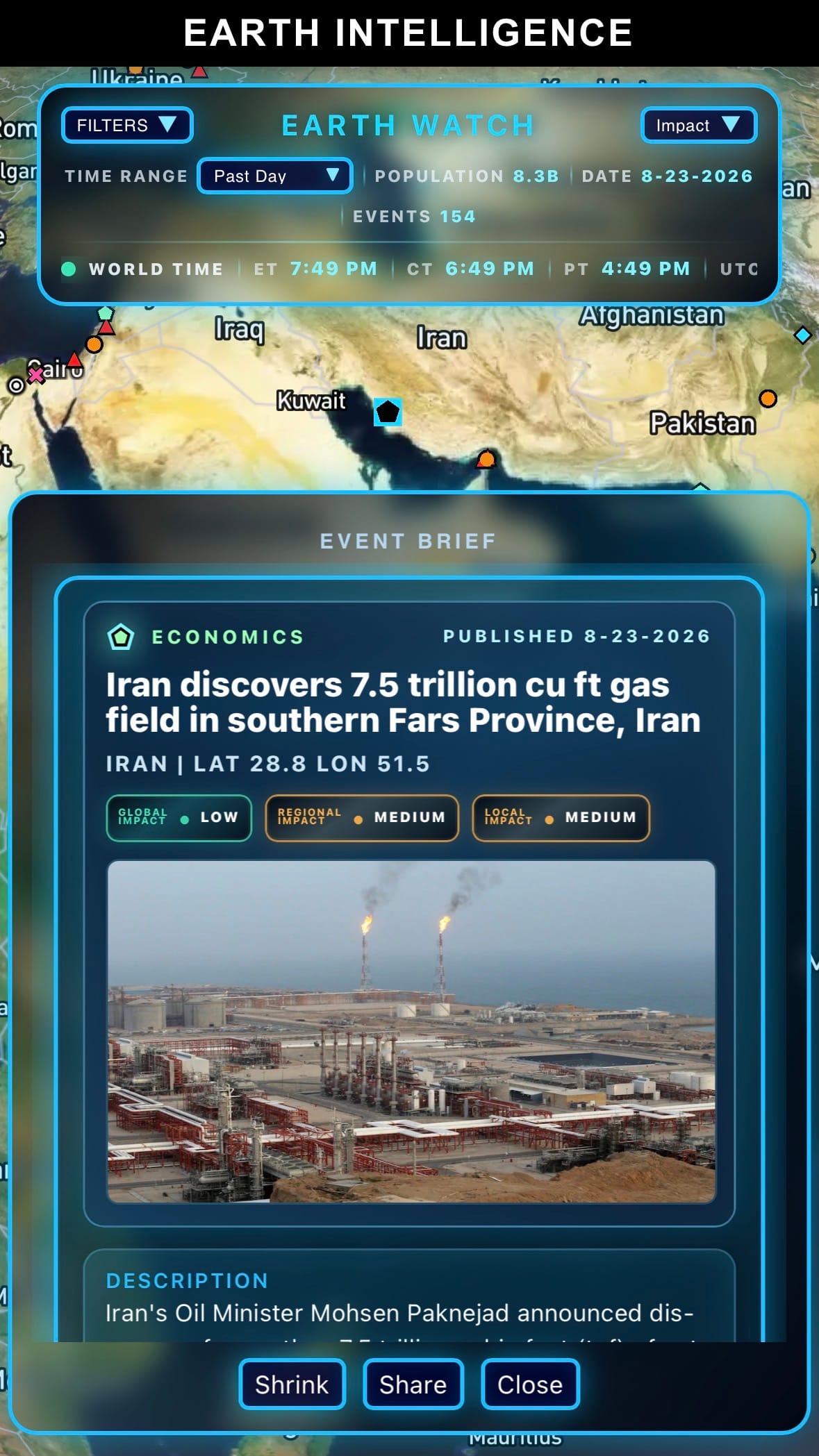
- The discovery could significantly strengthen Iran’s energy reserves and economy, although actually producing the gas will require major infrastructure and investment that could be complicated by sanctions and the ongoing conflict.
Economics & Markets:

Cyber:
- In July 2026, an Iran-linked cyberattack knocked a small UK power generator offline for four days last month, but officials said the incident had no impact on Britain’s electricity supply because the facility represented only a tiny fraction of grid capacity.
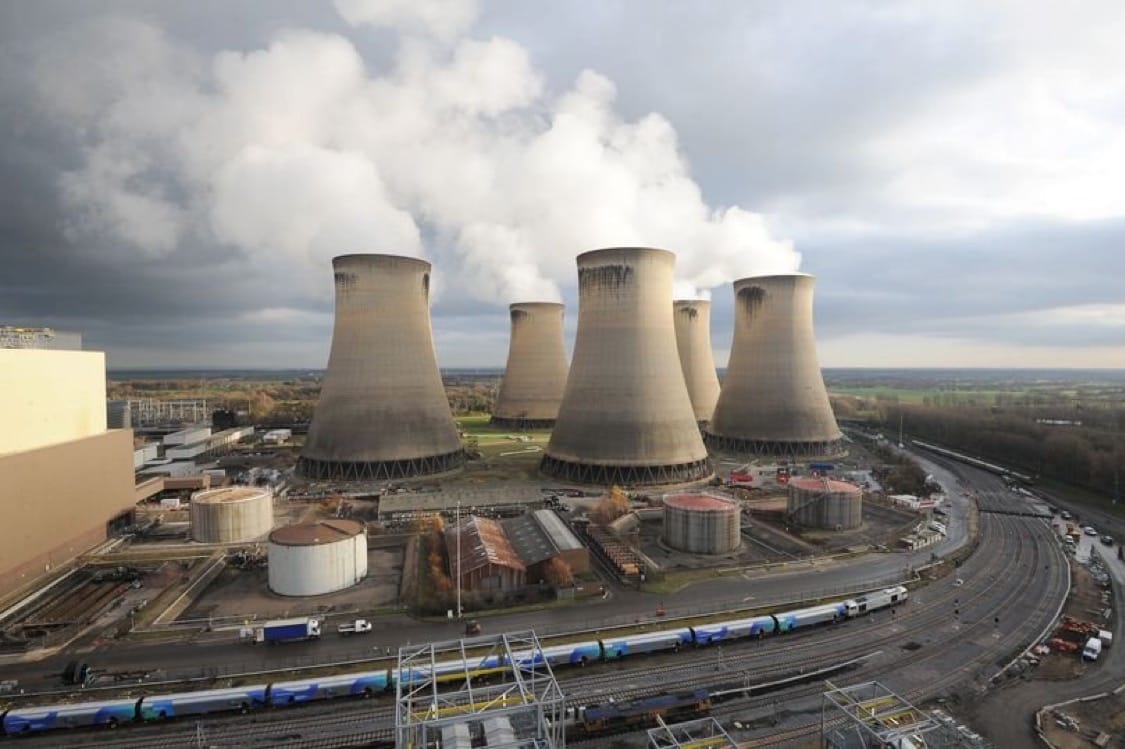
- While the attack itself was limited, it highlights a broader campaign by Iran-linked hackers targeting power, water, and industrial systems in the UK and U.S. amid heightened tensions with Iran.
Geopolitics & Military Activity:


Science & Technology:
- August 23, 2026 — The U.S. Navy publicly revealed the AIM-424 “Malice,” a previously undisclosed next-generation long-range air-to-air missile being developed for the F-35C and F/A-18E/F to engage advanced aircraft at greater distances.
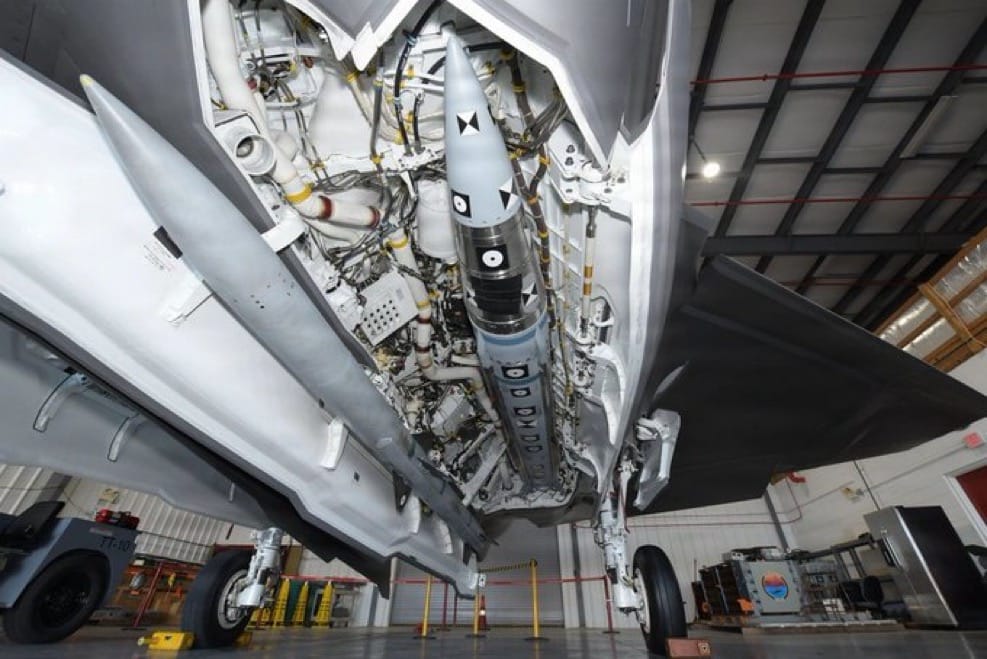
- Most notably, the missile fits inside the F-35C’s internal weapons bay, allowing the stealth fighter to carry a longer-range weapon without mounting it externally and reducing its stealth; its exact range and technical capabilities remain classified or undisclosed.
Space:
- August 22, 2026 — SpaceX successfully launched 27 Starlink internet satellites aboard a Falcon 9 rocket at 12:25 a.m. local time from Vandenberg Space Force Base in California, marking SpaceX’s 100th orbital launch of 2026.
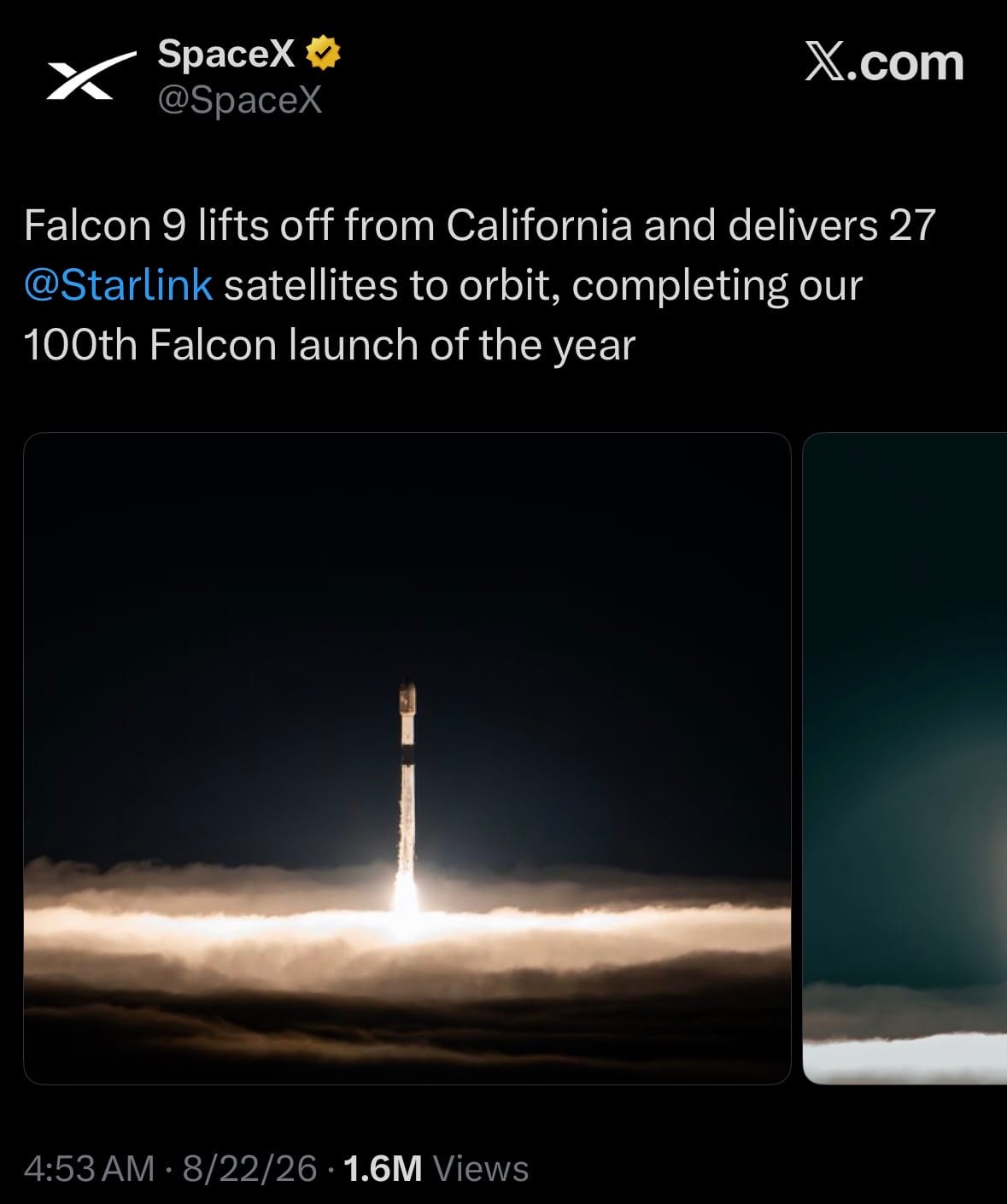
- The reusable booster landed on the Of Course I Still Love You droneship, while the satellites were deployed into low Earth orbit to expand Starlink’s global high-speed internet network.
EARTH INTELLIGENCE:
- New updates are now live on the EARTH INTEL mobile app, download on app stores today!

Statistic:
- Largest public companies by total debt:
- 🇺🇸 Fannie Mae: $4.172T
- 🇹🇭 Advanced Info Service (AIS): $3.989T
- 🇺🇸 Freddie Mac: $3.409T
- 🇯🇵 Bank of Japan: $733.52B
- 🇺🇸 JPMorgan Chase: $516.81B
- 🇨🇳 Agricultural Bank of China: $458.89B
- 🇺🇸 Goldman Sachs: $434.73B
- 🇨🇦 Royal Bank of Canada: $422.45B
- 🇨🇳 China Construction Bank: $419.24B
- 🇫🇷 BNP Paribas: $400.18B
- 🇺🇸 Morgan Stanley: $394.23B
- 🇨🇳 CITIC Limited: $386.79B
- 🇺🇸 Bank of America: $383.59B
- 🇪🇸 Santander: $380.35B
- 🇺🇸 Citigroup: $379.62B
- 🇨🇳 Bank of China: $375.55B
- 🇫🇷 Crédit Agricole: $367.36B
- 🇨🇳 ICBC: $354.53B
- 🇨🇦 Toronto-Dominion Bank: $348.97B
- 🇨🇭 UBS: $343.92B
- 🇯🇵 Toyota: $272.45B
- 🇨🇦 Brookfield Corporation: $263.73B
- 🇫🇮 Nordea Bank: $250.97B
- 🇨🇦 Scotiabank: $250.46B
- 🇦🇺 Macquarie Group: $235.82B
- 🇩🇪 Volkswagen: $225.89B
History of Lamborghini
- Lamborghini began with tractors, not supercars. Founder Ferruccio Lamborghini (1916–1993) served as a mechanic in the Italian Royal Air Force during World War II and, after returning home, began converting surplus military equipment into agricultural machinery. He founded Lamborghini Trattori in 1948, becoming wealthy as postwar Italy mechanized its farms. Ferruccio bought expensive sports cars from Ferrari, Maserati, and others but believed they were uncomfortable and mechanically imperfect. According to the famous story, he complained directly to Enzo Ferrari about Ferrari’s clutch, only to be dismissed as a tractor manufacturer who knew nothing about sports cars. Some details of the exchange remain disputed, but Ferruccio decided he could build a better grand-touring car. He founded Automobili Lamborghini in Sant’Agata Bolognese in 1963, hired engineers including Giotto Bizzarrini, Gian Paolo Dallara, Paolo Stanzani, and test driver Bob Wallace, and introduced the 350 GT in 1964 with a sophisticated V12. The breakthrough was the Miura in 1966. Its V12 was mounted behind the driver, creating the basic mid-engine layout that came to define the modern supercar. Lamborghini followed with the Espada (1968) and then the extraordinary Countach, revealed as a prototype in 1971 and produced from 1974–1990. Its wedge shape, scissor doors, enormous V12, and extreme proportions transformed Lamborghini into a global symbol of exotic cars.
- The company itself nearly collapsed several times. The 1973 oil crisis, declining tractor business, financial problems, and cancelled contracts forced Ferruccio to sell his ownership interests by 1974. Lamborghini passed through multiple owners and entered bankruptcy/receivership in 1978 before brothers Jean-Claude and Patrick Mimran acquired and revived it during the early 1980s. Lamborghini also developed the massive LM002 (1986), a V12-powered luxury off-road vehicle decades before high-performance SUVs became mainstream. Chrysler purchased Lamborghini in 1987 and supported development of the Diablo, launched in 1990 as the Countach’s successor and Lamborghini’s first production model capable of exceeding roughly 200 mph in certain versions. Chrysler sold Lamborghini in 1994 to an Indonesian-led investment group, but the decisive ownership change came in 1998, when the Volkswagen Group acquired Lamborghini through Audi. Audi brought financial stability, manufacturing discipline, electronics, quality control, and access to Volkswagen Group technology while preserving Lamborghini’s Italian design and engineering identity. The Murciélago arrived in 2001, followed by the smaller Gallardo in 2003, which became Lamborghini’s first genuinely high-volume model. The Aventador (2011) introduced a new Lamborghini-designed 6.5-liter V12, while the Huracán (2014) replaced the Gallardo with a naturally aspirated V10 and became another enormous commercial success.
- Modern Lamborghini transformed from a fragile exotic-car manufacturer into a highly profitable global luxury brand. The biggest change came with the Urus in 2018, a twin-turbo V8 performance SUV that dramatically expanded Lamborghini’s customer base and became its highest-volume product. Lamborghini surpassed 10,000 vehicles delivered in a single year for the first time in 2023, an extraordinary scale compared with its historically tiny production. Electrification then began reshaping the lineup. The limited-production Sián (2019) introduced hybrid assistance to Lamborghini’s V12 architecture, while the Revuelto (2023) replaced the Aventador with a 6.5-liter naturally aspirated V12 combined with three electric motors, producing more than 1,000 horsepower. The Urus SE added plug-in-hybrid power, and the Temerario, introduced in 2024 as the Huracán replacement, abandoned Lamborghini’s long-running V10 for a new twin-turbo V8 hybrid system capable of extremely high engine speeds. Lamborghini today remains headquartered in Sant’Agata Bolognese, under Audi and the Volkswagen Group, competing at the top of the performance market with Ferrari, McLaren, Porsche, Aston Martin, and increasingly ultra-exclusive manufacturers such as Rimac and Koenigsegg. Its evolution is essentially 1948 tractors → 1963 Automobili Lamborghini → 1966 Miura → 1974 Countach → near bankruptcy → 1986 LM002 → 1990 Diablo → 1998 Audi ownership → 2003 Gallardo → 2011 Aventador → 2018 Urus → today’s Revuelto, Temerario, and hybrid era. Ferruccio’s original company succeeded because it repeatedly pushed toward the outrageous: enormous engines, radical styling, scissor doors, mid-engine layouts, and cars designed to look and feel unlike almost anything else on the road.
Image of the day:

Thanks for reading! Earth is complicated, we make it simple.
- Download our mobile app:




Click below to view our previous newsletters:

Support/Suggestions Email:
support@earthintel.io