Wednesday☕️


Economics & Markets:
- On April 14, 2026, the SEC officially eliminated the $25,000 minimum equity requirement for pattern day traders — the biggest change to retail trading rules in 24 years.
- The old rule, in place since 2001, limited accounts under $25,000 to just 3 day trades per 5 business days and often locked out smaller traders; it has now been replaced with a real-time margin system that bases buying power on the actual risk of open positions rather than a fixed account balance. This means anyone can day trade without needing $25,000 — you only need enough margin to cover the real-time risk of your trades.


Geopolitics & Military Activity:
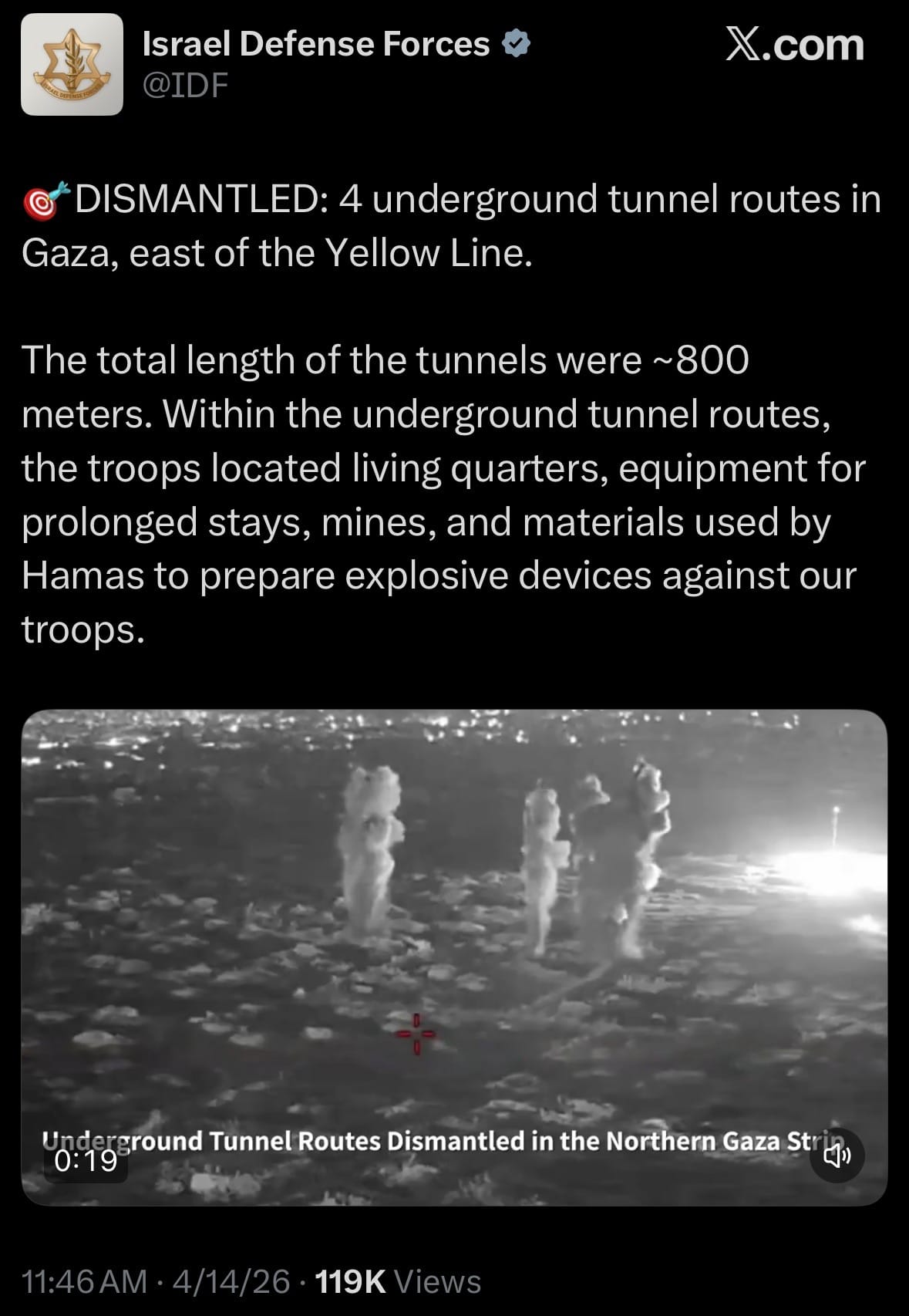
- As of April 14, 2026, the United States has deployed more than 10,000 U.S. Sailors, Marines, and Airmen, along with over a dozen warships and dozens of aircraft, to enforce a naval blockade of all ships entering or departing Iranian ports in the Arabian Gulf and Gulf of Oman.

- In the first 24 hours of the operation, no vessels successfully passed the blockade, and six merchant ships complied with U.S. orders and turned around to return to Iranian ports. The blockade is being applied impartially to ships of all nations, while U.S. forces continue to ensure freedom of navigation for vessels transiting the Strait of Hormuz to and from non-Iranian ports.
Science & Technology:
- On April 14, 2026, Meta announced an expanded multi-year partnership with Broadcom to co-develop multiple generations of its next-generation MTIA (Meta Training and Inference Accelerator) chips, extending the collaboration through 2029 and including the industry’s first 2nm AI compute accelerator.

- This custom silicon will provide the massive computing foundation needed to power AI workloads across all of Meta’s apps and services, with an initial deployment of over 1 gigawatt of capacity and plans for a multi-gigawatt rollout to support Meta’s long-term goal of delivering personal superintelligence to billions of users.
Space:
- On April 14, 2026, Rocket Lab officially completed its acquisition of Mynaric, a German leader in laser optical communications terminals, for $155.3 million (cash plus shares).
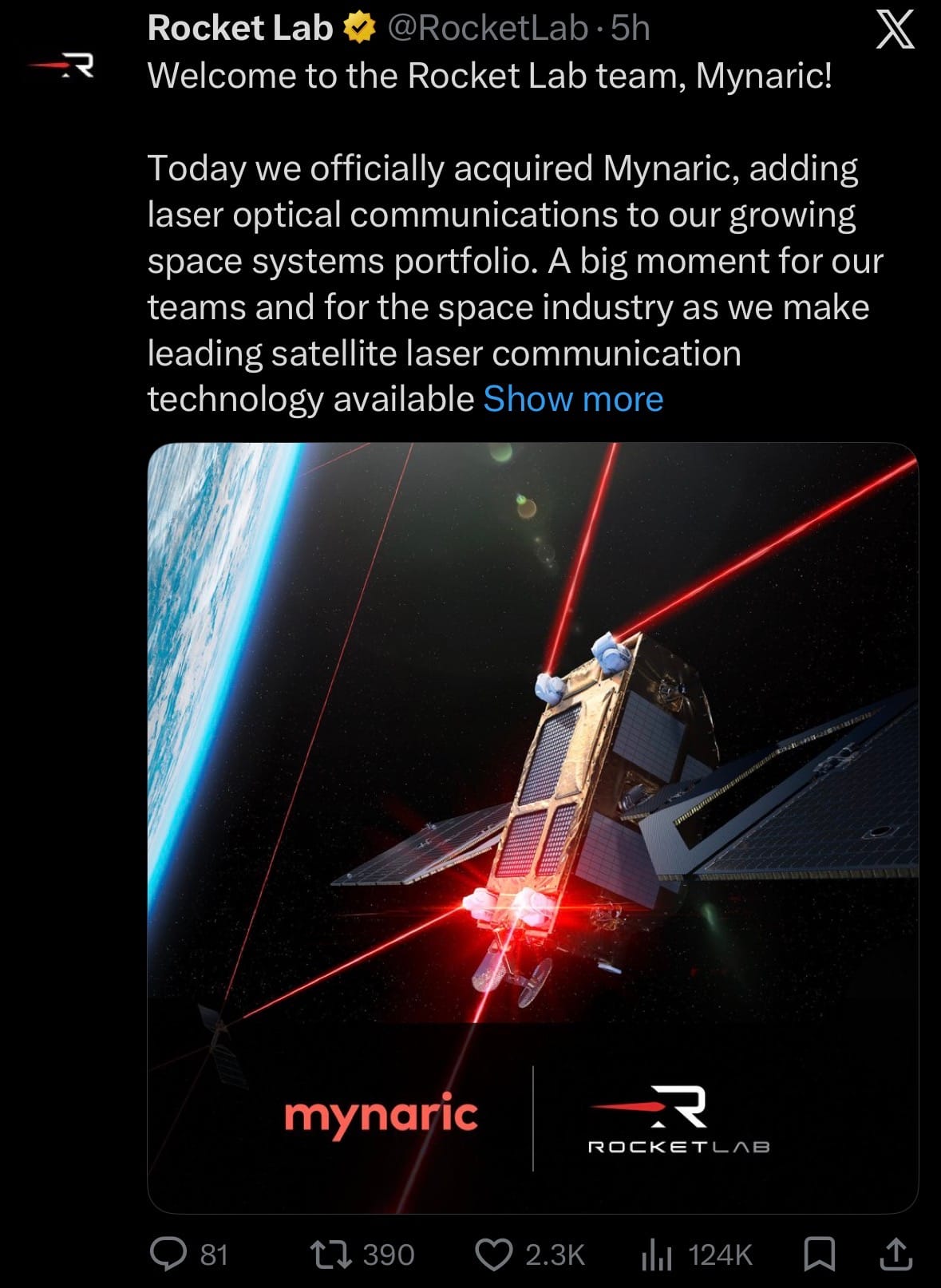
- This move adds high-speed, high-bandwidth laser comms technology to Rocket Lab’s growing space systems portfolio, enabling the company to scale production and deliver satellite laser communication systems at the volume and speed required by commercial and government customers in Europe, the U.S., and worldwide — a major step toward becoming a fully vertically integrated end-to-end space company.
- On April 14, 2026, Amazon announced it will acquire Globalstar for $11.57 billion ($90 per share) to significantly expand its Amazon Leo low-Earth orbit satellite network.
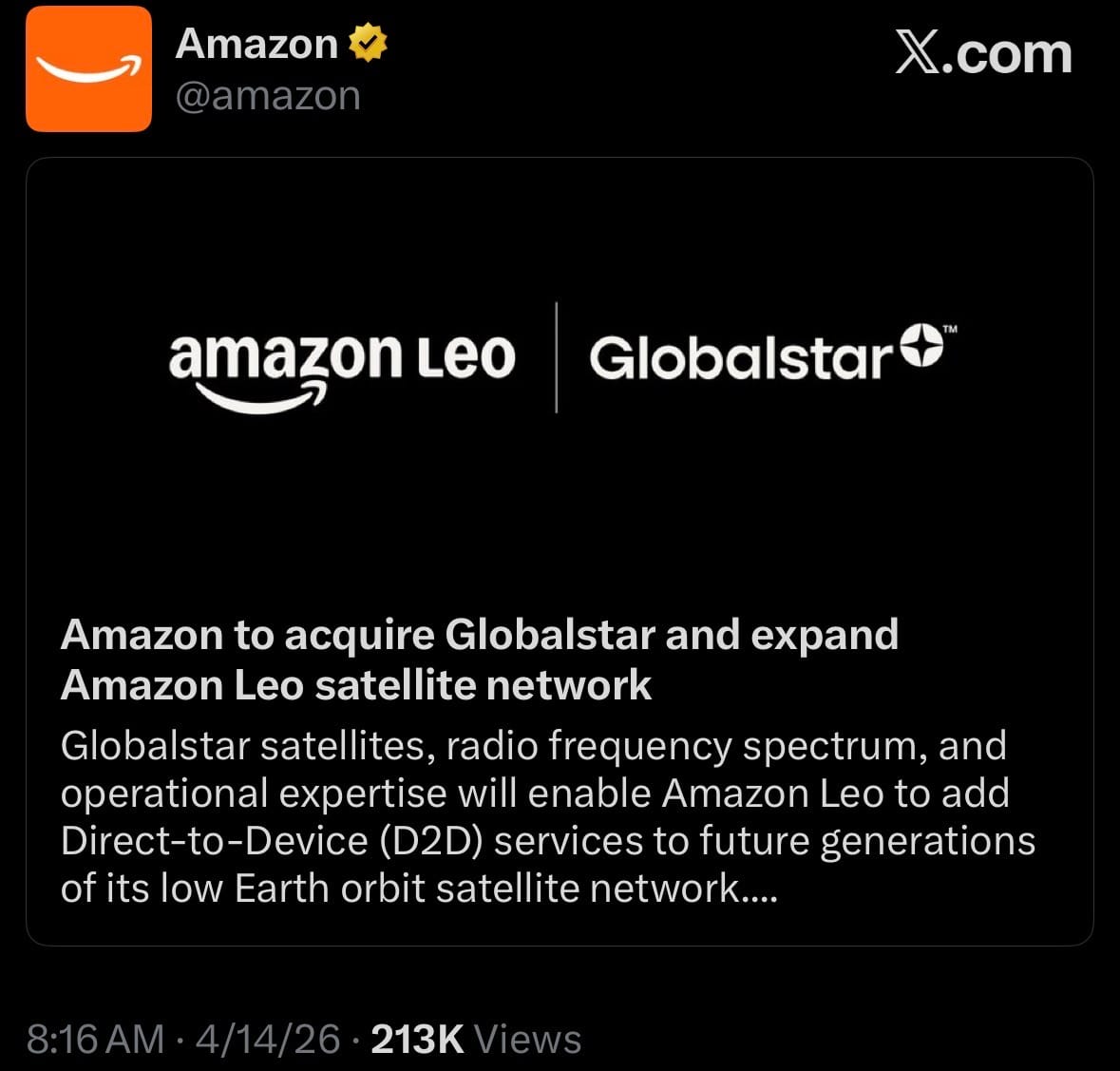
- The deal includes Globalstar’s existing satellite constellation, ground infrastructure, and valuable spectrum licenses, enabling direct-to-device (D2D) connectivity so standard smartphones can connect directly to satellites for voice, text, and data in remote areas without cell coverage, while strengthening Amazon’s competition with SpaceX’s Starlink. The acquisition is expected to close in 2027.
Statistic:
- Largest public companies by market capitalization:
- 🇺🇸 NVIDIA: $4.776T
- 🇺🇸 Alphabet (Google): $3.999T
- 🇺🇸 Apple: $3.804T
- 🇺🇸 Microsoft: $2.921T
- 🇺🇸 Amazon: $2.678T
- 🇹🇼 TSMC: $1.970T
- 🇺🇸 Broadcom: $1.805T
- 🇸🇦 Saudi Aramco: $1.763T
- 🇺🇸 Meta Platforms: $1.675T
- 🇺🇸 Tesla: $1.366T
- 🇺🇸 Berkshire Hathaway: $1.029T
- 🇺🇸 Walmart: $996.94B
- 🇰🇷 Samsung: $960.55B
- 🇺🇸 JPMorgan Chase: $839.10B
- 🇺🇸 Eli Lilly: $825.65B
- 🇺🇸 Exxon Mobil: $620.32B
- 🇺🇸 Visa: $600.33B
- 🇳🇱 ASML: $596.17B
- 🇺🇸 Johnson & Johnson: $578.61B
- 🇨🇳 Tencent: $576.43B
- 🇰🇷 SK Hynix: $557.78B
- 🇺🇸 Micron Technology: $525.14B
- 🇺🇸 Oracle: $468.79B
- 🇺🇸 Mastercard: $457.96B
- 🇺🇸 Netflix: $450.82B
History:
- The history of nuclear reactors begins with the discovery of radioactivity in 1896 by Henri Becquerel, followed by the work of Marie and Pierre Curie, which revealed the immense energy contained within atoms. The real breakthrough came in 1938, when German scientists Otto Hahn and Fritz Strassmann, with interpretation by Lise Meitner and Otto Frisch, discovered nuclear fission—the splitting of an atom that releases large amounts of energy. This led directly to the first controlled nuclear chain reaction on December 2, 1942, when Enrico Fermi and his team built Chicago Pile-1, the world’s first nuclear reactor, under the University of Chicago. This was part of the Manhattan Project, where early reactors were used to produce plutonium for nuclear weapons. After World War II, attention shifted toward peaceful uses of nuclear energy, and in 1951, the EBR-I reactor in Idaho became the first to generate usable electricity from nuclear power. The first commercial nuclear power plant followed in 1954 in Obninsk, Soviet Union, and in 1957, the U.S. launched Shippingport, its first full-scale nuclear power station. Early reactor designs included pressurized water reactors (PWRs) and boiling water reactors (BWRs), which used water as both coolant and moderator, and these designs became the global standard due to their relative stability and scalability.
- From the 1960s through the 1980s, nuclear power expanded rapidly worldwide, seen as a near-limitless energy source, but major accidents reshaped its trajectory. The Three Mile Island accident (1979, USA) exposed issues with reactor control and human error, while the Chernobyl disaster (1986, Soviet Union)—caused by a flawed RBMK reactor design and operational mistakes—resulted in a catastrophic explosion and widespread radioactive contamination, drastically slowing global nuclear expansion. Later, the Fukushima Daiichi disaster (2011, Japan), triggered by a tsunami, highlighted vulnerabilities to natural disasters and led to further safety reforms. Despite these setbacks, nuclear technology continued advancing, with improvements in reactor safety systems, containment structures, and fuel efficiency. By the 2000s–2020s, focus shifted toward Generation III+ reactors, which include passive safety systems that can shut down without human intervention, and the development of small modular reactors (SMRs), designed to be more flexible, scalable, and safer. As of 2026, nuclear reactors are being re-evaluated globally as a key solution for clean, reliable energy in a world pushing toward decarbonization, while next-generation concepts like Generation IV reactors, fast reactors, and even experimental fusion systems aim to create safer, more efficient, and less waste-producing energy systems—positioning nuclear technology as both a legacy of 20th-century science and a critical part of the future energy infrastructure.
Image of the day:

Thanks for reading! Earth is complicated, we make it simple.
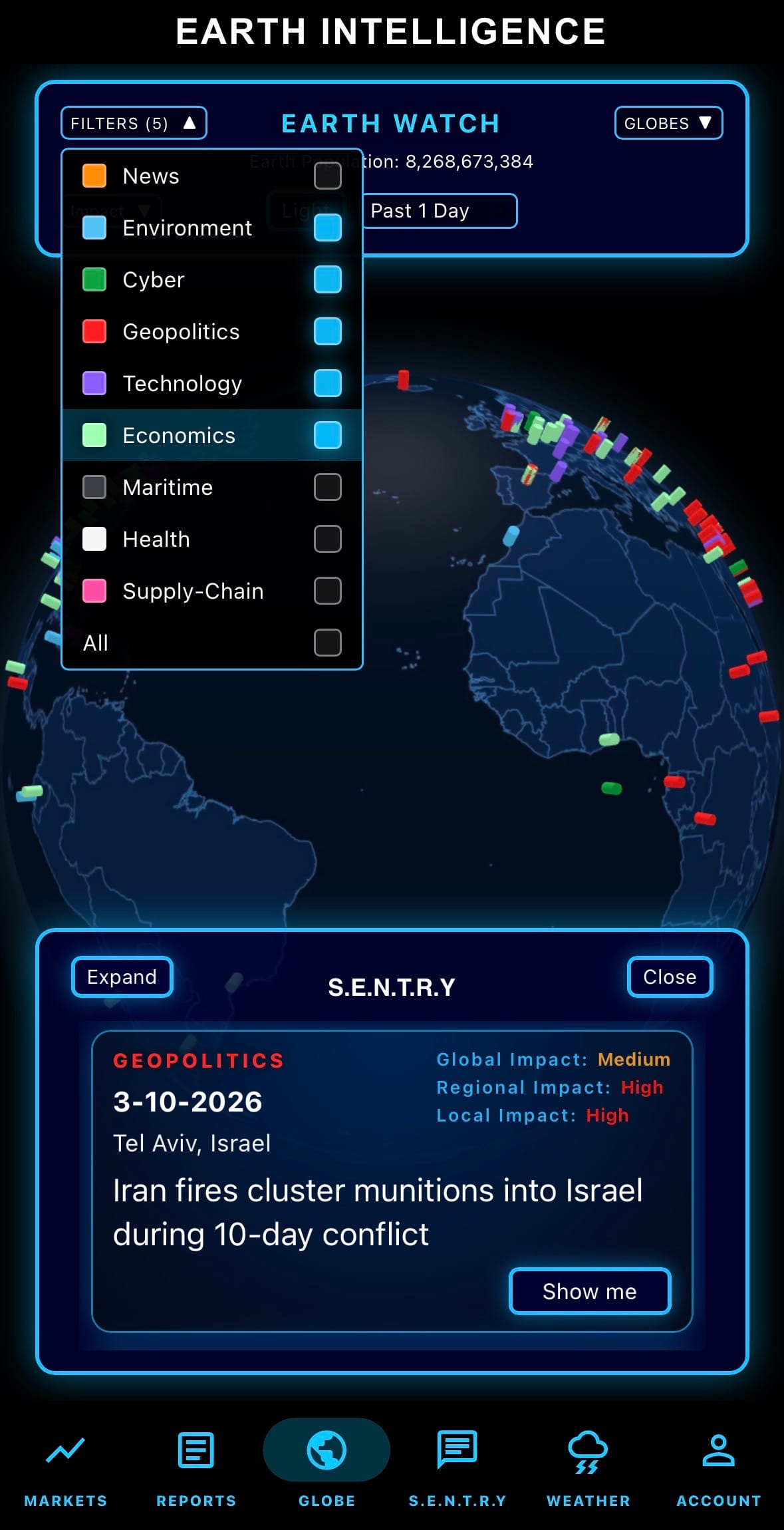
- Click below if you’d like to view our free EARTH WATCH globe:
- Download our mobile app:



Click below to view our previous newsletters:
Support/Suggestions Email:
support@earthintel.io