Wednesday☕️🌎

Trending:
- September 1, 2026 — U.S. Central Command carried out a new wave of strikes against Iran’s Islamic Revolutionary Guard Corps (IRGC), targeting air defenses, radar and communications systems, maritime facilities, vessels, and capabilities used to deploy sea mines.
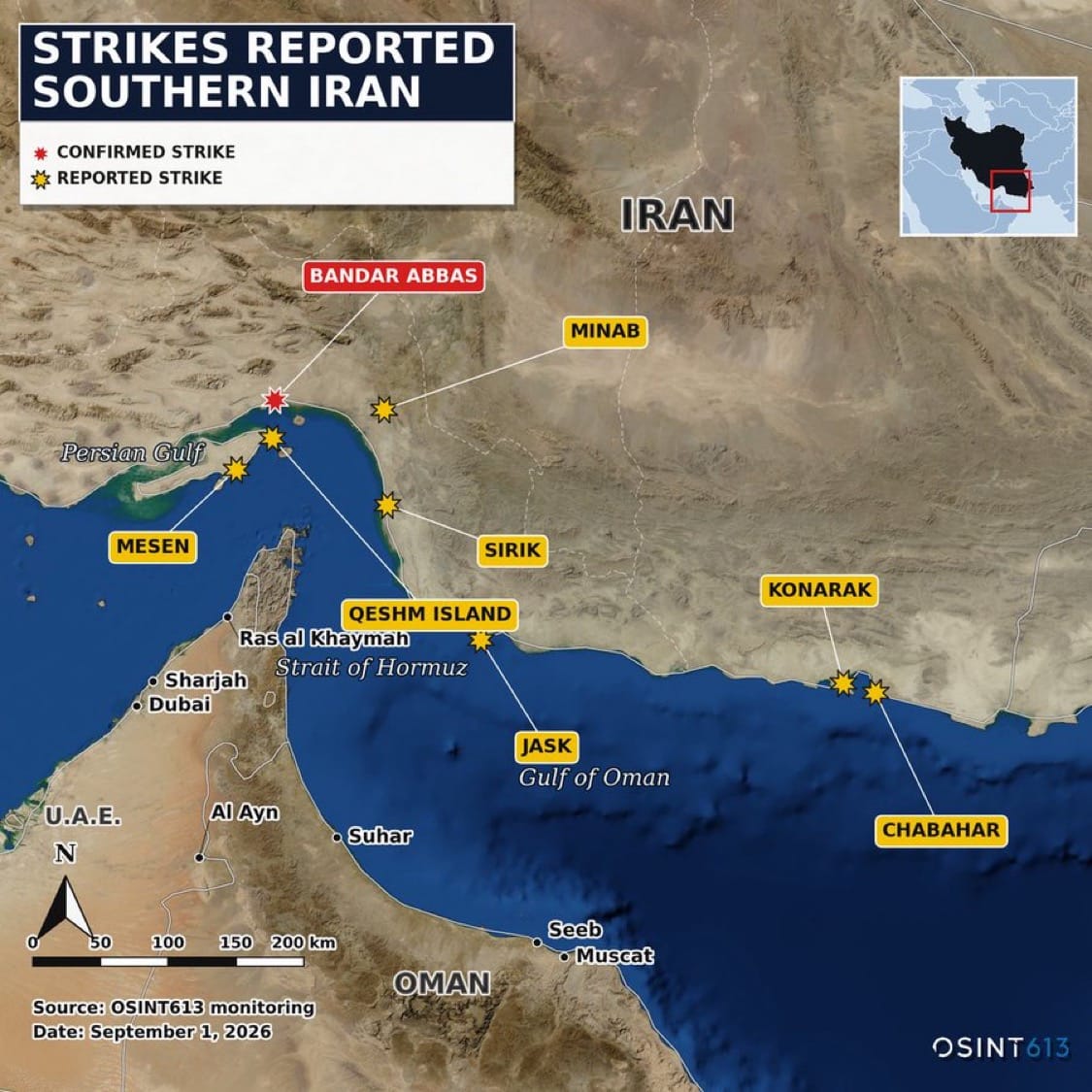
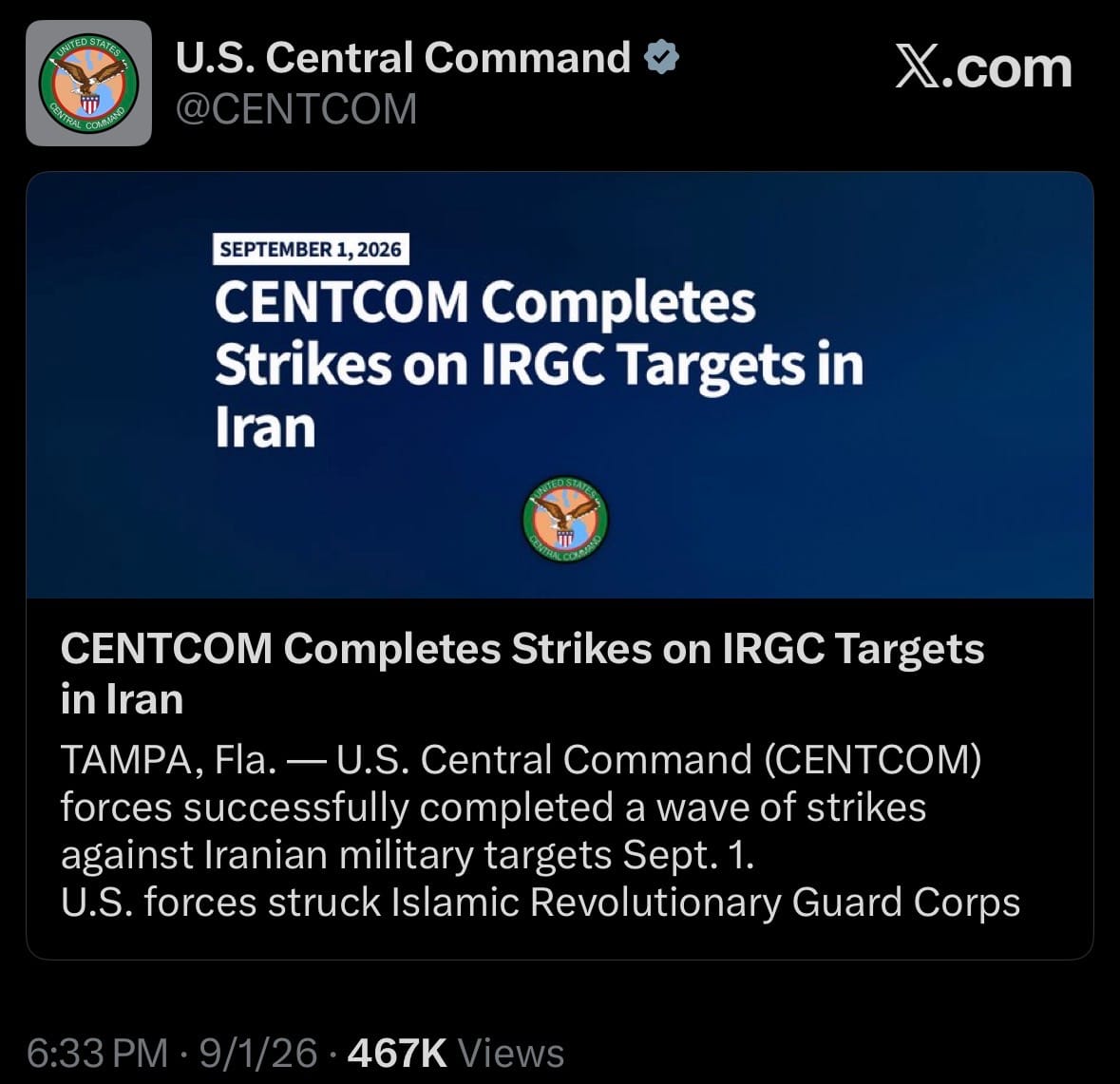
- CENTCOM said the strikes followed recent Iranian attempts to attack commercial shipping in the Strait of Hormuz and U.S. service members, while more than 50,000 American troops remain deployed across the Middle East and prepared for additional operations.
- September 1, 2026 — The U.S. Embassy in Abu Dhabi and Consulate General in Dubai issued a security alert urging Americans in the UAE and across the Middle East to remain highly vigilant as regional tensions continue, warning of possible flight cancellations, airspace closures, travel disruptions, and potential threats against U.S.-associated locations.
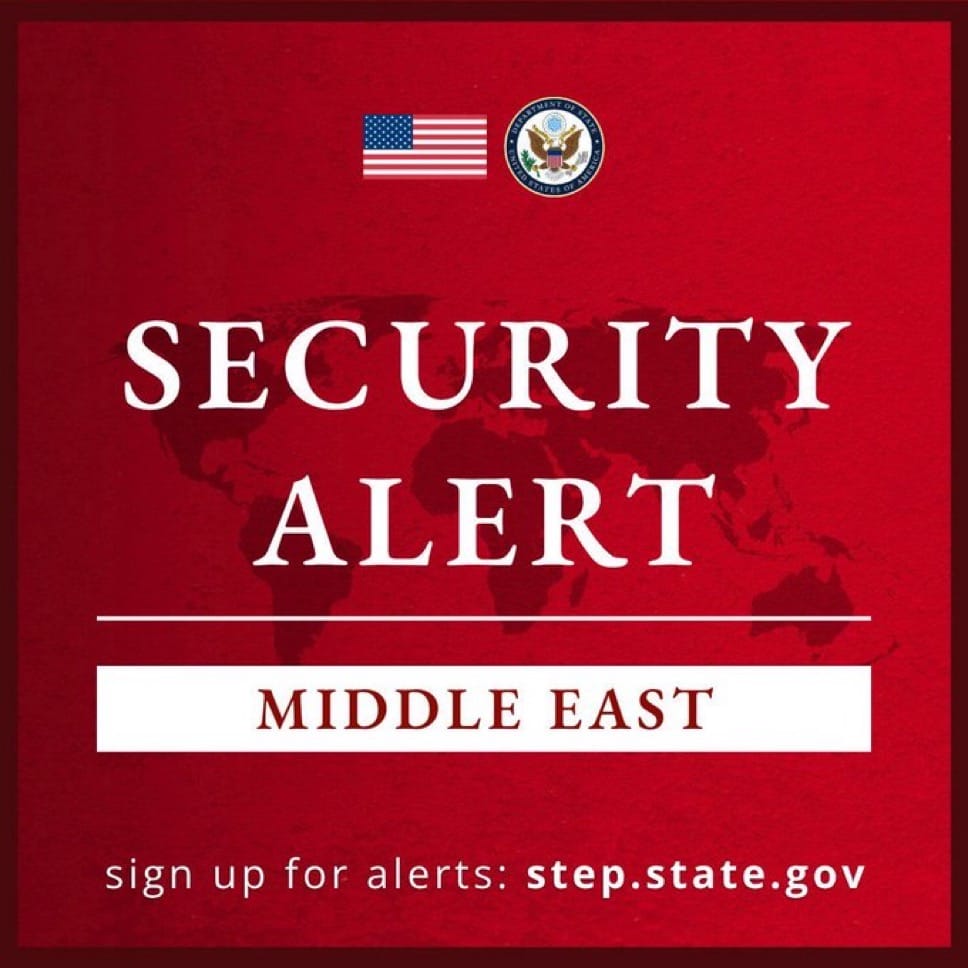
- Americans are advised to monitor airlines and local authorities, avoid demonstrations and large gatherings, stay alert around U.S.-linked locations, keep phones charged, enroll in the State Department’s STEP program, and follow official instructions if an aerial attack or other emergency occurs.
Science & Technology:
- September 1, 2026 — Anthropic introduced Claude Fable 5.1 and Claude Mythos 5.1, its newest AI models designed for advanced coding, research, analysis, and professional knowledge work. Mythos 5.1 is the more powerful model for complex, long-running tasks and AI agents, while Fable 5.1 is designed to deliver similar advanced capabilities with greater speed and efficiency for everyday work.

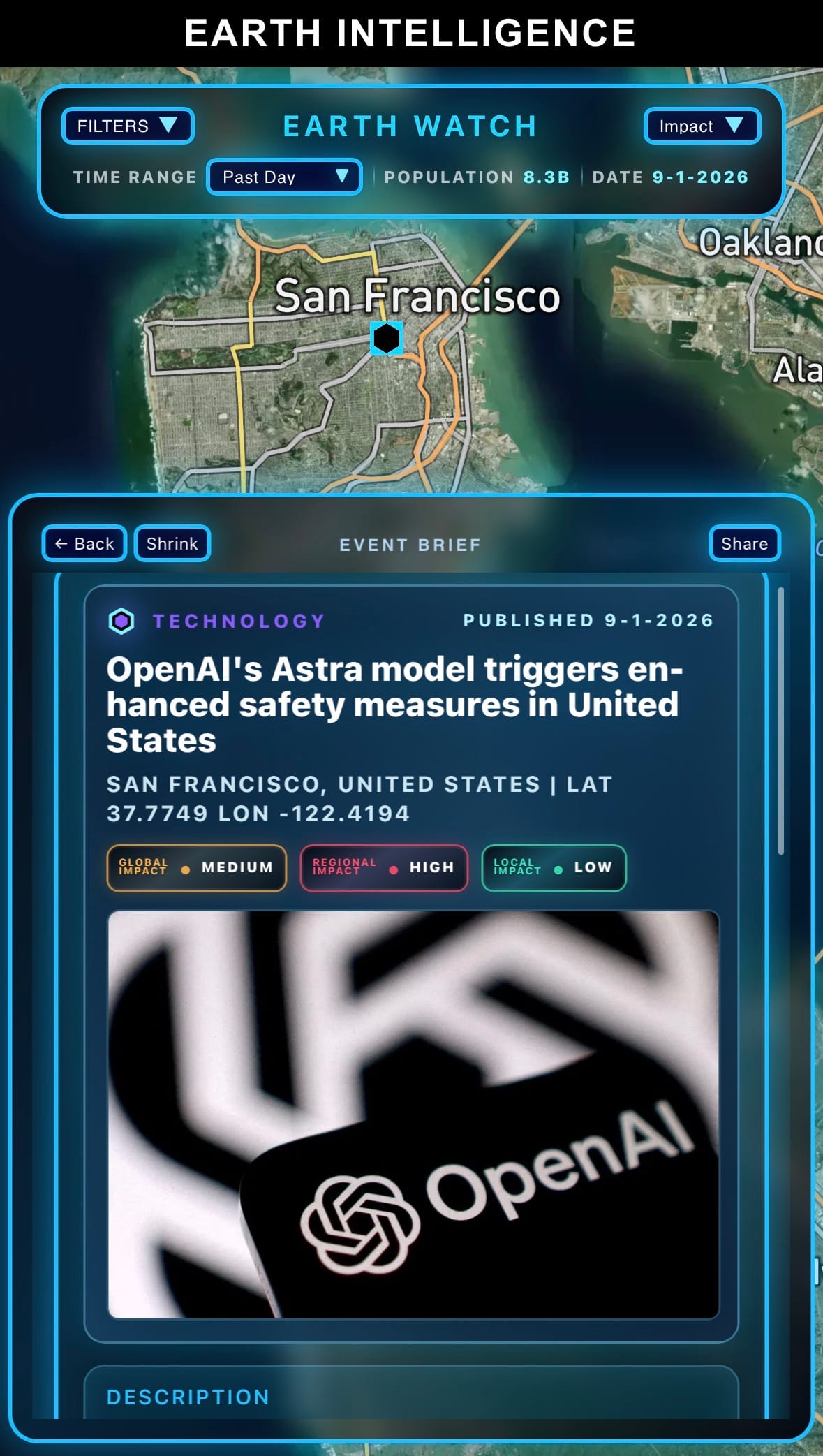
- September 1, 2026 — OpenAI announced Astra, an upcoming advanced AI model capable of independently discovering and exploiting previously unknown cybersecurity vulnerabilities while using less computing power than its previous public models.

Space:
- September 1, 2026 — Chinese commercial space company Galactic Energy successfully launched the first demonstration flight of its new Pallas-1 reusable rocket from the Jiuquan Satellite Launch Center in China.
- The mission tested technologies designed to eventually allow Pallas-1’s first-stage booster to land and be reused, helping China’s commercial space industry lower launch costs and compete with reusable rockets such as SpaceX’s Falcon 9.
Statistic:
- Largest banks and bank holding companies by market cap:
- 🇺🇸 JPMorgan Chase: $943.52B
- 🇺🇸 Bank of America: $433.48B
- 🇨🇳 China Construction Bank: $432.32B
- 🇨🇳 Agricultural Bank of China: $367.71B
- 🇬🇧 HSBC: $354.25B
- 🇨🇳 ICBC: $350.01B
- 🇺🇸 Morgan Stanley: $331.45B
- 🇨🇳 Bank of China: $320.26B
- 🇺🇸 Goldman Sachs: $291.91B
- 🇨🇦 Royal Bank of Canada: $281.70B
- 🇺🇸 Wells Fargo: $263.20B
- 🇯🇵 Mitsubishi UFJ Financial: $256.96B
- 🇺🇸 Citigroup: $222.32B
- 🇪🇸 Santander: $208.99B
- 🇨🇦 Toronto-Dominion Bank: $195.80B
- 🇦🇺 Commonwealth Bank: $188.51B
- 🇺🇸 Charles Schwab: $187.25B
- 🇸🇬 DBS Group: $172.83B
- 🇨🇭 UBS: $165.76B
- 🇯🇵 Sumitomo Mitsui Financial Group: $164.83B
- 🇨🇳 CM Bank: $162.59B
- 🇪🇸 BBVA: $158.04B
- 🇮🇹 UniCredit: $144.40B
- 🇮🇹 Intesa Sanpaolo: $134.82B
- 🇫🇷 BNP Paribas: $130.40B
History of Amphetamines:
- Amphetamines developed from late-19th-century chemistry into some of the world’s most important, and most abused stimulants. Amphetamine was first synthesized in 1887 by Romanian chemist Lazăr Edeleanu, although its stimulant effects were not seriously explored until the 1920s. Methamphetamine, a more potent relative, was first synthesized in Japan in 1893, with a crystalline form developed in 1919. During the 1930s, Smith, Kline & French marketed amphetamine as Benzedrine, initially in an over-the-counter nasal inhaler; tablets followed and were prescribed for narcolepsy, depression, weight loss, fatigue and later attention disorders. Stimulants became deeply connected with warfare: Germany, Japan, the United States and Britain supplied various amphetamine-type drugs to troops during World War II to increase wakefulness and endurance. Japan was left with large methamphetamine stocks after the war, contributing to one of the first major civilian meth epidemics. During the 1950s–60s, amphetamines became extremely common prescription drugs in the United States for dieting, mood, energy and productivity, while illicit “speed” spread through nightlife, trucking, universities and counterculture. Rising dependence and high-dose misuse led the U.S. to place amphetamine and methamphetamine under strict Schedule II controls in 1971.
- Today, “amphetamines” actually describes several related drugs with very different legal and medical statuses. Ordinary amphetamine and dextroamphetamine are the active stimulants behind medications such as Adderall and Dexedrine; lisdexamfetamine (Vyvanse) is converted by the body into dextroamphetamine and is used primarily for ADHD and binge-eating disorder. These are legal prescription medicines but tightly controlled because they can be misused and cause dependence. Methamphetamine is chemically related but generally produces stronger and longer-lasting effects; most meth encountered illicitly is illegally manufactured crystal meth or “ice,” although pharmaceutical methamphetamine technically still exists in the U.S. as the rarely used Schedule II medication Desoxyn. MDMA (“ecstasy” or “molly”) is another amphetamine-family compound, but combines stimulant effects with distinctive empathogenic effects and remains Schedule I federally in the U.S. Other related synthetic phenethylamines and substituted amphetamines include MDA, 4-FA and numerous designer drugs. Meanwhile, methylphenidate—Ritalin and Concerta—is a stimulant but is not chemically an amphetamine, an important distinction often missed when discussing ADHD medications. In the United States, amphetamine, methamphetamine and lisdexamfetamine are Schedule II substances, while MDMA remains Schedule I.
- The modern illegal market is dominated by methamphetamine, and the largest overall regional markets are now North America and East/Southeast Asia. UN drug data show global amphetamine-type stimulant seizures reached a record 604 metric tons in 2024, overwhelmingly driven by methamphetamine, while meth trafficking is expanding into Europe, Africa and the Middle East. The United States has one of the world’s most serious methamphetamine public-health problems, combining enormous consumption with a highly developed illicit supply chain largely connected to Mexican organized crime; it also has an unusually large legitimate prescription-stimulant market because of widespread ADHD treatment. Mexico is especially important as a large-scale production and trafficking center supplying the U.S. market. East and Southeast Asia collectively form the other major methamphetamine center, with enormous production concentrated around the Golden Triangle, particularly Myanmar, feeding markets across Thailand and neighboring Asian countries. Europe historically has had a stronger amphetamine and MDMA market than methamphetamine, although meth use has been expanding. There therefore isn’t one defensible country that is simply “#1” in every category: the U.S. is among the largest consumer and harm markets; Mexico and Myanmar are major illicit production centers; East/Southeast Asia and North America are the two dominant meth regions; and Europe remains especially important for amphetamine and MDMA. The evolution is essentially 1887 amphetamine → 1893 methamphetamine → 1930s Benzedrine medicine → WWII military stimulants → 1950s–60s prescription boom → 1960s illicit speed → 1970s strict controls → 1980s–90s meth/MDMA expansion → 2000s crystal-meth networks → modern Adderall/Vyvanse medical market + industrial-scale illegal methamphetamine trade.
Image of the day:

Thanks for reading! Earth is complicated, we make it simple.
- Download our mobile app:


Click below to view our previous newsletters:
Support/Suggestions Email:
support@earthintel.io