Friday☕️🌎


Trending:
- July 24, 2026: Anthropic introduced Claude Opus 5, a new AI model that comes close to the frontier intelligence of its flagship Fable 5 while costing roughly half as much.
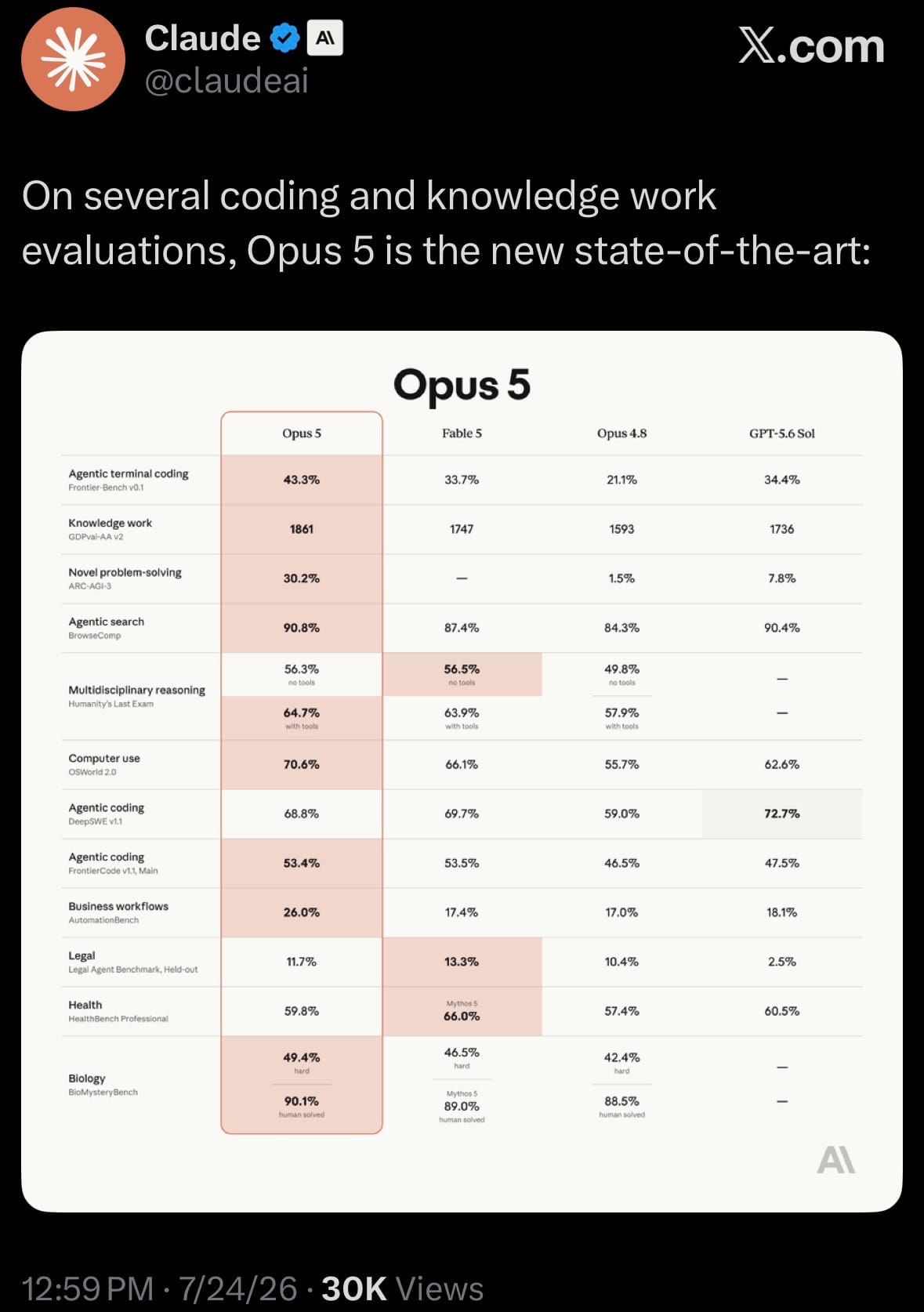
- The model is positioned for strong performance in coding, agentic workflows, and professional knowledge work, giving developers a more affordable option that still delivers near-top-tier capabilities.
Economics & Markets:
- July 23, 2026: Cryptocurrency exchange BitMEX announced it will shut down all operations on September 23, 2026, after a strategic review by its parent company.
- Once a major pioneer known for inventing high-leverage perpetual swaps, BitMEX now handles only about $100–140 million in daily trading volume — a tiny fraction of Binance’s tens of billions and Coinbase’s several billion — and has urged users to close positions and withdraw their funds before the deadline.
Geopolitics & Military Activity:
- July 24, 2026: Ukrainian drones struck multiple Wildberries logistics facilities around St. Petersburg overnight, including the Utkina Zavod park in Novosaratovka and a warehouse in Shushary, with the company’s founder Tatyana Kim confirming hits in St. Petersburg, the Leningrad region, and occupied Crimea that sparked fires at several sites.

- The attacks injured three people, delayed about 50 flights at Pulkovo Airport, and marked a significant deep strike 1,100 km from Ukraine’s border, further damaging Russia’s largest e-commerce logistics network after earlier July 18 strikes that disabled roughly 8% of Wildberries’ capacity.

Science & Technology:
- July 24, 2026: Chinese robotics company Unitree unveiled the Super Athlete AS2-W, a compact hybrid wheeled-legged robot designed for fluid movement across varied terrain.

- The robot supports a continuous 16 kg payload and offers more than 30 km of unloaded driving range, combining wheel efficiency on flat surfaces with legged mobility for obstacles in applications such as inspection, patrol, and logistics.

Statistic:
- Largest public companies on Earth by market capitalization:
- 🇺🇸 NVIDIA: $5.084T
- 🇺🇸 Apple: $4.889T
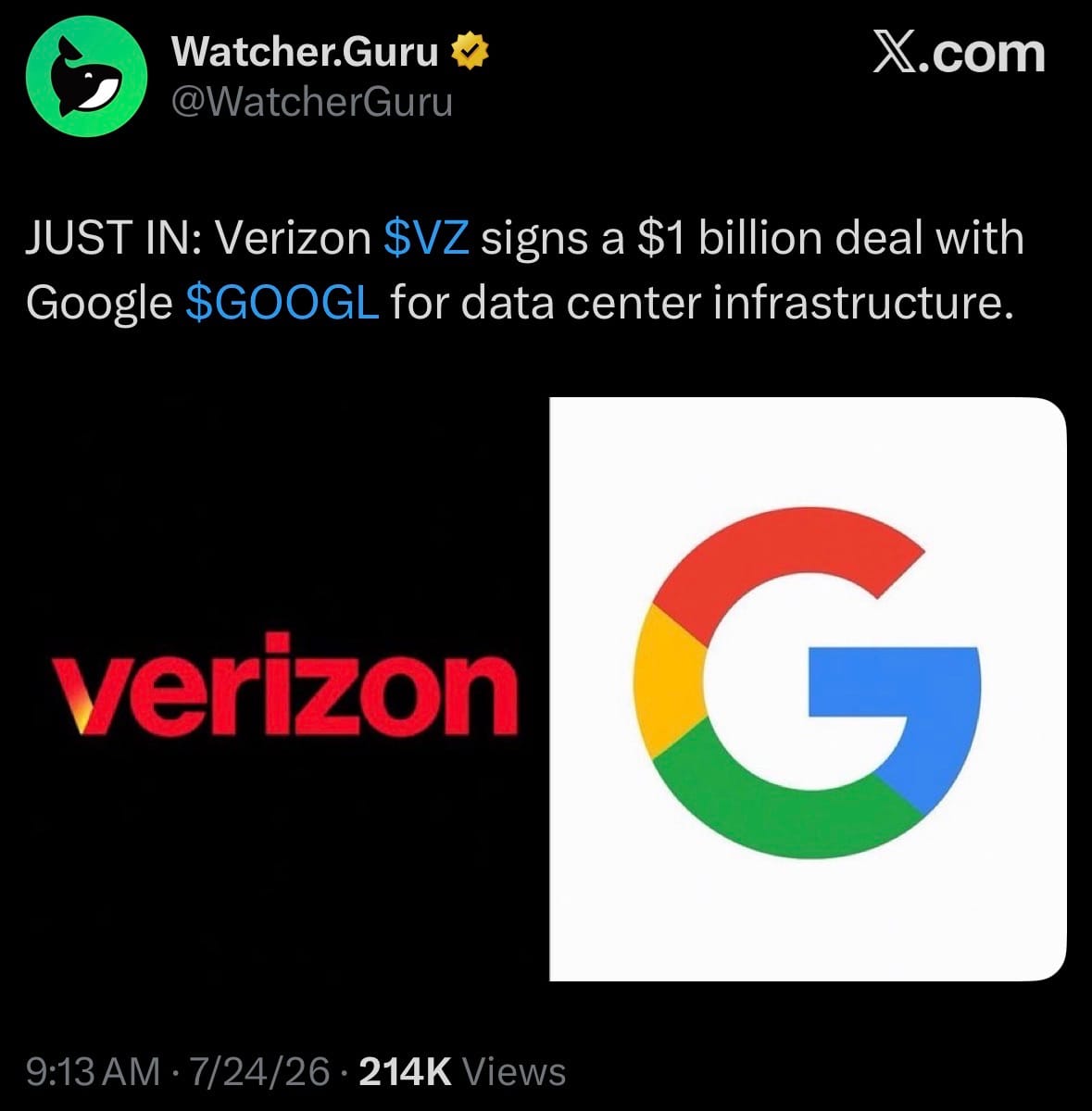
- 🇺🇸 Alphabet (Google): $3.907T
- 🇺🇸 Microsoft: $2.853T
- 🇺🇸 Amazon: $2.510T
- 🇹🇼 TSMC: $2.107T
- 🇺🇸 Broadcom: $1.828T
- 🇸🇦 Saudi Aramco: $1.729T
- 🇺🇸 Meta Platforms (Facebook): $1.529T
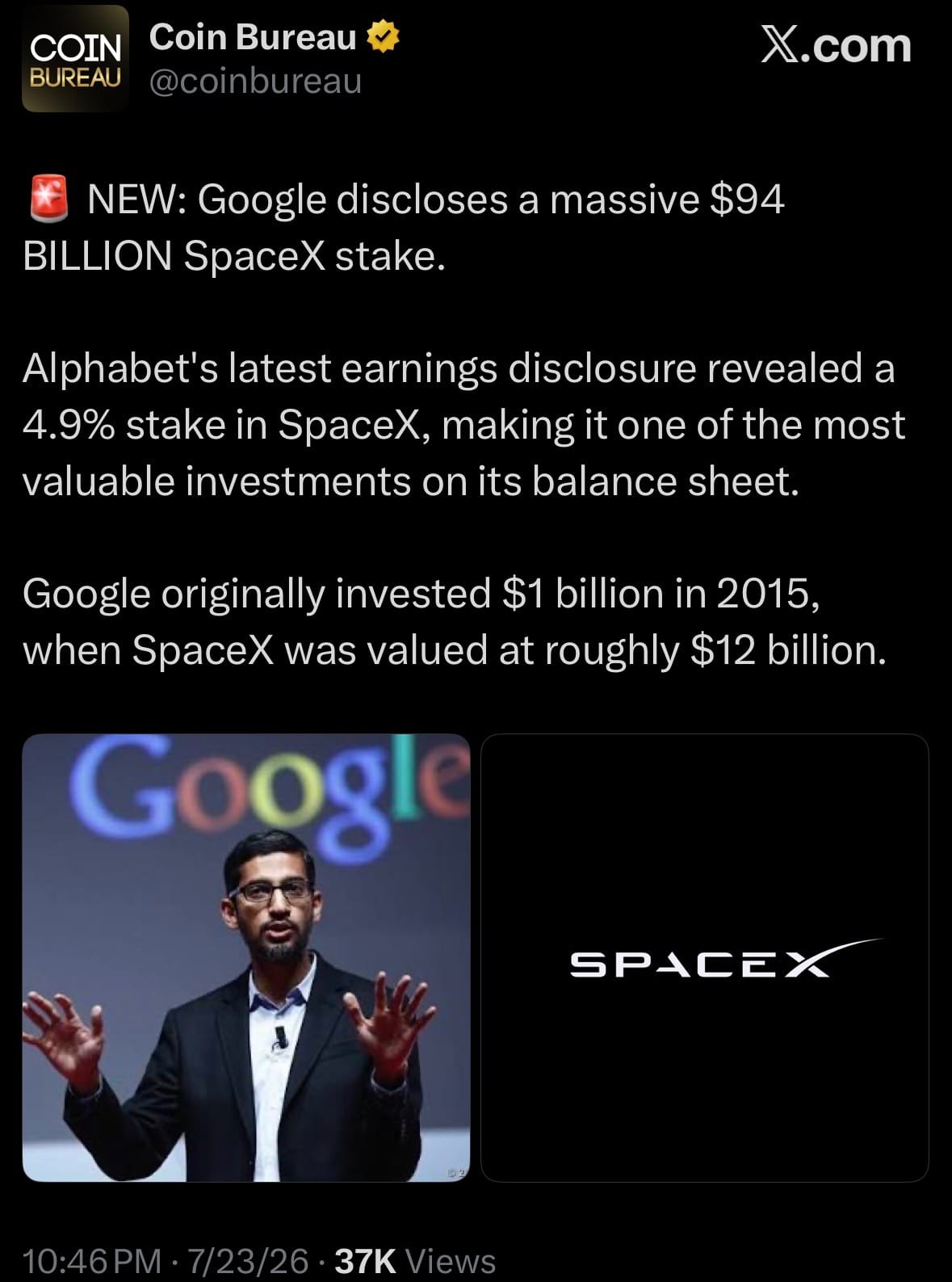
- 🇺🇸 SpaceX: $1.476T
- 🇺🇸 Tesla: $1.219T
- 🇰🇷 Samsung: $1.121T
- 🇺🇸 Eli Lilly: $1.071T
- 🇺🇸 Berkshire Hathaway: $1.065T
- 🇺🇸 Micron Technology: $1.053T
- 🇺🇸 JPMorgan Chase: $937.62B
- 🇺🇸 AMD: $869.19B
- 🇺🇸 Walmart: $867.98B
- 🇰🇷 SK Hynix: $854.78B
- 🇳🇱 ASML: $680.75B
- 🇺🇸 Visa: $671.73B
- 🇺🇸 Exxon Mobil: $649.90B
- 🇺🇸 Johnson & Johnson: $632.78B
- 🇨🇳 Tencent: $500.49B
- 🇺🇸 Intel: $481.64B
- 🇺🇸 Mastercard: $472.33B
- 🇺🇸 AbbVie: $457.59B
- 🇺🇸 Cisco: $449.79B
- 🇺🇸 Bank of America: $435.18B
- 🇺🇸 Applied Materials: $433.81B
- 🇺🇸 Costco: $413.93B
- 🇺🇸 Caterpillar: $410.09B
- 🇨🇳 China Construction Bank: $396.95B
- 🇺🇸 Lam Research: $389.05B
- 🇺🇸 Chevron: $387.73B
- 🇺🇸 UnitedHealth: $381.42B
- 🇺🇸 General Electric: $367.24B
- 🇬🇧 HSBC: $354.96B
- 🇺🇸 Coca-Cola: $352.58B
- 🇨🇭 Roche: $350.86B
- 🇨🇳 Agricultural Bank of China: $344.72B
- 🇺🇸 Procter & Gamble: $342.45B
- 🇺🇸 Oracle: $341.22B
- 🇺🇸 Morgan Stanley: $337.75B
- 🇺🇸 Home Depot: $329.11B
- 🇨🇳 ICBC: $326.77B
- 🇺🇸 Merck: $323.96B
- 🇺🇸 Goldman Sachs: $314.70B
- 🇺🇸 Philip Morris International: $301.58B
- 🇨🇭 Novartis: $295.42B
- 🇺🇸 Palantir: $295.10B
History:
- Government contracting has existed for thousands of years, beginning when ancient civilizations hired private individuals and businesses to construct roads, temples, walls, ships, weapons, and public infrastructure. Ancient Egypt contracted skilled laborers and craftsmen to build monuments and irrigation systems, while the Roman Empire relied heavily on private contractors, known as publicani, to construct roads, aqueducts, military forts, harbors, and public buildings while also collecting taxes and supplying the Roman legions. During the Middle Ages, European monarchs increasingly hired merchants, blacksmiths, shipbuilders, and weapons manufacturers to equip their armies rather than producing everything themselves. By the 1600s and 1700s, governments regularly contracted private shipyards, foundries, textile manufacturers, and trading companies to support expanding colonial empires. The Industrial Revolution dramatically increased the scale of government contracting as railroads, telegraphs, bridges, ports, and military equipment became too large and specialized for governments to build alone. In the United States, federal contracting expanded rapidly during the Civil War (1861–1865) as private companies supplied uniforms, firearms, locomotives, food, ammunition, and ships. While this accelerated industrial growth, it also exposed problems with fraud and poor oversight, leading to the first major procurement reforms. By the early 1900s, contracting had become the primary way governments purchased everything from office supplies to battleships, establishing the foundation of today’s procurement system.
- The modern era of government contracting was shaped largely by World War II, when the United States partnered with thousands of private companies to produce aircraft, tanks, ships, weapons, vehicles, electronics, and supplies on an unprecedented scale. Companies such as Boeing, Lockheed, Northrop, General Motors, Ford, General Electric, Westinghouse, and DuPont became critical defense manufacturers, helping transform the United States into the world’s largest industrial economy. After the war, the Cold War expanded government contracting even further as defense, aerospace, intelligence, nuclear technology, and space exploration became national priorities. The creation of NASA (1958) generated massive contracts for companies including North American Aviation, Grumman, McDonnell Douglas, and Rocketdyne, while the Department of Defense increasingly relied on contractors to design aircraft, missiles, submarines, satellites, communications systems, and advanced electronics. Throughout the 1980s and 1990s, the federal government modernized procurement through competitive bidding, standardized contracting rules, and digital acquisition systems. A major milestone came with the Federal Acquisition Regulation (FAR), implemented in 1984, which standardized procurement policies across nearly all federal agencies. Today, federal contracts are generally awarded through competitive solicitations, negotiated procurements, indefinite-delivery contracts, blanket purchase agreements, and government-wide acquisition contracts depending on the complexity and urgency of the requirement.
- Today, government contracting represents one of the largest purchasing systems in the world. The U.S. federal government awards hundreds of billions of dollars in contracts each year through agencies including the Department of Defense, Department of Homeland Security, Department of Energy, NASA, Department of Veterans Affairs, General Services Administration (GSA), Department of Transportation, and hundreds of other federal organizations. Contracting covers virtually every industry, including construction, software, cybersecurity, artificial intelligence, cloud computing, engineering, logistics, healthcare, scientific research, consulting, manufacturing, facility management, education, emergency response, and space systems. Large defense contractors such as Lockheed Martin, RTX (formerly Raytheon Technologies), Northrop Grumman, General Dynamics, Boeing, L3Harris, and Huntington Ingalls Industries receive many of the largest contracts, while hundreds of thousands of small businesses also compete through programs such as 8(a), HUBZone, Service-Disabled Veteran-Owned Small Business (SDVOSB), Women-Owned Small Business (WOSB), and Small Business Innovation Research (SBIR). Federal opportunities are primarily published through SAM.gov, where agencies release requests for proposals (RFPs), requests for quotations (RFQs), requests for information (RFIs), and invitations for bids (IFBs). Today, the government’s priorities are increasingly focused on cybersecurity, artificial intelligence, cloud infrastructure, semiconductor manufacturing, energy resilience, critical infrastructure, advanced manufacturing, biotechnology, quantum computing, and space technologies. Government contracting has evolved from hiring builders to construct roads and fortifications into one of the world’s largest procurement ecosystems, supporting national defense, public services, scientific innovation, infrastructure, and economic development while connecting millions of private-sector workers to government missions.
Image of the day:

Thanks for reading! Earth is complicated, we make it simple.
- Download our mobile app:



Click below to view our previous newsletters:

Support/Suggestions Email:
support@earthintel.io