Friday☕️🌎


Trending:
- Yesterday, The U.S. Navy awarded a record $76.6 billion in contracts to General Dynamics Electric Boat and Huntington Ingalls Industries for 14 new nuclear-powered submarines—five Columbia-class ballistic missile submarines valued at $29.5 billion that will carry nuclear-tipped Trident missiles, and nine Block VI Virginia-class fast-attack submarines at $42.1 billion equipped for conventional payloads including Tomahawk cruise missiles, torpedoes, and advanced sensors.

- These vessels will replace the aging Ohio-class fleet, strengthen the sea-based leg of the nuclear triad with superior stealth and multi-domain strike capability, sustain thousands of jobs at shipyards in Groton, Connecticut, and Newport News, Virginia, and support construction extending into the 2030s amid rising competition from China and Russia.
Economics & Markets:
- July 30, 2026: Amazon reported Q2 2026 revenue of $200.6 billion, up 20% year-over-year and beating expectations, with shares rising more than 7% in after-hours trading.
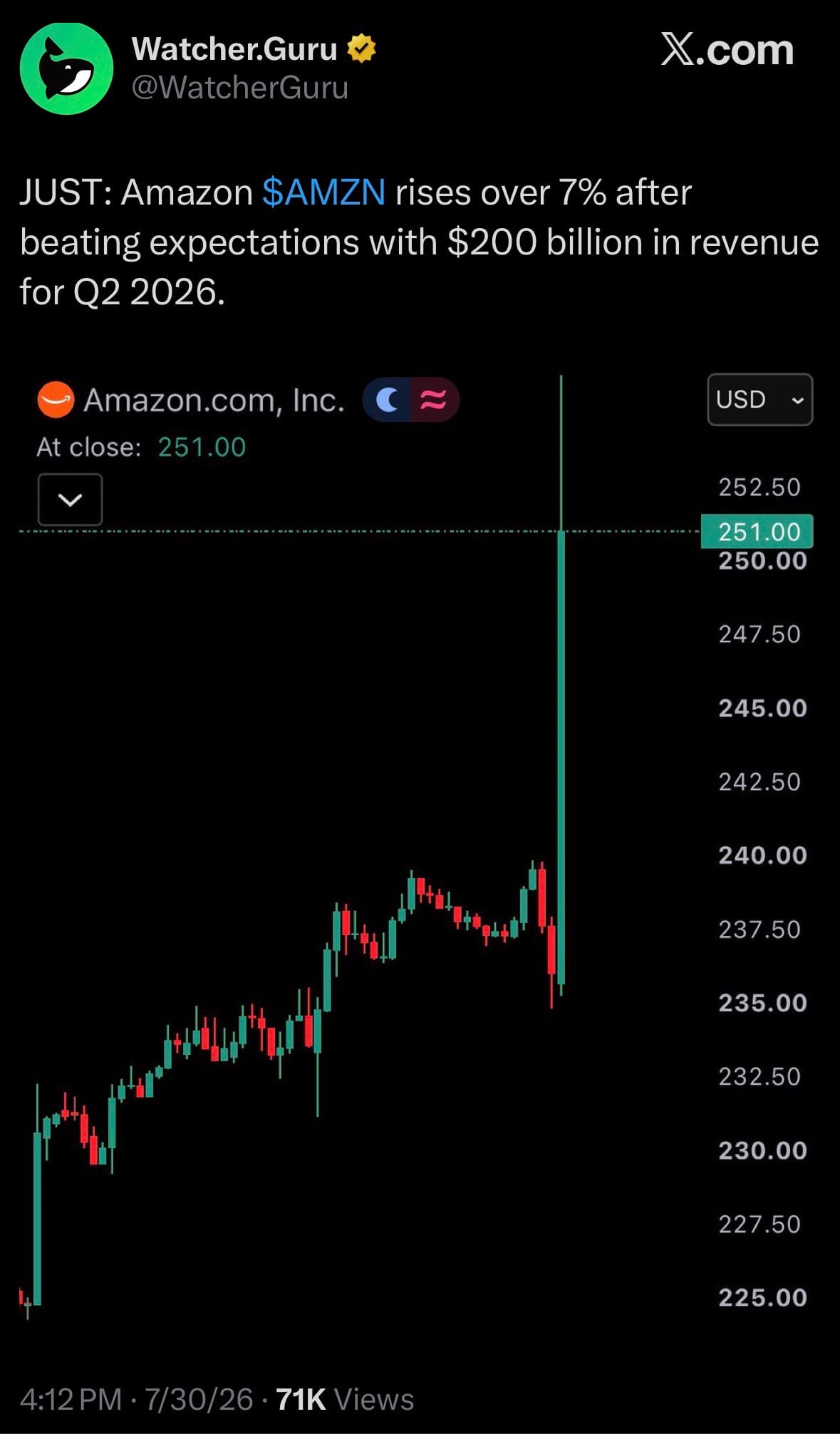
- AWS revenue jumped 37% to $42.2 billion—its fastest growth in 18 quarters—while net income reached $62.6 billion ($5.75 per share), driven in part by investment gains, and the company’s AI and chips businesses each surpassed $25 billion annual run rates.
FTX Update:
- Today, FTX will begin its fifth distribution round, paying out approximately $900 million to eligible creditors, bringing total recoveries to nearly $10 billion since the exchange’s 2022 collapse.

- Most creditors are receiving more than 100% of their original claims, with smaller accounts recovering up to 120%.

Science & Technology:
- July 30, 2026: OpenAI announced major price cuts for its GPT-5.6 models, reducing the cost of the fast, low-cost GPT-5.6 Luna by 80% and the mid-tier GPT-5.6 Terra by 20%, while also introducing a faster processing option for the flagship GPT-5.6 Sol in the API.
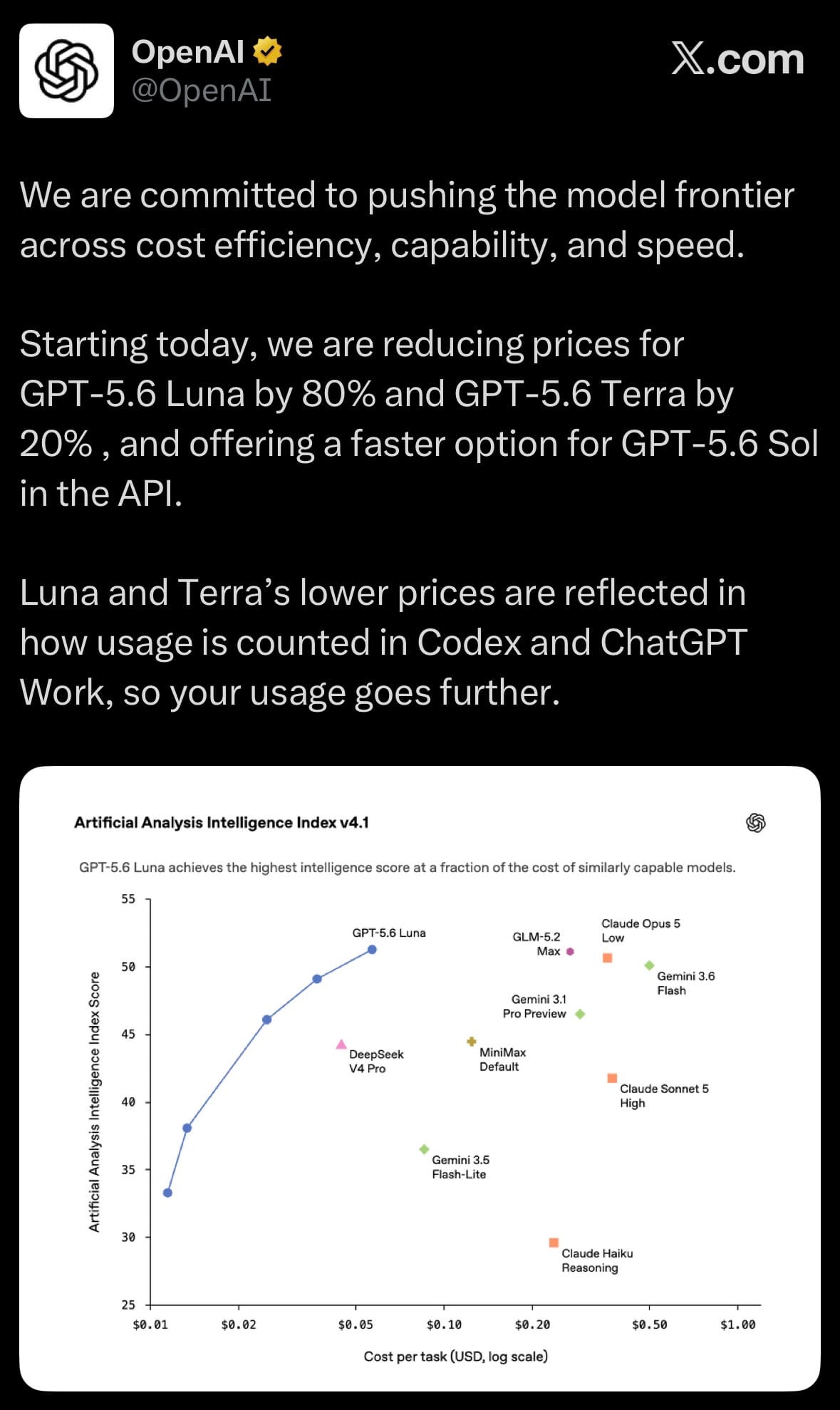
- The lower prices for Luna and Terra are reflected in usage tracking for Codex and ChatGPT Work, allowing customers to get more value from the same usage limits.
Statistic:
- Largest assets on Earth by market capitalization:
- 🥇 Gold: $29.020T
- 🇺🇸 Apple: $4.897T
- 🇺🇸 NVIDIA: $4.724T
- 🇺🇸 Alphabet (Google): $4.080T
- 🇺🇸 Microsoft: $3.350T
- 🥈 Silver: $3.347T
- 🇺🇸 Amazon: $2.533T
- 🇹🇼 TSMC: $2.091T
- 🇺🇸 Broadcom: $1.845T
- 🇸🇦 Saudi Aramco: $1.706T
- 🇺🇸 SpaceX: $1.478T
- 🇺🇸 Meta Platforms (Facebook): $1.368T
- ₿ Bitcoin: $1.299T
- 🇺🇸 Tesla: $1.219T
- 🇺🇸 Berkshire Hathaway: $1.099T
- 🇺🇸 Eli Lilly: $1.030T
- 🇺🇸 Micron Technology: $987.83B
- 🇺🇸 Vanguard S&P 500 ETF: $975.82B
- 🇰🇷 Samsung: $957.00B
- 🇺🇸 JPMorgan Chase: $932.84B
- 🇺🇸 Walmart: $884.14B
- 🇺🇸 iShares Core S&P 500 ETF: $869.14B
- 🇺🇸 AMD: $791.47B
- 🇺🇸 SPDR S&P 500 ETF: $788.15B
- 🇺🇸 Visa: $672.78B
History:
- The telescope developed from thousands of years of experiments with light, mirrors, and lenses. Ancient Egyptians and Mesopotamians used polished reflective surfaces, while Greek thinkers such as Euclid, around 300 BC, and Ptolemy, around 150 AD, studied how light travels and reflects. During the 11th century, Arab scientist Ibn al-Haytham produced major studies of vision, reflection, refraction, and the camera obscura, helping establish the scientific foundations of optics. European craftsmen began making eyeglasses during the late 1200s, creating the lens-making knowledge needed for the first telescope. In 1608, Dutch spectacle maker Hans Lippershey applied for a patent on an instrument that made distant objects appear closer. Jacob Metius and Zacharias Janssen were also later connected to similar early designs, so the exact inventor remains disputed. In 1609, Italian scientist Galileo Galilei learned of the device, built improved versions, and aimed them at the sky. He observed mountains and craters on the Moon, four large moons orbiting Jupiter, the phases of Venus, sunspots, and countless stars invisible to the naked eye. These discoveries challenged the belief that every object revolved around Earth and provided strong evidence for the Sun-centered model advanced by Nicolaus Copernicus. Galileo’s telescope used a convex objective lens and a concave eyepiece, producing an upright but narrow view. In 1611, Johannes Kepler described a design using two convex lenses, producing a wider field of view but an inverted image. Kepler’s arrangement became the basis of most later refracting telescopes. During the 1600s, astronomers including Christiaan Huygens, who discovered Saturn’s moon Titan in 1655, and Giovanni Cassini, who discovered several Saturnian moons and the Cassini Division in its rings, used increasingly long telescopes to reduce optical distortion. However, refractors suffered from chromatic aberration, in which different colors focused at different points. In 1668, Isaac Newton built the first successful reflecting telescope, using a curved mirror instead of a large objective lens. Reflectors avoided much of the color distortion and could eventually be built much larger than refractors.
- Telescope technology expanded rapidly during the 1700s and 1800s. English optician John Dollond patented the achromatic lens in 1758, combining different types of glass to reduce chromatic aberration and make refracting telescopes shorter and sharper. Astronomer William Herschel built powerful reflecting telescopes and discovered Uranus in 1781, the first planet identified with a telescope. He also discovered moons of Uranus and Saturn and used stellar observations to study the shape of the Milky Way. His enormous 40-foot telescope, completed in 1789, had a mirror roughly 1.2 meters wide and was one of the largest scientific instruments of its time. In 1845, the Earl of Rosse, William Parsons, completed the 72-inch Leviathan of Parsonstown in Ireland and used it to observe spiral structures in objects then called nebulae. Photography transformed astronomy after John William Draper produced a detailed photograph of the Moon in 1840, allowing observations to be permanently recorded rather than only sketched. Spectroscopy became equally important. Joseph von Fraunhofer mapped dark lines in the Sun’s spectrum in the early 1800s, while Gustav Kirchhoff and Robert Bunsen showed during the 1850s and 1860s that these lines could reveal the chemical composition of distant objects. Telescopes could now determine what stars were made of, not merely where they were located. Large observatories were constructed in clear, elevated locations, including Lick Observatory, Yerkes Observatory, Mount Wilson, and Palomar. At Mount Wilson, Edwin Hubble used the 100-inch Hooker Telescope during the 1920s to show that the Andromeda “nebula” was a separate galaxy and that distant galaxies were generally moving away from Earth, providing evidence that the universe is expanding. The 200-inch Hale Telescope, completed at Palomar in 1948, became one of the world’s most important optical instruments. At the same time, astronomy expanded beyond visible light. In 1932, engineer Karl Jansky detected radio waves coming from the Milky Way, beginning radio astronomy. Grote Reber built the first purpose-designed radio telescope in 1937. Later radio observatories identified pulsars, quasars, hydrogen gas, cosmic background radiation, and distant galaxies. Other instruments were developed to detect infrared, ultraviolet, X-rays, gamma rays, gravitational waves, and energetic particles, allowing astronomers to observe parts of the universe invisible to human eyes.
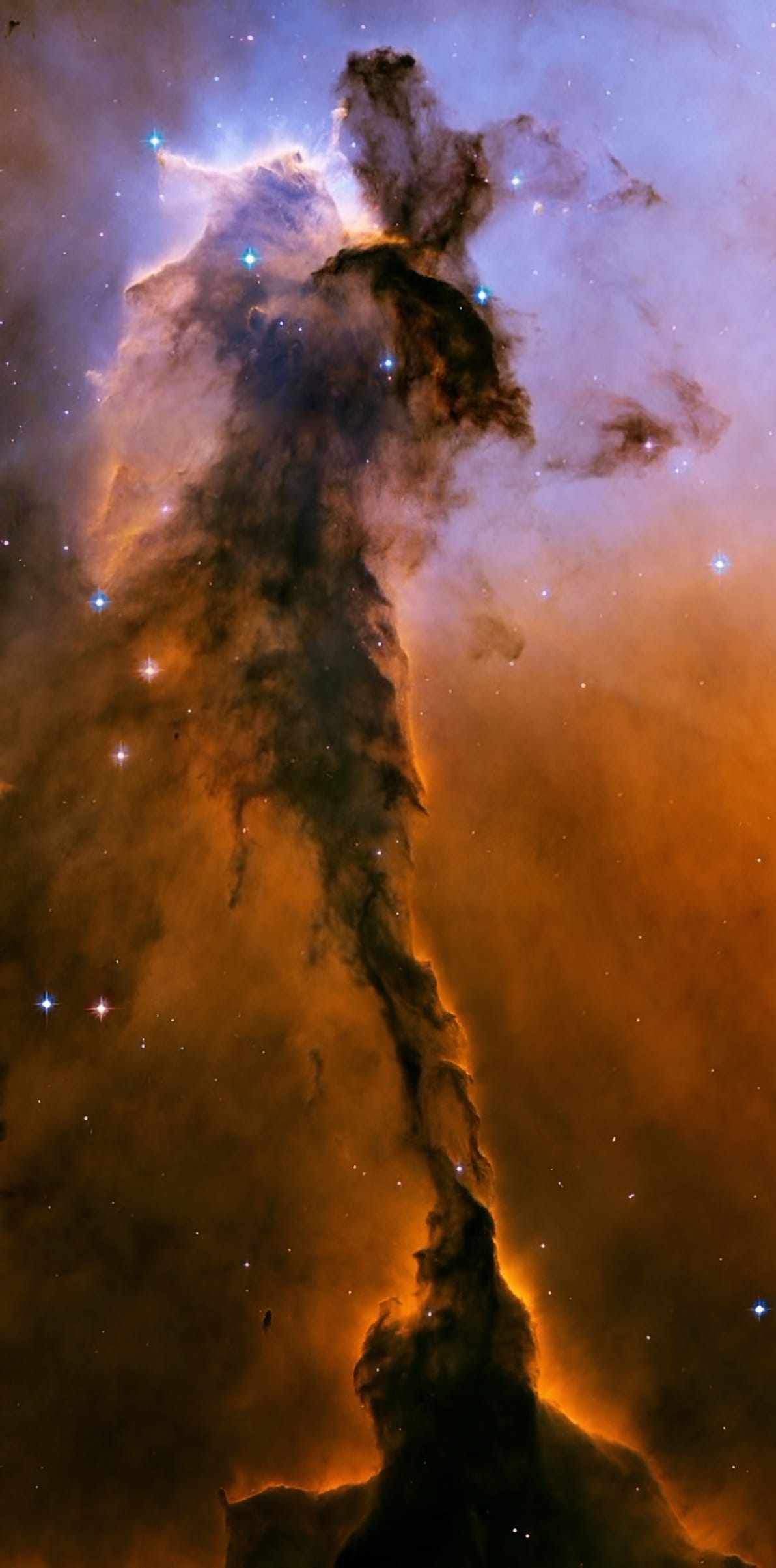
- Space telescopes became necessary because Earth’s atmosphere blocks or distorts much of the electromagnetic spectrum. The United States launched early ultraviolet and X-ray observatories during the 1960s and 1970s, including the Orbiting Astronomical Observatory series. NASA’s Hubble Space Telescope, launched in 1990, became the most famous space telescope. Its primary mirror was initially manufactured with the wrong shape, producing blurred images, but astronauts corrected the problem during a servicing mission in 1993. Hubble later measured the universe’s expansion, photographed distant galaxies, studied black holes, observed star formation, examined planets and exoplanet atmospheres, and helped establish that the expansion of the universe is accelerating. Other major space observatories included the Compton Gamma Ray Observatory in 1991, Chandra X-ray Observatory in 1999, Spitzer Space Telescope in 2003, Kepler in 2009, and the European Gaia mission in 2013. Kepler discovered thousands of possible planets by measuring tiny decreases in starlight as planets crossed in front of their stars. Gaia has mapped the positions and motions of billions of stars with extreme precision. The James Webb Space Telescope, launched on December 25, 2021, uses a segmented 6.5-meter mirror and primarily observes infrared light. Positioned roughly 1.5 million kilometers from Earth near the Sun-Earth L2 point, Webb studies some of the earliest galaxies, star and planet formation, exoplanet atmospheres, and objects hidden behind cosmic dust. Ground-based astronomy also remains essential. Modern observatories such as the twin Keck telescopes, the Very Large Telescope, ALMA, and the Event Horizon Telescope use adaptive optics, interferometry, and networks of instruments to achieve extraordinary resolution. In 2019, the Event Horizon Telescope collaboration released the first image of a black hole’s shadow, located in galaxy M87, followed by an image of the black hole at the center of the Milky Way in 2022. Telescopes are now used for astronomy, weather forecasting, climate monitoring, mapping Earth, tracking satellites and space debris, military surveillance, missile warning, navigation, communications, planetary defense, wildlife observation, search and rescue, and commercial imaging. Future instruments such as the Vera C. Rubin Observatory, Nancy Grace Roman Space Telescope, Extremely Large Telescope, Thirty Meter Telescope, and Giant Magellan Telescope are designed to study dark matter, dark energy, exoplanets, hazardous asteroids, and the earliest structures in the universe. The telescope has evolved from a simple arrangement of glass lenses into a global and space-based network that can detect light, radio waves, heat, radiation, gravitational effects, and objects billions of light-years away.
Image of the day:
Thanks for reading! Earth is complicated, we make it simple.
- Download our mobile app:


Click below to view our previous newsletters:
Support/Suggestions Email:
support@earthintel.io