Monday☕️🌎


Trending:
- August 2, 2026: Morgan Stanley added more than $74 billion in net new wealth management assets from second-quarter IPOs, including SpaceX, while earning $100 million in fees for underwriting the SpaceX listing.

- Morgan Stanley at Work head Scott Whatley said the firm has “dozens of IPOs lined up” for corporate clients and that the boost was “not a one-time hit.”


Geopolitics & Military Activity:
- August 2, 2026: Ukraine launched long-range drone strikes against Russia, hitting the Engels strategic air base, Saratov oil refinery, Kaluga oil depot, and a Wildberries logistics warehouse in Samara, while additional attacks caused casualties in several Russian regions.

- Russia responded by launching 133 drones overnight against Ukraine, striking Zaporizhzhia, Kharkiv, and other areas, damaging civilian infrastructure and killing multiple civilians.


Science & Technology:
- August 3, 2026: Alibaba’s Qwen team launched Qwen3.8-Max, its strongest AI model yet with 2.4 trillion parameters, now available via API and Qwen Cloud for $2 per million input tokens and $6 per million output tokens.
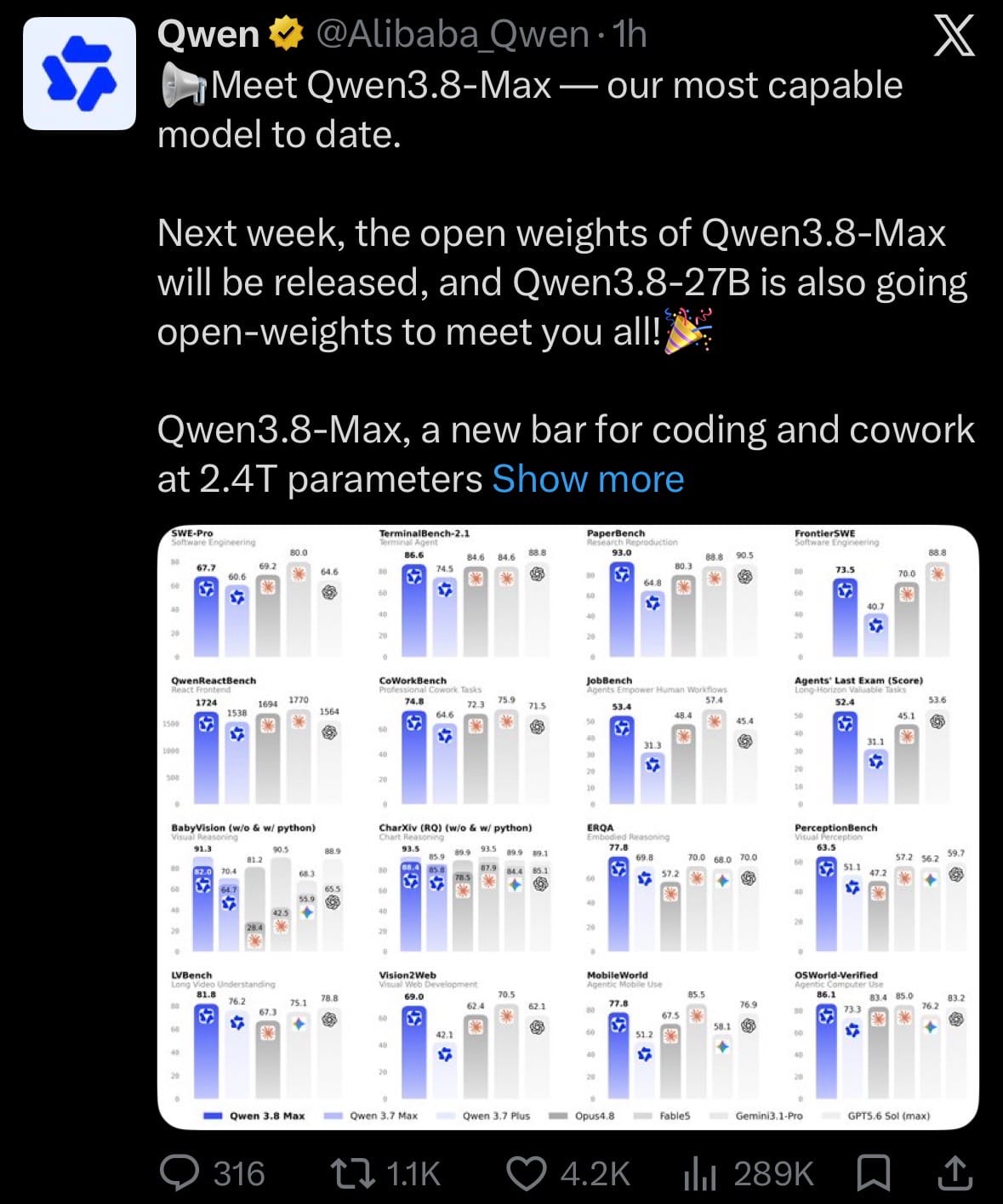
- Open weights (the downloadable model parameters that let anyone run or fine-tune it themselves) for Qwen3.8-Max and the smaller Qwen3.8-27B will drop next week; the model excels at long autonomous coding projects, complex planning, real-world professional work, and using vision for continuous feedback.
Space:

Statistic:
- Largest public semiconductor companies by market capitalization:
- 🇺🇸 NVIDIA: $4.862T
- 🇹🇼 TSMC: $2.096T
- 🇺🇸 Broadcom: $1.852T
- 🇰🇷 Samsung: $1.117T
- 🇺🇸 Micron Technology: $929.52B
- 🇰🇷 SK Hynix: $795.36B
- 🇺🇸 AMD: $776.41B
- 🇳🇱 ASML: $625.69B
- 🇨🇳 CXMT: $582.72B
- 🇺🇸 Intel: $454.96B
- 🇺🇸 Applied Materials: $403.06B
- 🇺🇸 Lam Research: $366.64B
- 🇬🇧 Arm Holdings: $255.98B
- 🇺🇸 Texas Instruments: $251.81B
- 🇺🇸 KLA: $238.81B
- 🇹🇼 MediaTek: $193.52B
- 🇺🇸 Analog Devices: $178.96B
- 🇺🇸 Marvell Technology: $168.34B
- 🇯🇵 Tokyo Electron: $158.99B
- 🇺🇸 QUALCOMM: $154.99B
- 🇯🇵 Advantest: $145.10B
- 🇨🇳 Cambricon Technologies: $97.51B
- 🇩🇪 Infineon: $92.45B
- 🇹🇼 ASE Group: $77.33B
- 🇺🇸 Synopsys: $74.43B
History:
- The history of computer chips began with the discovery of semiconductors—materials such as silicon and germanium that can precisely control the flow of electricity. Unlike metals, semiconductors can act as electrical switches, making modern computing possible. Scientists first studied these materials during the 1800s, with Michael Faraday (1833) observing their unusual electrical behavior and Karl Ferdinand Braun (1874) discovering their rectifying properties. The first major breakthrough came on December 16, 1947, when John Bardeen, Walter Brattain, and William Shockley at Bell Labs invented the transistor, replacing bulky vacuum tubes that powered early computers. The transistor was smaller, faster, cooler, and far more reliable, becoming one of the most important inventions in history. In 1958, Jack Kilby built the first integrated circuit (IC) by placing multiple electronic components on one chip, and in 1959, Robert Noyce at Fairchild Semiconductor developed the practical silicon chip that launched the modern semiconductor industry. Fairchild became the birthplace of Silicon Valley, with former employees later founding companies such as Intel, AMD, National Semiconductor, and many others.
- The semiconductor industry accelerated rapidly during the 1960s and 1970s. In 1965, Intel co-founder Gordon Moore predicted that the number of transistors on a chip would roughly double every two years, a trend known as Moore’s Law. In 1971, Intel introduced the 4004, the world’s first commercial microprocessor, containing about 2,300 transistors. Later processors including the 8086 powered the personal computer revolution. Manufacturing also evolved dramatically. Companies developed photolithography, chemical etching, ion implantation, and increasingly precise fabrication methods to shrink transistor sizes from micrometers to only a few nanometers. In 1987, TSMC pioneered the foundry model, manufacturing chips for companies such as Apple, NVIDIA, AMD, Qualcomm, Broadcom, and others instead of designing its own. This separated chip design from manufacturing and reshaped the global industry. Today, leading-edge semiconductor factories cost $20–40 billion to build and rely on ASML’s Extreme Ultraviolet (EUV) lithography systems, among the most advanced manufacturing machines ever created.
- Today, semiconductors power virtually every modern technology, including smartphones, computers, artificial intelligence, satellites, aircraft, automobiles, medical devices, military systems, robotics, telecommunications, financial markets, and cloud data centers. Manufacturing begins with ultra-pure silicon refined from quartz sand, grown into single-crystal ingots, sliced into wafers, and processed through hundreds of highly precise manufacturing steps before packaging. The global industry is highly specialized. NVIDIA leads AI processors, TSMC manufactures the world’s most advanced chips, Samsung and SK Hynix dominate memory, Intel remains a major manufacturer and designer, AMD competes in CPUs and AI chips, Broadcom leads networking silicon, and ASML is the only company producing advanced EUV lithography machines required for cutting-edge manufacturing. As of 2026, NVIDIA is the world’s largest semiconductor company by market capitalization at roughly $4.9 trillion, followed by TSMC (~$2.1T), Broadcom (~$1.9T), Samsung (~$1.1T), Micron (~$930B), and SK Hynix (~$795B). Today, computer chips are often called the brains of modern civilization, and control over semiconductor design and manufacturing has become one of the most important strategic competitions between the United States, Taiwan, South Korea, China, Japan, and Europe, underpinning AI, defense, space, communications, and the global economy.
Image of the day:

Thanks for reading! Earth is complicated, we make it simple.
- Download our mobile app:



Click below to view our previous newsletters:

Support/Suggestions Email:
support@earthintel.io