Your daily briefing on the world, markets, science and technology.
Snapshot:
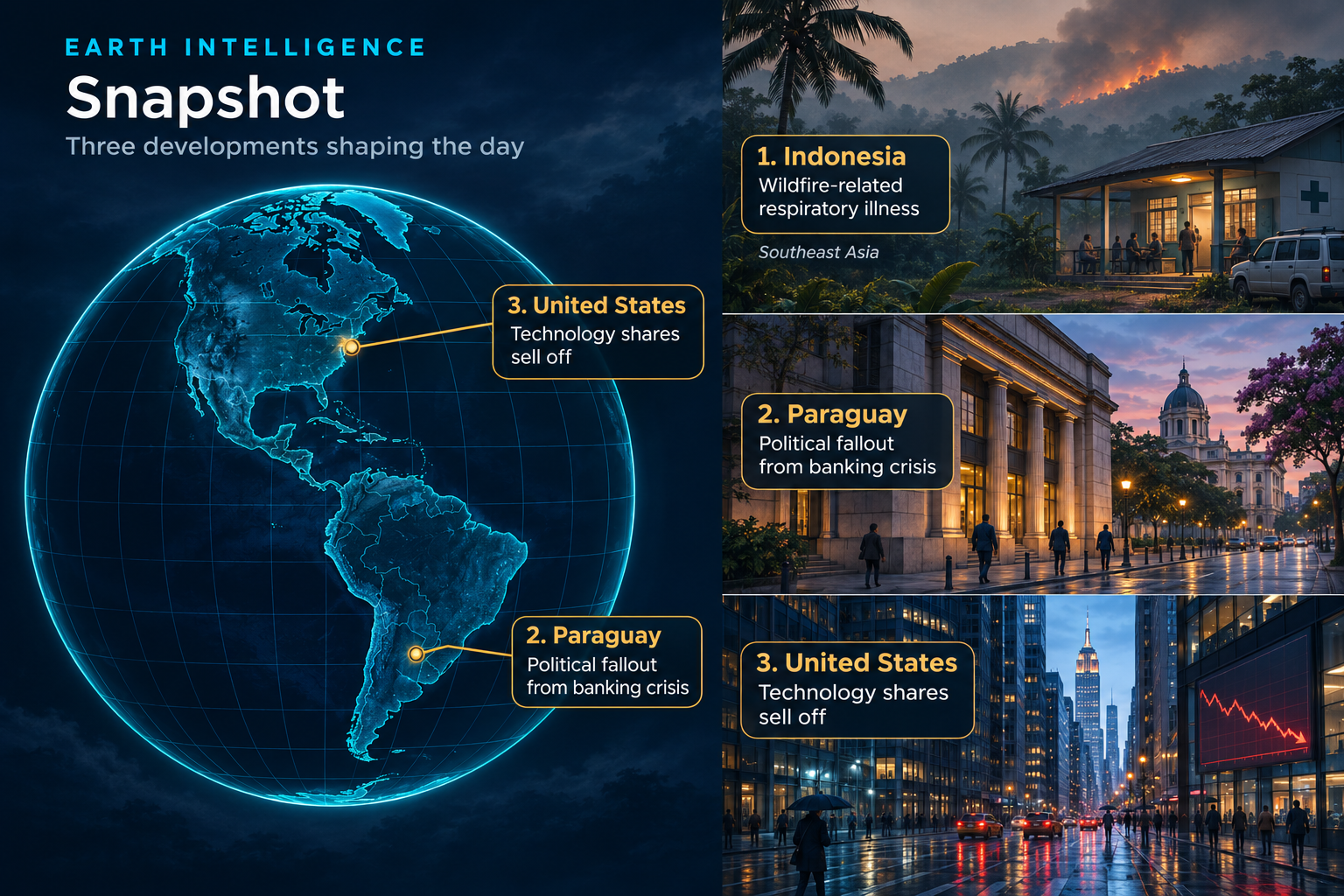
November 4, 2026 — Indonesia’s Health Ministry reported 401,586 acute respiratory infections linked to forest and land fires across seven provinces and 63 districts, including 3,906 new cases.
November 5, 2026 — President Santiago Peña resigned in Paraguay after Ueno Bank’s collapse froze savings and unpaid wages for millions; the lower house voted 78–0 to impeach him.
November 5, 2026 — A sell-off in U.S. artificial-intelligence data-center shares drove the S&P 500 down 4.4% and Nasdaq 5.5%, leaving Nasdaq 11.9% below its October record.
Geopolitics & Military Activity:
November 5, 2026 — Turkey’s parliament in Ankara, Turkey, ratified the Mecca defense agreement with Saudi Arabia and Pakistan, clearing the way for the three-country pact to take effect. It treats an armed attack on one member as an attack on all.
November 5, 2026 — A Saudi-led coalition said its air defenses destroyed a ballistic missile launched by Yemen’s Houthi armed group toward the Medina region, Saudi Arabia. The coalition reported no damage or casualties; the Houthis denied targeting Medina.
November 5, 2026 — South Korea decided to expand its Cheonghae naval unit’s mission to waters south of Oman, adding surveillance and mine-clearing equipment to protect merchant shipping. Seoul said the unit will remain outside the Strait of Hormuz.
November 5, 2026 — Ukraine’s embassy in Washington, United States, said it is seeking talks to renew U.S.-provided access to Starshield, SpaceX’s military satellite network, before the contract ends in mid-2027. Ukraine said speed limits last month disrupted some drone missions; the cause was not explained.
Economics & Markets:
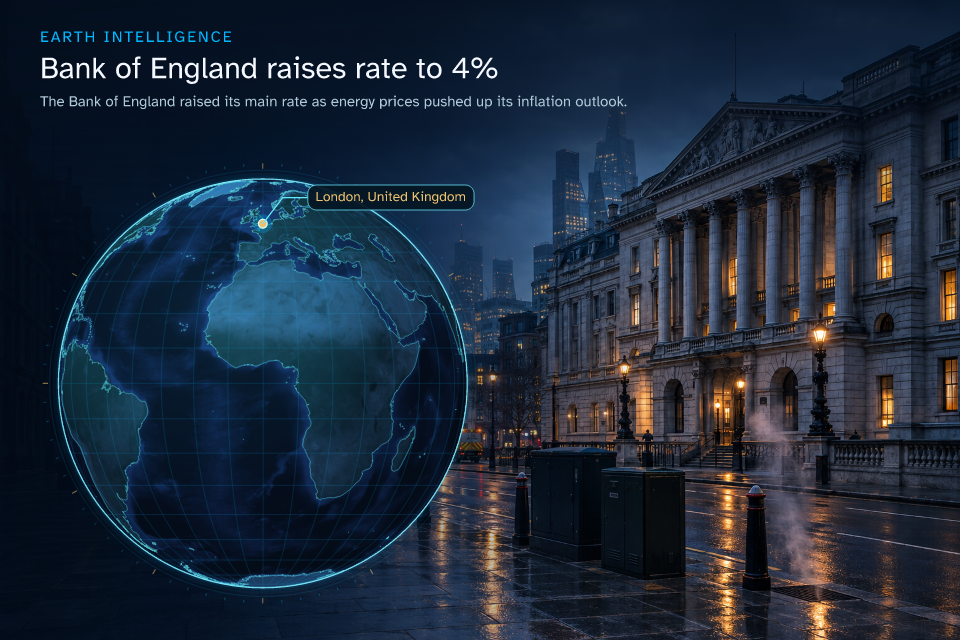
November 5, 2026 — The Bank of England raised its main interest rate from 3.75% to 4% in London, United Kingdom, by an 8–1 vote after higher energy prices lifted its inflation forecast to about 5% by mid-2027. The bank said energy costs will keep feeding into household and business bills.
November 5, 2026 — The Canadian government released Budget 2026 in Ottawa, Canada, proposing to combine the Business Development Bank of Canada and Export Development Canada into one development bank and seed a C$25-billion Canada Strong Fund. Both proposals still need transition work or legislation before they take effect.
November 5, 2026 — The World Bank released a report in Washington, D.C., United States, showing developing countries’ external debt rose 5.5% to a record $9.4 trillion in 2025. It said high borrowing costs could leave the poorest countries with less money for essential public investment.
Asset
Price
As of (Eastern)
🇺🇸 Apple
344.31 USD/share
Nov 5, 2026, 7:35 PM EST
🇺🇸 NVIDIA
181.595 USD/share
Nov 5, 2026, 7:34 PM EST
🇺🇸 Microsoft
535.65997 USD/share
Nov 5, 2026, 7:34 PM EST
🇺🇸 Alphabet
281.72 USD/share
Nov 5, 2026, 7:35 PM EST
🇺🇸 Amazon
260.51001 USD/share
Nov 5, 2026, 7:33 PM EST
🇹🇼 TSMC
352.029999 USD/share
Nov 5, 2026, 7:34 PM EST
🇸🇦 Saudi Aramco
26.16 SAR/share
Nov 5, 2026, 7:33 PM EST
🇺🇸 Meta Platforms
605.66998 USD/share
Nov 5, 2026, 7:34 PM EST
🇺🇸 Broadcom
291.38 USD/share
Nov 5, 2026, 7:33 PM EST
🇺🇸 Tesla
343.57001 USD/share
Nov 5, 2026, 7:33 PM EST
🌐 Gold
4102.37085 USD/troy ounce
Nov 5, 2026, 7:32 PM EST
🌐 Silver
52.02281 USD/troy ounce
Nov 5, 2026, 7:32 PM EST
🌐 Bitcoin
76279.94 USD/coin
Nov 5, 2026, 7:35 PM EST
🌐 Ethereum
2245.53 USD/coin
Nov 5, 2026, 7:35 PM EST
Business:
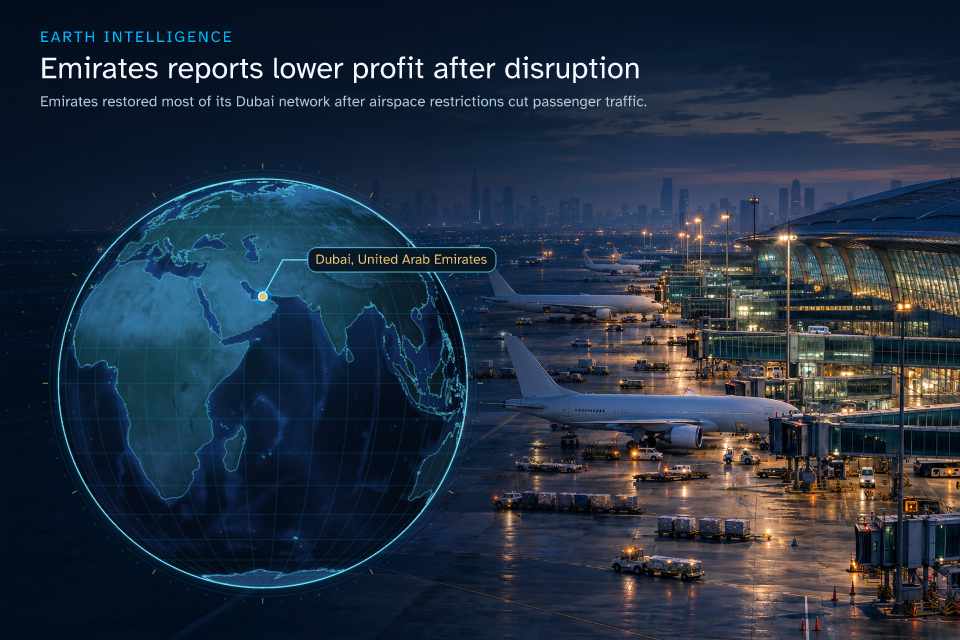
November 5, 2026 — Emirates Group, the Dubai, United Arab Emirates, airline and airport-services operator, said first-half profit fell 66% to AED 4.1 billion amid airspace limits and higher fuel costs. Its network had recovered to 91% of pre-disruption service by September 30, but passenger numbers were down 22%.
November 5, 2026 — Russian President Vladimir Putin put Japan Tobacco International’s Russian tobacco companies under a local entity’s temporary management. The order covers factories in St. Petersburg, Rostov-on-Don, Yelets and the Leningrad region, Russia; the manager’s exact identity is unclear.
November 5, 2026 — Zipline, a U.S. drone-delivery company, raised $1.5 billion to expand manufacturing and hiring. Walmart, the retailer, also agreed to add 300 planned U.S. delivery sites with Zipline; the multiyear rollout has not begun nationwide.
November 5, 2026 — Maersk, a Denmark-based shipping and logistics company, raised its 2026 profit forecast after higher freight rates and port congestion lifted third-quarter earnings. It said full vessels on some routes are limiting ship space for customers, while the Strait of Hormuz closure is hurting schedule reliability.
Politics & Society:
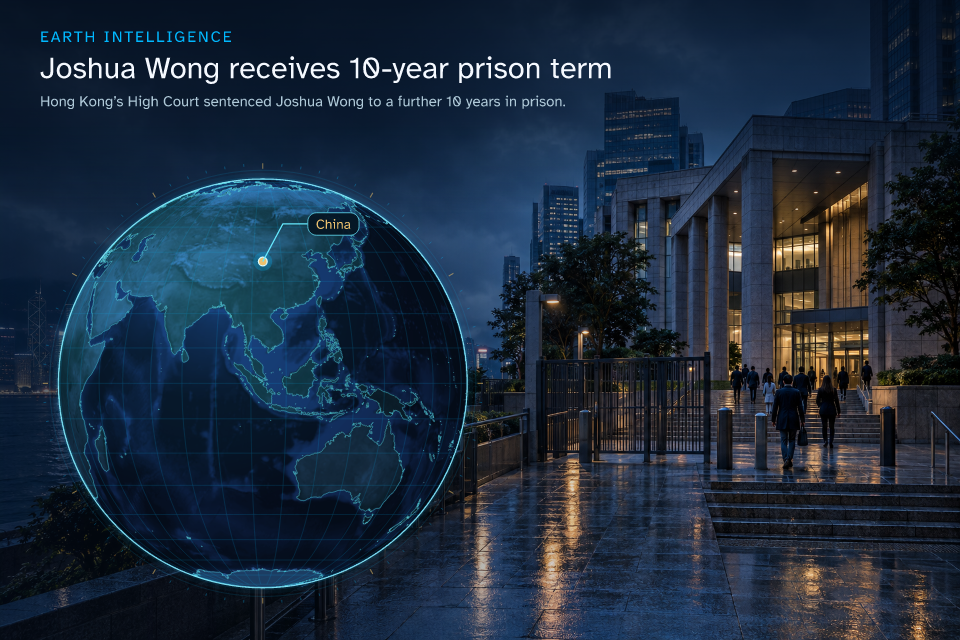
November 5, 2026 — In Hong Kong, China, a court gave pro-democracy activist Joshua Wong a further 10-year prison term under a Beijing-imposed security law, after he pleaded guilty to conspiring with foreign forces. He had been due for release in January from an earlier case.
November 5, 2026 — French trade unions, including CGT, held a one-day strike and more than 200 demonstrations across France over pay, living costs and public services. The Interior Ministry counted more than 600,000 protesters, while CGT said nearly 1.6 million; schools and some transport were disrupted.
November 5, 2026 — An Abuja, Nigeria, Federal High Court voided former Vice President Atiku Abubakar’s presidential candidacy after ruling that the African Democratic Congress’s leadership was invalid. The party, one of the main opposition groups, said it would appeal before January’s election.
Environment & Weather:
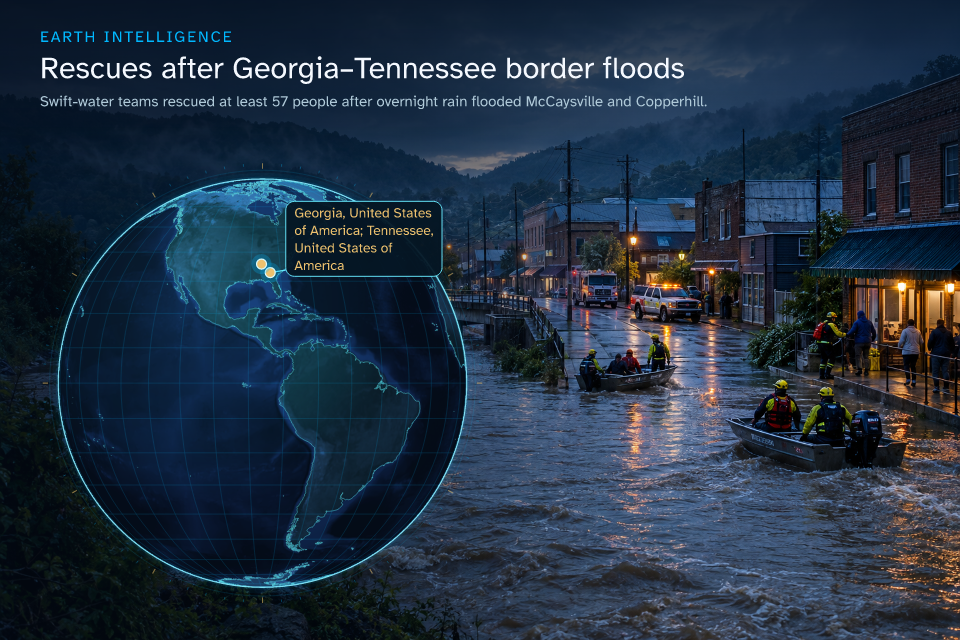
November 5, 2026 — Swift-water crews rescued at least 57 people after overnight rain flooded McCaysville, Georgia, and Copperhill, Tennessee, United States. McCaysville declared an emergency and restricted entry while crews checked flooded homes and streets.
November 5, 2026 — Karnataka Chief Minister D.K. Shivakumar released ₹17.43 crore in first drought payments in Bengaluru, India, to 106,462 farmers in Yadgir district. Each received ₹2,500; another ₹2,500 is planned after eligibility checks and funding.
November 4, 2026 — California’s State Water Resources Control Board approved a permit letting the proposed Sites Reservoir near Maxwell, United States, take and store Sacramento River water. The 1.5-million-acre-foot reservoir remains proposed; investment and construction choices still lie ahead.
Cyber:
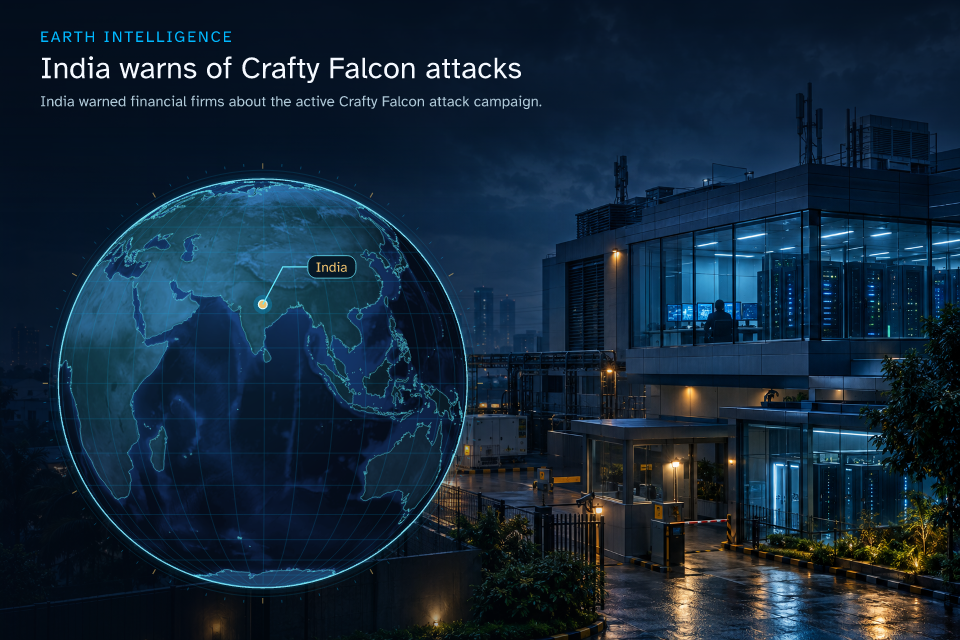
November 4, 2026 — India’s CERT-In, the national cyber agency, named the active threat actor Crafty Falcon in a campaign against Indian lenders, payment firms and cryptocurrency exchanges. CERT-In says successful break-ins used payment systems for unauthorized transfers and continued after incomplete fixes.
November 5, 2026 — The United States Treasury sanctioned 46 people and companies tied to the Prince Group criminal network, which it says supports online fraud, money laundering and human trafficking. The measures block U.S.-linked property and generally bar U.S. transactions with the targets.
November 5, 2026 — OpenAI released GPT-6 Cyber to a select group of approved security teams for authorized testing. OpenAI says it found 81 serious Firefox flaws and produced 948 Linux exploits in controlled research; Mozilla has fixed many Firefox flaws, while Linux patches are under review.
November 5, 2026 — Chainalysis, a blockchain-analysis company, said an attacker exposed information linked to all platform users, including password hashes and active tokens. It shut several services after suspicious activity; the attacker is unidentified, and the company has not said what data each user lost.
Science & Technology:
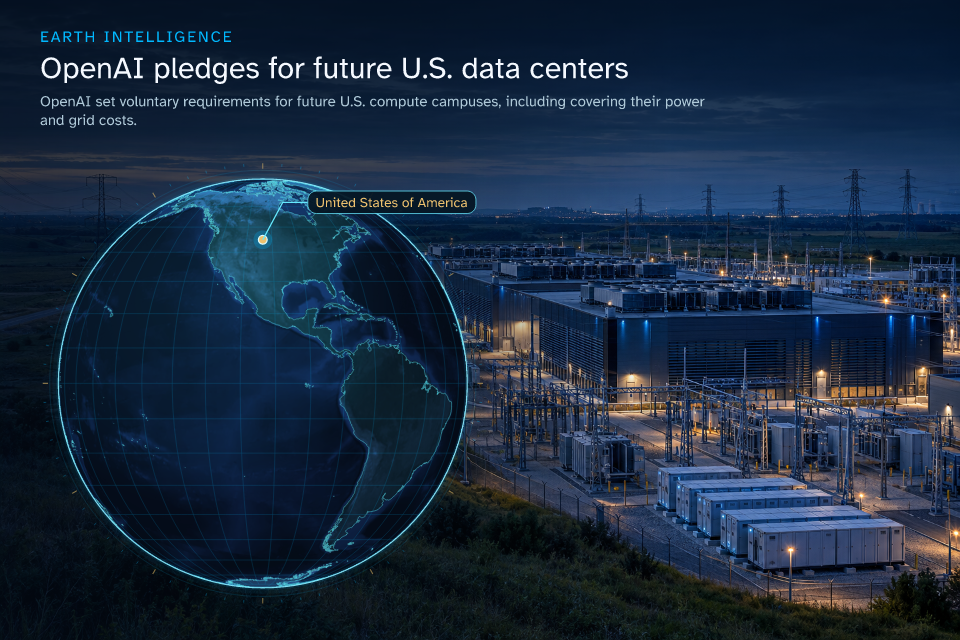
November 5, 2026 — OpenAI, the AI company, set voluntary rules for future United States data centers it owns: it says it will cover electricity and grid costs, publish local water and noise data, and guarantee funding if a project changes.
November 5, 2026 — VAST Data, a United States AI data-infrastructure company, said 14 customers committed more than $10 billion this year and that it aligned access to over 200 exabytes of flash-memory supply through 2029 for AI systems.
November 5, 2026 — Visa, a digital-payments company, established six technology hubs at its new Paya Lebar Green center in Singapore; the site will host more than 1,500 staff developing AI, payments, cyber-security and quantum-computing tools.
November 5, 2026 — IBM, Oak Ridge National Laboratory and chipmaker AMD launched a United States research platform linking quantum hardware to powerful conventional computers to test error correction, which protects quantum calculations from noise; it has not yet reported results.
November 5, 2026 — Google Research and United States medical partners reported that an AI model using standard smartwatch sensors detected signs of high blood pressure in a 196-person United States study, but it remains exploratory and cannot diagnose patients.
Space:
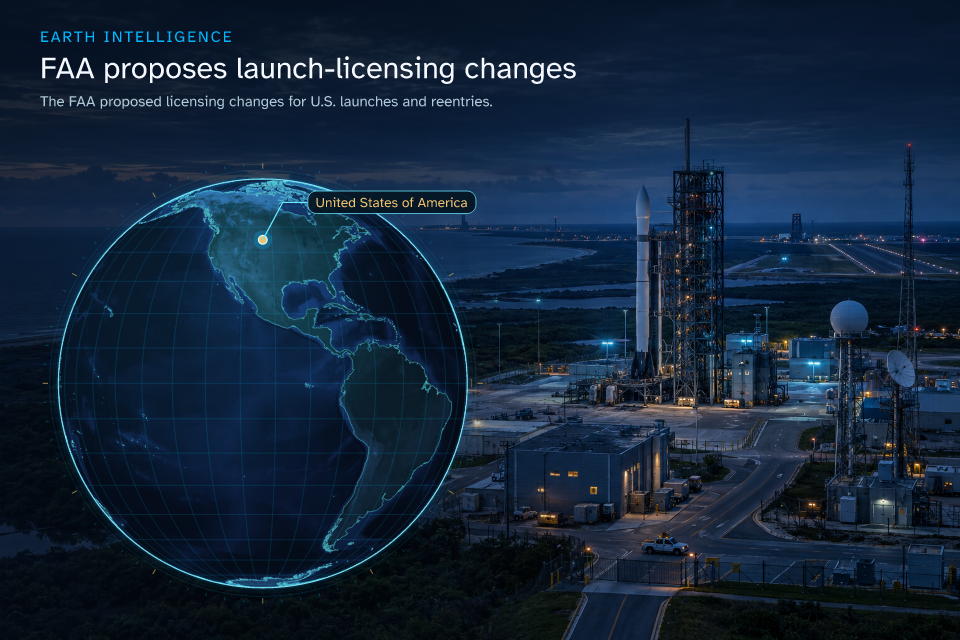
November 5, 2026 — The Federal Aviation Administration in Washington, DC, United States, proposed three changes to launch and reentry licensing and issued one minor final correction. It is hiring engineers; the proposals could speed applications, but are not final rules.
November 5, 2026 — Russia’s Cosmos 2612 military satellite approached X36, run by Finnish radar-imaging company ICEYE, in low Earth orbit in mid-October. A November 5 disclosure said two related satellites are moving toward X37’s orbital path; no collision or service loss was reported, and intent remains uncertain.
November 5, 2026 — Planet, a satellite-imaging company, opened an artificial-intelligence app that lets anyone search ten years of its Earth images in everyday language and compare changes over time. Planet says users can inspect the underlying images, and access is free for now.
November 5, 2026 — Redwire, a United States space-and-defense company, received a $20 million Defense Advanced Research Projects Agency contract for a second test of its SabreSat spacecraft in very low Earth orbit. The award funds future testing; it does not put an operational satellite into service.
Trends:
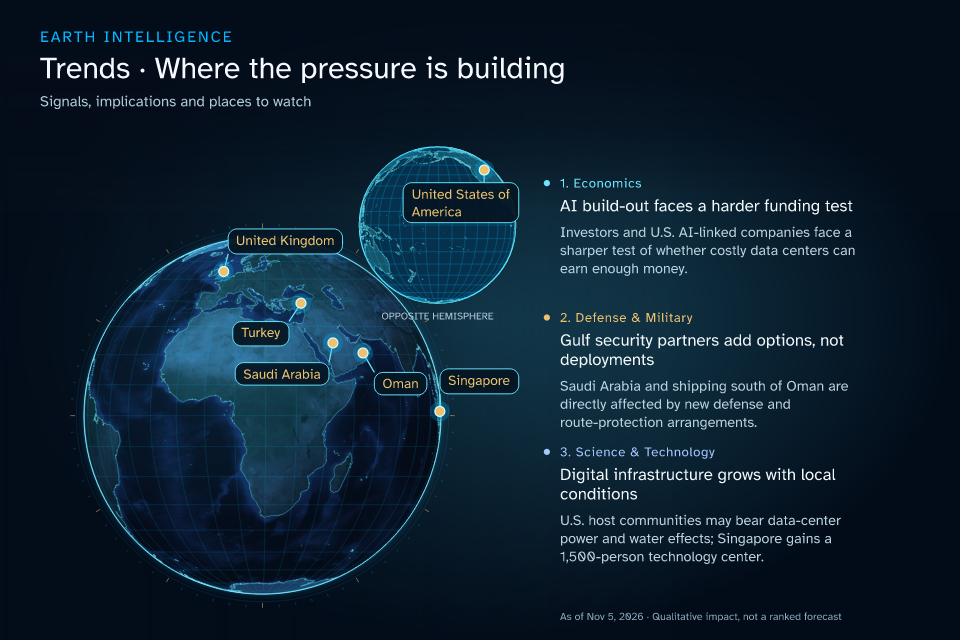
Wall Street’s AI-stock sell-off in New York, United States, shows investors questioning when data-center spending will pay back; it affects shareholders and companies seeking funding, not everyday services. Turkey approved a defense pact with Saudi Arabia and Pakistan, while South Korea widened shipping protection near Oman; these steps add options, not automatic deployments. OpenAI set rules for future U.S. campuses as Visa opened Singapore technology hubs, mixing expansion with local commitments.
What to watch: Watch whether New York, United States, AI companies cut spending or find cheaper funding after Wall Street’s drop. Watch whether Turkey’s pact or South Korea’s mission leads to approved deployments. Watch whether OpenAI’s U.S. promises become site agreements and Visa’s Singapore hubs deliver working tools.
Statistic of the Day:
Employer compensation costs for civilian workers in the United States were 3.4 percent higher in the 12 months ending September 2026.
Compensation includes wages, salaries and employer-paid benefits such as health insurance. The figure shows employers’ average cost per hour worked was 3.4 percent higher than a year earlier; it does not measure workers’ take-home pay.
History of Quantum error correction:
Quantum error correction protects fragile quantum information by spreading it across several quantum bits, or qubits. It grew from a theoretical answer to noise—the random disturbances that spoil quantum states—into a central requirement for machines meant to run long, accurate calculations.
1982: Physicist Richard Feynman argued that computers using quantum effects could simulate nature more directly than ordinary machines. The proposal treated quantum states as information, while leaving their extreme sensitivity unsolved.
1994: Peter Shor showed that a quantum algorithm could factor large whole numbers efficiently. That raised the promise of quantum computing but also sharpened a basic obstacle: small disturbances could ruin long calculations.
1995: Shor described a nine-qubit code that could find and repair a limited error without directly reading the original quantum state. Linked qubits could keep enough extra information to recover one damaged state.
1998: A team led by David Cory demonstrated quantum error correction using liquid-state nuclear magnetic resonance, which reads atomic nuclei. The experiment stabilized a state, but its signal would need much higher polarization for a net improvement.
2024: Google Quantum AI reported surface-code memories in which adding qubits reduced logical errors, meeting the key below-threshold condition. It was a research milestone, not a general-purpose computer; useful systems still need many protected qubits and reliable operations.
Image of the Day:
Thanks for reading! Earth is complicated, we make it simple.