Thursday☕️🌎


Trending:
- July 22, 2026: The U.S. House of Representatives passed the Stop Insider Trading Act, banning members of Congress, their spouses, and dependent children from purchasing individual stocks in publicly traded companies while requiring a 7-day public notice before any sales and increasing penalties for violations.

- The bill allows lawmakers to keep existing holdings and trade mutual funds or ETFs, but it was paired with unrelated voter ID requirements that drew Democratic opposition for not covering the executive branch; it now heads to the Senate, where its prospects are uncertain.
Economics & Markets:
- July 22, 2026: Alphabet reported Q2 revenue of $119.8–$120 billion, up 24% year-over-year and beating Wall Street estimates of around $117 billion.

- Google Cloud revenue jumped 82% to roughly $24.8 billion, driven by strong AI demand, while free cash flow turned negative at -$5.9 billion due to heavy AI infrastructure spending projected to reach $190 billion for the year.
Geopolitics & Military Activity:
- July 22, 2026: A tanker was struck by a projectile in the Red Sea and is currently on fire, with the crew fighting the blaze. The incident occurred about 70 nautical miles southwest of Al Shuqaiq near Saudi Arabia’s coast and the Bab al-Mandab Strait, shortly after the Houthis announced they had closed the strait to Saudi traffic.
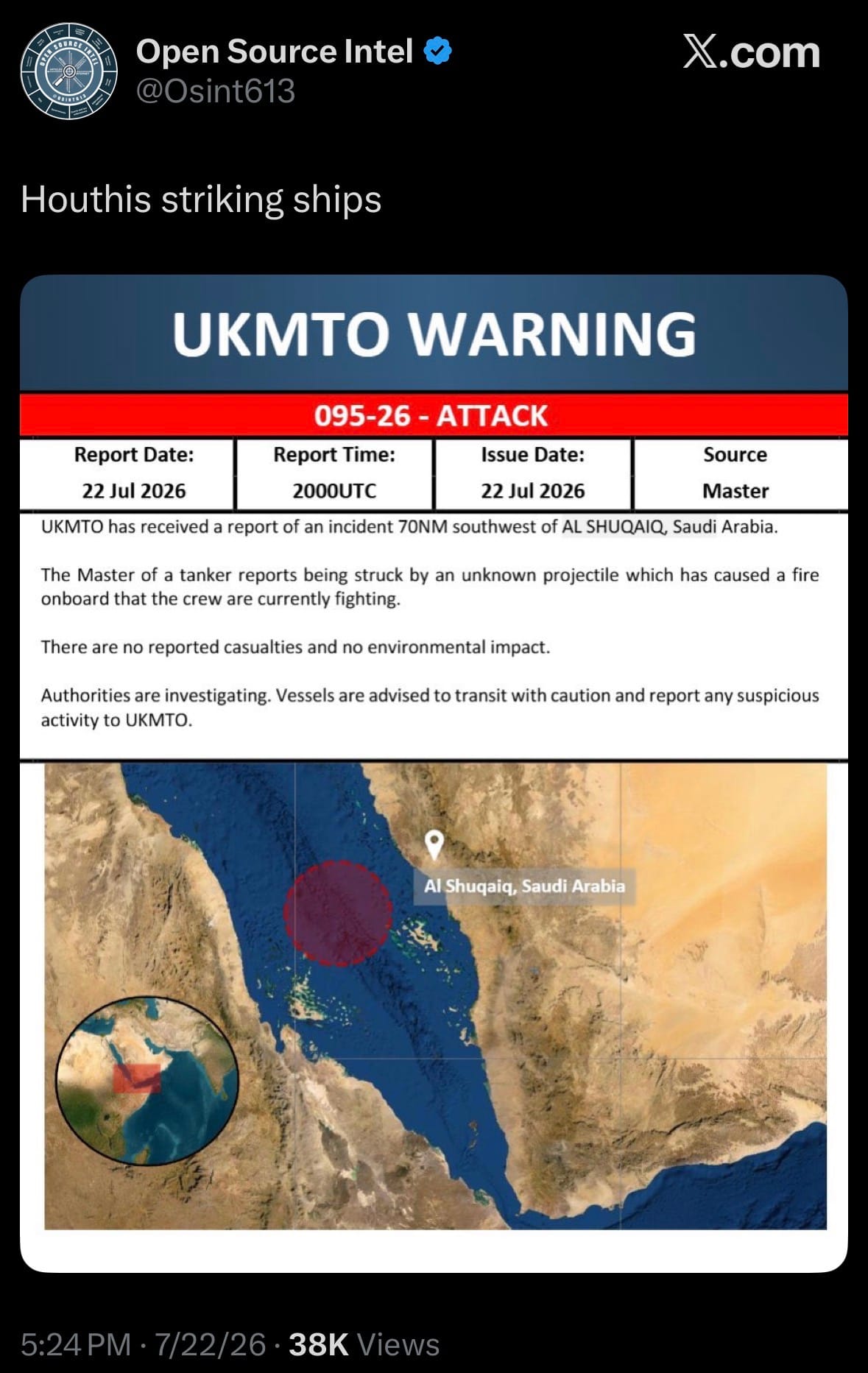
- UK Maritime Trade Operations has issued warnings for vessels in the area.
Science & Technology:
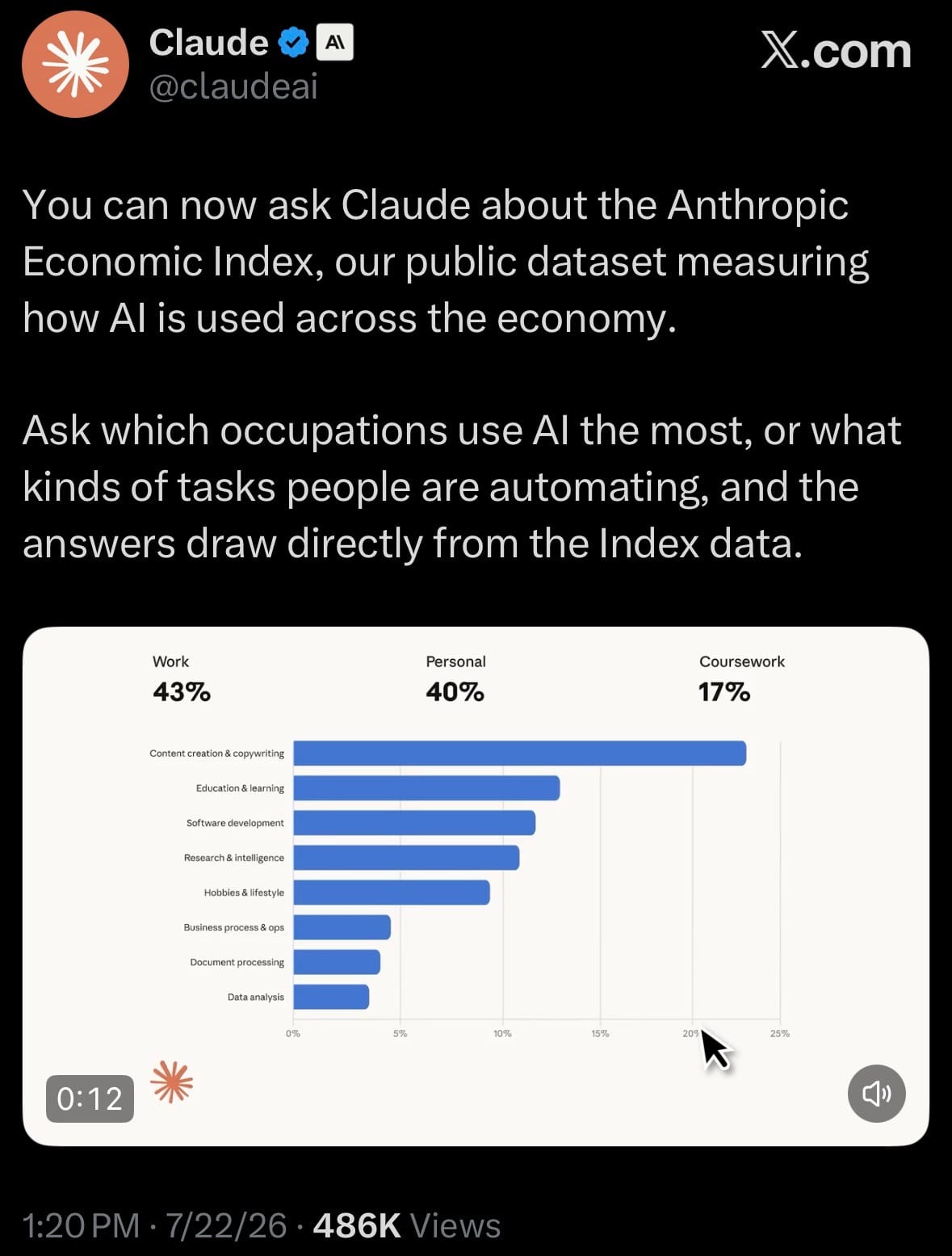
- Anthropic added a new capability to Claude allowing users to query the Anthropic Economic Index — its public dataset tracking real-world AI adoption across the economy.
Statistic:
- Largest assets on Earth by market capitalization:
- 🥇 Gold: $28.679T
- 🇺🇸 NVIDIA: $5.136T
- 🇺🇸 Apple: $4.786T
- 🇺🇸 Alphabet (Google): $4.172T
- 🥈 Silver: $3.372T
- 🇺🇸 Microsoft: $2.899T
- 🇺🇸 Amazon: $2.633T
- 🇹🇼 TSMC: $2.184T
- 🇺🇸 Broadcom: $1.887T
- 🇸🇦 Saudi Aramco: $1.713T
- 🇺🇸 Meta Platforms (Facebook): $1.592T
- 🇺🇸 SpaceX: $1.518T
- 🇺🇸 Tesla: $1.404T
- ₿ Bitcoin: $1.323T
- 🇰🇷 Samsung: $1.158T
- 🇺🇸 Micron Technology: $1.083T
- 🇺🇸 Berkshire Hathaway: $1.055T
- 🇺🇸 Eli Lilly: $1.037T
- 🇺🇸 Vanguard S&P 500 ETF: $983.58B
- 🇺🇸 JPMorgan Chase: $925.61B
- 🇺🇸 AMD: $900.62B
- 🇺🇸 iShares Core S&P 500 ETF: $881.89B
- 🇰🇷 SK Hynix: $879.87B
- 🇺🇸 Walmart: $870.05B
- 🇺🇸 SPDR S&P 500 ETF: $788.95B
- 🇳🇱 ASML: $692.09B
History:
- The United States Department of State is the nation’s oldest executive department, established on July 27, 1789, as the Department of Foreign Affairs under the newly adopted U.S. Constitution. Congress created the department to manage diplomacy, negotiate treaties, and represent the United States abroad. Just two months later, on September 15, 1789, it was renamed the Department of State and given additional domestic responsibilities, including maintaining the Great Seal of the United States, publishing federal laws, managing the national archives, and issuing certain government commissions. Thomas Jefferson became the first Secretary of State in 1790, helping define the department’s early role in shaping American foreign policy. During the nation’s first century, the department was instrumental in negotiating major territorial expansions, including the Louisiana Purchase (1803), the Adams-Onís Treaty (1819) that transferred Florida to the United States, the Oregon Treaty (1846) with Britain, and the Treaty of Guadalupe Hidalgo (1848) following the Mexican-American War. Throughout the 1800s, American diplomats expanded diplomatic missions overseas, protected U.S. citizens abroad, negotiated trade agreements, and represented U.S. interests as the country emerged as a growing international power. Many domestic responsibilities originally assigned to the department were gradually transferred to newly created agencies, allowing it to focus primarily on diplomacy and foreign affairs.
- During the 20th century, the Department of State became one of the central institutions of American national security and global leadership. Following the Spanish-American War (1898) and America’s growing international influence, the department rapidly expanded its diplomatic network. After World War I, it participated in international peace negotiations, although the United States never joined the League of Nations. Following World War II, the department played a leading role in creating the United Nations (1945), the Marshall Plan (1948) to rebuild Western Europe, the North Atlantic Treaty Organization (NATO) in 1949, and the postwar international system that shaped global politics for decades. During the Cold War, Secretaries of State including Dean Acheson, Henry Kissinger, George Shultz, James Baker, Madeleine Albright, Colin Powell, Hillary Clinton, John Kerry, Mike Pompeo, Antony Blinken, and Marco Rubio each influenced major diplomatic initiatives ranging from nuclear arms control and détente to Middle East peace efforts, NATO expansion, counterterrorism, sanctions, and strategic competition with China and Russia. The department has also overseen countless treaty negotiations, international economic agreements, humanitarian programs, crisis diplomacy, and diplomatic responses to conflicts around the world. Its global presence expanded to more than 270 embassies, consulates, and diplomatic missions, making it one of the world’s largest diplomatic organizations.
- Today, the Department of State serves as the United States’ primary foreign affairs and diplomatic agency. Led by the Secretary of State, who serves as the President’s chief foreign policy advisor, the department negotiates treaties, manages diplomatic relations, coordinates with foreign governments, protects U.S. citizens overseas, issues passports and visas, oversees foreign assistance programs, promotes American businesses abroad, supports international security partnerships, and represents the United States in organizations such as the United Nations, NATO, the G7, the G20, the Organization of American States, and many other international institutions. It also administers economic sanctions alongside the Treasury Department, coordinates humanitarian assistance, manages public diplomacy and educational exchange programs such as the Fulbright Program, monitors human rights, responds to international crises, and helps evacuate Americans during wars or natural disasters. The department works closely with the White House, Department of Defense, Central Intelligence Agency (CIA), National Security Council, Department of Homeland Security, Treasury Department, USAID, and U.S. embassies worldwide to coordinate American foreign policy. Today, its primary focus includes strategic competition with China and Russia, supporting allies and security partnerships, addressing conflicts in Europe and the Middle East, cybersecurity, emerging technologies such as artificial intelligence, global health, energy security, counterterrorism, nonproliferation, and maintaining the diplomatic relationships that underpin U.S. national security and international influence.
Image of day:

Thanks for reading! Earth is complicated, we make it simple.
- Download our mobile app:



Click below to view our previous newsletters:
Support/Suggestions Email:
support@earthintel.io