Thursday☕️🌎


Trending:
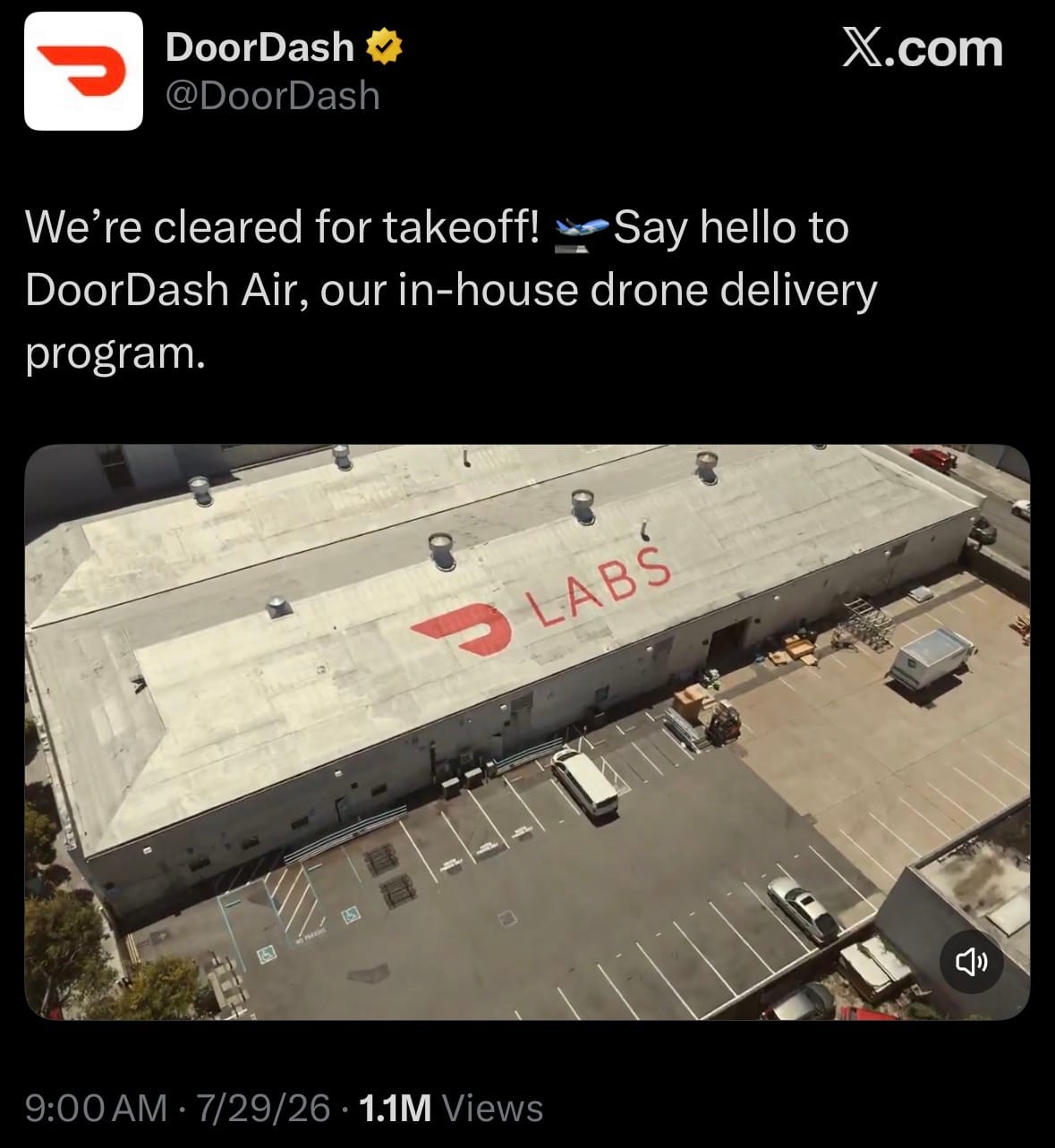
- Yesterday, DoorDash announced DoorDash Air, its new in-house drone delivery program, after receiving FAA Part 135 air carrier certification that allows it to operate commercial drone deliveries in the United States. Developed by DoorDash Labs, the company will design and build its own drones to handle mid-range deliveries alongside its existing human Dashers, sidewalk robots, and partner drone services, with commercial operations expected to begin later this year.
- July 29, 2026: President Trump unveiled plans and renderings for a major overhaul of Washington Dulles International Airport (IAD), backed by more than $20 billion in investment (some reports cite $22.5 billion) in partnership with the Metropolitan Washington Airports Authority and United Airlines.

- The project will add or renovate over 5 million square feet, modernize terminals, expand the AeroTrain system, eliminate the old “people mover” shuttles, and significantly improve the passenger experience.
Geopolitics & Military Activity:
Science & Technology:
- July 29, 2026: xAI announced Grok Voice Think Fast 2.0, its next-generation real-time voice model featuring stronger speech reasoning, significantly better transcription accuracy (especially in noisy conditions and across 24 languages), faster responses (0.70 seconds to first audio), more natural full-duplex conversations, and improved tool-use reliability for complex workflows.
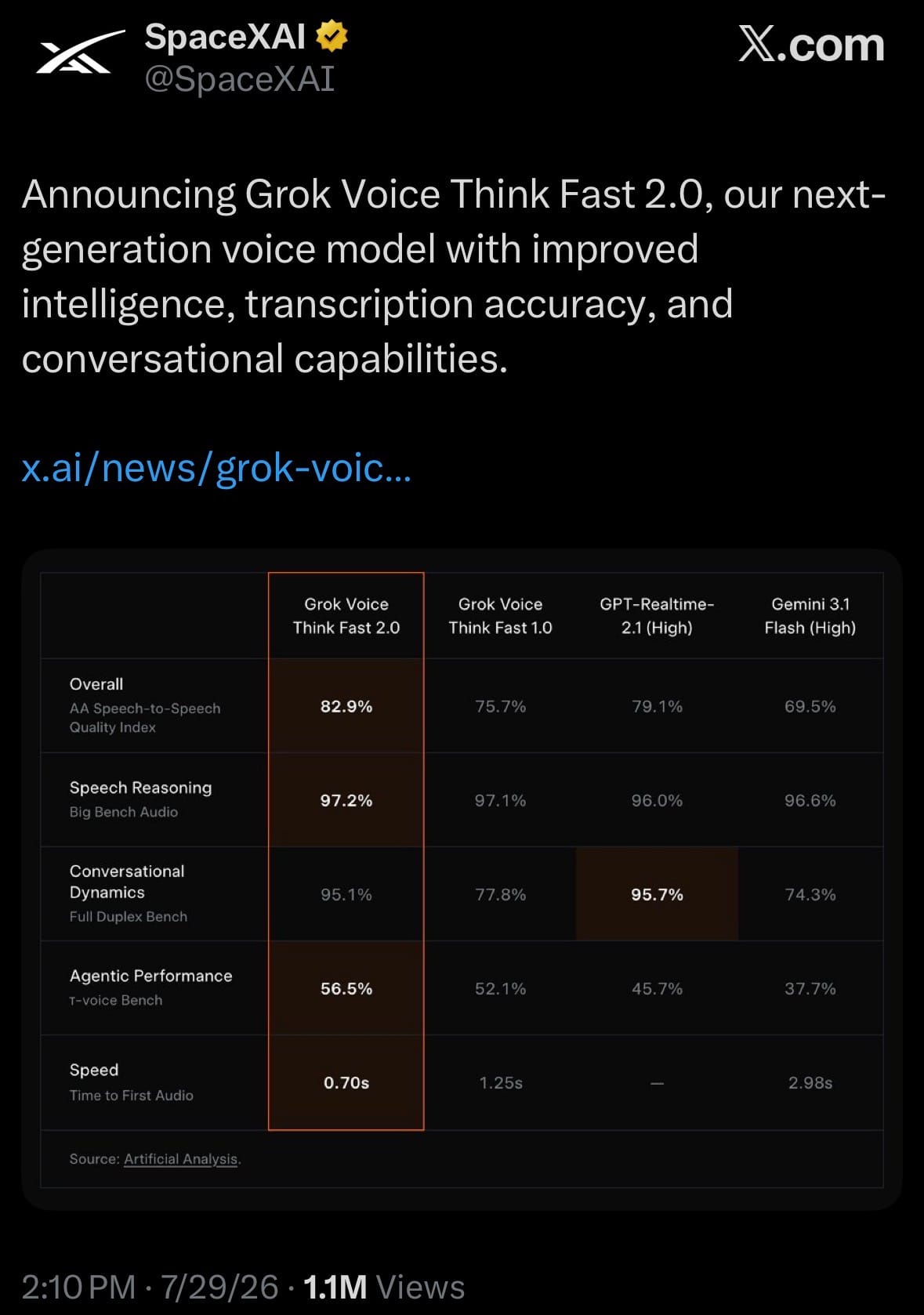
- The model is now accessible via the xAI API and Voice Agent Builder at $0.08 per minute of audio, meaning developers can programmatically integrate it into their own apps, phone systems, or custom voice agents rather than only using it inside the Grok app.
Space:
- July 29, 2026: China successfully launched the Tianlian-3-01 (Tianlian III-01) data relay satellite at 11:50 UTC aboard a Long March-7A rocket from the Wenchang Spacecraft Launch Site in Hainan.
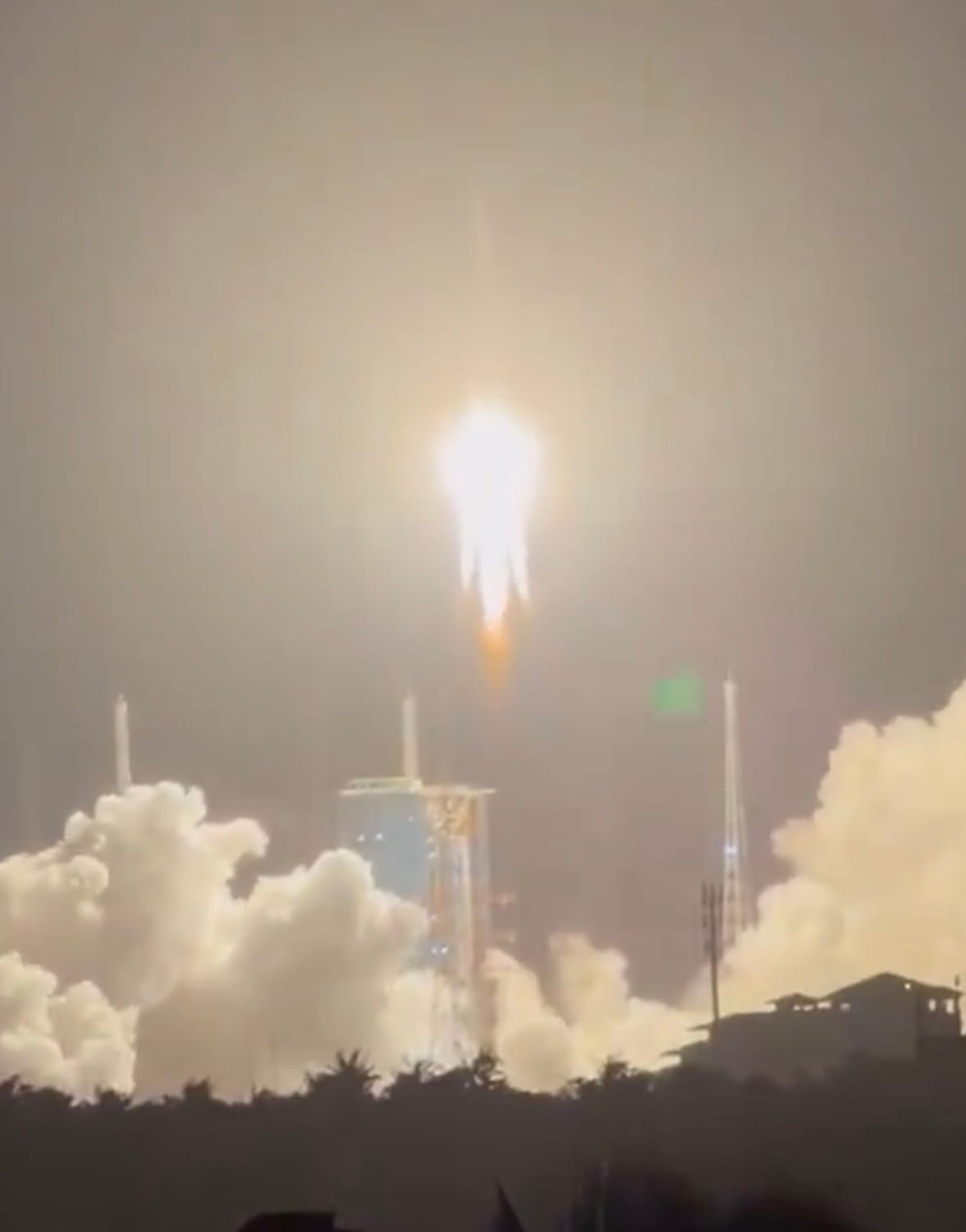
- The third-generation satellite will provide data relay and telemetry, tracking, and command (TT&C) services for China’s crewed spacecraft, space stations, and medium- and low-Earth-orbit satellites, marking the 659th flight of the Long March series.

Statistic:
- Largest public insurance companies by market capitalization:
- 🇺🇸 UnitedHealth: $381.93B
- 🇩🇪 Allianz SE: $185.61B
- 🇨🇳 China Life Insurance: $164.76B
- 🇨🇳 Ping An Insurance: $145.54B
- 🇨🇭 Chubb: $140.36B
- 🇺🇸 Progressive: $127.90B
- 🇨🇭 Zurich Insurance Group: $112.79B
- 🇫🇷 AXA: $104.64B
- 🇭🇰 AIA: $102.68B
- 🇯🇵 Tokio Marine: $97.50B
- 🇺🇸 Marsh & McLennan: $94.29B
- 🇺🇸 Elevance Health: $81.53B
- 🇺🇸 Travelers: $81.13B
- 🇬🇧 Aon: $80.55B
- 🇺🇸 The Cigna Group: $78.42B
- 🇩🇪 Munich RE: $76.66B
- 🇮🇹 Generali: $74.74B
- 🇨🇦 Manulife Financial: $73.15B
- 🇺🇸 Allstate: $70.63B
- 🇺🇸 Arthur J. Gallagher & Co.: $69.09B
- 🇺🇸 MetLife: $62.42B
- 🇧🇪 KBC: $58.61B
- 🇨🇦 Great-West Lifeco: $57.72B
- 🇨🇭 Swiss Re: $48.80B
- 🇨🇳 People’s Insurance Company (PICC): $48.57B
History:
- China’s modern space program grew directly from its missile program. After the establishment of the People’s Republic of China in 1949, scientist Qian Xuesen, who had worked in the United States and helped establish the Jet Propulsion Laboratory, returned to China in 1955 and became a central figure in Chinese rocketry. China created the Fifth Academy of the Ministry of National Defense in 1956, developed the Dong Feng missile family, and began planning satellites after the Soviet Union launched Sputnik. On April 24, 1970, a Long March 1 rocket successfully placed Dong Fang Hong 1 into orbit, making China the fifth country to independently launch a satellite. Progress was slowed by political disruption, limited resources, and the Cultural Revolution, but China continued developing communications, reconnaissance, weather, and recoverable satellites. Its first human-spaceflight initiative was canceled, but Project 921, approved in 1992, created the Shenzhou spacecraft and China’s modern crewed space program. On October 15, 2003, Yang Liwei flew aboard Shenzhou 5, making China only the third country to independently place a person into orbit. China later completed its first spacewalk, tested the Tiangong 1 and Tiangong 2 laboratories, and began constructing the permanent Tiangong space station in 2021. The three-module station was completed in 2022 and now supports rotating crews, scientific experiments, spacewalks, cargo flights, and long-duration missions independent of the U.S.-led International Space Station.
- China’s fastest progress has come through a step-by-step strategy of attempting increasingly difficult missions. The Chang’e lunar program began with orbiters Chang’e 1 and Chang’e 2, followed by Chang’e 3, which made China’s first soft landing on the Moon in 2013. In 2019, Chang’e 4 became the first spacecraft ever to land on the Moon’s far side. Chang’e 5 returned approximately 1,731 grams of lunar material in 2020, making China the first country since the Soviet Union in 1976 to return Moon samples. In 2024, Chang’e 6 completed the first-ever sample return from the lunar far side. China plans additional missions to the lunar south pole, tests of resource extraction and construction, and a crewed Moon landing before 2030. It also launched Tianwen 1 in 2020, placed an orbiter around Mars, and landed the Zhurong rover in 2021. China’s broader program includes BeiDou navigation satellites, military reconnaissance systems, weather satellites, communications networks, Earth-observation spacecraft, experimental reusable vehicles, asteroid missions, planetary probes, anti-satellite weapons, and large planned broadband constellations. Compared with the United States, however, China remains behind in several important areas. It has never landed humans on the Moon, operated missions across as many planets, developed a space telescope comparable to Hubble or James Webb, or created an operational reusable launch system with the flight rate of Falcon 9. The United States also has a much longer record in human spaceflight, planetary exploration, military space operations, commercial satellite services, and international partnerships.
- Today, China is the world’s strongest space power behind the United States, but much of the current American lead comes from SpaceX. In 2025, China conducted approximately 93 orbital launch attempts, while the United States conducted roughly 193. SpaceX alone performed about 165 Falcon 9 orbital launches, meaning one American company launched far more often than the entire Chinese space sector. Without SpaceX, the remaining U.S. launch industry would have completed only about 28 launches by the same method of counting, far below China’s total. SpaceX transformed the competition through reusable Falcon 9 boosters, high-frequency launch operations, Crew Dragon, Cargo Dragon, Falcon Heavy, Starlink, national-security launches, and development of Starship. Reusing boosters dramatically lowered launch costs and allowed the United States to deploy thousands of satellites faster than China. SpaceX now carries astronauts, supplies the International Space Station, launches intelligence and military spacecraft, operates the world’s largest satellite constellation, and supports NASA’s lunar plans. China is responding by developing reusable rockets, encouraging commercial launch companies, building its own satellite constellations, expanding Tiangong, and preparing for crewed lunar missions. China may lead in selected missions and has become the only country capable of challenging the United States across nearly every major space category, but the United States still leads overall in reusable launch systems, launch frequency, satellite numbers, commercial scale, planetary science, human-spaceflight experience, military space infrastructure, and international partnerships. SpaceX is the main reason the competition is not currently much closer.
Image of the day:

Thanks for reading! Earth is complicated, we make it simple.
- Download our mobile app:



Click below to view our previous newsletters:

Support/Suggestions Email:
support@earthintel.io