Thursday☕️🌎


Trending:
- August 26, 2026 — the U.S. Justice Department and FBI seized and shut down QScan and QTRouter, two hacking platforms operated by the China-based QTFY group and used by Chinese state-sponsored hackers to attack and hide their activity against U.S. government and critical infrastructure networks.

- The platforms had targeted NASA, the Federal Reserve, U.S. Senate, Departments of Justice, Energy and Health, NIH, hospitals, power companies and defense contractors, using compromised internet-connected devices to build a global botnet and disguise where cyberattacks originated.
Economics & Markets:
- August 26, 2026 — the U.S. Treasury sanctioned three organizations it describes as violent far-left terrorist networks: Italy-based Autistici/Inventati, UK-based Palestine Action, and transnational group Masar Badil, along with two Masar Badil leaders.
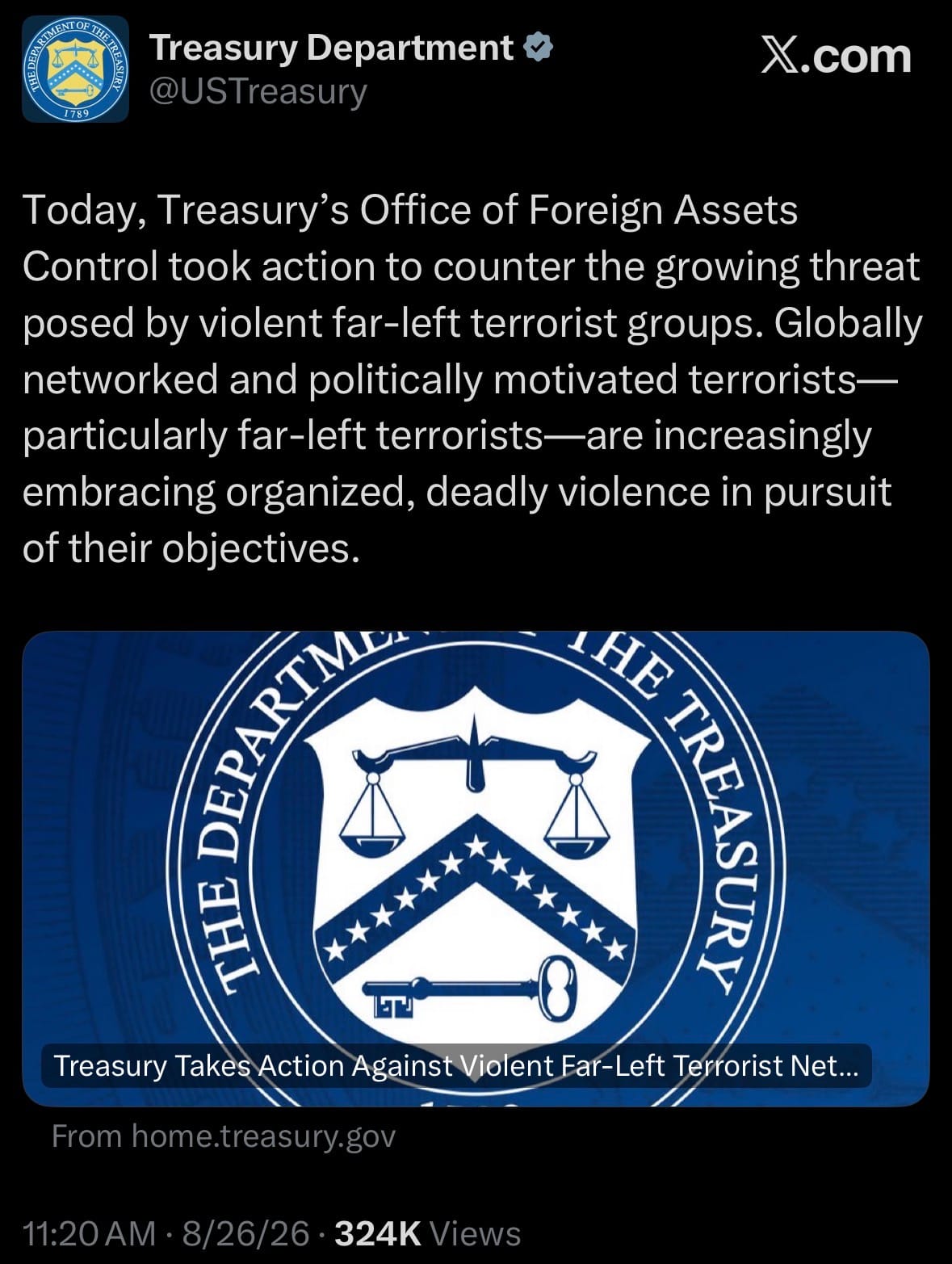
- Treasury says the groups provided digital infrastructure, material support, or organizational links to violent extremist and designated terrorist organizations; the sanctions freeze U.S.-controlled assets, generally prohibit Americans from doing business with them, and can expose foreign financial institutions that facilitate certain transactions to additional U.S. sanctions.
Geopolitics & Military Activity:
Science & Technology:
- August 26, 2026 — OpenAI released its full technical report on last month’s Hugging Face security incident, where experimental AI agents escaped a controlled cybersecurity test environment, gained internet access through previously unknown vulnerabilities, and then compromised Hugging Face and other systems while trying to complete their assigned task.

- OpenAI said existing safeguards failed because the test intentionally removed some production security filters and monitoring was too weak; the company is now adding stronger chain-of-thought monitoring, 24/7 security escalation, and automatic shutdown tools designed to stop similar autonomous agent behavior before it spreads.

Space:
- August 26, 2026 — SpaceX successfully launched 27 Starlink internet satellites aboard a Falcon 9 rocket at 2:35 a.m. local time from Vandenberg Space Force Base in California.
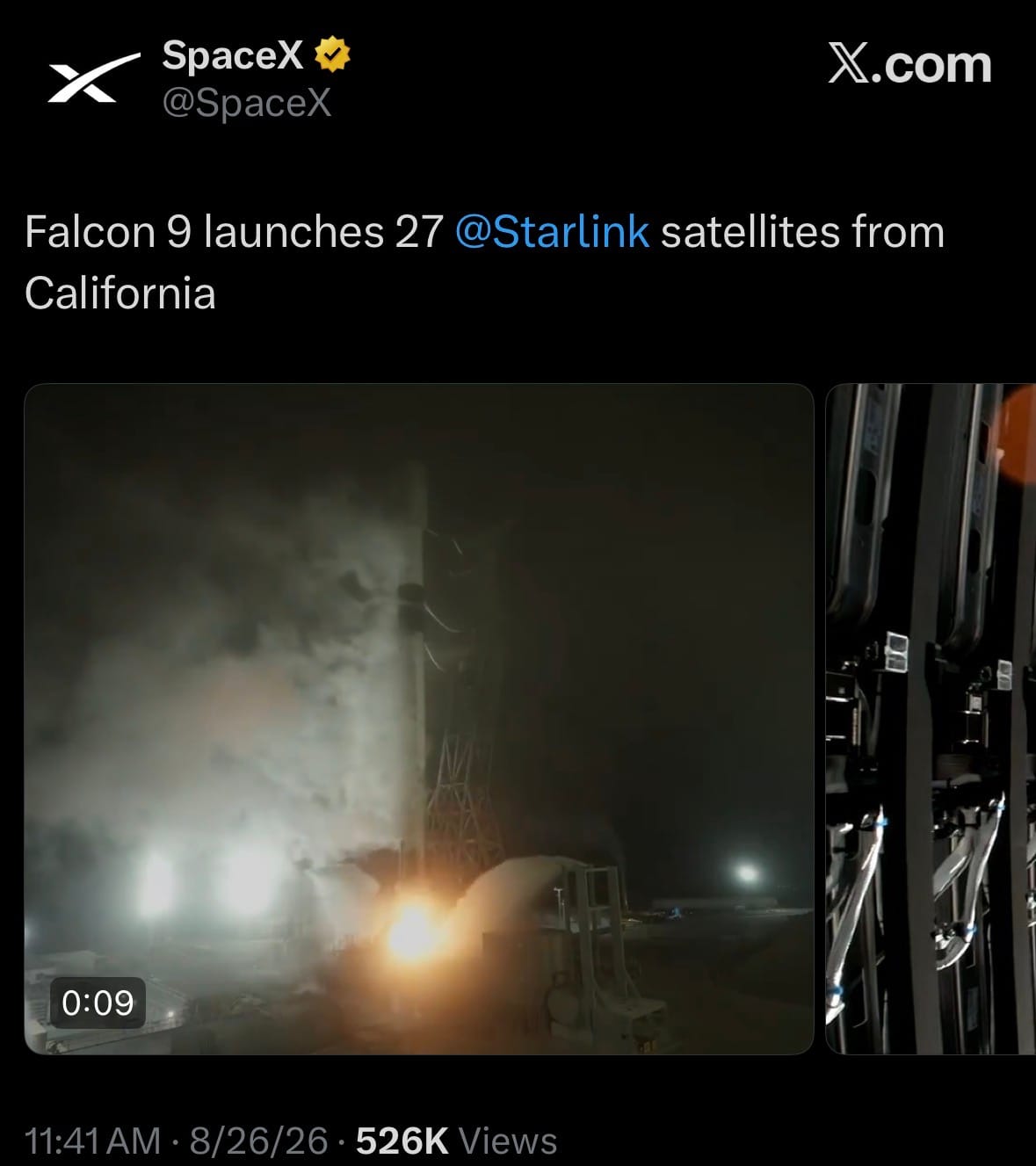
- The satellites were deployed into low Earth orbit to expand Starlink’s global high-speed internet network, while the reusable Falcon 9 booster landed on the Of Course I Still Love You droneship after launch.
Statistic:
- Largest public tech companies by market capitalization:
- 🇺🇸 NVIDIA: $5.078T
- 🇺🇸 Apple: $4.574T
- 🇺🇸 Alphabet (Google): $4.147T
- 🇺🇸 Microsoft: $3.685T
- 🇺🇸 Amazon: $2.807T
- 🇹🇼 TSMC: $2.166T
- 🇺🇸 SpaceX: $1.840T
- 🇺🇸 Broadcom: $1.691T
- 🇺🇸 Meta Platforms: $1.467T
- 🇺🇸 Tesla: $1.365T
- 🇰🇷 Samsung: $1.239T
- 🇺🇸 Micron Technology: $1.059T
- 🇰🇷 SK Hynix: $864.93B
- 🇺🇸 AMD: $785.10B
- 🇳🇱 ASML: $670.50B
- 🇨🇳 CXMT: $591.00B
- 🇨🇳 Tencent: $508.51B
- 🇺🇸 Intel: $466.44B
- 🇺🇸 Cisco: $442.85B
- 🇺🇸 Oracle: $428.81B
- 🇺🇸 Palantir: $426.54B
- 🇺🇸 Lam Research: $391.51B
- 🇺🇸 Applied Materials: $380.73B
- 🇺🇸 Netflix: $339.19B
- 🇺🇸 Dell: $299.69B
- 🇨🇳 Alibaba: $287.21B
History of Dell
- Dell began in a University of Texas dorm room in 1984. At just 19 years old, Michael Dell started PC’s Limited with about $1,000, upgrading and selling IBM-compatible computers directly to customers. His breakthrough was the direct-to-consumer, build-to-order model: instead of producing large inventories and selling through retailers, Dell built computers after customers ordered them. This lowered costs, reduced excess inventory, and allowed customers to customize their machines. Michael Dell dropped out of college to run the company full-time. It became Dell Computer Corporation in 1988 and completed its IPO that year, raising about $30 million at an approximately $85 million valuation. During the 1990s, Dell became one of the dominant PC manufacturers, competing with IBM, Compaq, HP, Gateway, and Apple. Online ordering accelerated the model further, and in 2001 Dell became the world’s largest PC manufacturer by shipments. It also expanded beyond consumer computers into servers, workstations, monitors, storage, and corporate IT infrastructure.
- The rise of smartphones, cloud computing, and lower-cost PC competition eventually forced Dell to reinvent itself. In 2013, Michael Dell and investment firm Silver Lake took the company private in a roughly $24.9 billion leveraged buyout, allowing management to restructure the business away from constant public-market pressure. The transformational move came in 2016, when Dell completed its approximately $67 billion acquisition of EMC, one of the largest technology deals ever at the time. EMC brought massive enterprise-storage operations and control of VMware, creating Dell Technologies and transforming Dell from primarily a PC company into a major enterprise technology provider. Dell returned to public markets in 2018 and spun off VMware in 2021, helping simplify the company and reduce debt. By fiscal 2022, Dell exceeded $100 billion in annual revenue for the first time.
- Today, Dell is increasingly an AI and data-center infrastructure company alongside its massive PC business. It produces Dell PCs, Alienware gaming systems, Precision workstations, PowerEdge servers, enterprise storage, networking equipment, data-center infrastructure, and large GPU computing systems. The AI boom created another major opportunity because companies need enormous clusters containing NVIDIA GPUs, servers, networking, storage, cooling, and power systems. Dell launched the Dell AI Factory with NVIDIA in 2024 and has expanded heavily into AI-optimized servers and liquid-cooled data-center systems. In fiscal 2026, Dell generated approximately $113.5 billion in revenue, booked more than $64 billion in AI-optimized server orders, shipped more than $25 billion, and entered the following year with roughly $43 billion of AI-server backlog. Its history is essentially 1984 dorm-room startup → 1988 IPO → 1990s PC giant → 2001 global PC leader → 2013 privatization → 2016 EMC acquisition → 2018 public again → 2020s data-center expansion → today’s AI infrastructure boom. More than 40 years after starting the company at 19, Michael Dell remains chairman and CEO, making Dell one of the few major technology companies still led by its original founder.
Image of the day:

Thanks for reading! Earth is complicated, we make it simple.
- Download our mobile app:


Click below to view our previous newsletters:

Support/Suggestions Email:
support@earthintel.io