Tuesday☕️🌎

Trending:
- August 17, 2026 — The U.S. Navy awarded Raytheon, an RTX company, a $22.9 billion seven-year contract to dramatically increase production of Tomahawk cruise missiles, long-range precision weapons launched from ships, submarines, and ground systems to strike targets hundreds of miles away.
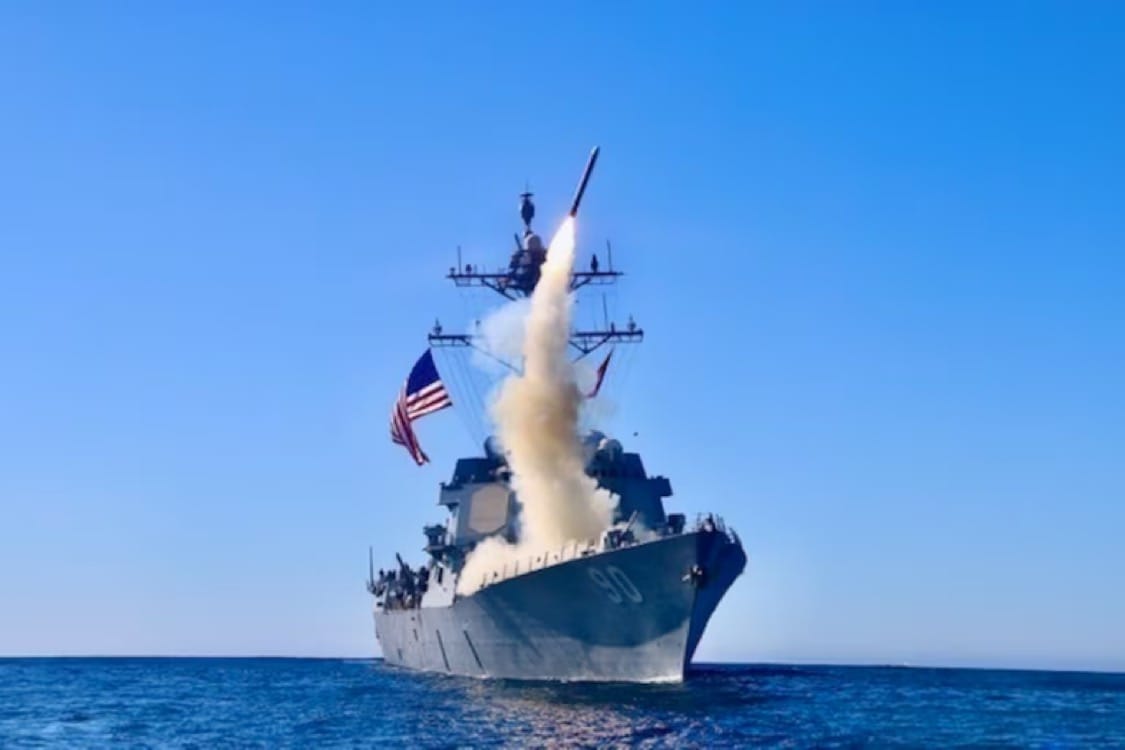
- The deal aims to raise production to more than 1,000 Tomahawks per year as the U.S. rebuilds missile stockpiles depleted by the Iran war and prepares for future conflicts; the exact number of missiles covered by the $22.9 billion contract has not been disclosed.
Foreign Academic Collaboration Audit:
- August 17, 2026 — The U.S. Department of War ordered 30 American universities and academic institutions to immediately audit their research, financial, and academic partnerships with foreign organizations considered national security risks, particularly entities in China, Russia, and Iran.
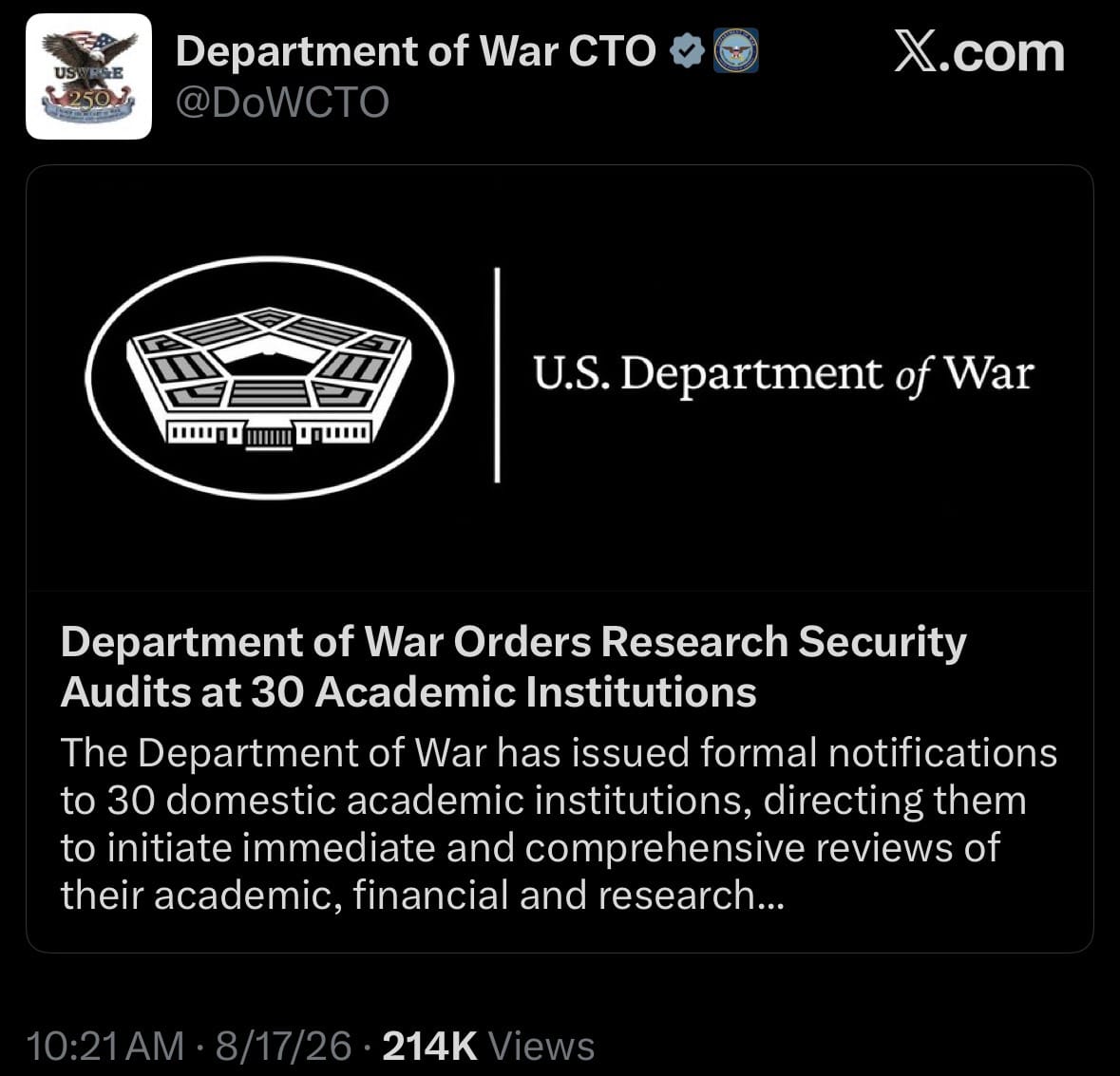
- The schools must identify any exposure of sensitive or export-controlled research and end problematic partnerships by August 31 or risk losing eligibility for future federal research funding; the Department has not publicly identified the 30 institutions.
Economics & Markets:
Science & Technology:
- August 17, 2026 — Anthropic introduced a new /design skill for Claude Code that lets developers create and edit visual UI designs directly inside Claude before turning them into working code.
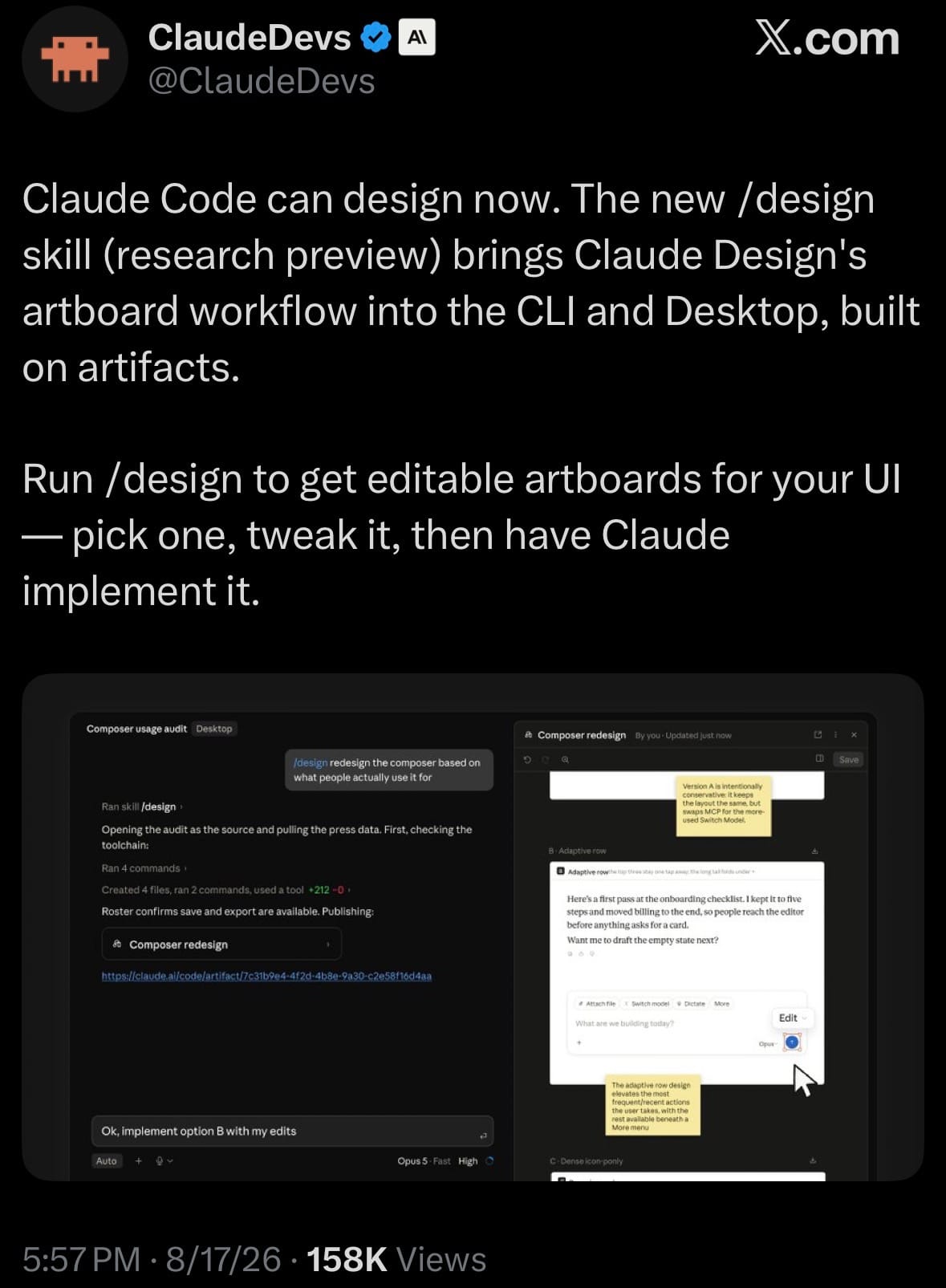
- Users can generate multiple editable artboards, choose and refine a design, then have Claude implement that exact interface, bringing design and development into a single workflow.
Space:
- August 17, 2026 — The UAE’s Satellite for Earth Observation (SEO) successfully launched at 11:02 a.m. local time aboard a Chinese Long March 2C rocket from the Taiyuan Satellite Launch Center in Shanxi, China.
- Developed through the UAE’s National Space Science and Technology Centre, the satellite will collect Earth imagery and data for environmental monitoring, natural resource management, research, and planning.
Statistic:
- Public companies ranked by trailing 12 month revenue (TTM) revenue:
- 🇺🇸 Amazon: $742.77B
- 🇺🇸 Walmart: $725.30B
- 🇸🇦 Saudi Aramco: $459.04B
- 🇺🇸 Apple: $451.44B
- 🇺🇸 UnitedHealth: $449.71B
- 🇨🇳 Sinopec: $444.74B
- 🇺🇸 Alphabet (Google): $422.49B
- 🇺🇸 CVS Health: $407.90B
- 🇨🇳 PetroChina: $407.25B
- 🇺🇸 McKesson: $403.43B
- 🇺🇸 Berkshire Hathaway: $385.68B
- 🇩🇪 Volkswagen: $364.51B
- 🇯🇵 Toyota: $334.31B
- 🇺🇸 Cencora: $328.68B
- 🇺🇸 Exxon Mobil: $326.00B
- 🇺🇸 Microsoft: $318.27B
- 🇨🇳 China State Construction Engineering: $302.86B
- 🇺🇸 Costco: $293.58B
- 🇺🇸 The Cigna Group: $276.88B
- 🇰🇷 Samsung: $270.94B
- 🇬🇧 Shell: $267.34B
- 🇹🇼 Foxconn: $261.93B
- 🇺🇸 NVIDIA: $253.49B
- 🇺🇸 Cardinal Health: $250.73B
- 🇨🇭 Glencore: $247.53B
History of the Tomahawk Missile
- The Tomahawk grew from Cold War efforts to give U.S. ships and submarines a long-range weapon capable of penetrating heavily defended territory without sending aircraft directly into danger. Earlier American cruise-missile programs included the JB-2 Loon (1944–1945), derived from Germany’s V-1, followed by systems such as Regulus, first deployed by the U.S. Navy in 1955. Modern Tomahawk development began in the 1970s as the Navy investigated a new generation of submarine-launched cruise missiles. General Dynamics won the principal development competition, producing the weapon originally designated BGM-109. Tomahawk was designed as a relatively small, jet-powered missile that could launch from ships or submarines, descend to low altitude and navigate hundreds of miles toward a target. Early versions used inertial navigation, TERCOM terrain matching and DSMAC digital scene matching, allowing the missile to compare terrain and imagery against stored reference data. Tomahawk entered operational service in 1983. Several versions followed: Tomahawk Land Attack Missile-Nuclear (TLAM-N) carried the W80 nuclear warhead; conventional TLAM-C carried a unitary warhead; TLAM-D carried submunitions; and Tomahawk Anti-Ship Missile (TASM) targeted surface vessels. The nuclear variant was eventually withdrawn, while conventional land attack became Tomahawk’s primary mission.
- Tomahawk became famous during Operation Desert Storm in 1991, when U.S. warships and submarines launched 288 Tomahawks against Iraqi command facilities, air defenses and other strategic targets, demonstrating that precision strikes could be launched from hundreds of miles away without risking pilots. Tomahawks were subsequently used in Iraq in 1993, Bosnia in 1995, Afghanistan and Sudan in 1998, Yugoslavia in 1999, Afghanistan beginning in 2001, Iraq in 2003, Libya in 2011, Syria in 2017 and 2018, and later operations against Houthi targets in Yemen. The missile continuously evolved. Block III, introduced during the 1990s, improved range and navigation with GPS. Block IV Tactical Tomahawk, operational in the 2000s, added satellite communications, mission updates and the ability to loiter or be redirected after launch. The newest Block V, introduced into the fleet beginning in 2021, modernized communications, navigation and survivability. Block Va, called the Maritime Strike Tomahawk, adds a seeker intended to attack moving ships, while Block Vb incorporates the Joint Multiple Effects Warhead System for harder and more complex land targets. The modern missile is approximately 18–20 feet long depending on configuration, weighs roughly 3,000 pounds with booster, flies at subsonic speed and has a land-attack range generally stated around 1,000 miles or more, depending on variant and mission.
- Today, Tomahawk is less a single missile than a continuously modernized weapons ecosystem involving launch platforms, targeting intelligence, mission-planning software, communications networks and multiple missile variants. RTX’s Raytheon is now the principal manufacturer after the original General Dynamics missile business changed ownership through decades of defense-industry consolidation. Tomahawks can be launched from U.S. Navy destroyers and cruisers using the Mk 41 Vertical Launching System and from attack and guided-missile submarines. The weapon has also returned to land: the U.S. Army’s Typhon/Mid-Range Capability uses ground launchers capable of firing Tomahawk and SM-6 missiles, giving land forces a long-range strike capability. The United Kingdom has operated submarine-launched Tomahawks for decades, while additional allies including Australia and Japan have moved to acquire the weapon. Tomahawk’s importance comes from its combination of long range, precision, low-altitude flight, multiple launch platforms and decades of combat experience. It is not America’s fastest missile—the United States is simultaneously developing hypersonic and newer long-range weapons—but Tomahawk remains valuable because thousands have been produced, the launch infrastructure already exists across the fleet, and the missile can continually receive upgrades. Its evolution is essentially Regulus and early cruise missiles → 1970s BGM-109 program → 1983 deployment → 1991 combat breakthrough → GPS-enabled Block III → networked Block IV → Block V land and maritime strike → today’s ship, submarine and ground-launched Tomahawk force.
Image of the day:

Thanks for reading! Earth is complicated, we make it simple.
- Download our mobile app:



Click below to view our previous newsletters:

Support/Suggestions Email:
support@earthintel.io