Tuesday☕️🌎


Trending:
- August 31, 2026 — The Pentagon added Starshield AI’s Grok for Government to GenAI.mil, its secure generative-AI platform available to more than 1.7 million Department of War personnel, joining OpenAI’s ChatGPT and Google’s Gemini.
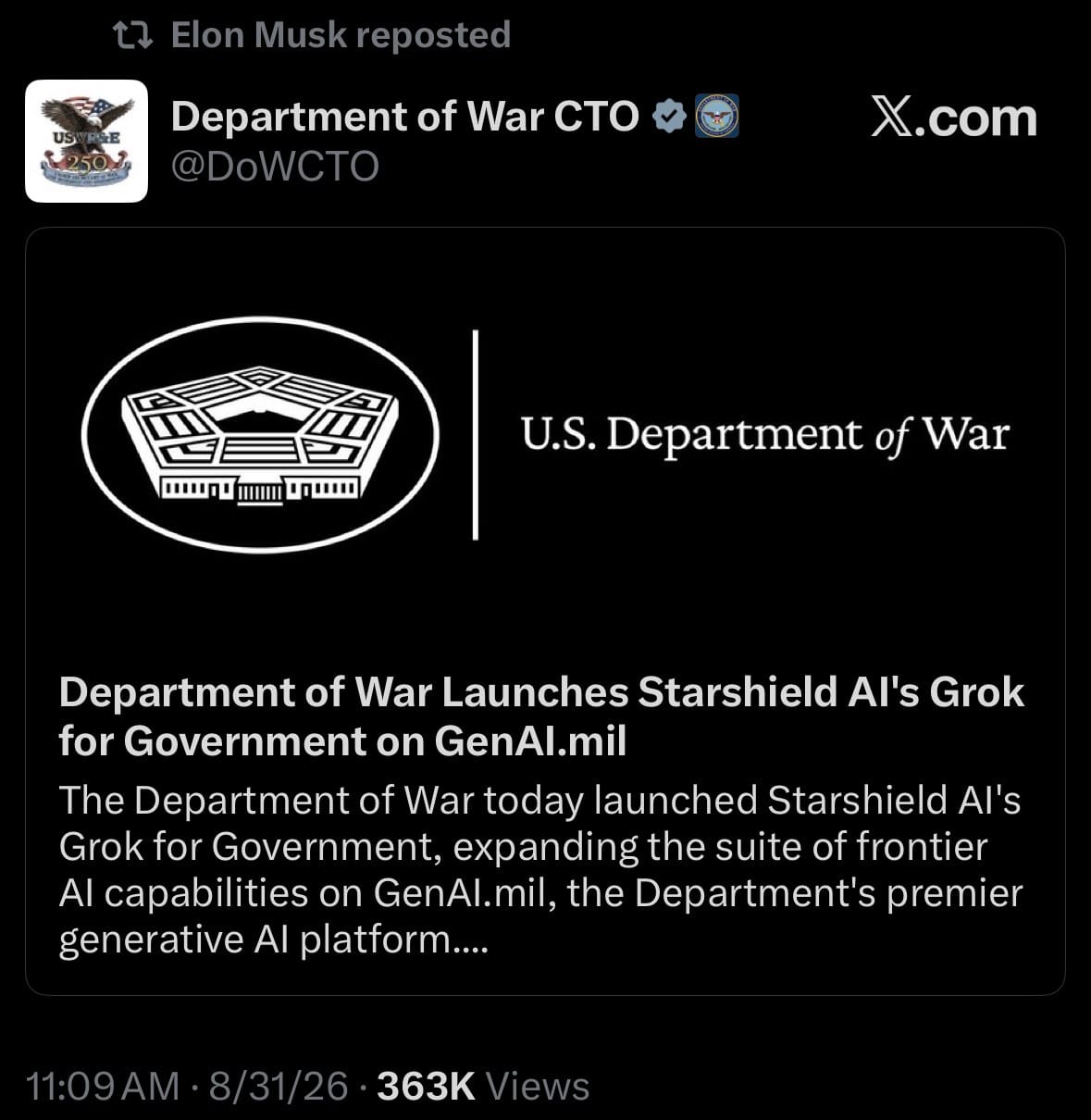
- Grok is approved to handle sensitive information and provides advanced reasoning modes, customizable workspaces, and reusable AI workflows designed to help personnel with tasks such as acquisition, logistics, research, analysis, and knowledge management while remaining separate from classified networks.
Economics & Markets:
- August 31, 2026 — UK Chancellor of the Exchequer John Healey, the government official responsible for Britain’s finances and economic policy, announced tougher enforcement of sanctions designed to increase economic pressure on Russia and the financial networks helping it evade restrictions.
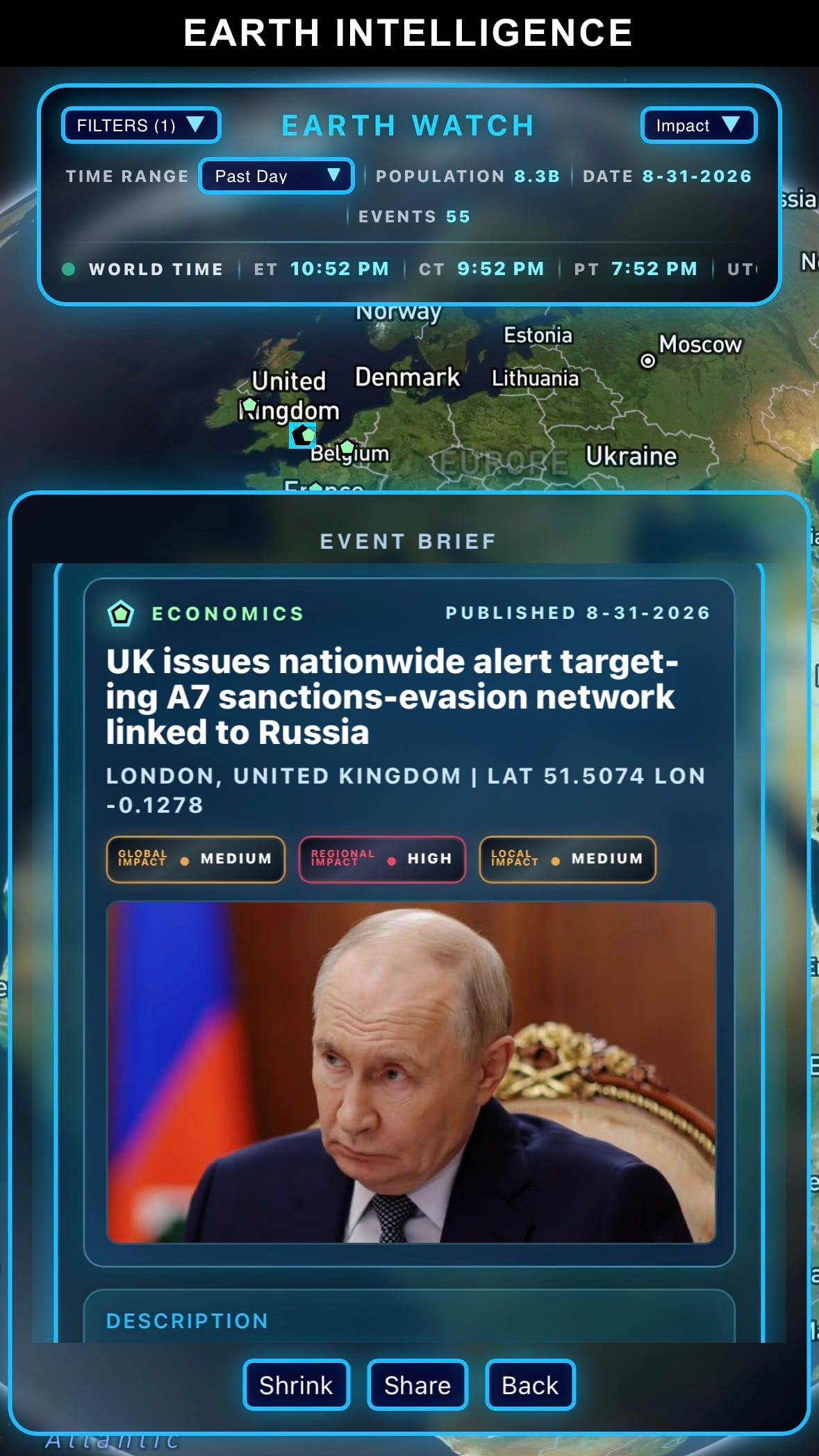
- The UK plans to double the maximum OFSI penalty from the greater of £1 million or 50% of a sanctions breach to the greater of £2 million or 100% of its value, meaning a £10 million violation could now carry a fine of up to £10 million.
Geopolitics & Military Activity:
Cyber:
- August 31, 2026 — CrowdStrike, widely regarded as one of the leading cybersecurity companies, introduced Falcon IQ, a new AI-powered system that automatically finds, prioritizes, and helps fix security vulnerabilities that previously required significant manual work.

- CrowdStrike is best known for its Falcon platform, a cloud-based security system used by organizations to continuously monitor computers, identities, cloud systems, and other infrastructure for cyberattacks and automatically detect and stop threats; Falcon has been named a Gartner endpoint-security Leader for seven consecutive years.
Science & Technology:


Statistic:
- Largest mining companies by market capitalization:
- 🇦🇺 BHP Group: $238.69B
- 🇺🇸 Southern Copper: $176.35B
- 🇬🇧 Rio Tinto: $166.70B
- 🇨🇳 China Shenhua Energy: $158.80B
- 🇨🇳 Zijin Mining: $134.54B
- 🇺🇸 Newmont: $132.82B
- 🇺🇸 Freeport-McMoRan: $108.76B
- 🇲🇽 Grupo México: $104.85B
- 🇨🇦 Agnico Eagle Mines: $102.84B
- 🇨🇭 Glencore: $97.64B
- 🇨🇦 Barrick Gold: $73.78B
- 🇨🇦 Wheaton Precious Metals: $68.50B
- 🇸🇦 Ma’aden: $68.34B
- 🇧🇷 Vale: $64.21B
- 🇬🇧 Anglo American: $61.95B
- 🇿🇦 AngloGold Ashanti: $56.80B
- 🇬🇧 Antofagasta: $53.93B
- 🇭🇰 Zijin Gold International: $53.63B
- 🇨🇦 Franco-Nevada: $50.75B
- 🇨🇳 CMOC: $46.23B
- 🇨🇦 Cameco: $43.01B
- 🇿🇦 Gold Fields: $41.31B
- 🇦🇺 Fortescue: $38.28B
- 🇨🇦 Kinross Gold: $36.39B
- 🇨🇦 Nutrien: $36.04B
EARTH INTELLIGENCE: Global Situation — September 1, 2026
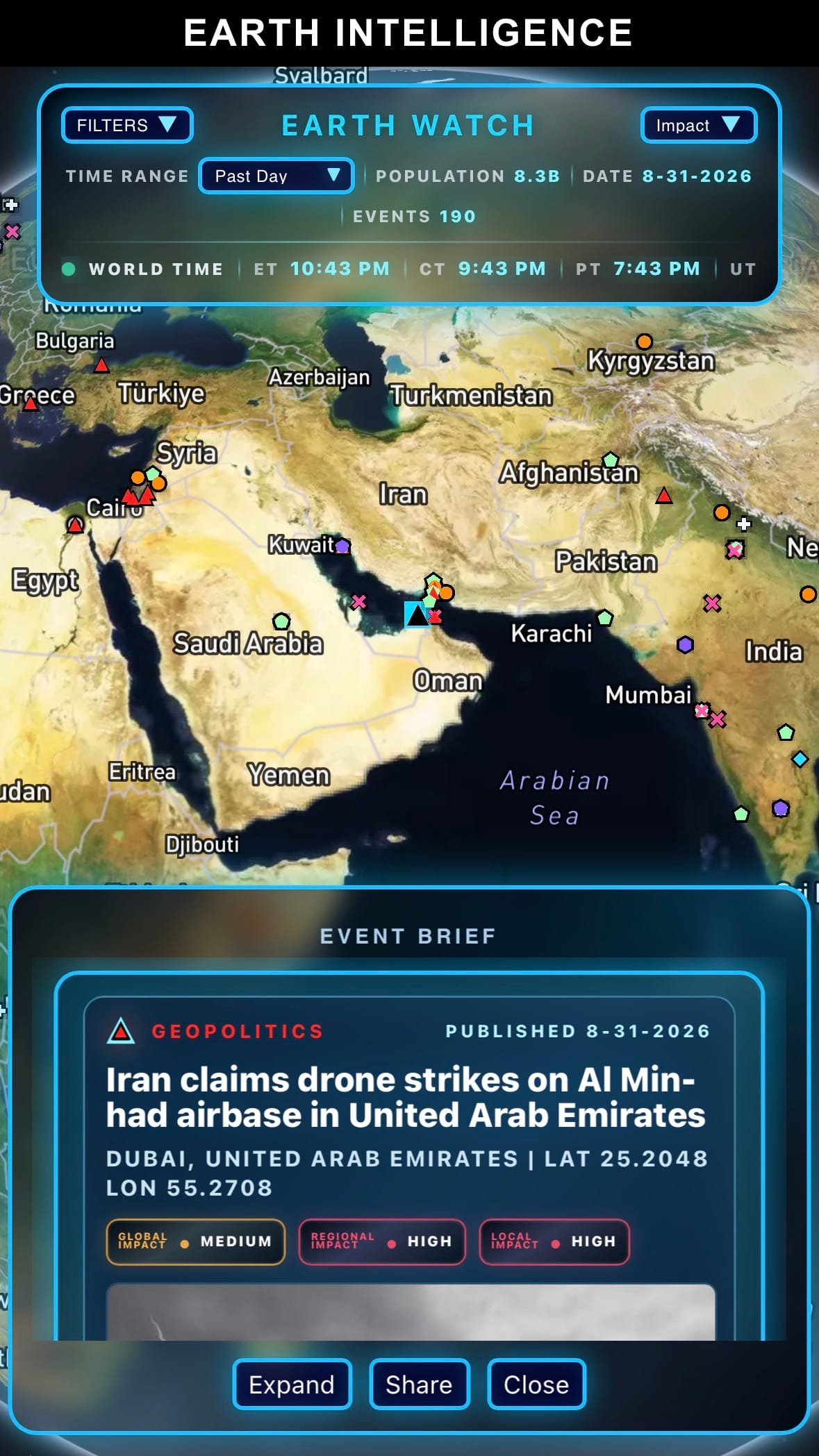
- The world’s three main geopolitical focal points remain the U.S.–Iran conflict in the Middle East, the Russia–Ukraine war, and China–Taiwan tensions. These involve the world’s largest military and economic powers and currently have the greatest influence on global security, trade, energy, and markets.
- The Middle East is having the largest direct economic impact because the Strait of Hormuz connects major oil and gas exporters including Saudi Arabia, the UAE, Qatar, Kuwait, Iraq, and Iran with global markets. China, India, Japan, and South Korea are major buyers of Gulf energy, while disruptions are affecting Asian and European gas markets and trade in fertilizer, ammonia, sulfur, petrochemicals, and other products used throughout agriculture and manufacturing.
- Russia and Ukraine remain at war without a lasting settlement, while China continues military pressure around Taiwan without moving to full-scale conflict. The U.S. remains heavily engaged in Europe and the Indo-Pacific, and Taiwan remains particularly important because of its semiconductor industry; for now, global attention remains focused on diplomacy, potential agreements, military activity, and signs that tensions are either increasing or easing.
History of the Department of War
- The department traces back to the American Revolution. In 1775, the Continental Congress created the Continental Army, appointed George Washington commander in chief, and established boards to manage weapons, supplies, troops, and military planning. After the Constitution created the new federal government, President Washington established the Department of War in 1789 to manage the Army and national military affairs. The Department of the Navy became separate in 1798 as American naval power expanded. The War Department then managed the Army through the War of 1812, Mexican-American War, Civil War, Spanish-American War, World War I, and World War II. During WWII it became enormous, overseeing the Army and Army Air Forces, millions of personnel, weapons production, logistics, bases, research, and worldwide operations. The Pentagon was built from 1941–1943 to provide a headquarters for this rapidly expanding military establishment.
- World War II showed that America’s Army, Navy, and air forces needed to operate under a unified national-defense structure. The National Security Act of 1947 replaced the old War Department with the Department of the Army, created the independent U.S. Air Force, and brought the military departments together under the new National Military Establishment and Secretary of Defense. In 1949, it was officially renamed the Department of Defense (DoD). It subsequently became the center of America’s Cold War military system—overseeing nuclear deterrence, missiles, aircraft carriers, submarines, satellites, global bases, Korea, Vietnam, and competition with the Soviet Union. The Goldwater-Nichols Act of 1986 further integrated the services around joint combatant commands. After the Cold War came the 1991 Gulf War, Afghanistan, Iraq, global counterterrorism operations, drones, cyber warfare, missile defense, AI, and autonomous weapons. In 2019, the Space Force became the newest military service as space became an increasingly important warfighting domain.
- In 2025, President Donald Trump authorized “Department of War” as a secondary title for the Department of Defense and “Secretary of War” for the Secretary of Defense, while directing work toward making the change permanent. Legally, however, federal law still establishes the organization as the Department of Defense unless Congress formally changes its statutory name. Today, the department coordinates America’s Army, Navy, Marine Corps, Air Force, and Space Force, along with worldwide combatant commands and organizations such as DARPA, DIA, NSA, the Missile Defense Agency, and Defense Logistics Agency. Its mission now extends across land, sea, air, space, cyberspace, nuclear deterrence, intelligence, missile defense, satellites, AI, autonomous systems, logistics, and military technology. The evolution is: 1775 Continental Army → 1789 Department of War → 1798 separate Navy Department → WWII/Pentagon → 1947 unified military structure → 1949 Department of Defense → Cold War global military → 1986 joint-force reforms → 2019 Space Force → 2025 Department of War secondary title → today’s global U.S. military system.
Image of the day:

Thanks for reading! Earth is complicated, we make it simple.
- Download our mobile app:


Click below to view our previous newsletters:

Support/Suggestions Email:
support@earthintel.io