Tuesday☕️🌎


Trending:
- September 14, 2026 — The U.S. military publicly acknowledged for the first time that it has “space control weapons” already operating in orbit, capable of protecting U.S. forces and potentially disrupting or attacking enemy space systems.

- The Pentagon has not revealed exactly what weapons are deployed or how many, but possible capabilities could include cyber and electronic-warfare systems, lasers and other directed-energy weapons, anti-satellite weapons, missile-based systems, or more advanced concepts such as kinetic orbital weapons.
Economics & Markets:

Geopolitics & Military Activity:
Science & Technology:
- September 14, 2026 — Lockheed Martin’s Skunk Works publicly displayed a full-scale model of its Vectis autonomous combat aircraft for the first time at the Air, Space & Cyber Conference in Maryland.
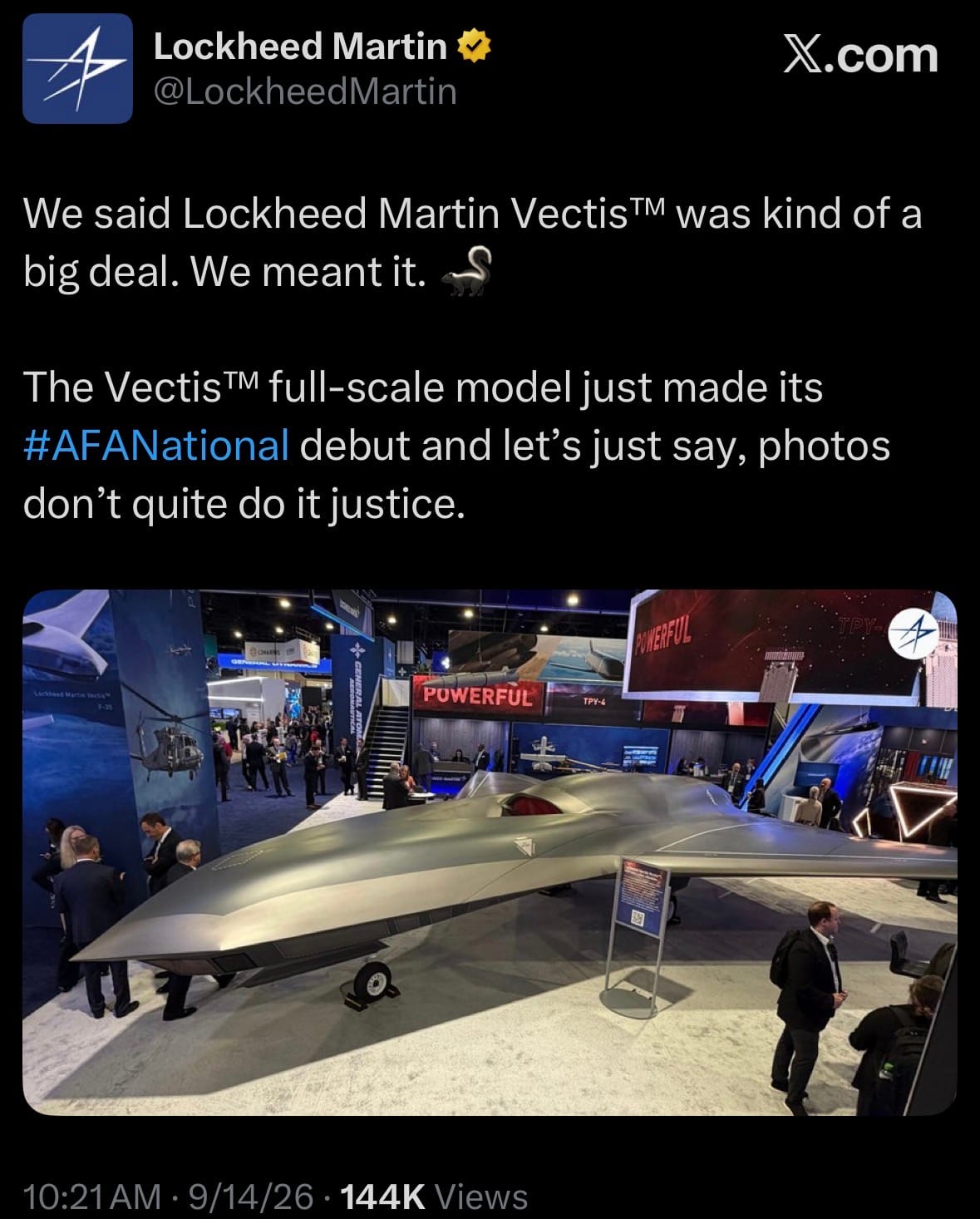
- Vectis is a stealthy unmanned aircraft designed to fly independently or alongside fighters like the F-35 for strike, surveillance, electronic warfare and air-combat missions; Lockheed is now building four additional aircraft, bringing the planned test fleet to five, with first flight targeted by the end of 2027.

Space:
- FLEX & Sentinel-3C — September 14, 2026 — Europe’s Vega-C rocket launched at 10:21 p.m. local time from Europe’s Spaceport in French Guiana, carrying two Earth-observation satellites into orbit. Sentinel-3C will monitor oceans, land, ice and the atmosphere, while FLEX will measure plant health and photosynthesis from space.

Statistic:
- Largest public hotel companies by market capitalization:
- 🇺🇸 Marriott International: $88.78B
- 🇺🇸 Hilton Worldwide: $69.90B
- 🇯🇵 Oriental Land: $32.68B
- 🇺🇸 Las Vegas Sands: $27.46B
- 🇬🇧 InterContinental Hotels Group: $22.74B
- 🇭🇰 Galaxy Entertainment: $18.07B
- 🇺🇸 Host Hotels & Resorts: $15.53B
- 🇺🇸 Hyatt Hotels: $15.42B
- 🇨🇳 H World Group: $13.26B
- 🇫🇷 Accor: $12.10B
- 🇮🇳 Indian Hotels Company: $10.93B
- 🇺🇸 MGM Resorts: $10.19B
- 🇺🇸 Wynn Resorts: $9.03B
- 🇺🇸 Ryman Hospitality Properties: $8.42B
- 🇸🇬 Genting Singapore: $5.78B
- 🇬🇧 Whitbread: $5.24B
- 🇺🇸 Wyndham Hotels & Resorts: $5.13B
- 🇺🇸 Vail Resorts: $5.00B
- 🇲🇴 MGM China Holdings: $4.83B
- 🇨🇳 Atour Lifestyle: $4.48B
- 🇺🇸 Choice Hotels International: $4.39B
- 🇭🇰 Mandarin Oriental: $4.22B
- 🇫🇷 Covivio Hotels: $3.92B
- 🇮🇱 Fattal Holdings (Leonardo Hotels): $3.83B
- 🇹🇭 Minor International: $3.65B
History of Anthropic
- Anthropic came directly out of OpenAI’s early frontier-AI team. In 2021, siblings Dario Amodei and Daniela Amodei left OpenAI alongside Tom Brown, Jack Clark, Jared Kaplan, Sam McCandlish, and Chris Olah to create Anthropic. Dario had been OpenAI’s VP of Research, while several of the other founders had worked on major language-model and scaling research. They believed increasingly powerful AI needed much greater emphasis on alignment, interpretability, reliability, and safety, so Anthropic was established as a Public Benefit Corporation with Dario as CEO and Daniela as president. Its early research included scaling laws and Constitutional AI in 2022, where models are trained to evaluate their behavior against written principles. The company was initially viewed as a safety-focused OpenAI offshoot, but quickly developed into an independent frontier laboratory with ambitions to build some of the world’s most capable models.
- Anthropic launched Claude in March 2023, putting it into direct competition with ChatGPT. Claude 2 followed that year, while Claude 3 in 2024 established the Haiku, Sonnet, and Opus families and pushed Anthropic much closer to the frontier. The company subsequently expanded beyond chat into enterprise AI, APIs, reasoning, computer use, scientific research, autonomous agents, and especially software development through Claude Code. Its growth has been backed by enormous infrastructure investment: Amazon/AWS and Google became major strategic investors and computing partners, giving Anthropic access to the huge quantities of chips, data centers, and electricity required to train frontier models. By 2026, Claude had developed into one of the strongest AI ecosystems for coding and knowledge work, and Anthropic had evolved from a seven-person group of former OpenAI researchers into one of the world’s most valuable private AI companies.
- Today, the frontier race is best understood as a group of competing laboratories rather than a definitive universal leaderboard, because rankings change depending on coding, reasoning, math, agents, multimodal performance, cost, and the benchmark being measured. As of September 2026, Anthropic and OpenAI are consistently at or near the very top across broad frontier evaluations, while xAI and Google DeepMind are major competitors; Meta and increasingly powerful Chinese laboratories such as DeepSeek, Alibaba/Qwen, and Moonshot AI also matter significantly. One current broad benchmark aggregation places Anthropic’s Claude Fable 5.1 narrowly ahead of OpenAI’s GPT-6 Astra, while other individual benchmarks can favor Grok, Gemini, or other models. Anthropic is therefore reasonably described as one of OpenAI’s closest direct competitors, particularly in coding, agents, enterprise AI, and frontier research—not as the uncontested #1 across every category. The competitive picture is roughly Anthropic ↔ OpenAI at the leading edge, with xAI and Google DeepMind among the closest major U.S. challengers, while the Chinese frontier is advancing rapidly. Anthropic’s evolution is essentially OpenAI researchers → 2021 Anthropic → 2022 Constitutional AI → 2023 Claude → 2024 Claude 3 → Claude Code/agents → massive Amazon and Google backing → 2026 frontier models → today’s Anthropic–OpenAI–xAI–Google competition for leadership in advanced AI.
Image of the day:

Thanks for reading! Earth is complicated, we make it simple.
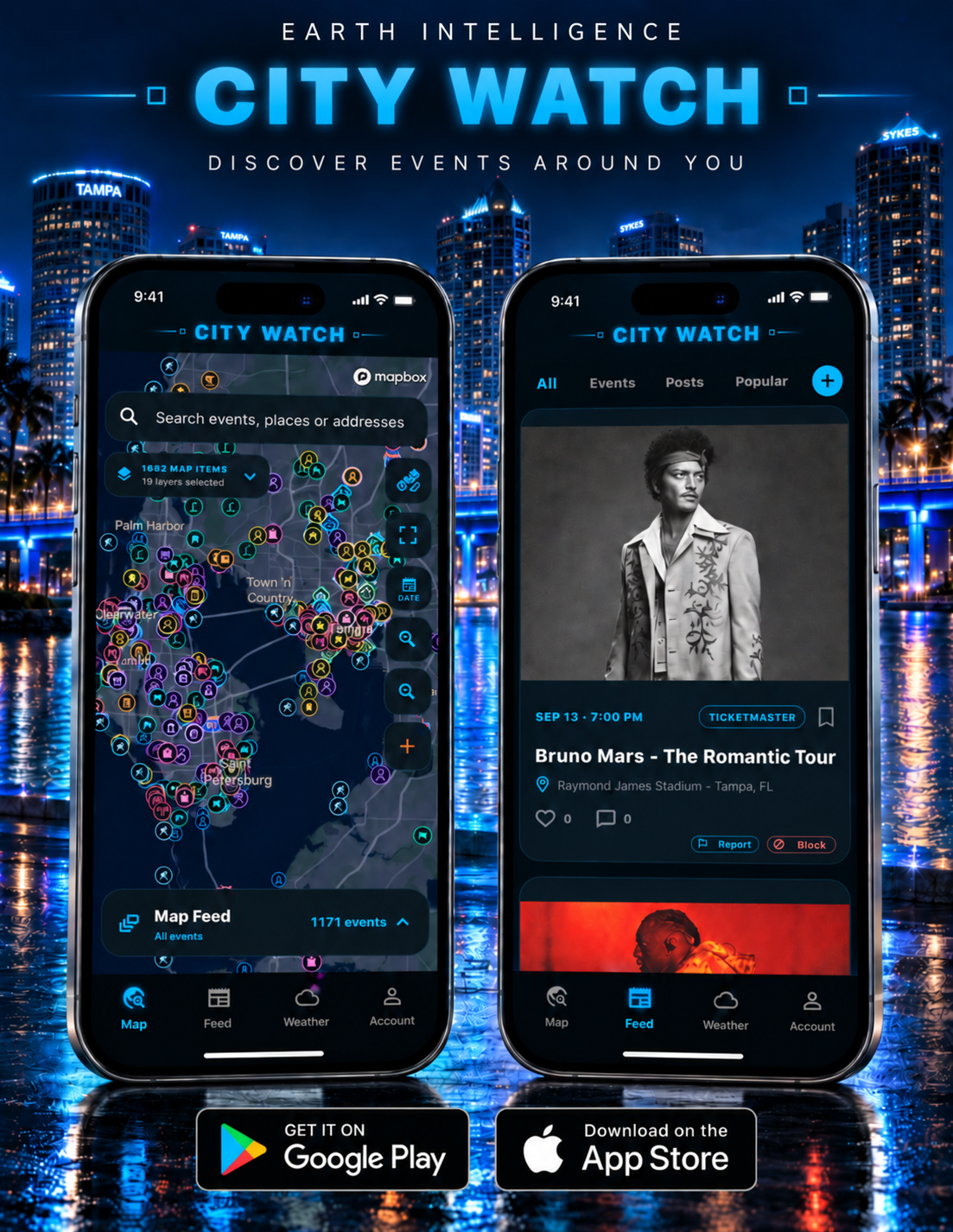
- Download our mobile app:

Click below to view our previous newsletters:

Support/Suggestions Email:
support@earthintel.io