Wednesday☕️🌎


Trending:
- July 21, 2026: France’s National Assembly approved a landmark law banning social media access for children under the age of 15, making it the first EU country to impose a nationwide age restriction on platforms like TikTok, Instagram, Snapchat, and Facebook.

- The bill requires age verification through ID, government login, or facial recognition; new accounts must comply from September 1, 2026, and existing ones by January 1, 2027.
Tesla Robotaxi:
- July 21, 2026: Tesla expanded its unsupervised Robotaxi service to Tampa and Orlando, Florida, adding two new cities to its growing autonomous ride-hailing network.
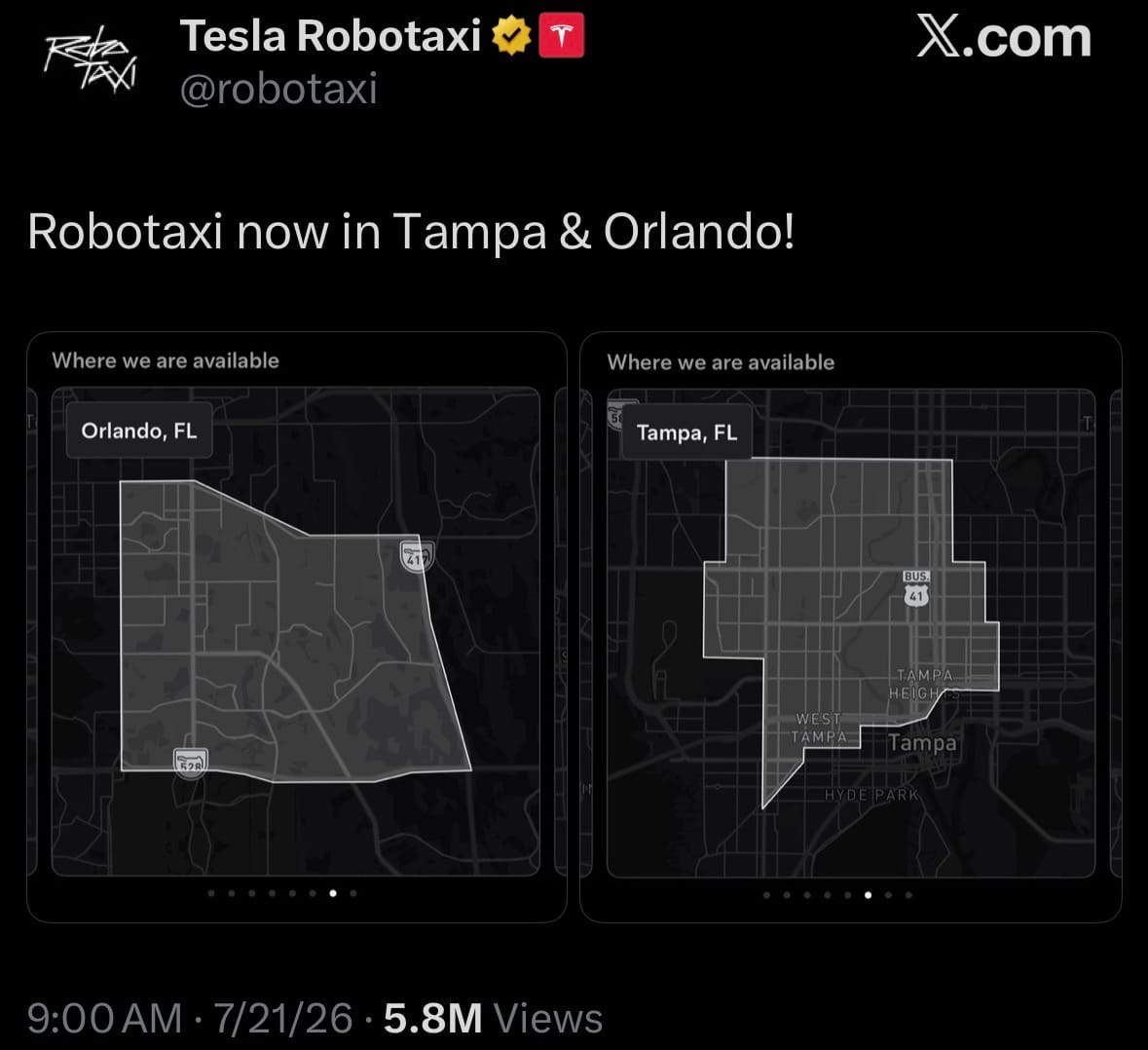
- The launches follow Miami earlier this month and build on operations in Texas and California, with Tesla sharing service area maps for the new markets as it continues scaling the program ahead of its Q2 earnings report.
Geopolitics & Military Activity:
- July 22, 2026: A large fire broke out at a Wildberries logistics center in Krasnodar, Russia, following Ukrainian long-range drone strikes overnight.

- This is the latest in a series of Ukrainian attacks on Wildberries warehouses (Russia’s largest e-commerce logistics network) in recent days, including facilities in the Moscow and Tambov regions that caused significant damage and losses for sellers.

Science & Technology:
- July 21, 2026: Anthropic introduced a new feature in Claude Cowork called “teach Claude a skill,” allowing users to record their screen while performing a task, narrate the steps, and have Claude turn the demonstration into a reusable skill it can execute independently.

- Available now on Pro, Max, and Team plans via the “Record a skill” option in the + menu of the Claude desktop app, it enables Claude to learn and repeat complex workflows from user examples.

Statistic:
- Largest public automakers by market capitalization:
- 🇺🇸 Tesla: $1.423T
- 🇯🇵 Toyota: $213.54B
- 🇨🇳 BYD: $122.01B
- 🇨🇳 Xiaomi: $90.53B
- 🇰🇷 Hyundai: $75.12B
- 🇺🇸 General Motors: $71.70B
- 🇮🇹 Ferrari: $65.07B
- 🇺🇸 Ford: $56.86B
- 🇩🇪 Mercedes-Benz: $49.02B
- 🇩🇪 Porsche: $46.46B
- 🇮🇳 Maruti Suzuki India: $44.42B
- 🇩🇪 Volkswagen: $41.48B
- 🇮🇳 Mahindra & Mahindra: $39.95B
- 🇩🇪 BMW: $39.37B
- 🇰🇷 Kia: $38.72B
- 🇯🇵 Honda: $37.05B
- 🇺🇸 Rivian: $25.70B
- 🇨🇳 Geely: $24.62B
- 🇯🇵 Suzuki Motor: $24.28B
- 🇨🇳 Great Wall Motors: $20.16B
- 🇨🇳 Chery Automobile: $17.90B
- 🇨🇳 SAIC Motor: $17.71B
- 🇳🇱 Stellantis: $16.74B
- 🇮🇳 Tata Motors: $16.63B
- 🇮🇳 Hyundai Motor India: $16.53B
- 🇨🇳 Seres Group: $14.34B
- 🇨🇳 XPeng: market cap not provided
History:
- Mail routes have existed for more than 5,000 years and were among the first organized communication networks in human history. The earliest known postal systems appeared in Ancient Egypt and Mesopotamia around 2400 BC, where royal couriers carried government orders between cities. The Persian Empire created one of the first true long-distance mail networks under King Darius I around 500 BC, building the famous Royal Road, which stretched roughly 1,700 miles (2,700 km) from Susa to Sardis. Relay stations with fresh horses allowed couriers to travel far faster than ordinary travelers, inspiring the phrase, “Neither snow nor rain nor heat nor gloom of night…” The Roman Empire later established the Cursus Publicus, an extensive state-run postal system connecting thousands of miles of roads across Europe, North Africa, and the Middle East. At the same time, China’s imperial dynasties developed massive courier networks with thousands of relay stations, while the Mongol Empire built the Yam System during the 1200s, creating one of history’s fastest communication networks by maintaining horse stations across Asia. During the Age of Exploration, expanding empires established regular sea mail routes linking Europe with the Americas, Africa, and Asia. By the 1700s and 1800s, improved roads, stagecoaches, canals, and steamships dramatically increased the speed and reliability of mail delivery. The invention of railroads transformed postal systems, allowing specialized railway post offices to sort mail while trains were moving. In 1860, the American Pony Express briefly carried mail across the western United States in just ten days before the transcontinental telegraph made it obsolete only eighteen months later. By the late 1800s, international steamship routes connected nearly every major port, creating the first truly global postal network.
- The 20th century revolutionized mail transportation. Air mail began experimentally in the early 1900s and expanded rapidly after World War I, dramatically reducing delivery times across continents. Commercial airlines eventually carried much of the world’s priority mail, while dedicated cargo aircraft became increasingly important for overnight delivery. The creation of the Universal Postal Union (UPU) in 1874 standardized international mail exchange, allowing countries to operate within a single global postal framework. During the second half of the century, highways, container shipping, cargo aviation, automated sorting equipment, ZIP codes, and barcode technology transformed postal logistics into highly automated networks. Companies such as FedEx, founded in 1971, pioneered the overnight hub-and-spoke delivery model, concentrating packages at central hubs before redistributing them nationwide. UPS, originally founded in 1907, expanded into one of the world’s largest logistics companies, while DHL, established in 1969, became a global leader in international express shipping. National postal services such as the United States Postal Service (USPS), Royal Mail, Canada Post, Japan Post, La Poste, and China Post continued handling billions of letters and packages while integrating with commercial carriers. Modern mail networks rely on aircraft, trucks, trains, ships, sorting centers, distribution hubs, and sophisticated routing software that determines the fastest and most efficient path for every shipment.
- Today, mail routes form one of the largest logistics systems ever created. Every letter or package typically moves through multiple stages, including local collection, regional processing centers, long-distance transportation by truck, aircraft, rail, or ship, destination sorting facilities, and final delivery by local carriers. The largest global cargo hubs include Memphis for FedEx, Louisville for UPS, Leipzig for DHL, and major international airports such as Hong Kong, Anchorage, Dubai, and Shanghai, which connect worldwide shipping networks. The rapid growth of e-commerce has shifted postal systems from primarily delivering letters to transporting billions of parcels each year. Modern logistics companies increasingly use artificial intelligence, automated warehouses, robotics, GPS tracking, machine vision, predictive routing, and real-time traffic analysis to optimize deliveries. Drones, autonomous delivery vehicles, electric trucks, and advanced fulfillment centers are also being tested to improve last-mile delivery. Although digital communication has greatly reduced traditional letter volumes, global mail routes remain essential for transporting legal documents, government correspondence, medicines, financial records, consumer goods, and e-commerce shipments. Today, the world’s postal and logistics networks connect virtually every inhabited region on Earth, making them one of the most complex and essential transportation systems supporting global trade, commerce, and communication.
Image of the day:

Thanks for reading! Earth is complicated, we make it simple.
- Download our mobile app:





Click below to view our previous newsletters:

Support/Suggestions Email:
support@earthintel.io