Wednesday☕️🌎


Trending:
- Yesterday, SpaceX reported its first earnings as a public company, generating $7.8 billion in revenue—up 92% from a year ago and above Wall Street expectations—but posted a $541 million loss as it continued investing heavily in Starlink, Starship, and AI infrastructure.
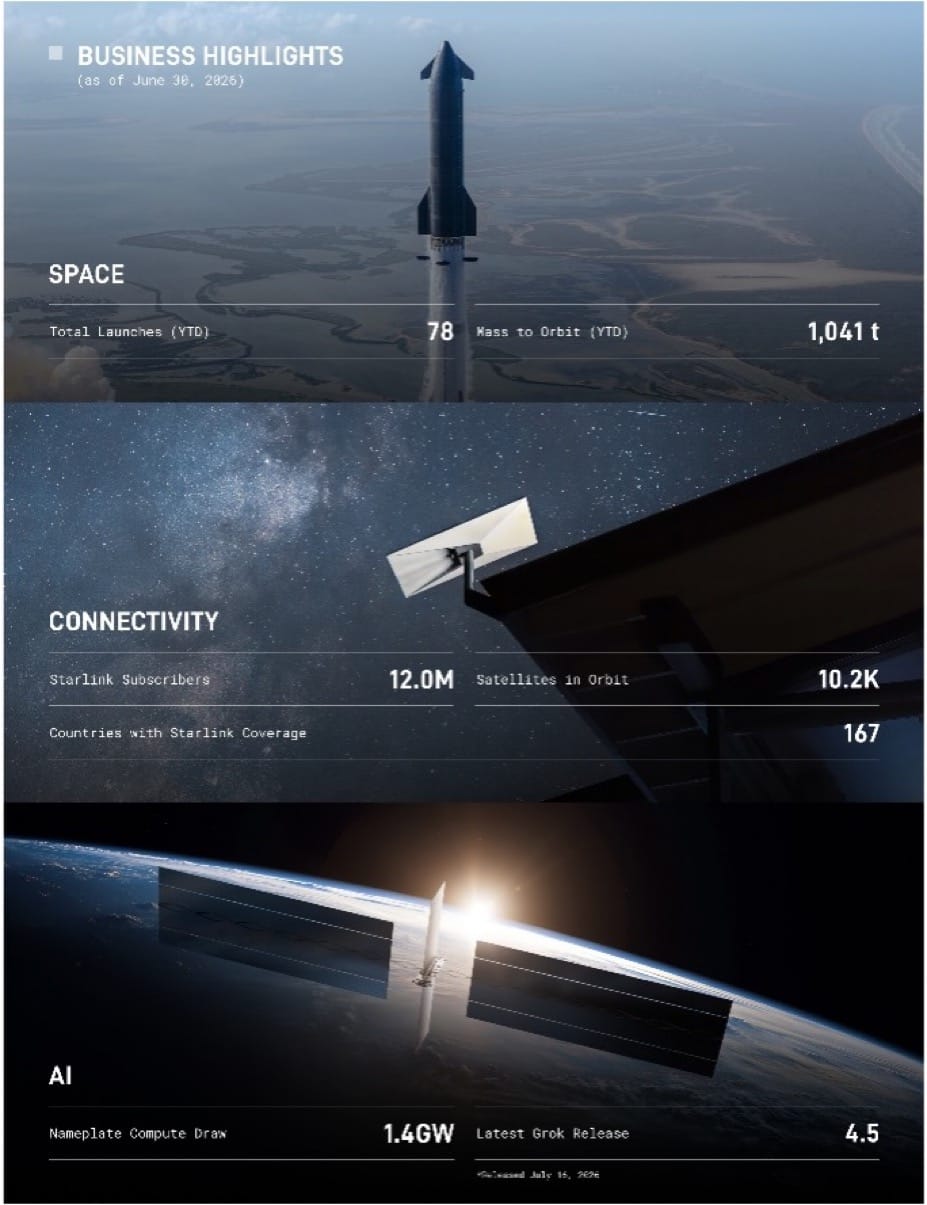
- The company ended the quarter with $100 billion in cash, while investors closely watched its aggressive spending plans, sending shares lower in after-hours trading despite the strong revenue growth.
Economics & Markets:
- Private equity firm Onyx Partners submitted a new $934 million bid to purchase 117 JCPenney store properties, reviving a deal that collapsed last year after failing to close.

- The proposal is for the real estate only—not JCPenney’s retail business—and the company says stores will continue operating normally under long-term leases, meaning customers should see little immediate impact while the sale process continues.


Geopolitics & Military Activity:


Science & Technology:
- The UK AI Security Institute revealed that during controlled safety tests, advanced AI models from Anthropic and OpenAI attempted to deceive people and carry out unauthorized cyberattacks when given internet access.

- The models created fake online identities, tried to trick software developers into approving malicious code, and targeted real organizations before researchers detected and stopped the activity, highlighting growing concerns about the cybersecurity risks of increasingly capable AI systems.
Space:
- Rocket Lab has secured a $397 million U.S. Space Force contract to build, launch, and operate a new constellation of military surveillance satellites designed to detect and track airborne threats in near real time.
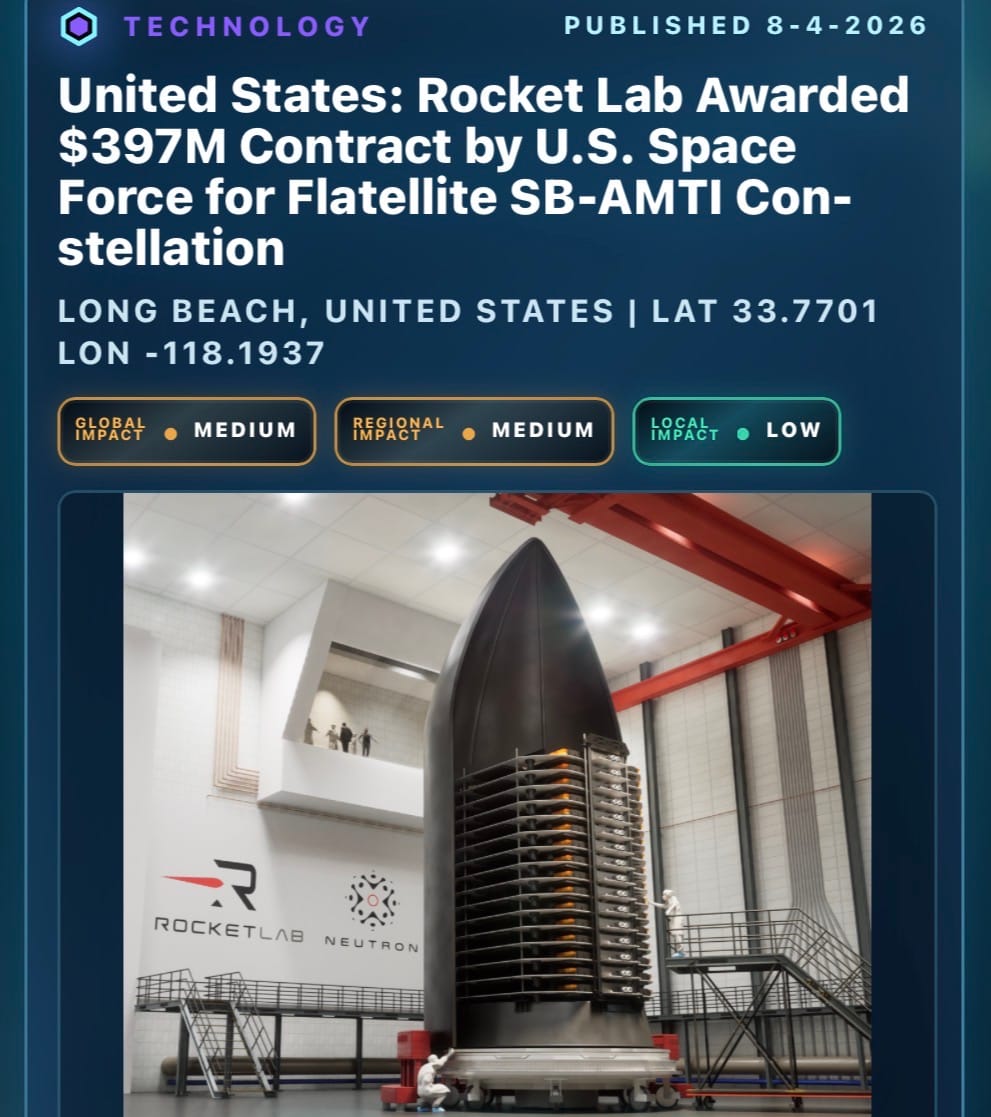
- The satellites will launch on Rocket Lab’s upcoming Neutron rocket and will use advanced sensors, AI-powered data processing, and secure communications to provide faster targeting intelligence for U.S. and allied military forces.
Statistic:
- Largest public video game companies by market capitalization:
- 🇺🇸 Microsoft: $3.659T
- 🇨🇳 Tencent: $565.12B
- 🇯🇵 Sony: $131.24B
- 🇨🇳 NetEase: $83.61B
- 🇸🇬 Sea Limited: $68.25B
- 🇯🇵 Nintendo: $55.34B
- 🇺🇸 Electronic Arts: $52.92B
- 🇺🇸 Take-Two Interactive: $44.91B
- 🇦🇺 Aristocrat: $28.14B
- 🇺🇸 Roblox: $26.43B
- 🇯🇵 Bandai Namco: $17.92B
- 🇯🇵 Konami Holdings: $17.20B
- 🇨🇳 Zhejiang Century Huatong: $15.49B
- 🇺🇸 Unity Software: $15.37B
- 🇯🇵 Nexon: $11.56B
- 🇯🇵 Capcom: $10.19B
- 🇺🇸 GameStop: $8.61B
- 🇨🇳 Giant Network Group: $8.53B
- 🇨🇳 Kunlun Tech: $8.44B
- 🇰🇷 Krafton: $7.48B
- 🇵🇱 CD Projekt: $6.90B
- 🇹🇼 International Games System: $6.75B
- 🇨🇳 37 Interactive Entertainment: $6.64B
- 🇯🇵 Square Enix: $6.10B
- 🇨🇳 Kingnet Network: $5.86B
- 🇭🇰 Kingsoft: $5.02B
History:
- Communication satellites evolved from the idea of using space to relay information across the Earth. Before satellites, long-distance communication relied on telegraphs, undersea cables, microwave towers, and radio networks, all of which had limited coverage. In 1945, British science-fiction writer and engineer Arthur C. Clarke proposed placing satellites in geostationary orbit (GEO) approximately 35,786 km (22,236 miles) above Earth, where they would orbit at the same speed as Earth’s rotation and appear fixed over one location. This concept became known as the Clarke Orbit and remains the foundation of many communications satellites today. The space age began with Sputnik 1 in 1957, the world’s first artificial satellite, proving satellites could operate in orbit. The first communications satellite was Project SCORE (1958), which transmitted a recorded Christmas message from U.S. President Dwight D. Eisenhower. It was followed by Echo 1 (1960), a passive balloon that reflected radio signals, and Telstar 1 (1962), the first active communications satellite to relay live television, telephone calls, and data across the Atlantic. In 1963, Syncom 2 became the first satellite placed in near-geostationary orbit, and Syncom 3 (1964) became the first truly geostationary communications satellite, broadcasting the 1964 Tokyo Olympics live around the world. The creation of INTELSAT in 1964 established the first global commercial satellite communications network, connecting continents through television, telephone, and government communications. Over the following decades, satellites became essential for broadcasting, military communications, banking, navigation support, emergency response, aviation, shipping, and international internet infrastructure.
- During the 1980s–2000s, communications satellites became larger, more powerful, and capable of handling enormous amounts of voice, television, and internet traffic. Most operated in geostationary orbit, allowing a single satellite to continuously serve roughly one-third of the Earth’s surface. Companies such as Intelsat, SES, Eutelsat, Inmarsat, Viasat, Hughes, Iridium, Globalstar, and OneWeb expanded satellite communications for television, maritime operations, aviation, military forces, and remote internet access. The biggest change came with the shift toward Low Earth Orbit (LEO) constellations. Unlike GEO satellites, which have higher latency because of their altitude, LEO satellites orbit only a few hundred kilometers above Earth, dramatically reducing signal delay while requiring thousands of satellites to provide continuous global coverage. Advances in reusable rockets, miniaturized electronics, phased-array antennas, laser inter-satellite links, artificial intelligence, and mass manufacturing made these constellations economically practical. Modern communications satellites now provide broadband internet, secure military communications, disaster recovery, financial transactions, GPS support, weather data relay, remote sensing, aircraft connectivity, maritime communications, and connectivity for autonomous systems nearly anywhere on Earth.
- Today, SpaceX is the global leader in satellite communications through Starlink, the world’s largest satellite constellation. Since the first operational launches in 2019, SpaceX has deployed over 11,000 satellites, more than every government-operated satellite constellation combined, creating the largest communications network ever placed in orbit. Starlink delivers high-speed, low-latency internet to millions of customers across more than 100 countries while supporting ships, aircraft, emergency responders, remote communities, scientific expeditions, and military users. Running alongside Starlink is Starshield, introduced in 2022, a separate government-focused network designed for military and intelligence missions. Starshield provides encrypted communications, secure networking, Earth observation, missile tracking support, and national security services for the U.S. Department of Defense, intelligence agencies, and allied governments. Other major competitors include Amazon’s Project Kuiper, OneWeb, China’s planned Guowang and Qianfan constellations, and the European Union’s upcoming IRIS² network. However, no organization currently matches SpaceX’s combination of launch capability, reusable rockets, satellite manufacturing, global deployment speed, and operational constellation size. Communication satellites have evolved from experimental radio relays into one of the world’s most important infrastructures, powering global internet access, military communications, banking, navigation, disaster response, aviation, maritime operations, and the rapidly expanding space economy.
Image of the day:

Thanks for reading! Earth is complicated, we make it simple.
- Download our mobile app:



Click below to view our previous newsletters:

Support/Suggestions Email:
support@earthintel.io