Wednesday☕️🌎

Trending:
- August 18, 2026 — Israel confirmed it carried out eight airstrikes on Syria’s Abu al-Duhur airbase in Idlib to prevent Turkish forces from deploying there, saying the planned deployment threatened Israeli security and violated an agreed security status quo with Syria.
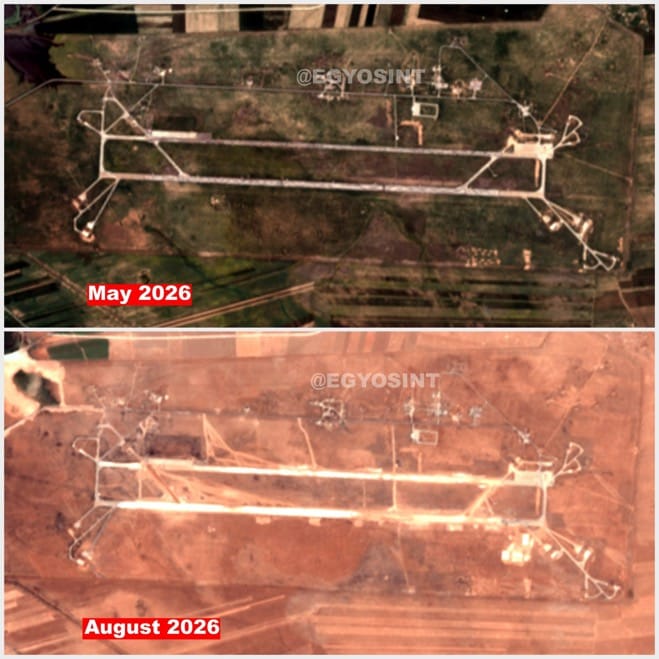
- The strikes damaged the runway and hangars but caused no reported casualties, while Syria and Turkey condemned the attack and the United States called it an “unnecessary escalation.”
Economics & Markets:
Geopolitics & Military Activity:
- August 18, 2026 — The UAE said it detected two ballistic missiles launched from Iran toward the country, with both falling into the sea—one inside Emirati territorial waters and one outside—and no casualties or damage reported; Iran later denied responsibility.
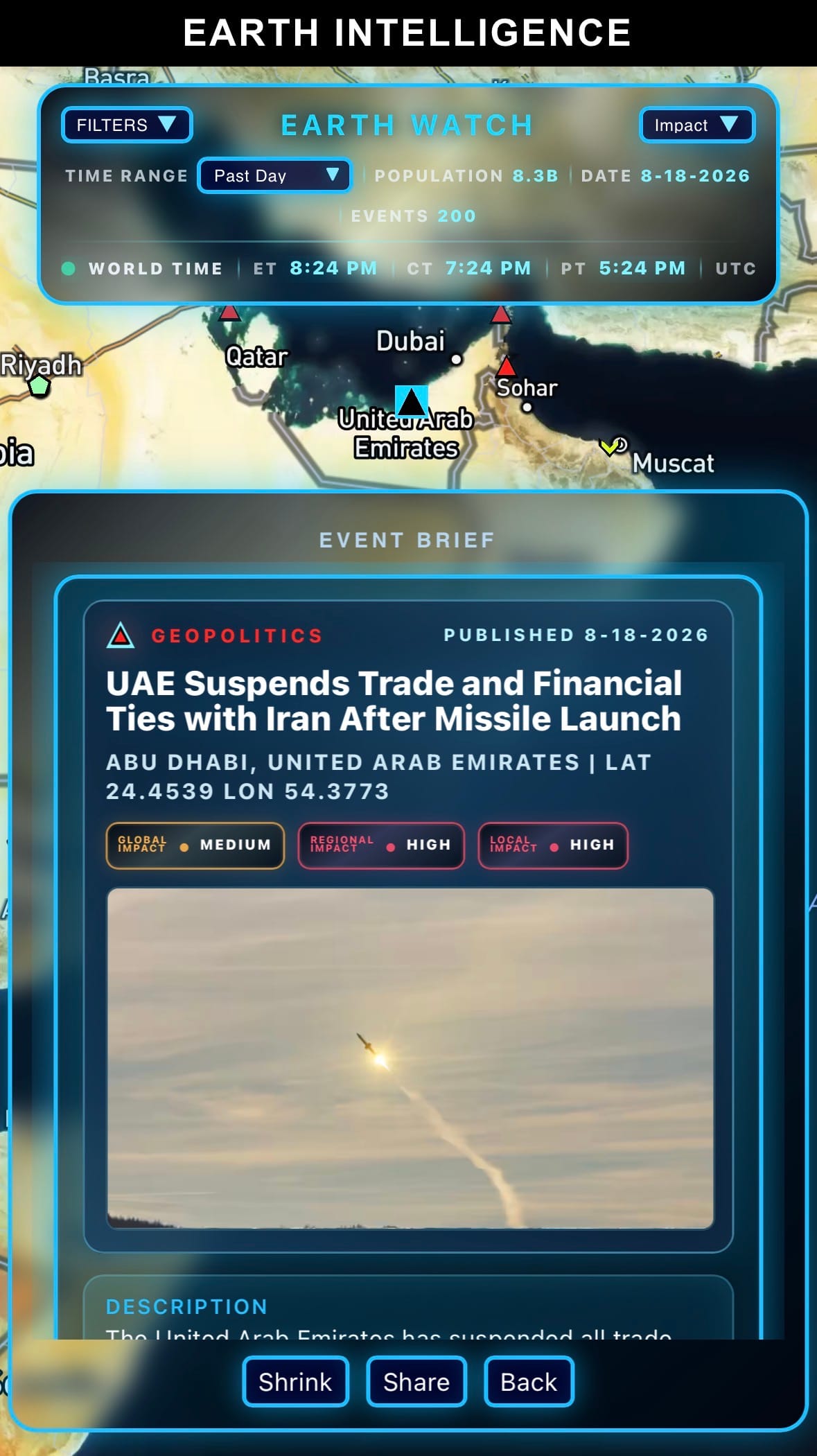
- Hours later, the UAE halted all trade, commercial exchanges, and financial transactions with Iran until further notice, marking a major escalation in tensions following recent attacks on Emirati-linked shipping in the Strait of Hormuz.
Science & Technology:
- August 18, 2026 — Amazon increased its planned investment in northwest Louisiana data centers from $12 billion to $18 billion, adding a third AWS campus at Resilient Technology Park in Shreveport to support growing cloud computing and AI demand.
- The three campuses are expected to create up to 750 permanent jobs and thousands of construction and supporting jobs, while Amazon will fully fund the required power infrastructure and invest up to $400 million in public water upgrades so those costs are not passed on to local residents.

Space:
- August 18, 2026 — Rocket Lab announced it has joined the U.S. Space Force’s Space Data Network Consortium and received two orders worth a combined $12 million to help build a secure, high-speed satellite communications network for the U.S. military.
- Rocket Lab will develop laser-based communications that allow satellites and ground systems to exchange large amounts of data quickly and securely, including an in-orbit test using its Photon spacecraft and an operational demonstration planned for 2027.
Statistic:
- Largest public airline by market capitalization:
- 🇺🇸 Delta Air Lines: $56.35B
- 🇺🇸 United Airlines Holdings: $38.53B
- 🇮🇪 Ryanair: $28.74B
- 🇪🇸 International Consolidated Airlines: $24.78B
- 🇮🇳 InterGlobe Aviation (IndiGo): $21.09B
- 🇺🇸 Southwest Airlines: $20.78B
- 🇨🇳 Air China: $17.83B
- 🇸🇬 Singapore Airlines: $17.29B
- 🇨🇱 LATAM Airlines: $14.79B
- 🇨🇳 China Southern Airlines: $13.48B
- 🇨🇳 China Eastern Airlines: $11.47B
- 🇭🇰 Cathay Pacific: $11.38B
- 🇩🇪 Lufthansa: $10.93B
- 🇦🇺 Qantas Airways: $10.39B
- 🇺🇸 American Airlines: $9.30B
- 🇨🇳 Hainan Airlines: $8.85B
- 🇹🇷 Turkish Airlines: $8.60B
- 🇯🇵 ANA Holdings: $8.24B
- 🇯🇵 Japan Airlines: $8.06B
- 🇹🇼 EVA Air: $7.09B
- 🇬🇧 easyJet: $6.77B
- 🇨🇳 Spring Airlines: $6.43B
- 🇨🇦 Air Canada: $6.02B
- 🇵🇦 Copa Holdings: $5.85B
- 🇰🇷 Korean Air Lines: $5.63B
History of the United Arab Emirates
- The land that became the United Arab Emirates (UAE) has been connected to civilization and trade for thousands of years. Archaeological evidence shows human activity more than 100,000 years ago, while the Hafit (c. 3200–2600 BC) and Umm Al Nar (c. 2600–2000 BC) cultures developed settlements, copper production, maritime trade, and elaborate tombs. Ancient Mesopotamian records describe Magan, generally associated with modern UAE and Oman, as an important trading region. Islam reached southeastern Arabia during the 7th century, and Gulf ports later connected Arabia with Persia, India, and East Africa. By the 1700s, major tribal powers included the Bani Yas, connected to today’s Al Nahyan rulers of Abu Dhabi and Al Maktoum rulers of Dubai, and the Al Qasimi around Sharjah and Ras Al Khaimah. Britain increasingly dominated Gulf security during the 1800s through treaties beginning in 1820, and the emirates became known as the Trucial States. Before petroleum, their economies depended on pearling, fishing, shipping, dates, and regional trade. Commercial oil was discovered in Abu Dhabi in 1958, exports began in 1962, and Sheikh Zayed bin Sultan Al Nahyan became ruler in 1966. After Britain announced its withdrawal from the region, six emirates formed the UAE on December 2, 1971; Ras Al Khaimah joined in February 1972, completing the seven-emirate federation.
- Oil transformed the UAE, but its rulers deliberately built beyond oil. Abu Dhabi became the political and energy center through ADNOC, enormous petroleum reserves, sovereign wealth funds, defense investment, and infrastructure. Dubai, possessing much less oil, developed around trade, finance, tourism, real estate, aviation, and logistics. Jebel Ali Port opened in 1979, Emirates Airline was founded in 1985, and Dubai became one of the world’s major transportation and business hubs. The UAE later expanded into nuclear energy through Barakah, renewable energy through Masdar, defense technology through EDGE, artificial intelligence, advanced manufacturing, and space, with the Hope probe reaching Mars in 2021. Its growing power also brought greater involvement abroad. In 2015, the UAE joined the Saudi-led intervention in Yemen against the Iran-aligned Houthis. Yemen then became increasingly divided: the Houthis dominated much of the north, the internationally recognized government competed for other territory, and the UAE supported southern forces—especially the Southern Transitional Council (STC)—that favored southern autonomy or independence. Saudi Arabia generally supported keeping Yemen unified, creating an important difference between the two allies. The UAE reduced its direct military presence beginning in 2019 but maintained considerable political, military, and maritime influence in southern Yemen.
- Today, the UAE is one of the Middle East’s most important energy, finance, aviation, logistics, investment, technology, and military hubs, but its geography creates serious geopolitical risk. Sheikh Mohamed bin Zayed Al Nahyan, president since 2022, has built relationships with the United States, Saudi Arabia, India, China, Europe, and Israel while historically maintaining economic and diplomatic channels with Iran. The UAE sits directly across the Persian Gulf from Iran and beside the Strait of Hormuz, through which enormous amounts of global energy and commercial shipping move. The ongoing 2026 U.S.-Iran conflict therefore threatens Emirati shipping, airspace, ports, aviation, energy exports, insurance markets, and infrastructure even when the UAE is not a direct combatant. The UAE must simultaneously manage tensions involving Iran, Yemen, the Houthis, Red Sea shipping, Saudi Arabia, Israel, and its security partnership with the United States. Its modern story is essentially ancient trading center → tribal emirates → British-protected Trucial States → oil discovery → UAE federation in 1971 → global trade and investment hub → technology, defense and space power → strategically exposed Gulf power balancing between some of the world’s largest geopolitical rivals.
Image or the day:

Thanks for reading! Earth is complicated, we make it simple.
- Download our mobile app:



Click below to view our previous newsletters:
Support/Suggestions Email:
support@earthintel.io