Friday☕️


Trending:
- On May 15, the U.S. formally rejected all of Iran’s conditions in response to Tehran’s latest proposal on the Strait of Hormuz.

- This leaves negotiations at a deadlock, with the naval blockade remaining fully in effect.
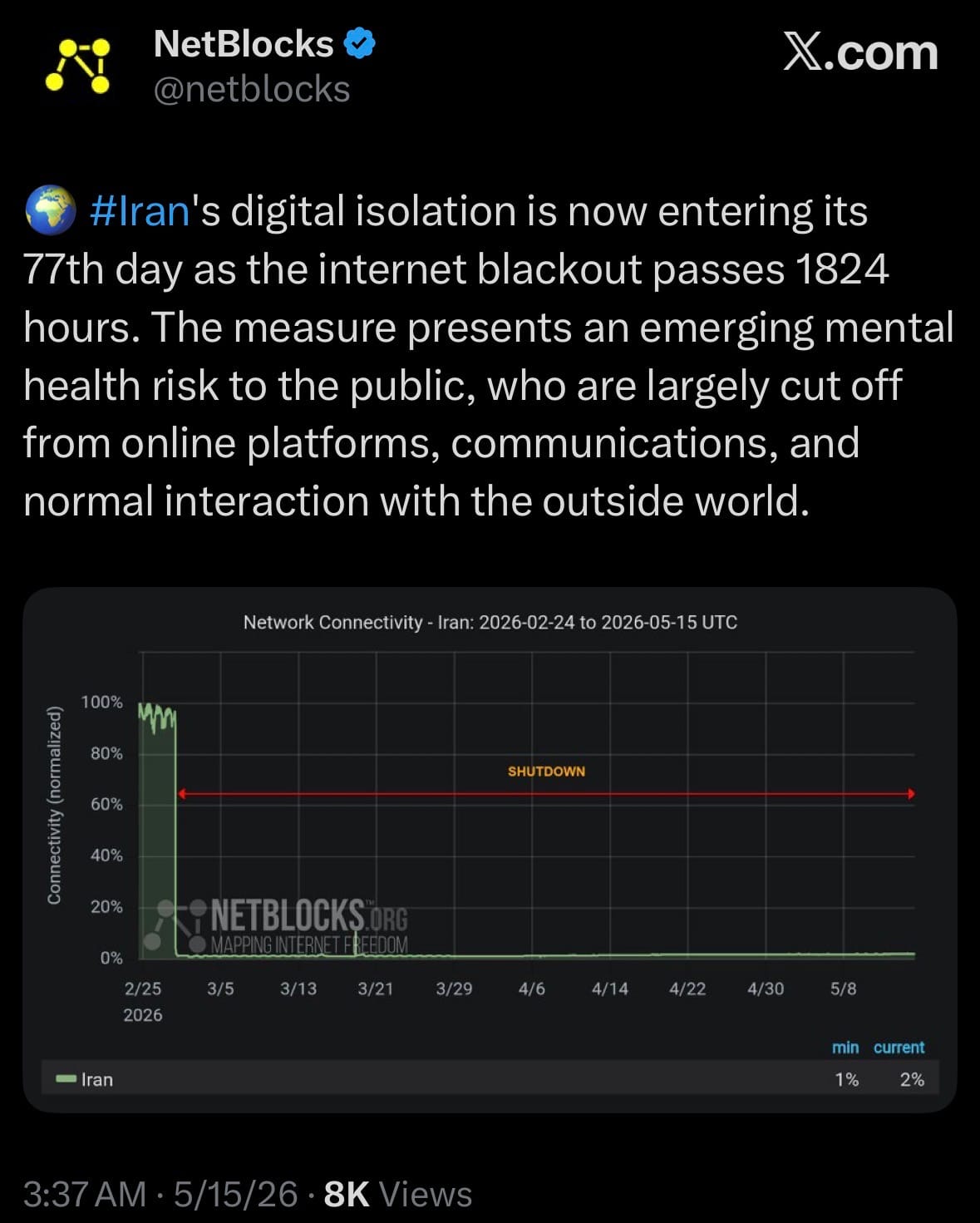
Economics & Markets:
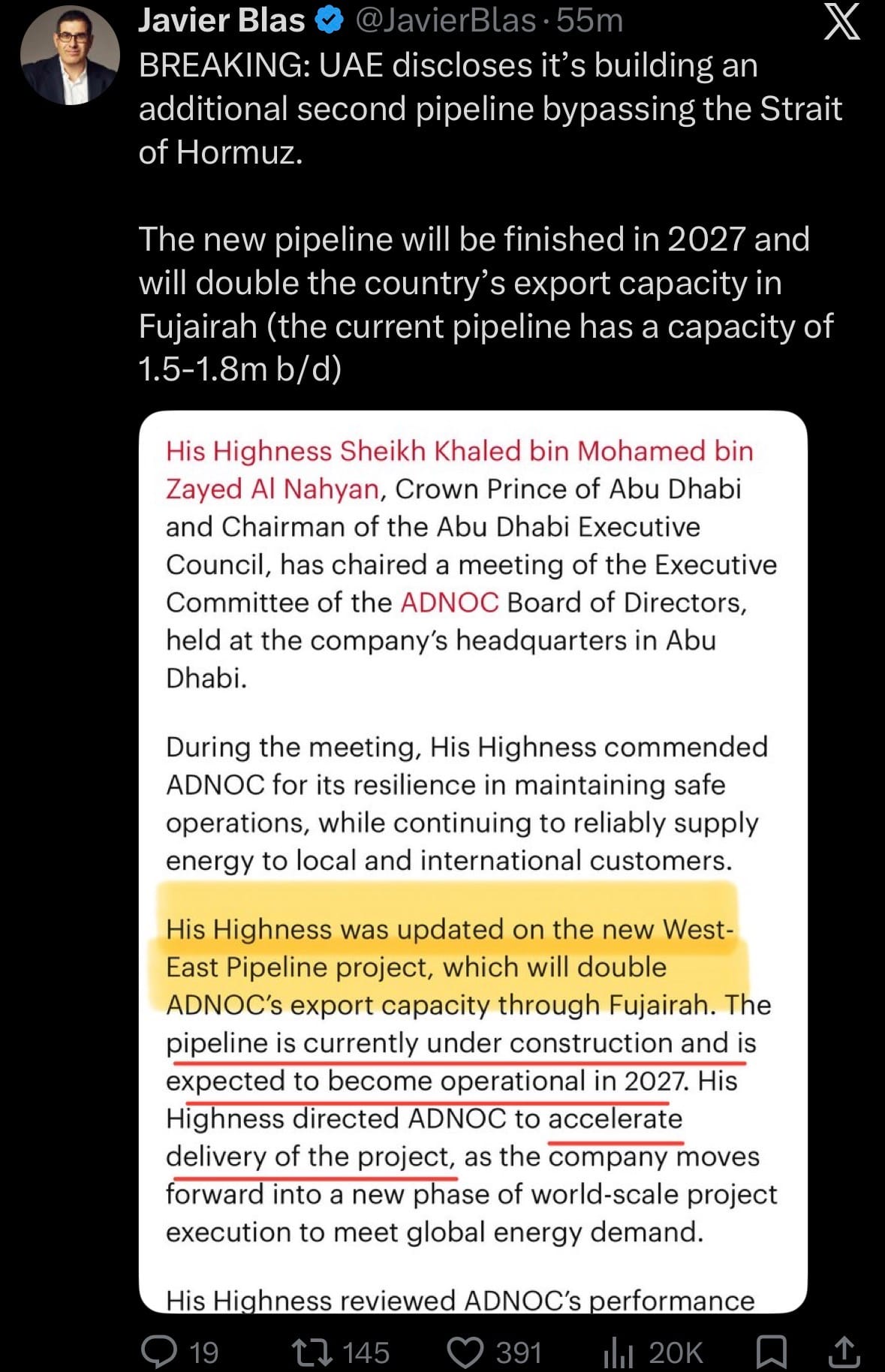
Geopolitics & Military Activity:
- On May 15, a major fire engulfed Russia’s Ryazan oil refinery after Ukrainian drones struck the facility overnight.
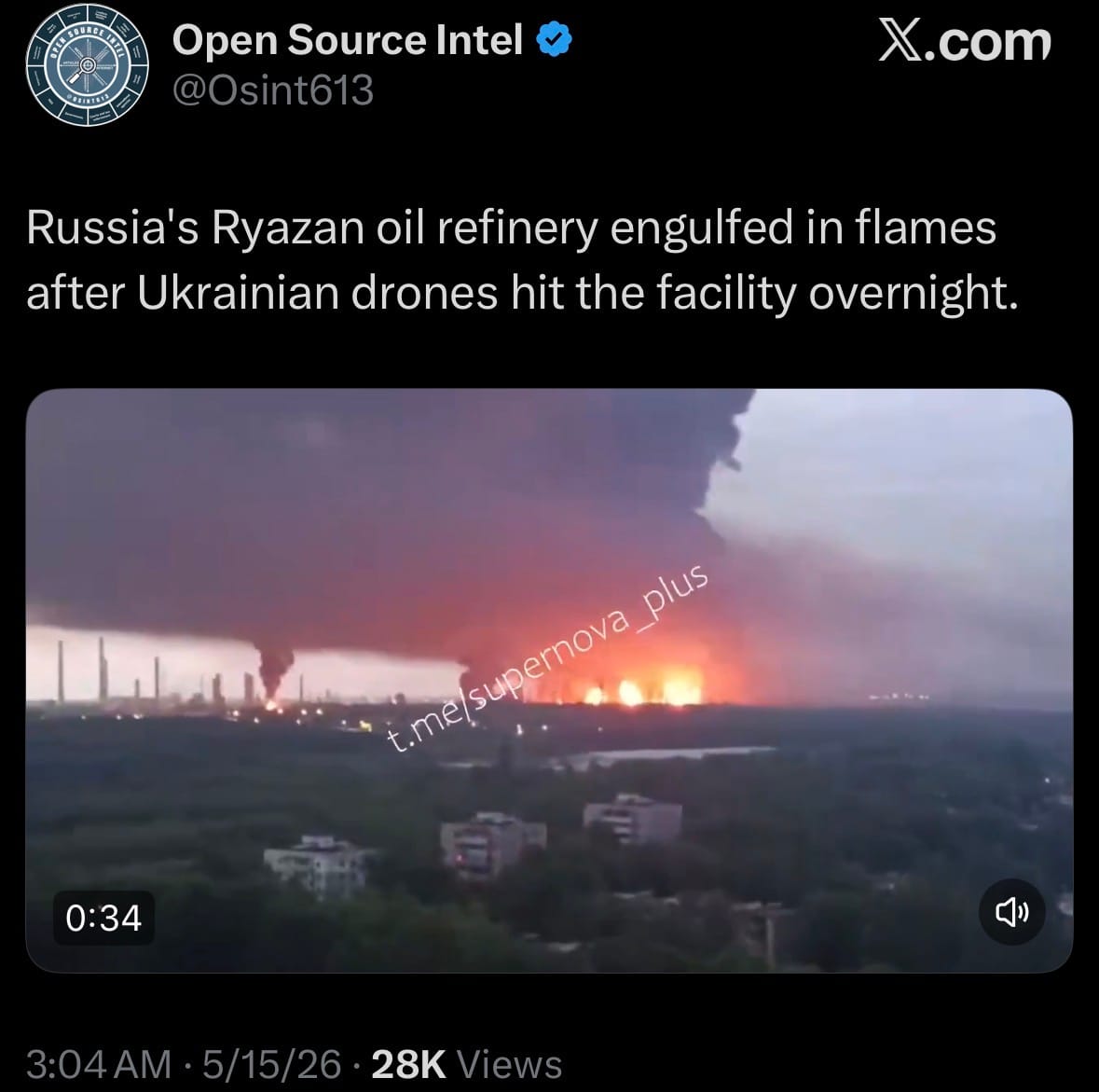
- The Rosneft-owned refinery — one of Russia’s largest, processing about 17 million tons of oil per year (roughly 5% of the country’s capacity) — was hit in a wave of drone attacks, causing explosions, thick black smoke, and significant damage. Russian officials reported 3 people killed and 12 injured from falling debris and fires in nearby residential areas.
Science & Technology:
- On May 15, OpenAI made Codex available on the ChatGPT mobile app (in preview). You can now use your phone to start a coding project, check the code Codex is writing, give instructions, and approve changes — all while the actual heavy coding work keeps running on your computer or server in the background. It lets you manage and control AI coding from anywhere without needing to sit at your laptop.

Statistic:
- Largest assets on Earth by market capitalization:
- Gold: $31.750T
- 🇺🇸 NVIDIA: $5.709T
- 🇺🇸 Alphabet (Google): $4.811T
- Silver: $4.437T
- 🇺🇸 Apple: $4.379T
- 🇺🇸 Microsoft: $3.041T
- 🇺🇸 Amazon: $2.874T
- 🇹🇼 TSMC: $2.166T
- 🇺🇸 Broadcom: $2.082T
- 🇸🇦 Saudi Aramco: $1.785T
- 🇺🇸 Tesla: $1.664T
- Bitcoin: $1.614T
- 🇺🇸 Meta Platforms (Facebook): $1.569T
- 🇰🇷 Samsung: $1.180T
- 🇺🇸 Walmart: $1.055T
- 🇺🇸 Berkshire Hathaway: $1.044T
- Vanguard S&P 500 ETF: $965.92B
- 🇺🇸 Eli Lilly: $897.71B
- 🇺🇸 Micron Technology: $875.13B
- 🇰🇷 SK Hynix: $858.13B
- iShares Core S&P 500 ETF: $834.68B
- 🇺🇸 JPMorgan Chase: $803.61B
- SPDR S&P 500 ETF: $776.39B
- 🇺🇸 AMD: $733.28B
- Vanguard Total Stock Market Index Fund ETF Shares: $647.57B
History:
- GPS began as a Cold War military navigation problem: the United States needed a way to precisely track submarines, missiles, aircraft, and troops anywhere on Earth in real time. Its roots trace back to 1957, when scientists monitoring the Soviet launch of Sputnik realized they could determine a satellite’s position by tracking its radio signals through the Doppler effect—and then realized the reverse was also possible: if you knew the satellite’s position, you could determine your own. This led to early U.S. military navigation systems like TRANSIT (1960), used mainly by Navy submarines, but it was slow and limited. During the 1960s and 1970s, the Department of Defense combined several competing navigation programs into what became the Global Positioning System (GPS). The first GPS satellite launched in 1978, and the system was originally designed purely for military use under the Air Force. GPS worked through a constellation of satellites broadcasting highly precise timing signals from atomic clocks; receivers calculate position by measuring tiny differences in signal arrival times from multiple satellites. A major turning point came after the Korean Air Lines Flight 007 incident in 1983, when a civilian airliner accidentally entered Soviet airspace and was shot down. In response, President Reagan announced GPS would eventually be made available for civilian use to improve navigation safety worldwide.
- Through the 1990s–2000s, GPS transformed from a military tool into one of the foundational systems of modern civilization. The full satellite constellation became operational in 1995, and in 2000, the U.S. removed “Selective Availability,” an intentional accuracy reduction placed on civilian signals, dramatically improving public precision. This triggered an explosion of GPS integration into cars, aircraft, smartphones, shipping, agriculture, finance, emergency response, and military systems. GPS became essential not just for navigation, but for timing synchronization—power grids, banking networks, internet infrastructure, cellular networks, and stock exchanges all began relying on GPS timing signals. At the same time, other powers built rival systems to avoid dependence on the U.S.: Russia developed GLONASS, Europe created Galileo, and China expanded BeiDou, turning satellite navigation into a major geopolitical and strategic domain. Militaries also increasingly recognized GPS vulnerability to jamming, spoofing, cyber attacks, and anti-satellite weapons, especially as modern warfare became precision-guided and networked.
- From 2020–2026, GPS evolved into part of a much larger global positioning and timing ecosystem integrated with AI, autonomous systems, and real-time battlefield networks. The U.S. continued deploying advanced satellites like the GPS III series, improving signal strength, anti-jamming capability, and accuracy. GPS now supports autonomous drones, precision-guided missiles, self-driving systems, logistics networks, and global commerce at massive scale. At the same time, electronic warfare involving GPS disruption has become increasingly common in conflicts, especially around Eastern Europe and the Middle East, where jamming and spoofing operations can distort navigation and targeting systems. Nations are now investing heavily in resilient alternatives like inertial navigation, quantum sensing, and multi-constellation receivers that combine GPS with Galileo, BeiDou, and GLONASS signals. By 2026, GPS is no longer just a navigation tool—it is a hidden global infrastructure layer underpinning transportation, finance, communications, military operations, and digital synchronization across the planet. What began as a Cold War satellite-tracking experiment has become one of the most important invisible systems powering modern civilization.
Thanks for reading! Earth is complicated, we make it simple.

- Download our mobile app:


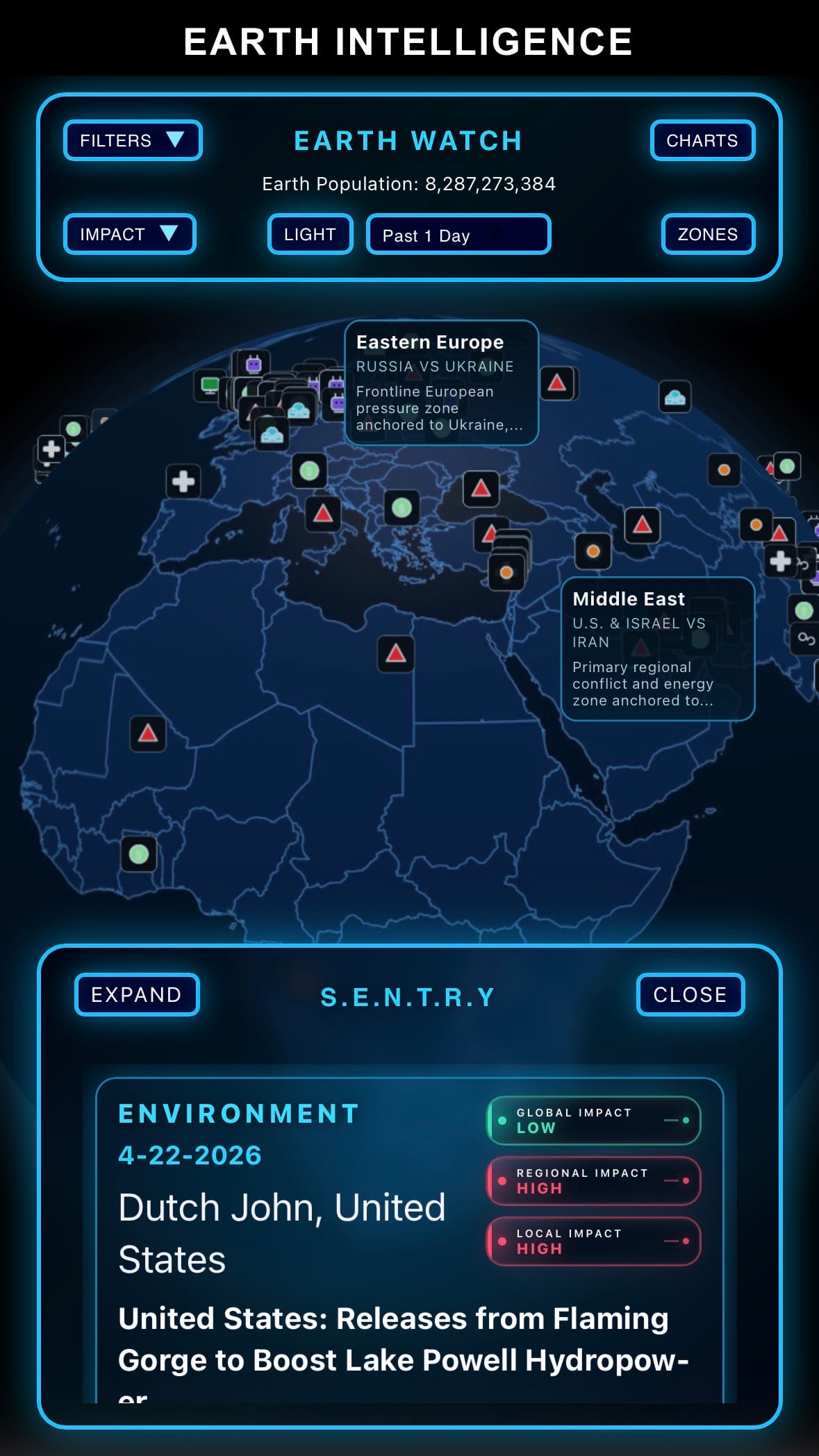
- Click below if you’d like to view our free EARTH WATCH globe:
Click below to view our previous newsletters:

Support/Suggestions Email:
support@earthintel.io