Friday☕️


Economics & Markets:




Geopolitics & Military Activity:
- On May 7, U.S. Navy guided-missile destroyers successfully intercepted unprovoked Iranian missile and drone attacks while transiting the Strait of Hormuz into the Gulf of Oman, destroying several incoming threats.

- In immediate self-defense, the U.S. warships struck back at the Iranian attack positions, neutralizing the threat with precision strikes as the naval blockade remains fully in effect.
Russia vs Ukraine:
- Ukraine launched a major swarm attack on Russia using around 300 drones (Russia claims ~347), with many targeting the Moscow region, right as Putin’s unilateral “Victory Day” ceasefire began on May 8.
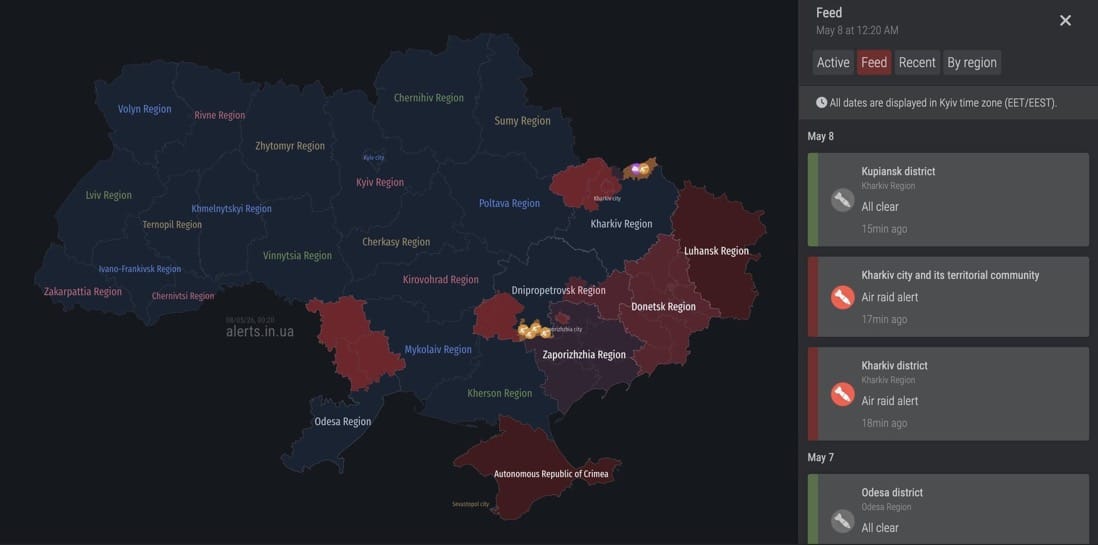
- Putin declared a three-day ceasefire (May 8–10) for Victory Day celebrations, but it has been largely ignored by both sides — within minutes of it starting, Russian air defenses activated, sirens sounded across Ukrainian regions including Kharkiv, and reciprocal drone activity continued. As of today (May 8), the ceasefire is in effect on paper but effectively broken and not being observed.
Science & Technology:
- On May 7, the B-21 Raider Combined Test Force, partnering with the U.S. Air Force, finished a 180-day test plan in just 73 days using half the planned missions, successfully securing $11.8 billion in contract value while advancing next-generation stealth technology.

- The B-21 is America’s first 6th-generation aircraft and is designed to be crew-optional (capable of flying with or without a pilot), making it smaller, more advanced in stealth, cheaper to operate, and more efficient than the larger B-2 Spirit.

Statistic:
- Largest public railroad companies on Earth by market capitalization:
- 🇺🇸 Union Pacific Corporation: $157.26B
- 🇺🇸 CSX Corporation: $82.61B
- 🇨🇦 CPKC (Canadian Pacific Kansas City): $75.65B
- 🇺🇸 Norfolk Southern: $70.38B
- 🇨🇦 Canadian National Railway: $67.23B
- 🇯🇵 East Japan Railway: $25.96B
- 🇯🇵 Central Japan Railway: $21.81B
- 🇮🇳 Indian Railway Finance: $14.72B
- 🇨🇳 China Railway Construction: $13.43B
- 🇫🇷 Getlink: $11.80B
- 🇯🇵 West Japan Railway: $8.12B
- 🇯🇵 Hankyu Hanshin Holdings: $6.75B
- 🇦🇺 Qube Holdings: $6.41B
- 🇧🇷 Rumo: $6.13B
- 🇯🇵 Tokyu: $5.96B
- 🇯🇵 Tokyo Metro: $5.60B
- 🇦🇺 Aurizon Holdings: $4.90B
- 🇮🇳 Indian Railway Catering & Tourism: $4.81B
- 🇹🇼 Taiwan High Speed Rail: $4.76B
- 🇯🇵 Kintetsu GHD: $4.16B
- 🇯🇵 Kyushu Railway Company: $3.54B
- 🇯🇵 Tobu Railway: $3.50B
- 🇯🇵 Odakyu Electric Railway: $3.49B
- 🇯🇵 Keisei Electric Railway: $3.42B
- 🇯🇵 Keio Corporation: $2.75B
History:
- The idea that humans can sense hidden information, feel unseen attention, predict danger, or perceive beyond normal awareness is ancient—far older than modern science. In ancient Egypt, Mesopotamia, Greece, India, China, and indigenous cultures, rulers, priests, generals, and shamans all relied on systems built around heightened perception, intuition, dreams, trance states, and symbolic interpretation. The Oracle of Delphi (active from around the 8th century BC) influenced wars and political decisions across Greece, while Roman augurs interpreted environmental patterns before military campaigns. In India, yogic traditions described advanced states of consciousness and “siddhis,” abilities tied to perception, influence, and awareness beyond ordinary senses. Across cultures, there was a repeated belief that the human mind could detect hidden intent, emotional energy, danger, or future probability before events fully unfolded. Even today, experiences like “feeling someone watching you,” instantly reading a room, or sensing danger before evidence appears remain common. Modern neuroscience partially explains this through subconscious processing—the brain constantly absorbs micro-expressions, environmental cues, body language, and threat signals faster than conscious thought—but the depth of this process still isn’t fully understood, which is why intuition can sometimes feel almost supernatural.
- Modern scientific investigation began in the late 1800s with organizations like the Society for Psychical Research (1882) and accelerated in the 1930s through J.B. Rhine’s ESP experiments at Duke University, where researchers tested telepathy, clairvoyance, and precognition using controlled methods like Zener cards. While controversial, some statistical anomalies kept interest alive for decades. But the real turning point came during the Cold War, when intelligence agencies quietly began asking a dangerous question: what if some of this is real—or at least useful? The United States launched a series of classified programs through the 1970s–1990s, culminating in Project STARGATE, where the CIA and Defense Intelligence Agency investigated remote viewing—the alleged ability to mentally perceive distant locations, objects, or events. Remote viewers were tasked with describing military sites, hidden facilities, and targets without physical access, and while results were inconsistent, the programs lasted for years because some sessions produced details that operators considered difficult to explain away. At the same time, the CIA’s infamous MKUltra program (1953–1973) explored hypnosis, LSD, psychological conditioning, sensory deprivation, and behavior manipulation, proving intelligence agencies were willing to aggressively investigate the boundaries of consciousness, control, and human perception.
- By 2026, the conversation around psychic phenomena has shifted from mysticism alone into a strange overlap between neuroscience, intelligence, AI, and human cognition. Mainstream science still does not officially validate supernatural psychic powers, but it increasingly acknowledges that the brain processes vastly more information than conscious awareness can detect. The modern battlefield isn’t just physical—it’s cognitive. Governments and corporations now study behavior prediction, biometric analysis, emotional mapping, subconscious pattern recognition, and neurotechnology at massive scale. AI systems can already detect emotional states, stress, and behavioral shifts through voice, movement, and facial micro-signals, almost like an externalized form of intuition. Brain-computer interfaces, advanced neural scanning, and cognitive warfare research are pushing humanity closer to understanding consciousness itself as a measurable system. What ancient civilizations called “second sight” may ultimately prove to be a partially understood layer of human perception that science is only beginning to map. Whether psychic phenomena are supernatural, hyper-intuitive, or something in between, the deeper pattern across history is undeniable: for thousands of years, humans have repeatedly encountered moments where perception seemed to reach beyond ordinary explanation—and powerful institutions, from temples to intelligence agencies, have never fully stopped investigating it.
Image of the day:

Thanks for reading! Earth is complicated, we make it simple.

- Download our mobile app:


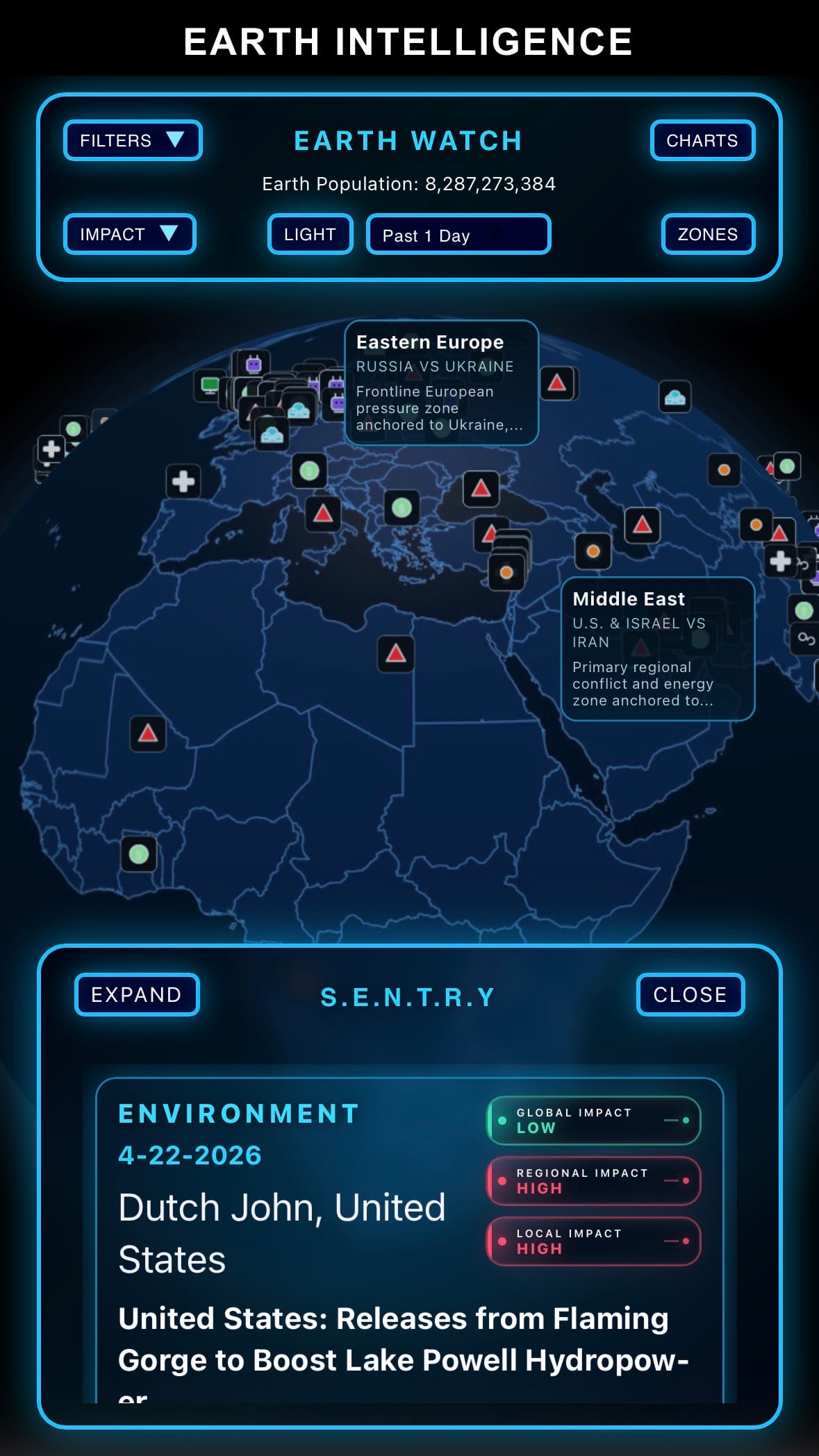
- Click below if you’d like to view our free EARTH WATCH globe:
Click below to view our previous newsletters:

Support/Suggestions Email:
support@earthintel.io