Monday☕️🌎


Trending:
- Yesterday, U.S. Central Command launched additional strikes against Iranian targets at 5 p.m. ET yesterday to degrade their ability to threaten civilian mariners and commercial shipping in the Strait of Hormuz, as directed by the Commander in Chief to hold Iranian forces accountable.
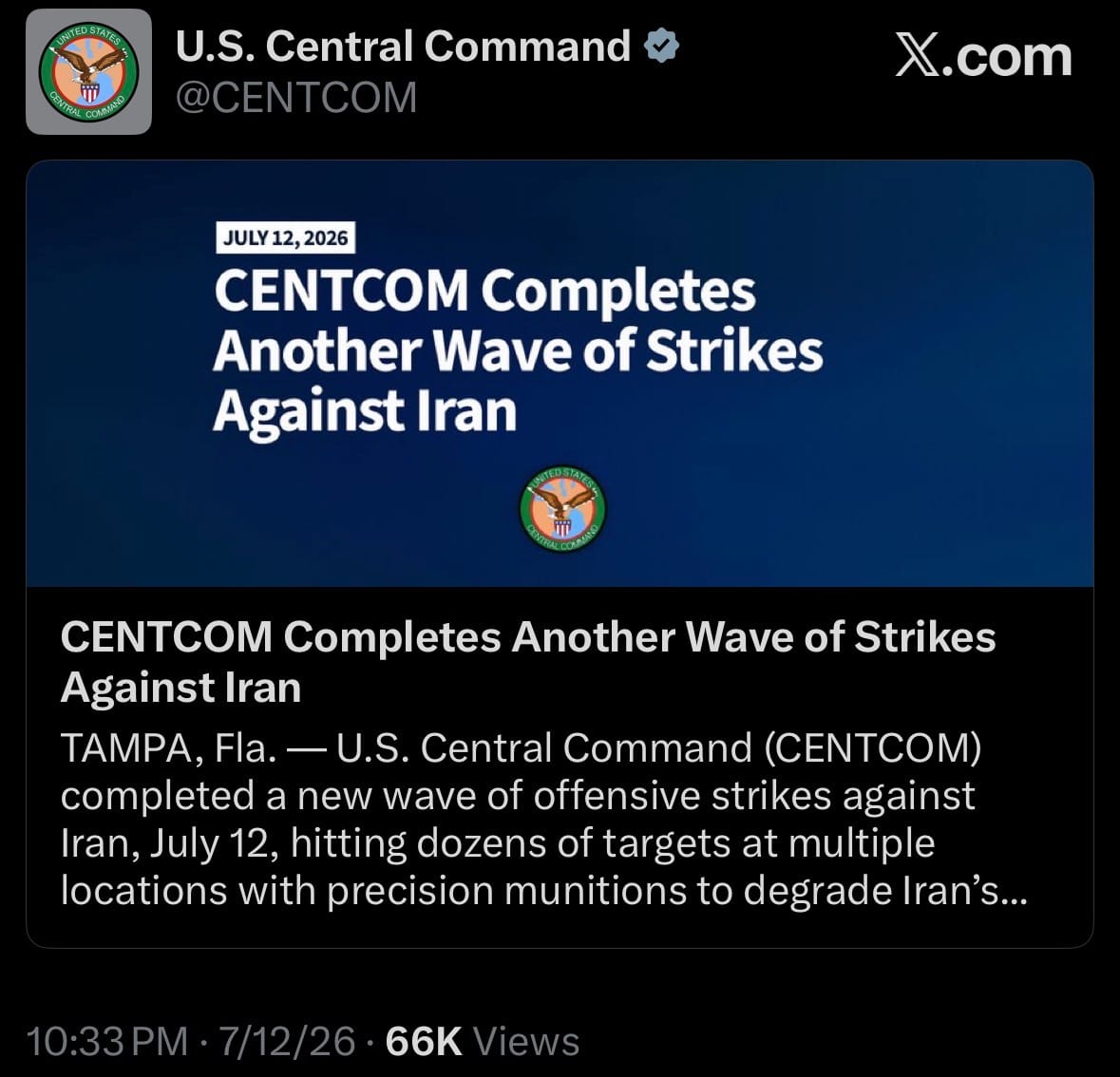
- Iran continues to claim exclusive management and control over the strait, asserting it alone can designate safe routes, while the U.S. maintains that navigation must remain free and open under international law, perpetuating the core dispute amid ongoing disruptions to the critical waterway.

Economics & Markets:
- The U.S. House will hold a hearing on the Crypto Clarity Act this Friday, July 18, 2026, just five days from today, as lawmakers continue efforts to establish clearer regulatory frameworks for digital assets.

- The bill aims to provide greater legal certainty for cryptocurrencies, addressing issues like market structure, innovation, and consumer protection in the evolving crypto industry.
Geopolitics & Military Activity:
- Yesterday, Ukrainian drones struck an oil refinery in Mikhaylovsk in southern Russia, part of ongoing long-range attacks on Russian energy infrastructure. The strike highlights Ukraine’s strategy of targeting refineries to disrupt Russian fuel supplies and logistics amid the continued conflict.

Science & Technology:
- Anthropic is extending access to Claude Fable 5 on all paid plans and maintaining 50% higher weekly rate limits for Claude Code through July 19. The move provides continued availability of the advanced model during a period of high demand and ongoing rollout adjustments.

Statistic:
- Largest cryptocurrencies on Earth by market capitalization:
- ₿ Bitcoin (BTC): $1.285T
- Ethereum (ETH): $219.05B
- Tether (USDT): $184.22B
- BNB: $77.83B
- USD Coin (USDC): $73.37B
- XRP: $68.44B
- Solana (SOL): $44.97B
- TRON (TRX): $31.44B
- WhiteBIT Coin (WBT): $16.51B
- Hyperliquid (HYPE): $15.07B
- Dogecoin (DOGE): $11.33B
- USDS: $10.95B
- Rain (RAIN): $9.55B
- Zcash (ZEC): $9.03B
- LEO Token (LEO): $8.80B
- Stellar (XLM): $6.41B
- Monero (XMR): $6.20B
- Cardano (ADA): $6.10B
- Chainlink (LINK): $6.04B
- Canton (CC): $5.25B
- Bitcoin Cash (BCH): $4.93B
- Dai (DAI): $4.64B
- DeXe (DEXE): $4.51B
- Gram (GRAM): $4.46B
- USD1: $4.46B
- Ethena USDe (USDE): $3.95B
- Litecoin (LTC): $3.44B
History
- Artificial Intelligence (AI) is the effort to build machines capable of performing tasks that normally require human intelligence, including reasoning, learning, language, perception, planning, and decision-making. Its roots stretch back centuries through mechanical automata and mathematical logic, but the modern era began with George Boole’s Boolean Algebra (1854), which established mathematical logic for computation, and Alan Turing’s concept of the universal computer in 1936, followed by his landmark paper “Computing Machinery and Intelligence” (1950) introducing the Turing Test. The field officially received its name at the Dartmouth Conference in 1956, organized by John McCarthy, Marvin Minsky, Claude Shannon, and Nathaniel Rochester. Early AI relied on symbolic reasoning and manually written rules. Systems such as Logic Theorist (1956), General Problem Solver (1957), ELIZA (1966), SHRDLU (1970), and medical expert systems like MYCIN (1972) demonstrated impressive capabilities within narrow domains but struggled outside predefined rules. Funding slowed during the AI Winters (1974–1980 and 1987–1993) as expectations exceeded available computing power and data. Meanwhile, Machine Learning (ML) emerged as a different approach: instead of programming rules, computers learned statistical patterns from data. Milestones included Arthur Samuel’s self-learning checkers program (1959), the Perceptron (1957), backpropagation (1986), Support Vector Machines (1995), and IBM Deep Blue defeating world chess champion Garry Kasparov in 1997, proving machine learning could outperform humans in highly structured domains.
- The modern AI revolution began with deep learning, which uses large neural networks trained on massive datasets. Improvements in GPUs, cloud computing, and data availability enabled much larger models than previously possible. The breakthrough came with AlexNet (2012), which dramatically outperformed previous image-recognition systems and launched the deep learning era. AI rapidly expanded into computer vision, speech recognition, natural language processing, recommendation systems, autonomous driving, robotics, and medical imaging. Landmark achievements followed: DeepMind’s AlphaGo defeated Lee Sedol in 2016, transformers were introduced in the paper “Attention Is All You Need” (2017), fundamentally changing AI architecture, and BERT (2018) transformed language understanding. Computer vision evolved from simple object detection into systems capable of identifying faces, vehicles, weapons, terrain, infrastructure, and medical abnormalities. Audio models progressed from basic speech recognition to highly accurate transcription, multilingual translation, voice synthesis, voice cloning, music generation, and natural real-time conversation. Video AI advanced from recognizing actions in clips to generating realistic video with consistent motion, lighting, physics, and audio. Military applications evolved alongside commercial AI. Programs such as the U.S. Department of Defense’s Project Maven (2017) applied machine learning to drone imagery, satellite intelligence, surveillance feeds, object recognition, logistics, predictive maintenance, cybersecurity, and battlefield decision support. Similar AI systems are now being developed by major military powers including the United States, China, Russia, Israel, the United Kingdom, France, and others, supporting intelligence analysis, autonomous drones, missile defense, electronic warfare, and command-and-control systems.
- The current era is defined by Foundation Models and Large Language Models (LLMs). OpenAI released GPT-1 (2018), GPT-2 (2019), GPT-3 (2020), and ChatGPT on November 30, 2022, introducing conversational AI to hundreds of millions of users. Anthropic, founded in 2021 by former OpenAI researchers, released Claude in 2023, emphasizing long-context reasoning, coding, enterprise workflows, and AI safety. Google developed the Gemini family, Meta released Llama, xAI introduced Grok, Mistral released high-performance open-weight models, and Chinese companies including DeepSeek, Alibaba (Qwen), Tencent (Hunyuan), Moonshot AI (Kimi), Zhipu AI, and Baidu (ERNIE) rapidly advanced domestic frontier models. By 2026, frontier AI systems—including GPT-5.6, Claude Sonnet 5, Claude Opus 4.8, Gemini 3, and leading open-weight models—are multimodal systems capable of understanding and generating text, code, images, video, audio, documents, spreadsheets, diagrams, and live computer interactions. They can write software, browse the web, analyze scientific literature, operate computers, coordinate autonomous software agents, reason across millions of tokens of context, assist engineers, researchers, physicians, lawyers, analysts, and businesses, and increasingly interact with robotics. AI is also being integrated into scientific discovery, drug development, financial markets, cybersecurity, manufacturing, space exploration, defense, and education. The frontier is now shifting from passive chatbots toward agentic AI—systems that plan, use tools, execute complex workflows, collaborate with other AI systems, and operate autonomously under human supervision. The global competition is no longer only about building the smartest model; it is increasingly about controlling the underlying semiconductor supply chain, advanced GPUs, data centers, electricity generation, networking infrastructure, robotics, proprietary datasets, and the software ecosystems that determine who can deploy intelligence at planetary scale.
Image of the day:

Thanks for reading! Earth is complicated, we make it simple.
- Download our mobile app:


Click below to view our previous newsletters:

Support/Suggestions Email:
support@earthintel.io