Tuesday☕️


Trending:
- Ten Japan-linked oil tankers have departed the Strait of Hormuz after months of being stranded in the Gulf due to security disruptions and restrictions during the US-Iran tensions.
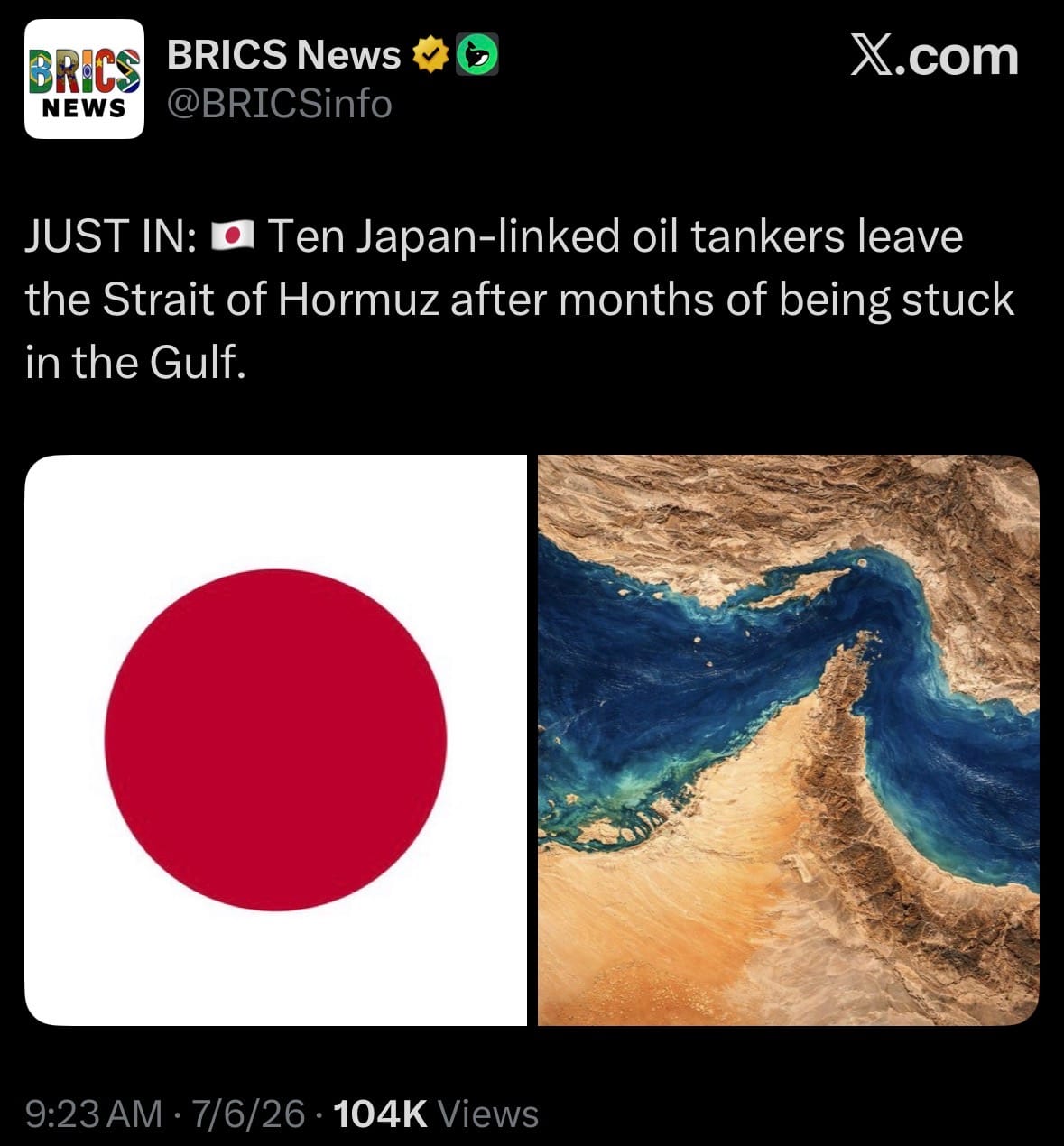
- The movement signals a gradual normalization of shipping in the vital waterway, though traffic remains below pre-crisis levels amid lingering risks and operational caution.
Economics & Markets:
- SpaceX will officially join the Nasdaq-100 index on July 7, 2026, before markets open, following its recent addition to the Russell 1000.
- J.P. Morgan estimates around $4.3 billion in passive buying from funds like QQQ, automatically giving millions of investors exposure to the company.
Geopolitics & Military Activity:
- A Russian missile-and-drone barrage struck Kyiv overnight into Monday, July 6, 2026, killing at least 22 people (including seven children) in and around the capital with dozens wounded, as rescue efforts continue in heavily damaged residential districts like Podilsky and Darnytskyi.
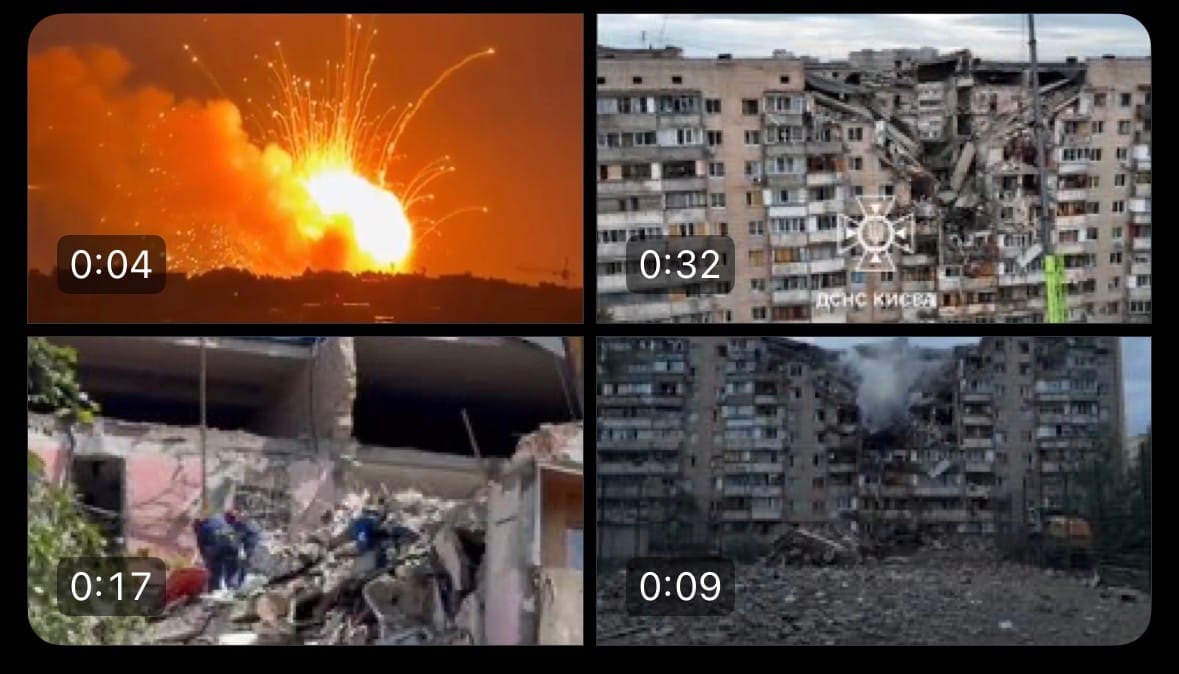
- Ukraine reported Russia launched 68 missiles and 351 drones with no ballistic missiles intercepted, while Russia claimed strikes on military-industrial and energy targets; the attack comes ahead of the NATO summit in Ankara and follows a pattern of intensified strikes on civilian areas amid ongoing Ukraine strikes on Russian oil infrastructure.
Chinese Missile Launch:
- On July 6, 2026, at 12:01 local time, a Chinese nuclear-powered submarine successfully launched an intercontinental ballistic missile into the Pacific Ocean as part of a test demonstrating its strategic deterrent capabilities.
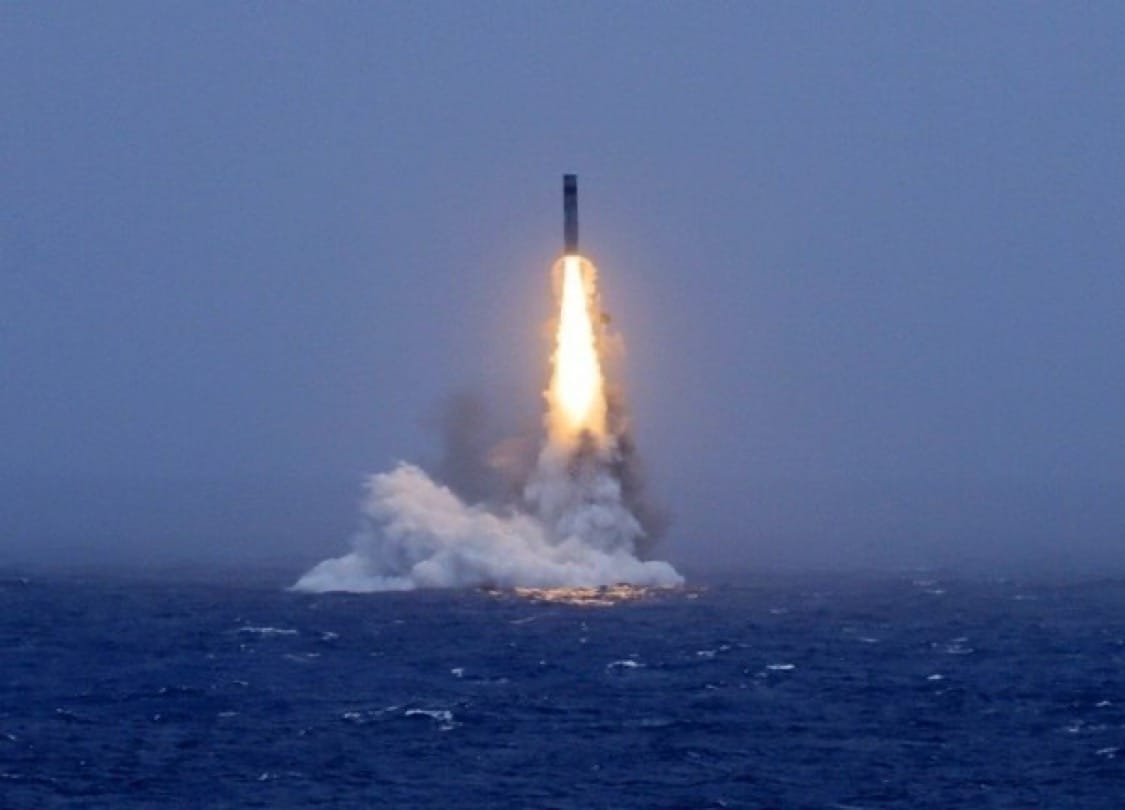
- The launch, from a Type 094 Jin-class submarine carrying JL-2 or JL-3 missiles, underscores China’s advancing underwater nuclear strike options amid regional tensions.
Statistic:
- Largest public semiconductor companies by market capitalization:
- 🇺🇸 NVIDIA: $4.736T
- 🇹🇼 TSMC: $2.343T
- 🇺🇸 Broadcom: $1.778T
- 🇰🇷 Samsung: $1.364T
- 🇺🇸 Micron Technology: $1.112T
- 🇰🇷 SK Hynix: $1.087T
- 🇺🇸 AMD: $900.17B
- 🇳🇱 ASML: $703.41B
- 🇺🇸 Intel: $614.17B
- 🇺🇸 Applied Materials: $470.65B
- 🇺🇸 Lam Research: $437.94B
- 🇬🇧 Arm Holdings: $344.17B
- 🇺🇸 KLA: $304.76B
- 🇺🇸 Texas Instruments: $276.21B
- 🇺🇸 Marvell Technology: $218.24B
- 🇹🇼 MediaTek: $205.75B
- 🇯🇵 Tokyo Electron: $202.86B
- 🇺🇸 QUALCOMM: $196.54B
- 🇺🇸 Analog Devices: $189.39B
- 🇯🇵 Advantest: $132.15B
- 🇨🇳 Cambricon Technologies: $126.89B
- 🇩🇪 Infineon: $114.79B
- 🇹🇼 ASE Group: $95.04B
- 🇨🇳 NAURA Technology Group: $85.98B
- 🇺🇸 Synopsys: $84.68B
- 🇨🇳 SMIC: $82.68B
- 🇺🇸 Astera Labs: $74.17B
History:
- Ballistic missiles are among the most consequential weapons ever developed, capable of striking targets hundreds to thousands of miles away by traveling high into the atmosphere—or even into space—before descending at extreme speeds. The concept dates back centuries to 13th-century China, where early gunpowder rockets were used in warfare. Modern rocketry emerged in the late 1800s and early 1900s through pioneers such as Konstantin Tsiolkovsky (Russia), Robert Goddard (United States), and Hermann Oberth (Germany), who established the scientific foundations of rocket flight. During World War II, Nazi Germany developed the V-2 rocket, first launched operationally in 1944. Designed by Wernher von Braun, it became the world’s first long-range guided ballistic missile, reaching speeds over Mach 4 and altitudes above 80 km, making it the first human-made object to reach the edge of space. Following Germany’s defeat in 1945, both the United States and Soviet Union competed to capture V-2 technology and German rocket scientists. This directly fueled both the Space Race and the ballistic missile age, leading to the development of increasingly powerful missiles capable of carrying conventional and nuclear warheads.
- During the Cold War (1947–1991), ballistic missiles became the foundation of nuclear deterrence. The Soviet Union launched the world’s first Intercontinental Ballistic Missile (ICBM), the R-7 Semyorka, in 1957, which also launched Sputnik 1, the first artificial satellite. The United States soon fielded the Atlas, Titan, and later Minuteman ICBMs. Ballistic missiles evolved into several categories: Short-Range Ballistic Missiles (SRBMs) under 1,000 km, Medium-Range (MRBMs) from 1,000–3,000 km, Intermediate-Range (IRBMs) from 3,000–5,500 km, and Intercontinental Ballistic Missiles (ICBMs) exceeding 5,500 km, with many capable of ranges greater than 12,000 km. During the 1960s–1980s, both superpowers deployed thousands of nuclear missiles on land, submarines, and bombers, creating the nuclear triad. Technologies advanced rapidly, introducing solid-fuel rockets, Multiple Independently Targetable Reentry Vehicles (MIRVs) in the 1970s, maneuverable reentry vehicles, and increasingly accurate guidance systems. The Cuban Missile Crisis (1962) demonstrated how ballistic missiles could bring the world to the brink of nuclear war, while arms-control treaties such as SALT I (1972), INF (1987), START I (1991), and New START (2010) sought to limit strategic arsenals.
- By 2026, ballistic missiles remain central to global military strategy. The United States, Russia, and China possess the world’s largest and most advanced ballistic missile forces, while France, the United Kingdom, India, Pakistan, North Korea, and Israel also field strategic ballistic missile capabilities. Russia operates systems such as the RS-24 Yars, Sarmat (RS-28), and submarine-launched Bulava, while the United States fields the Minuteman III (with the LGM-35 Sentinel under development), Trident II D5 submarine-launched missiles, and advanced missile defense systems including Ground-Based Midcourse Defense (GMD), Aegis, and THAAD. China has rapidly expanded its missile force with systems such as the DF-21, DF-26, DF-31, and DF-41, alongside hundreds of new missile silos. Modern ballistic missiles can carry conventional, nuclear, maneuverable, or even hypersonic glide vehicle payloads, making interception increasingly difficult. They travel into space before reentering the atmosphere at speeds often exceeding Mach 20, leaving defenders only minutes to detect, track, and respond. What began with primitive rockets over 700 years ago has evolved into one of the most powerful strategic technologies ever created, shaping deterrence, space exploration, missile defense, and the global balance of power for more than half a century.
Image of the day:

Thanks for reading! Earth is complicated, we make it simple.
- Download our mobile app:


Click below to view our previous newsletters:

Support/Suggestions Email:
support@earthintel.io