Wednesday☕️🌎


Trending:
- Over the past 48 hours, Iranian forces attacked three commercial vessels in the Strait of Hormuz, prompting the US Treasury to revoke Iran’s temporary authorization to sell oil internationally and US Central Command to launch strikes on Iranian military targets in retaliation.
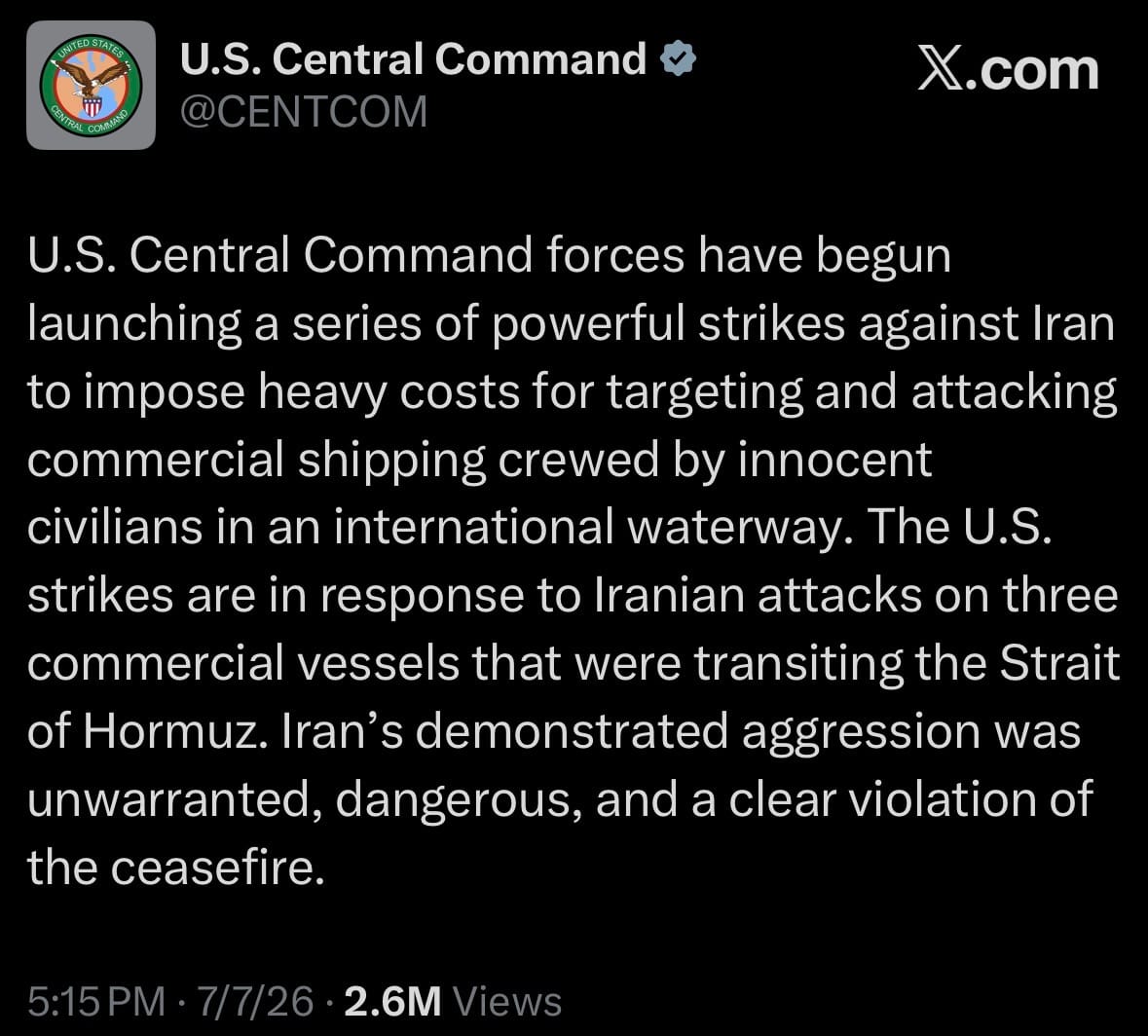
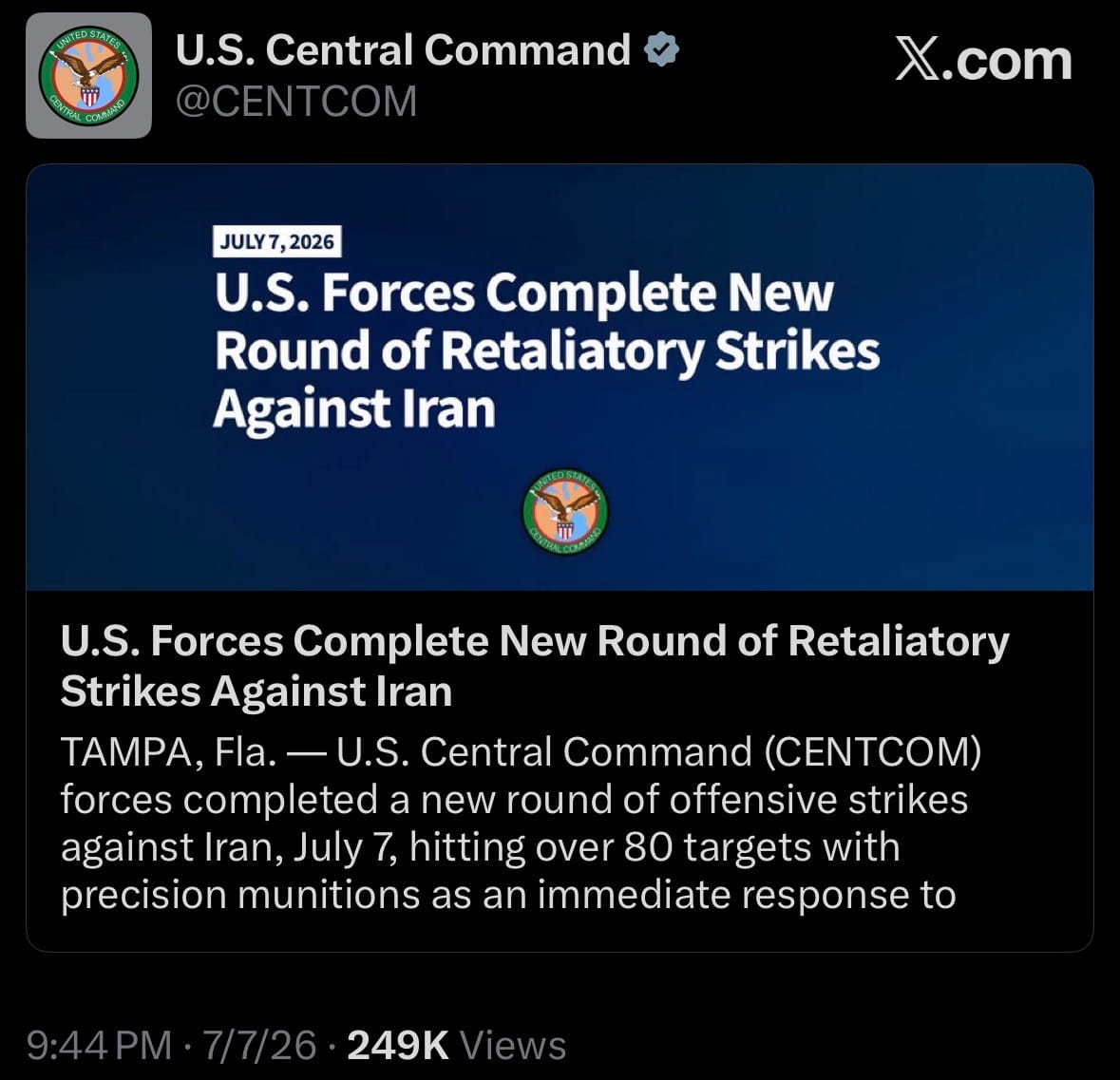
- The escalation has heightened tensions, disrupted shipping, and raised risks to global oil flows through the critical waterway.
Science & Technology:
- Poland’s Polska Grupa Zbrojeniowa and Anduril Industries announced a cooperative agreement to establish localized production of surface-launched Barracuda-500M cruise missiles in Bydgoszcz, Poland, signed with Prime Minister Donald Tusk and Defense Minister Władysław Kosiniak-Kamysz.
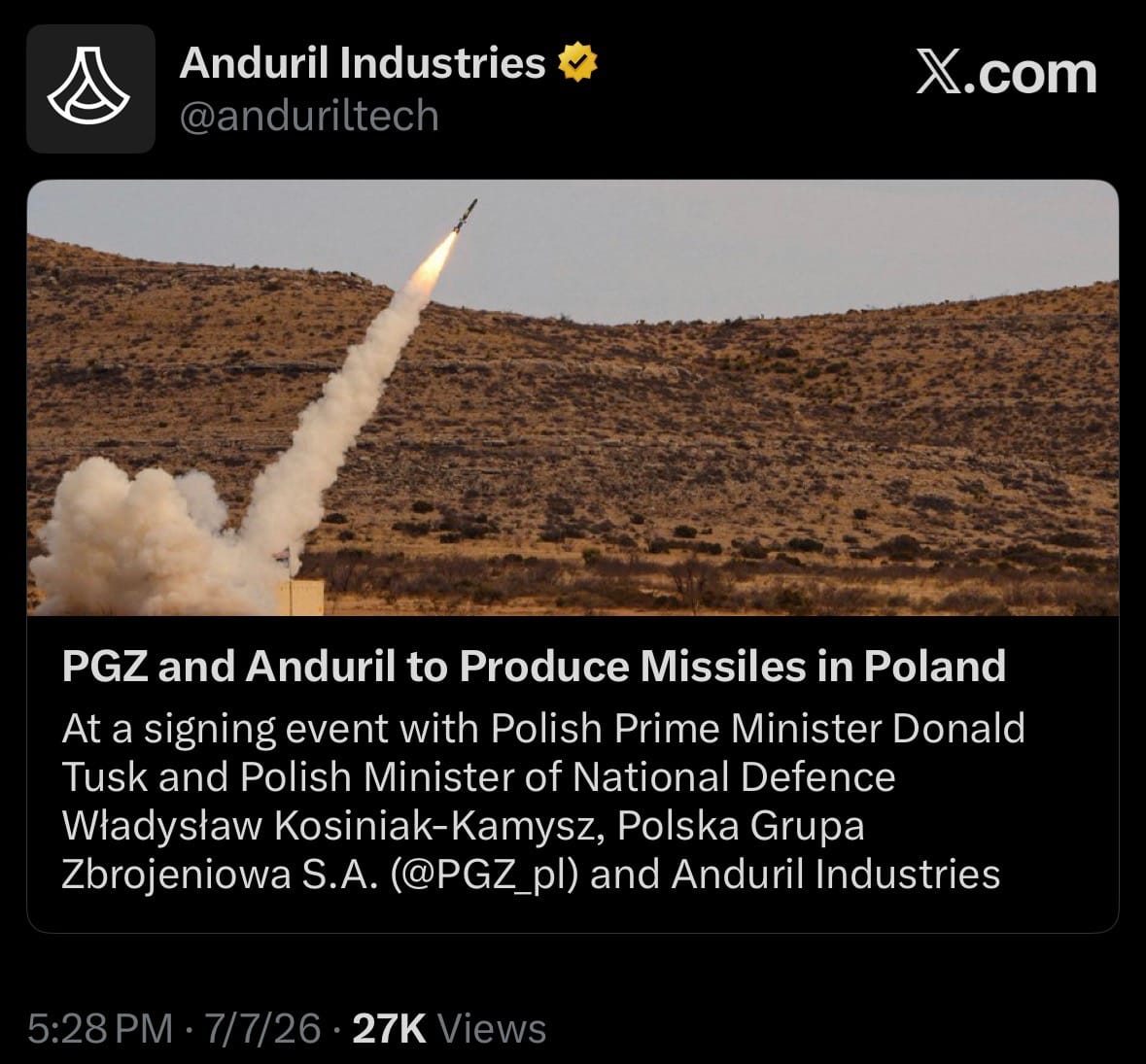
- The long-range precision weapon is designed for cost-effective mass production to meet urgent deterrence needs along NATO’s eastern flank.
Space:
- On July 7, 2026, SpaceX launched Transporter-17, a dedicated rideshare mission deploying dozens of small satellites and payloads into sun-synchronous orbit aboard a Falcon 9 rocket from Vandenberg Space Force Base in California.
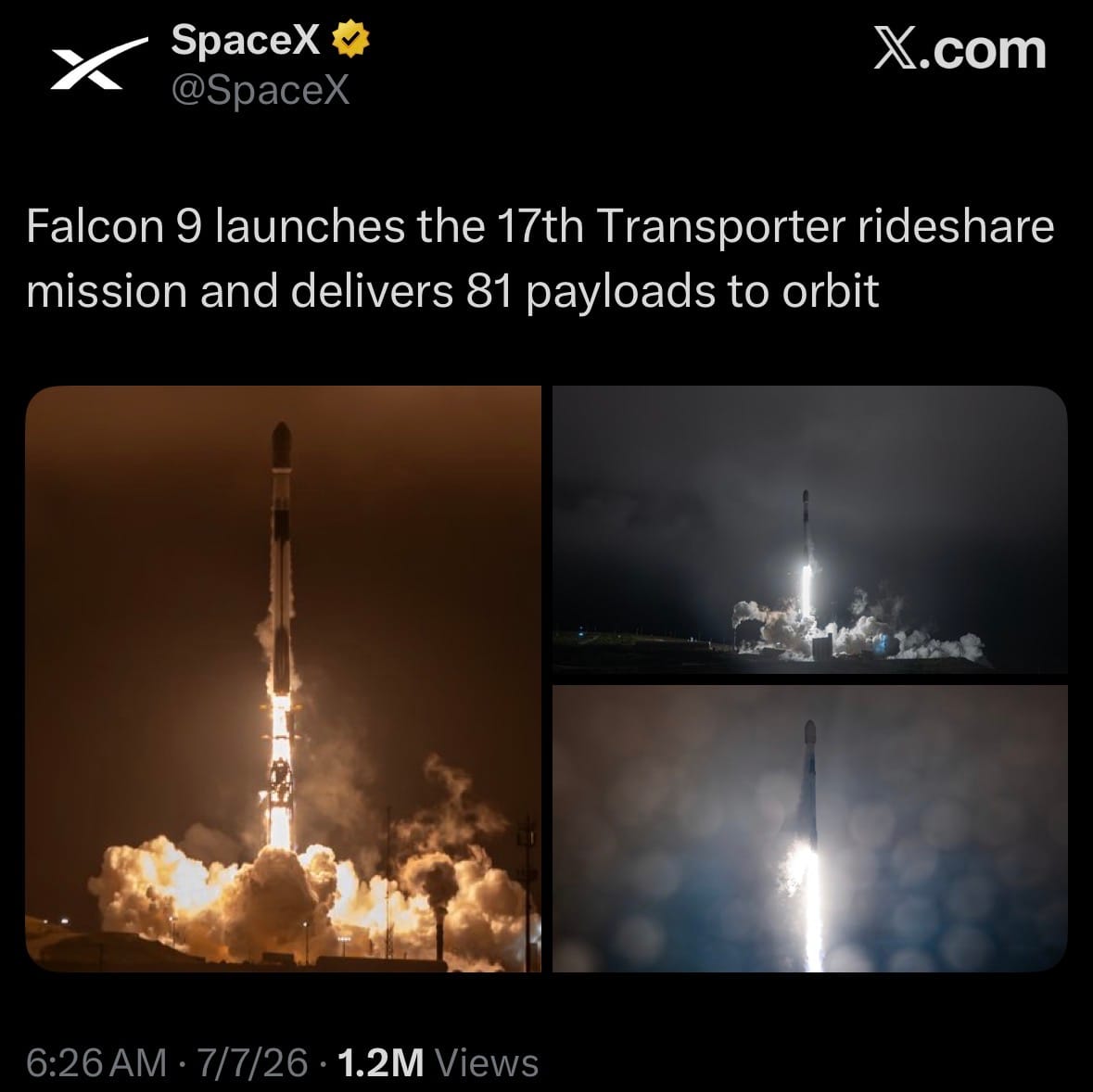
- The mission included a mix of commercial, government, and international payloads such as Earth observation satellites, technology demonstrators, and research spacecraft from various operators.
Statistic:
- Largest assets on Earth by market capitalization:
- 🥇 Gold: $28.701T
- 🇺🇸 NVIDIA: $4.769T
- 🇺🇸 Apple: $4.562T
- 🇺🇸 Alphabet (Google): $4.437T
- 🥈 Silver: $3.398T
- 🇺🇸 Microsoft: $2.888T
- 🇺🇸 Amazon: $2.646T
- 🇹🇼 TSMC: $2.243T
- 🇺🇸 SpaceX: $1.969T
- 🇺🇸 Broadcom: $1.764T
- 🇸🇦 Saudi Aramco: $1.685T
- 🇺🇸 Meta Platforms (Facebook): $1.562T
- 🇺🇸 Tesla: $1.513T
- ₿ Bitcoin: $1.260T
- 🇰🇷 Samsung: $1.245T
- 🇺🇸 Eli Lilly: $1.101T
- 🇺🇸 Berkshire Hathaway: $1.087T
- 🇺🇸 Micron Technology: $1.059T
- 🇰🇷 SK Hynix: $1.051T
- 🇺🇸 Vanguard S&P 500 ETF: $983.65B
- 🇺🇸 JPMorgan Chase: $908.94B
- 🇺🇸 iShares Core S&P 500 ETF: $888.22B
- 🇺🇸 Walmart: $887.64B
- 🇺🇸 AMD: $841.56B
- 🇺🇸 SPDR S&P 500 ETF: $779.65B
- 🇳🇱 ASML: $673.43B
- 🇺🇸 Visa: $669.79B
History:
- The U.S. National Reconnaissance Office (NRO) is one of the most secretive organizations ever created and is responsible for designing, building, launching, and operating the United States’ intelligence satellites. Its origins lie in the early Cold War, when the United States needed reliable intelligence on Soviet nuclear weapons and military capabilities. Before satellites, reconnaissance relied on high-risk aircraft such as the U-2 spy plane, which first flew in 1955. After the 1960 U-2 Incident, when pilot Francis Gary Powers was shot down over the Soviet Union, U.S. leaders accelerated space-based reconnaissance. On September 6, 1961, the NRO was established as a classified joint organization between the Department of Defense and the CIA, although its existence remained officially secret until 1992. One of its first major successes was the CORONA program (1960–1972), the world’s first successful reconnaissance satellite system. CORONA satellites photographed Soviet missile sites, military bases, airfields, and nuclear facilities using film capsules that were physically ejected from orbit and caught midair by U.S. aircraft. The program returned over 800,000 images and fundamentally changed intelligence gathering, reducing uncertainty about Soviet military strength while helping prevent strategic miscalculations during the Cold War.
- Throughout the 1960s, 1970s, and 1980s, the NRO became the backbone of U.S. space-based intelligence. It developed increasingly advanced satellite families including KH (KeyHole) optical reconnaissance satellites capable of extremely high-resolution imaging, Lacrosse/Onyx radar satellites able to image through clouds and at night, and SIGINT satellites that intercepted military communications, radar emissions, missile telemetry, and electronic signals. The NRO also supported early-warning satellites capable of detecting ballistic missile launches within seconds. During major events such as the Cuban Missile Crisis (1962), the Vietnam War, the Yom Kippur War (1973), the Gulf War (1991), and the collapse of the Soviet Union, NRO satellites provided continuous intelligence to U.S. leaders and military commanders. The agency worked closely with the CIA, NSA, DIA, NGA, U.S. Strategic Command, and later U.S. Space Force, creating one of the most sophisticated intelligence architectures ever built. Many of the NRO’s satellites remain classified, with only limited information publicly available, but they are believed to include some of the largest and most capable spacecraft ever launched.
- By 2026, the NRO operates the world’s most advanced reconnaissance satellite constellation, with well over 100 classified satellites in orbit and dozens more launched in partnership with commercial providers such as SpaceX and United Launch Alliance (ULA). Its systems support electro-optical imaging, synthetic aperture radar (SAR), signals intelligence (SIGINT), missile warning, maritime surveillance, battle damage assessment, geospatial intelligence, and real-time targeting for U.S. military and intelligence operations. The agency has shifted toward deploying large constellations of smaller satellites alongside traditional large reconnaissance spacecraft, greatly increasing revisit rates and resilience. NRO intelligence supports virtually every major U.S. military operation, from counterterrorism to monitoring China, Russia, Iran, North Korea, and global missile launches. Working alongside the National Geospatial-Intelligence Agency (NGA), which analyzes imagery, the NSA, which analyzes communications, and the CIA, which collects human intelligence, the NRO provides the “eyes in space” for the United States. From recovering film canisters in the 1960s to operating AI-assisted satellite constellations today, the NRO has become one of the most technologically advanced and strategically important intelligence organizations in the world, providing persistent global surveillance that underpins U.S. national security and military decision-making.
Image of the day:

Thanks for reading! Earth is complicated, we make it simple.
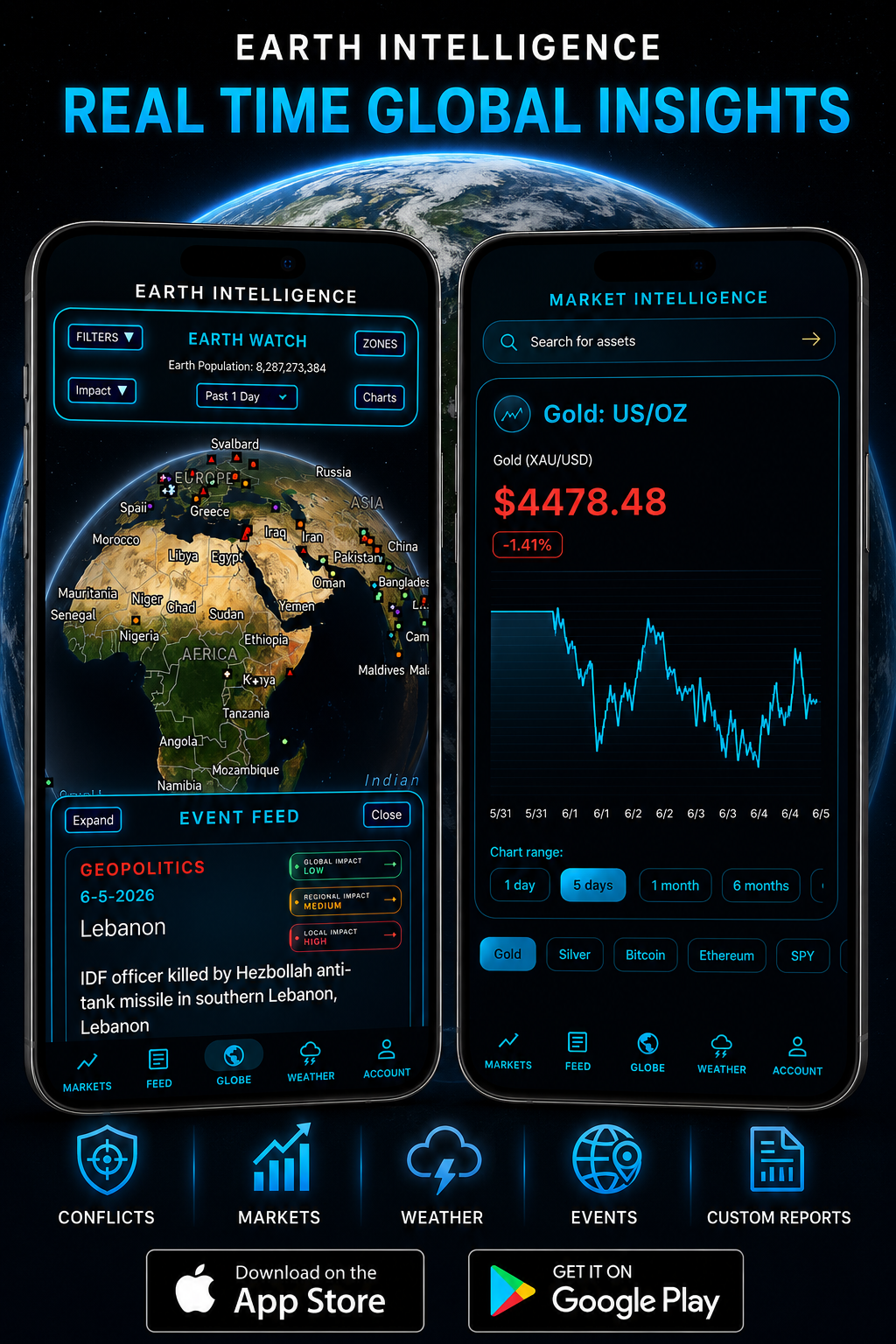
- Download our mobile app:


Click below to view our previous newsletters:

Support/Suggestions Email:
support@earthintel.io