Tuesday☕️🌎

Economics & Markets:
- July 27, 2026: The Digital Asset Market Clarity Act (CLARITY Act), which defines regulatory jurisdiction by giving the CFTC authority over digital commodity spot markets while keeping SEC oversight of investment contracts and setting clear rules for crypto trading platforms, has passed the House and cleared the Senate Banking Committee.
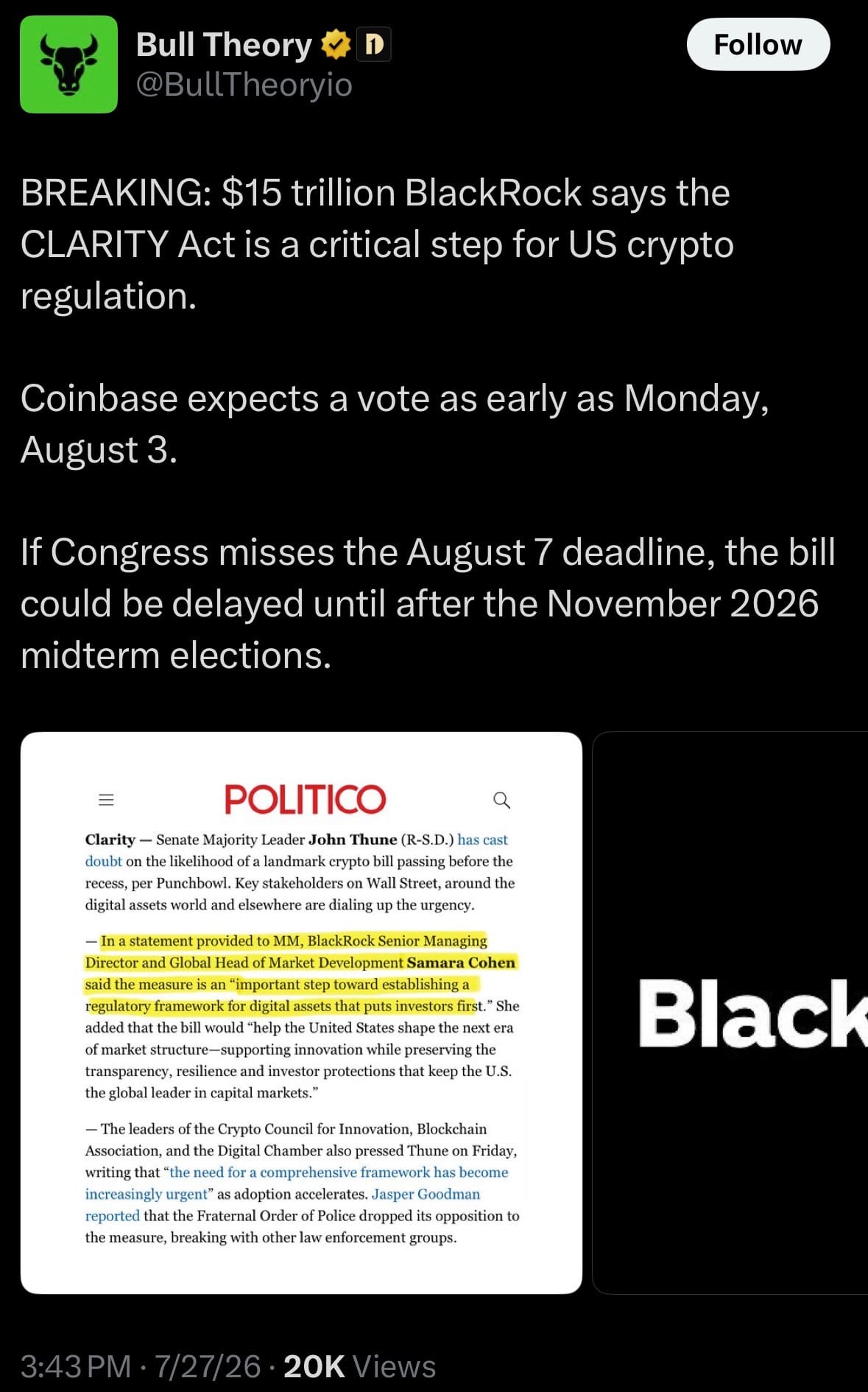
- A Senate floor vote is now expected on or around August 3, just before the August recess, as negotiators finalize remaining ethics and enforcement provisions.
Geopolitics & Military Activity:

Cyber:
- July 27, 2026: Cybersecurity firm Check Point reported that SparkKitty malware, hidden in apps on the Apple App Store and Google Play, scanned users’ photos for crypto wallet seed phrases using optical character recognition and uploaded them to attacker servers.

- The malware was embedded in the iOS crypto app “币coin” and the Android messaging/crypto exchange app “SOEX” (downloaded more than 10,000 times before removal), as well as modified TikTok and gambling apps distributed through official and third-party stores.
Space:
- July 27, 2026: Rocket Lab announced it is establishing its fourth launch complex in Kodiak, Alaska, to support its largest launch contract yet — a $266 million deal with the U.S. Space Force for up to 18 suborbital launches focused on missile defense testing.
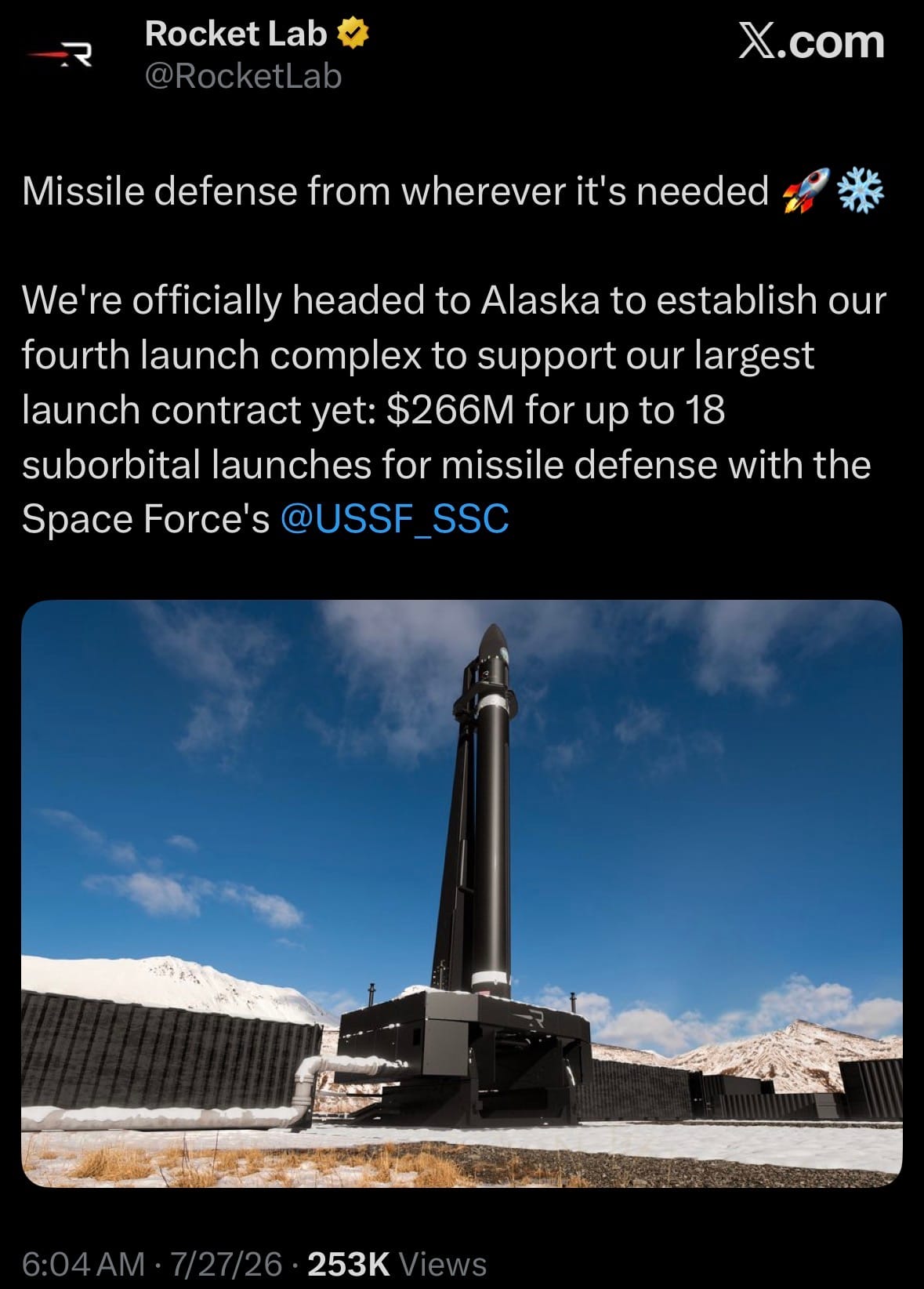
- The new site at the Pacific Spaceport Complex-Alaska will complement Rocket Lab’s existing facilities in New Zealand and Virginia, with the first mission expected no earlier than the end of 2026.
Statistic:
- Largest public financial service companies by market capitalization:
- 🇺🇸 JPMorgan Chase: $946.85B
- 🇺🇸 Visa: $689.43B
- 🇺🇸 Mastercard: $487.48B
- 🇺🇸 Bank of America: $436.02B
- 🇨🇳 China Construction Bank: $401.24B
- 🇬🇧 HSBC: $356.57B
- 🇨🇳 Agricultural Bank of China: $348.20B
- 🇺🇸 Morgan Stanley: $337.28B
- 🇨🇳 ICBC: $331.35B
- 🇺🇸 Goldman Sachs: $309.23B
- 🇨🇦 Royal Bank of Canada: $291.14B
- 🇨🇳 Bank of China: $286.22B
- 🇺🇸 Wells Fargo: $264.29B
- 🇯🇵 Mitsubishi UFJ Financial Group: $260.49B
- 🇺🇸 American Express: $228.84B
- 🇺🇸 Citigroup: $223.26B
- 🇦🇺 Commonwealth Bank: $205.82B
- 🇪🇸 Santander: $199.97B
- 🇨🇦 Toronto-Dominion Bank: $197.66B
- 🇯🇵 SoftBank Group: $185.57B
- 🇺🇸 Charles Schwab: $181.18B
- 🇨🇭 UBS: $172.21B
- 🇯🇵 Sumitomo Mitsui Financial Group: $167.34B
- 🇸🇬 DBS Group: $163.48B
- 🇨🇳 CM Bank: $157.47B
- 🇺🇸 Interactive Brokers: $156.51B
History:
- Goldman Sachs began in 1869, when German immigrant Marcus Goldman opened a small financial business in New York City that bought and sold short-term business debt known as commercial paper. In 1882, his son-in-law Samuel Sachs joined the firm, which became M. Goldman and Sachs and later Goldman, Sachs & Co. The company built its early reputation by helping businesses raise money and connecting merchants with investors. By the early 1900s, Goldman Sachs had expanded into investment banking and helped manage major stock offerings, including the 1906 public offering of Sears, Roebuck and Company, one of the largest retail companies of its era. The firm suffered a major setback after creating the Goldman Sachs Trading Corporation investment trust shortly before the 1929 stock market crash, causing significant investor losses and damaging its reputation. Under leader Sidney Weinberg, who became senior partner in 1930, Goldman rebuilt itself by emphasizing long-term corporate relationships, careful financial advice, and a culture of internal discipline. Weinberg became known as “Mr. Wall Street” and helped establish Goldman as a trusted adviser to major American companies and government leaders.
- After World War II, Goldman Sachs grew into one of the most influential investment banks in the world. It advised companies on mergers, acquisitions, stock offerings, bond sales, and major corporate restructurings. The firm worked on important transactions including Ford Motor Company’s 1956 public offering, which was one of the largest stock offerings in history at the time. During the 1970s and 1980s, Goldman expanded internationally and became a leader in trading, asset management, and mergers and acquisitions under figures such as Gustave Levy, John Whitehead, John Weinberg, Robert Rubin, and Stephen Friedman. Its culture became famous for recruiting highly competitive employees, promoting from within, maintaining strong client relationships, and operating as a private partnership in which senior partners personally shared the firm’s risks and profits. Goldman also developed a powerful network of former employees who later entered government, central banking, and corporate leadership. Notable alumni included Robert Rubin, who became U.S. Treasury secretary, and Mario Draghi, who later led the European Central Bank. In 1999, Goldman Sachs ended more than a century as a private partnership and became a publicly traded company, raising billions of dollars and giving it more capital to expand globally.
- During the 2000s, Goldman became a major force in global trading, investment banking, private equity, and asset management, but its influence also brought controversy. During the 2008 financial crisis, the firm faced heavy criticism over its role in mortgage-backed securities and its relationships with governments and financial institutions. Goldman converted into a bank holding company, received emergency access to Federal Reserve financing, and accepted $10 billion through the U.S. government’s bank-rescue program, which it later repaid. In 2010, it paid $550 million to settle allegations involving the Abacus mortgage investment without admitting or denying the most serious claims. In later years, Goldman expanded beyond traditional investment banking through consumer banking products such as Marcus, credit-card partnerships, wealth management, and financial technology, although it later reduced parts of its consumer-banking strategy after significant losses. Today, Goldman Sachs remains one of the world’s most powerful financial institutions, advising governments and corporations, managing investments for wealthy individuals and institutions, arranging mergers and public offerings, and trading securities across global markets. Its history reflects both the growth of modern finance and the recurring concerns surrounding Wall Street influence, financial risk, government connections, and the power of large investment banks.
Image of the day:

Thanks for reading! Earth is complicated, we make it simple.
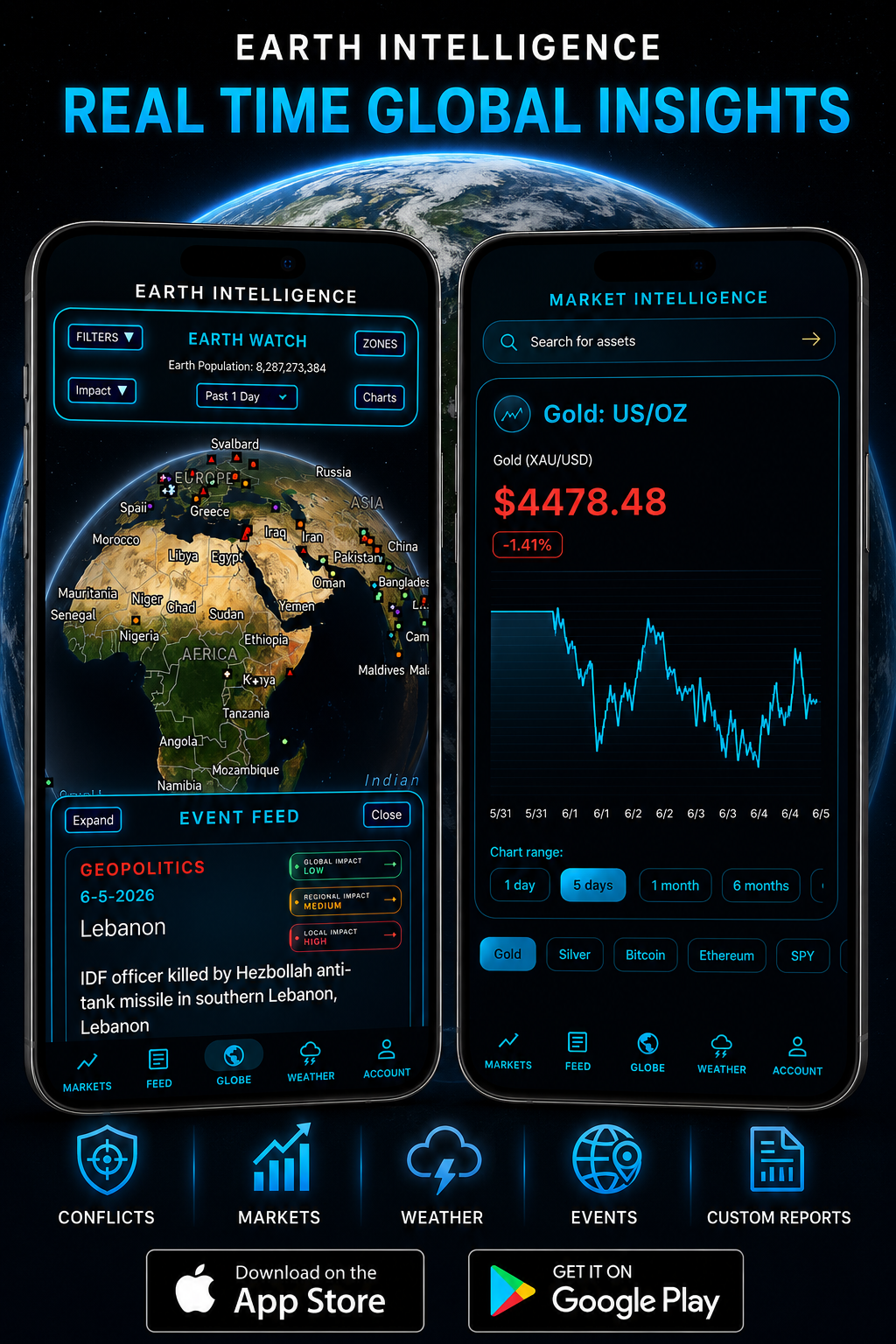
- Download our mobile app:

Click below to view our previous newsletters:
Support/Suggestions Email:
support@earthintel.io