Wednesday☕️


Trending:
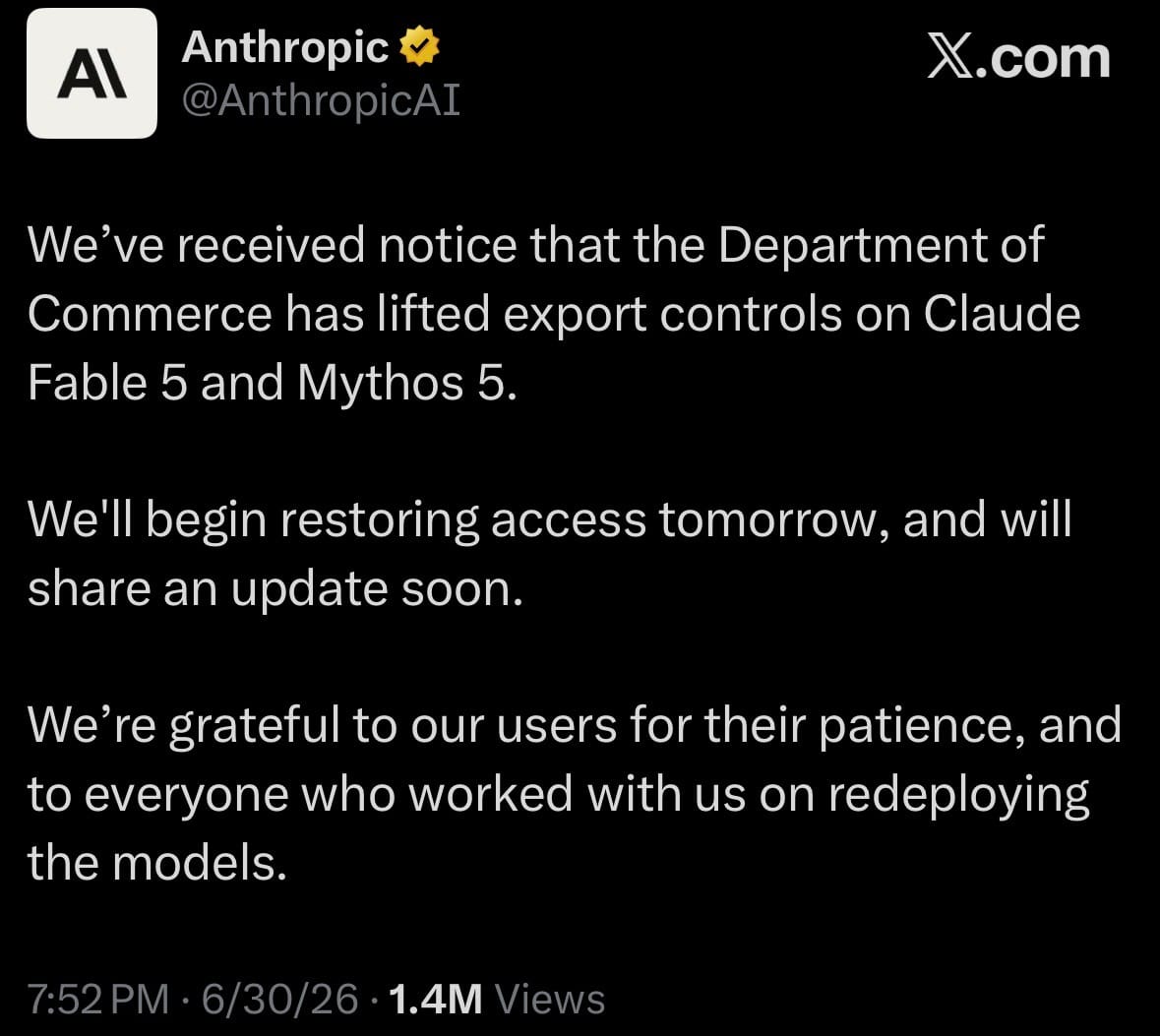
- The US Department of Commerce has lifted export controls on Anthropic’s Claude Fable 5 and Mythos 5 models, with access restoration beginning today after a period of restrictions.
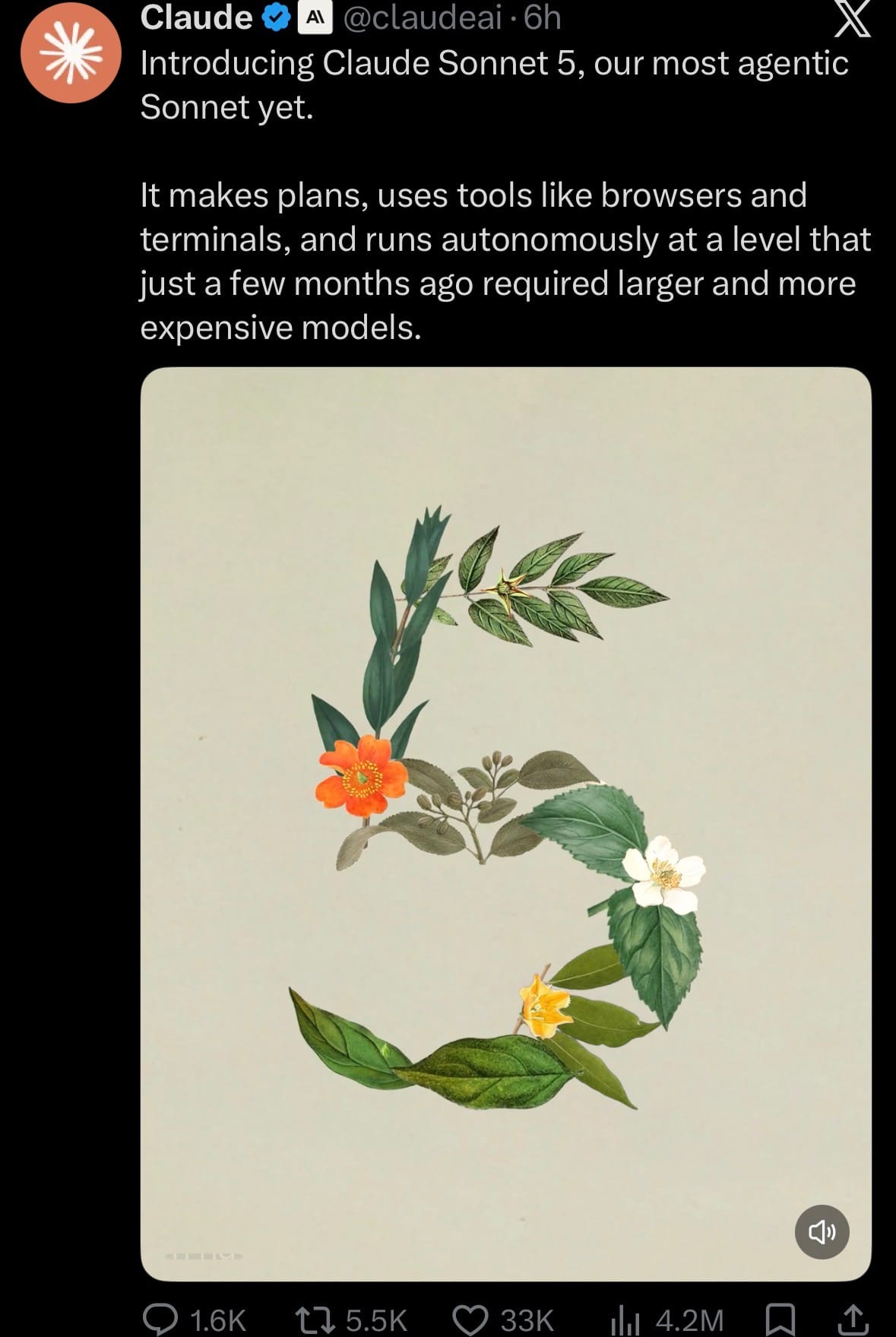
- Anthropic has also introduced Claude Sonnet 5, its most agentic Sonnet yet, capable of planning, using tools like browsers and terminals, and operating autonomously at levels previously requiring larger models.
Economics & Markets:
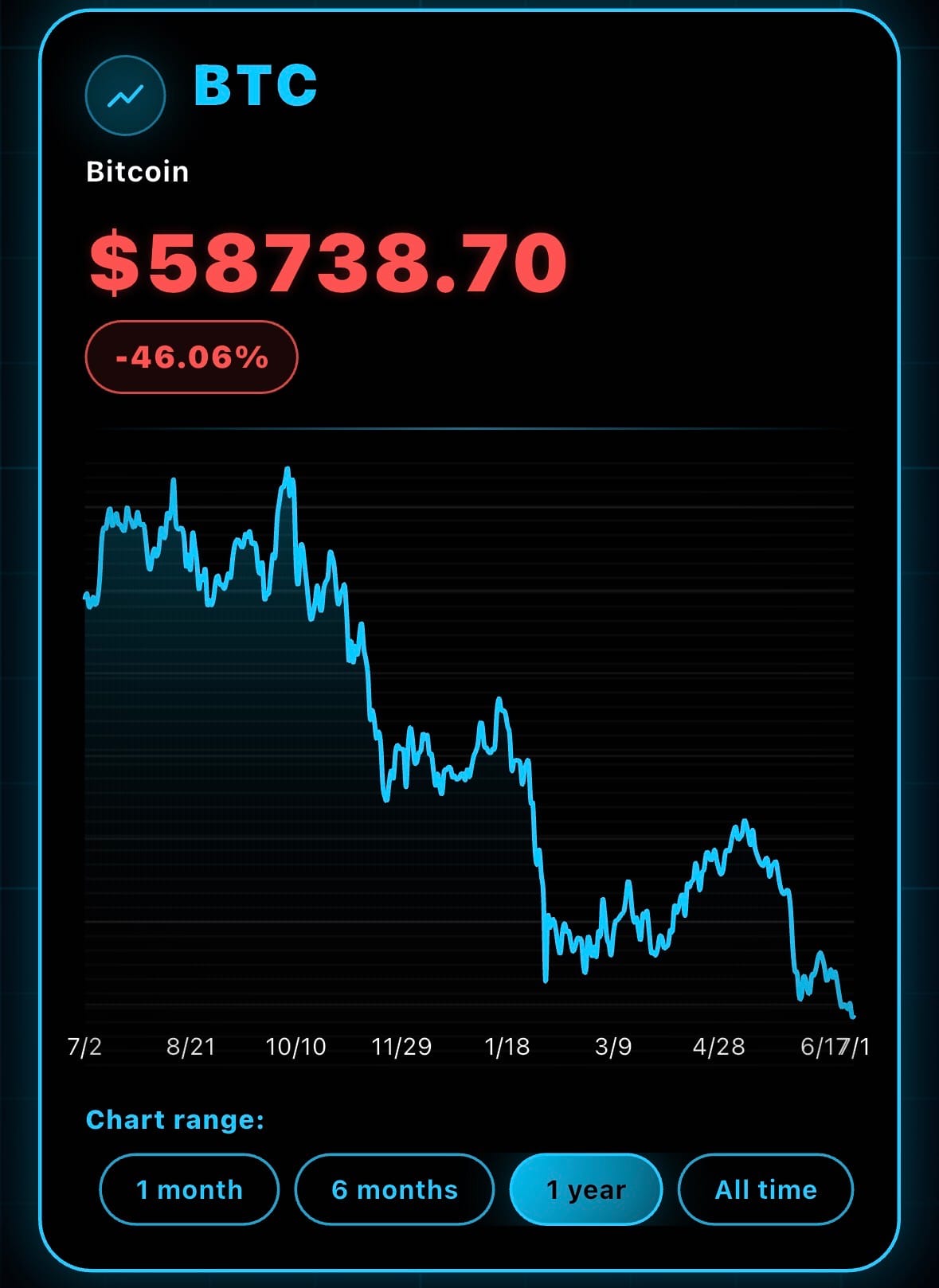
- Over the past year, Bitcoin reached an all-time high near $126,000 in October 2025 before a sharp correction, trading around $58,000–$60,000 as of early July 2026 (down roughly 45–50% from its peak and negative year-over-year performance).
- The broader crypto market followed similar volatility, influenced by macroeconomic factors, regulatory developments, and geopolitical events, with major assets like Ethereum also experiencing significant drawdowns from 2025 highs.
Geopolitics & Military Activity:

Science & Technology:
- Menace-I has integrated its proven deployable edge infrastructure into 10-ft portable data centers equipped with AWS Outposts, enabling full cloud capabilities in austere or disconnected environments.
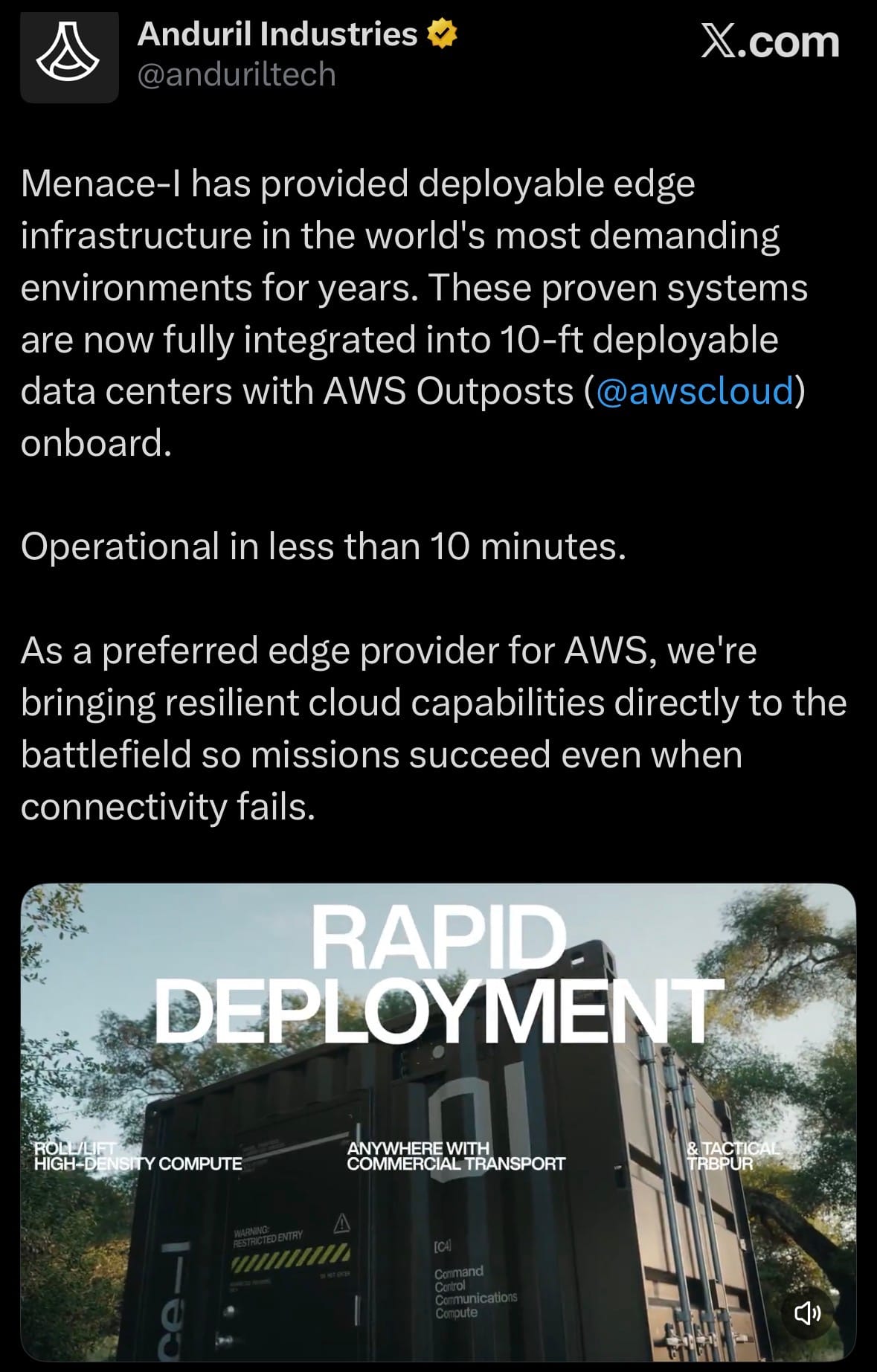
- The systems can become operational in under 10 minutes and are positioned as a preferred edge solution for AWS, supporting military and mission-critical operations by maintaining resilient computing even when traditional connectivity is unavailable.


Statistic:
- Largest assets on Earth by market capitalization:
- Gold: $27.788T
- 🇺🇸 NVIDIA: $4.846T
- 🇺🇸 Alphabet (Google): $4.311T
- 🇺🇸 Apple: $4.249T
- Silver: $3.296T
- 🇺🇸 Microsoft: $2.770T
- 🇺🇸 Amazon: $2.563T
- 🇹🇼 TSMC: $2.476T
- 🇺🇸 SpaceX: $2.250T
- 🇺🇸 Broadcom: $1.797T
- 🇸🇦 Saudi Aramco: $1.681T
- 🇺🇸 Tesla: $1.579T
- 🇺🇸 Meta Platforms: $1.429T
- 🇰🇷 Samsung: $1.371T
- 🇺🇸 Micron Technology: $1.303T
- 🇰🇷 SK Hynix: $1.178T
- ₿ Bitcoin: $1.166T
- 🇺🇸 Berkshire Hathaway: $1.079T
- 🇺🇸 Eli Lilly: $1.069T
- 📈 Vanguard S&P 500 ETF: $983.27B
- 🇺🇸 AMD: $947.23B
- 🇺🇸 Walmart: $901.33B
- 📈 iShares Core S&P 500 ETF: $887.88B
- 🇺🇸 JPMorgan Chase: $877.08B
- 📈 SPDR S&P 500 ETF: $790.85B
- 🇳🇱 ASML: $766.76B
History:
- Coffee is one of the world’s oldest and most influential beverages, shaping global trade, politics, culture, and economics for over 1,000 years. According to tradition, coffee was discovered around 850 AD in the Ethiopian region of Kaffa, where a goat herder named Kaldi noticed his goats becoming unusually energetic after eating berries from a wild plant. Although the story cannot be historically verified, Ethiopia is widely recognized as coffee’s birthplace. By the 1400s, coffee cultivation had spread across the Red Sea into Yemen, where Sufi monks drank it to stay awake during long prayers. The port city of Mocha became the world’s first major coffee export hub, giving rise to the term “mocha.” Throughout the 1500s, coffee spread rapidly across the Ottoman Empire, Persia, Egypt, and North Africa. The first coffeehouses opened in Constantinople (Istanbul) around 1554, becoming centers for business, politics, literature, science, and philosophy. Because people gathered to exchange ideas, some rulers viewed coffeehouses with suspicion, occasionally banning them, though the bans rarely lasted. Europeans first encountered coffee through trade with the Ottoman Empire, and by the 1600s, coffeehouses had opened in Venice (1645), Oxford (1650), London (1652), Paris (1672), and Vienna (1683). They became known as “Penny Universities” because, for the price of a cup of coffee, patrons could discuss politics, finance, and science with scholars, merchants, and philosophers.
- During the 1700s and 1800s, coffee became one of the world’s most valuable commodities. European colonial powers established massive plantations across Brazil, Colombia, Central America, Indonesia, India, Vietnam, and Africa. Brazil emerged as the dominant producer by the mid-1800s and remains the world’s largest producer today, supplying roughly 35–40% of global coffee. Two primary species came to dominate the market: Arabica, discovered in Ethiopia and Yemen, known for smoother flavor and accounting for roughly 60% of global production, and Robusta, identified in Central Africa during the late 1800s, valued for higher caffeine content, disease resistance, and stronger taste. The industrial era brought major innovations, including vacuum packaging (1900s), instant coffee (1901), espresso machines (1901), and later commercial chains such as Starbucks (founded 1971), which helped popularize specialty coffee worldwide beginning in the 1980s and 1990s. Coffee also played an important role during both World Wars, becoming a standard ration for U.S. and Allied troops because of its ability to improve alertness during long operations. Today, coffee supports the livelihoods of an estimated 125 million people worldwide, from farmers and exporters to roasters, logistics providers, and retailers.
- By 2026, coffee is the second most traded commodity in the world by value after crude oil in many historical commodity rankings, though exact rankings vary depending on the methodology and year. More than 2.25 billion cups are consumed every day worldwide. The largest producers are Brazil, Vietnam, Colombia, Indonesia, and Ethiopia, while the largest consuming markets include the United States, European Union, Brazil, and Japan. Companies such as Starbucks, Nestlé (Nescafé), JDE Peet’s, Lavazza, and Tim Hortons have helped build a global coffee industry worth hundreds of billions of dollars annually. Modern coffee production increasingly focuses on sustainability, climate resilience, specialty beans, and direct trade with growers, while climate change presents growing challenges for traditional coffee-growing regions. From its origins in the highlands of Ethiopia over a millennium ago to becoming one of the world’s most consumed beverages, coffee has influenced exploration, colonial expansion, global commerce, finance, science, military history, and everyday culture more than almost any other agricultural product in history.
Image of the day:

Thanks for reading! Earth is complicated, we make it simple.
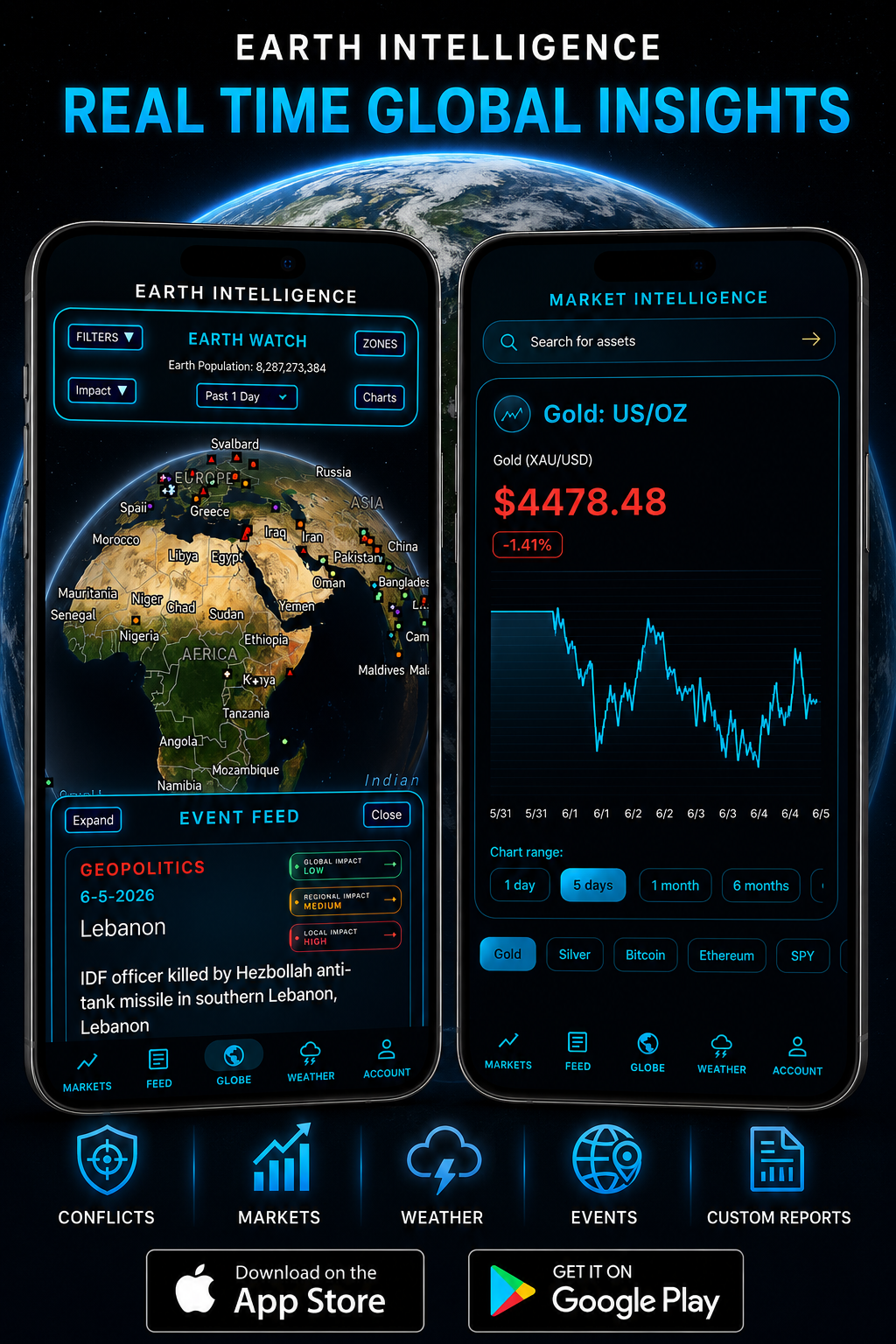
- Download our mobile app:


Click below to view our previous newsletters:
Support/Suggestions Email:
support@earthintel.io