Wednesday☕️🌎


Trending:
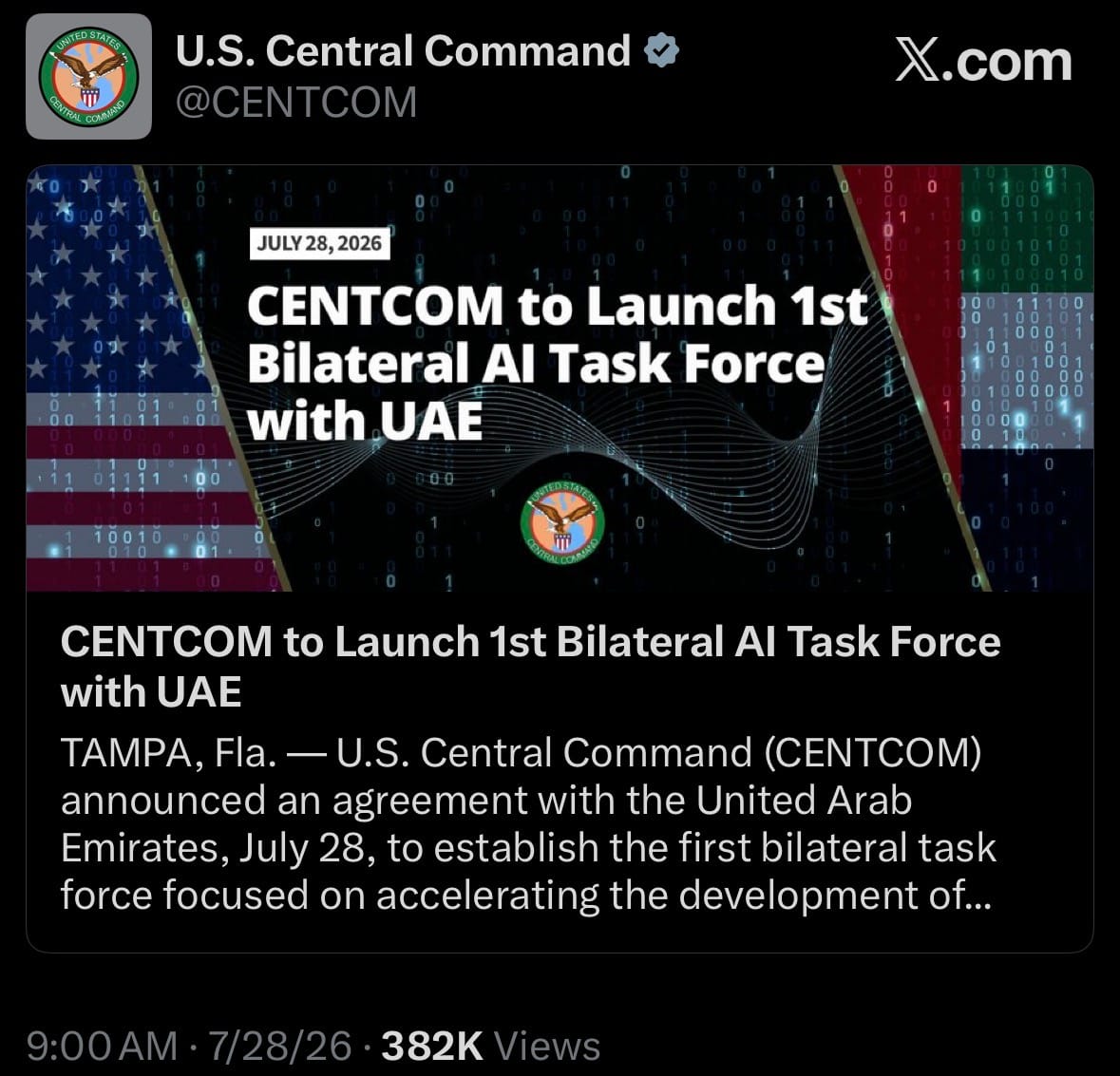
- July 27, 2026: The Pentagon is building AI data centers on at least a dozen U.S. military bases by opening underutilized federal land to commercial developers in exchange for access to computing power, with Fort Bliss in Texas set to host the military’s first hyperscale data center.

- These facilities will supply the massive processing capacity needed to train and operate advanced AI models for military uses such as improving combat effectiveness, supporting force transformation, and increasing overall operational resilience.
Economics & Markets:
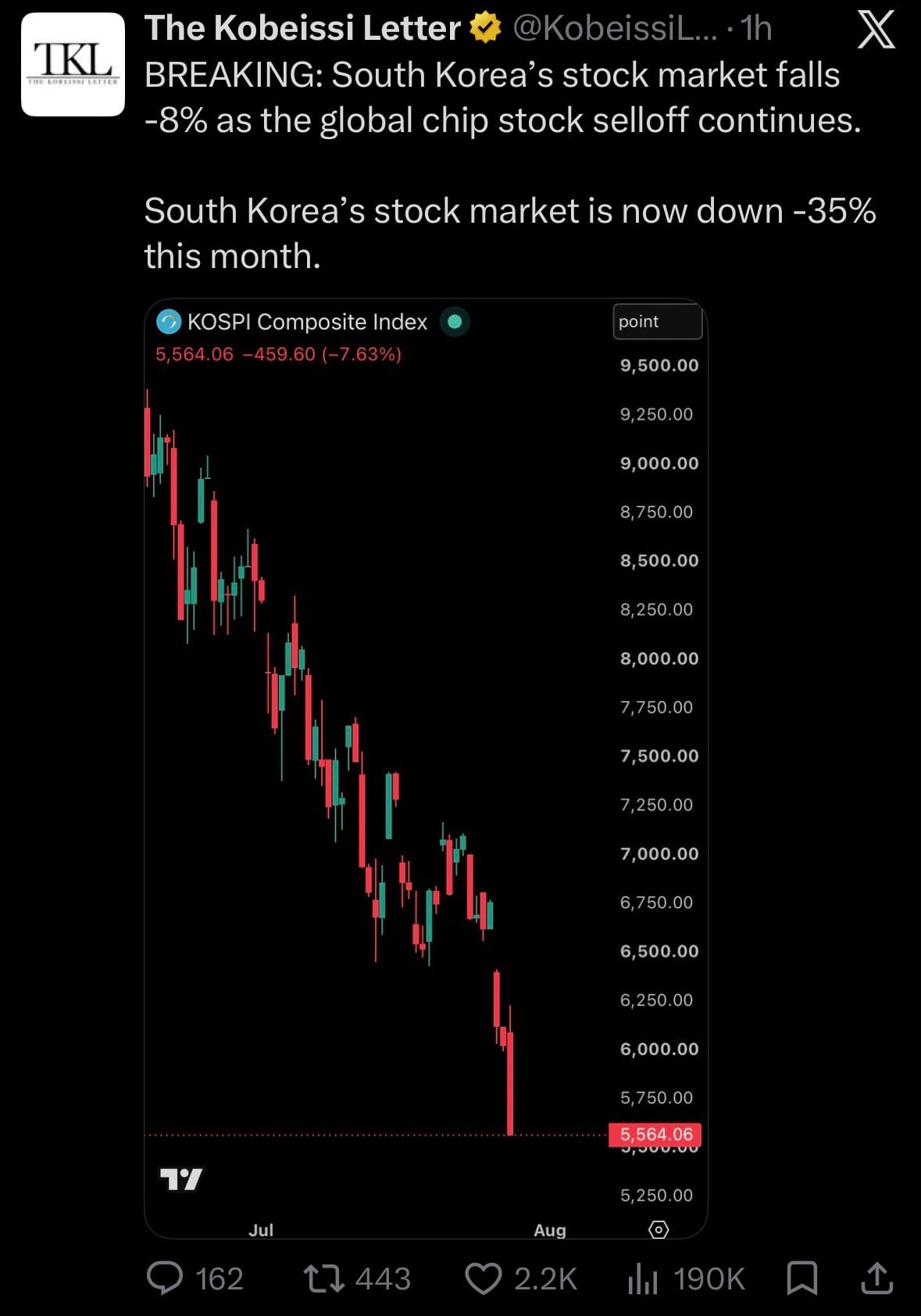
Geopolitics & Military Activity:
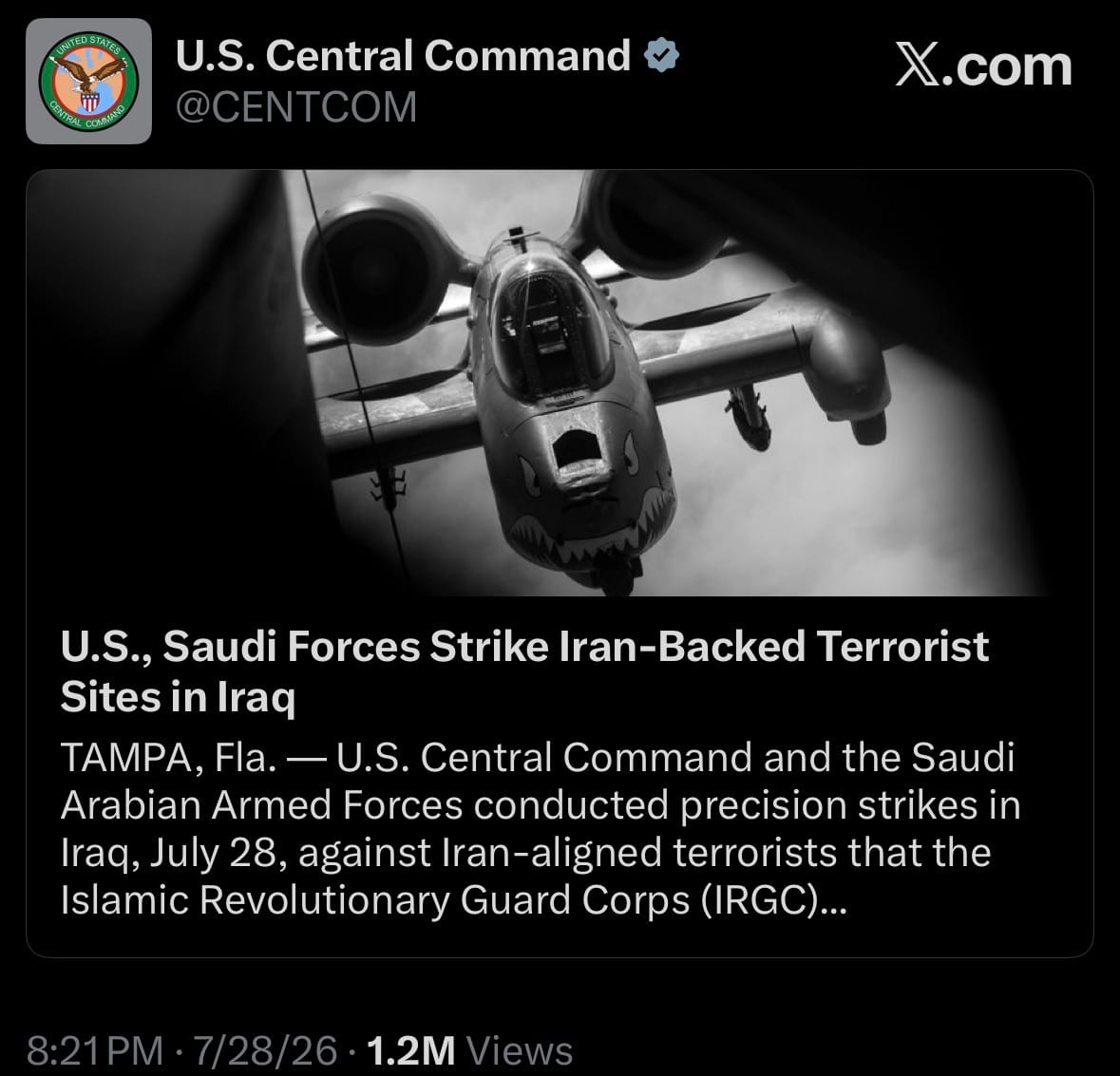
- July 28, 2026: U.S. Central Command reported that Islamic Revolutionary Guard Corps forces launched multiple ballistic missiles from Iran at 5:45 p.m. ET in an attempted surprise attack on U.S. forces based in the Middle East.

- All of the Iranian missiles were successfully intercepted, and U.S. forces remain at a high state of readiness following the incident that ended a brief lull in fighting.
Science & Technology:
- July 28, 2026: OpenAI quietly released an open-source command-line tool called Codex Security CLI that lets developers scan their code repositories for security problems, keep track of issues over multiple checks, confirm that fixes actually work, and automatically add security tests to their build processes.

- Hacker News discovered the tool before OpenAI could officially announce it; the company notes this is still an early version and is actively collecting user feedback to improve it.
Statistic:
- Largest assets on Earth by market capitalization:
- 🥇 Gold: $27.908T
- 🇺🇸 Apple: $4.994T
- 🇺🇸 NVIDIA: $4.771T
- 🇺🇸 Alphabet (Google): $4.067T
- 🥈 Silver: $3.216T
- 🇺🇸 Microsoft: $2.921T
- 🇺🇸 Amazon: $2.483T
- 🇹🇼 TSMC: $2.034T
- 🇺🇸 Broadcom: $1.812T
- 🇸🇦 Saudi Aramco: $1.694T
- 🇺🇸 SpaceX: $1.533T
- 🇺🇸 Meta Platforms: $1.506T
- ₿ Bitcoin: $1.279T
- 🇺🇸 Tesla: $1.214T
- 🇺🇸 Berkshire Hathaway: $1.105T
- 🇺🇸 Eli Lilly: $1.088T
- 🇰🇷 Samsung: $994.55B
- 🇺🇸 Vanguard S&P 500 ETF: $974.89B
- 🇺🇸 JPMorgan Chase: $949.80B
- 🇺🇸 Micron Technology: $926.70B
- 🇺🇸 Walmart: $900.05B
- 🇺🇸 iShares Core S&P 500 ETF: $868.72B
- 🇺🇸 SPDR S&P 500 ETF: $783.33B
- 🇰🇷 SK Hynix: $757.47B
- 🇺🇸 AMD: $741.30B
- 🇺🇸 Visa: $697.16B
History:
- Gold has been valued for more than 6,000 years, largely because it is rare, bright, easy to shape, resistant to corrosion, and often found naturally as visible nuggets or flakes. The oldest major collection of worked gold comes from the Varna Necropolis in present-day Bulgaria, dating to roughly 4600–4300 BC, where gold objects were buried with powerful or high-status individuals. Ancient Egypt later became one of the world’s most important gold-producing civilizations, using gold in temples, royal burials, jewelry, diplomacy, and payments. Egyptians viewed gold as a divine and nearly indestructible material, while Nubia became a major source of supply. Gold also appears throughout early religious and historical traditions, including biblical references to Havilah, Ophir, the golden calf, the Tabernacle, and Solomon’s Temple. Some of these references may reflect real ancient trade networks, but locations such as Ophir remain uncertain and are still debated. Greek legends such as King Midas and later stories about El Dorado show how gold became associated not only with wealth, but also with greed, power, and danger. Across Mesopotamia, India, China, Africa, Europe, and the Americas, gold became a symbol of authority, sacred status, and long-distance trade long before it became standardized money.
- Gold gradually became a formal monetary system. Before coins, people usually traded it by weight in the form of dust, rings, bars, or cut pieces. Merchants relied on scales, purity tests, and official seals to verify value. Around the 7th century BC, the kingdom of Lydia issued some of the earliest widely used coins, first using electrum and later separate gold and silver coins under King Croesus. The Persian daric, Roman aureus and solidus, Islamic dinar, Venetian ducat, Florentine florin, Spanish escudo, and British sovereign later became important international trade coins. Their value depended on weight, purity, trust in the issuing government, and acceptance by merchants. Gold moved through major trade systems, including the Roman trade with India, the trans-Saharan gold routes of West Africa, and the Atlantic trade after European colonization of the Americas. During the 1800s, many countries adopted the gold standard, meaning each currency represented a fixed amount of gold. This made exchange rates more stable but limited governments during recessions, wars, and banking crises. World War I weakened the system, and the Great Depression helped destroy it. The United States restricted private monetary gold ownership in 1933, raised the official price from about $20.67 to $35 per ounce, and later made the dollar the center of the Bretton Woods system. Under that system, foreign governments could exchange dollars for gold at $35 per ounce. On August 15, 1971, President Richard Nixon ended dollar convertibility into gold, and major currencies eventually shifted to floating exchange rates.
- Today, gold’s value is determined by global supply and demand rather than one government or central bank. It is mainly priced in U.S. dollars per troy ounce and traded through London bullion markets, COMEX futures in New York, the Shanghai Gold Exchange, banks, refiners, mining companies, investment funds, central banks, and retail dealers. Investors can buy physical bars and coins, exchange-traded funds, futures, options, mining stocks, or allocated and unallocated bullion accounts. Gold prices are influenced by central-bank purchases, inflation expectations, interest rates, wars, banking stress, currency weakness, mine production, recycling, jewelry demand, and investor confidence. Gold often becomes more attractive when real interest rates fall or when investors fear inflation, debt, or financial instability, although it can still be volatile. Its physical properties also make it important in technology. Gold conducts electricity well, does not easily corrode, reflects heat and radiation, and can be stretched into fine wire or hammered into extremely thin sheets. It is used in smartphones, computers, semiconductors, satellites, spacecraft, radar, medical devices, diagnostic tests, dental work, aircraft, and military electronics. Thin gold coatings help protect spacecraft and astronaut helmet visors from heat and radiation, while gold-plated contacts are used where failure is unacceptable. Most gold ever mined still exists in jewelry, bars, coins, central-bank reserves, artifacts, or recoverable electronics. Estimates place total above-ground gold near 220,000 metric tons, or roughly 7.07 billion troy ounces. At about $4,067 per ounce, that would equal approximately $28.8 trillion in total value. This is not technically a company market capitalization, but it makes gold the largest single asset commonly ranked by total value, far larger than any public company. Its lasting value comes from scarcity, durability, beauty, usefulness, and thousands of years of human trust.
Image of the day:

Thanks for reading! Earth is complicated, we make it simple.
- Download our mobile app:


Click below to view our previous newsletters:
Support/Suggestions Email:
support@earthintel.io