Friday☕️


Trending:
- SpaceX has officially launched its IPO roadshow ahead of a planned June 12, 2026 Nasdaq debut under the ticker SPCX.

- The company is targeting $135 per share to raise up to $75 billion at a $1.77 trillion valuation (largest in history), highlighting its dominance with 80% of global mass to orbit since 2023, 10.3 million Starlink users in 164 countries, and major AI compute capabilities powered by Megapack batteries.
Foreign Agent Case:
- Yesterday, June 4, American citizen Thomas Weir Pauken II pleaded guilty to acting as an agent of the People’s Republic of China.
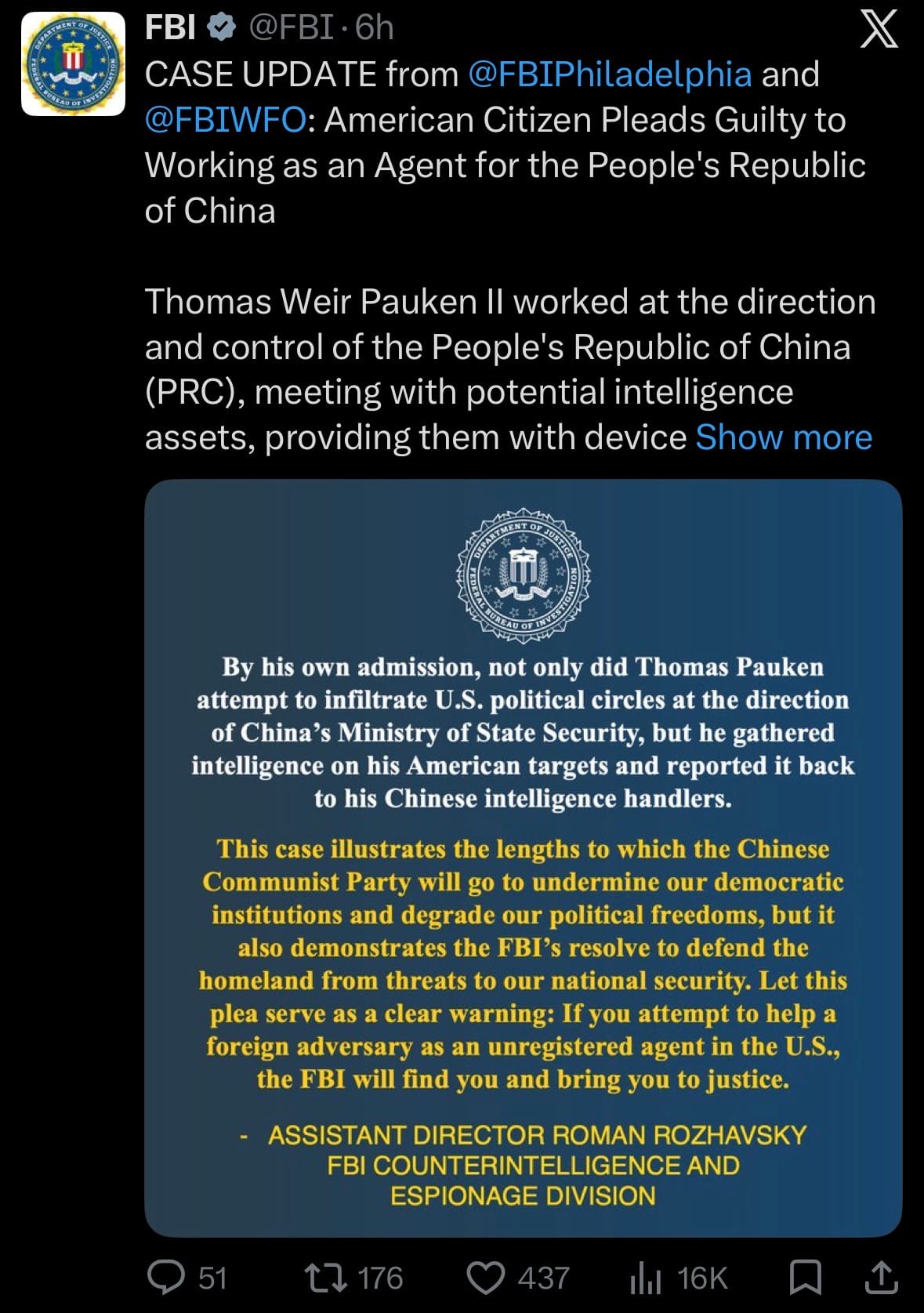
- Pauken worked at the direction of Chinese intelligence, meeting potential assets, supplying them with devices such as laptops and cellphones, assigning information-gathering tasks, and delivering reports back to his PRC handlers.
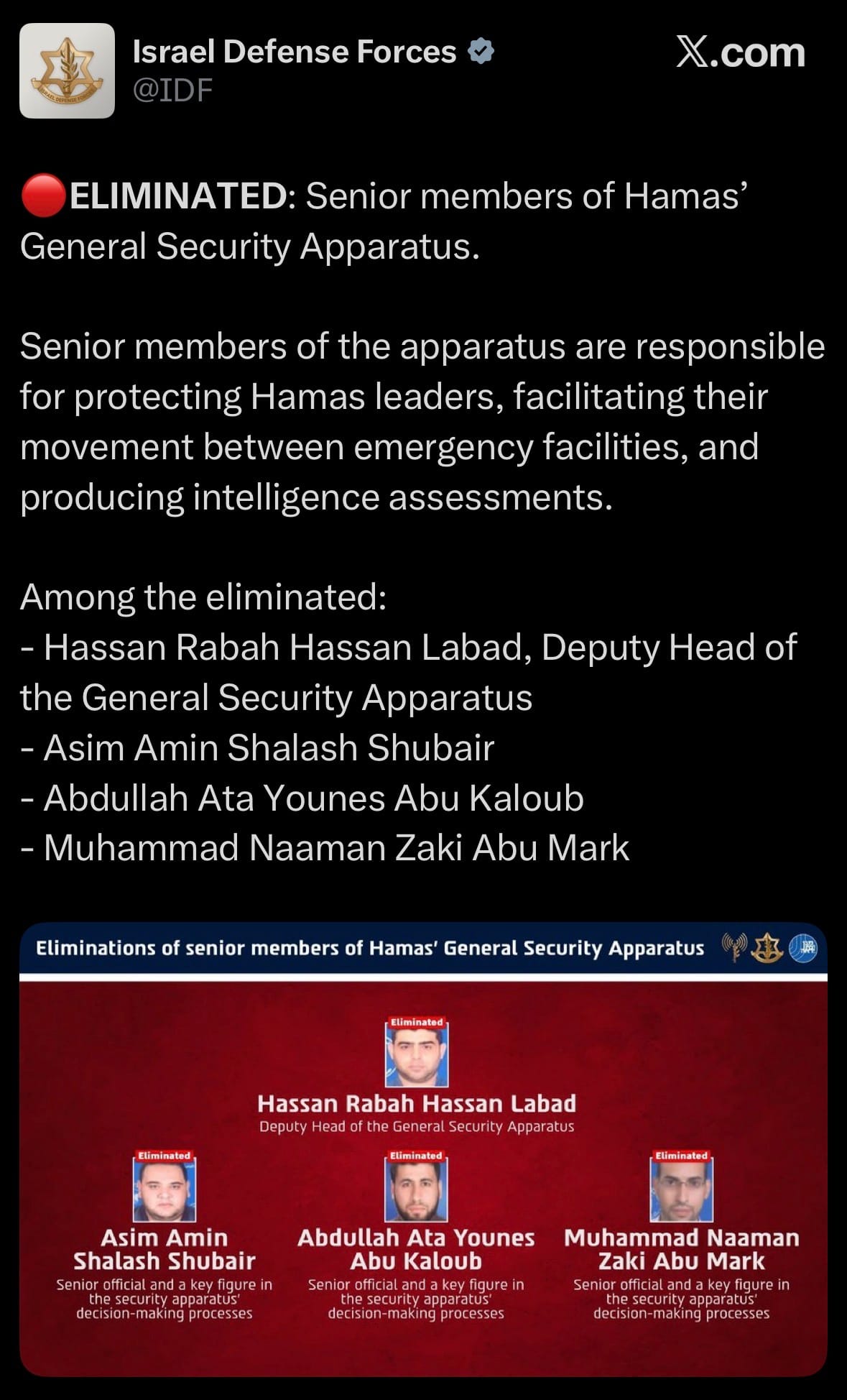
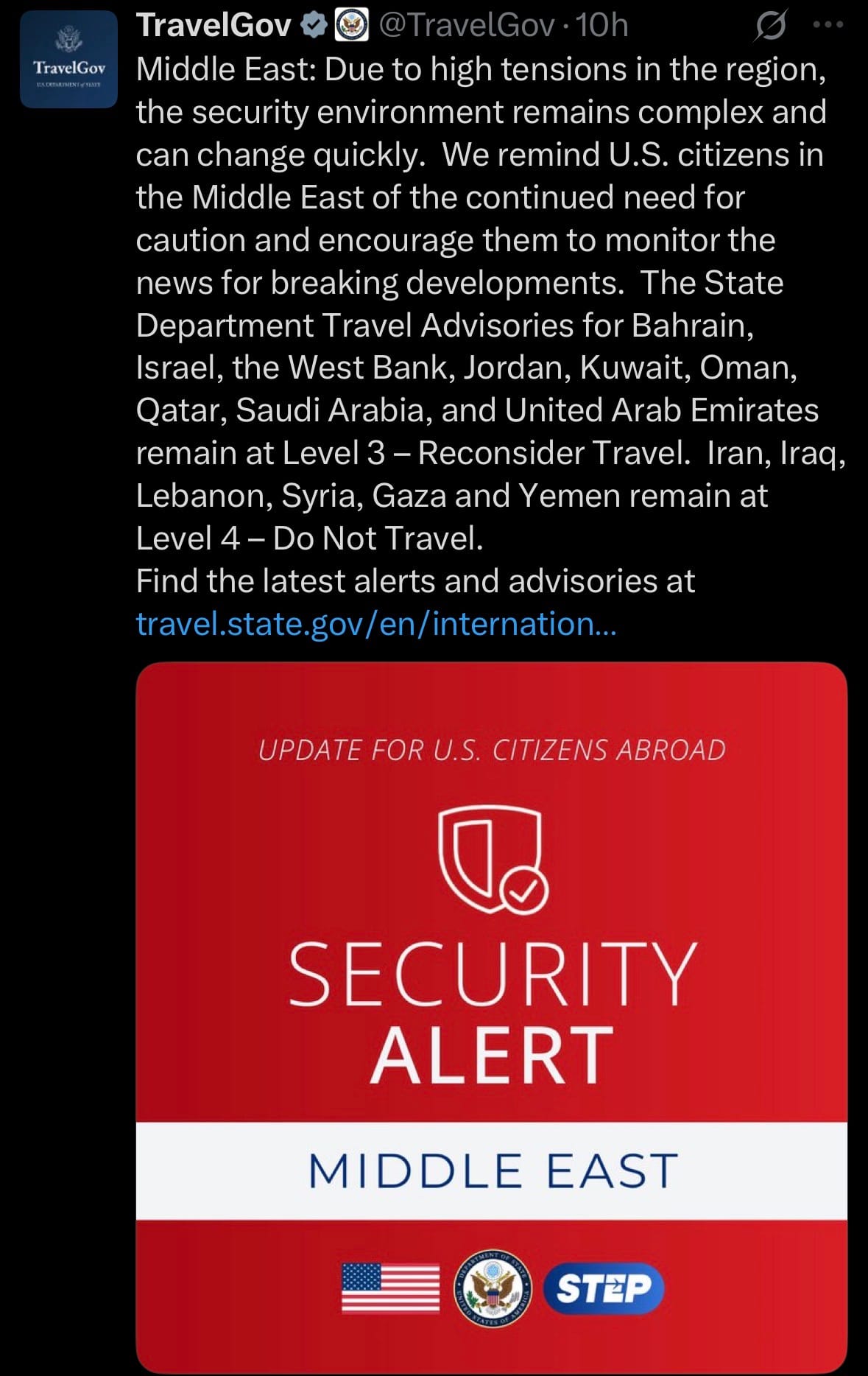
Geopolitics & Military Activity:
Energy:
- Yesterday, the U.S. Department of Energy announced it will use Defense Production Act funding to expand and modernize coal power capacity at 13 plants.
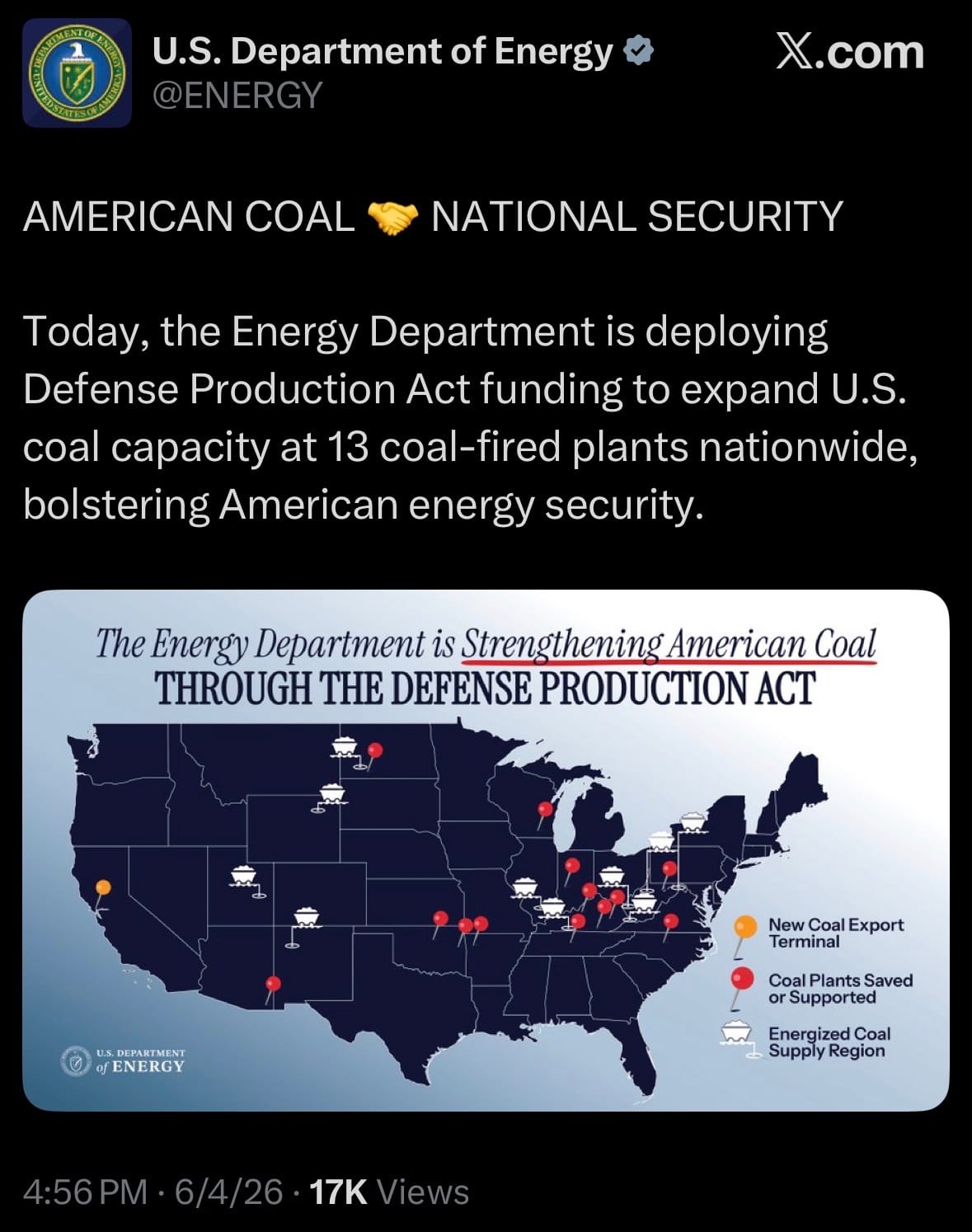
- The plan includes up to $425 million for 12 projects to upgrade and extend the life of existing coal-fired plants, plus $75 million for the new West Gateway coal export terminal in Oakland, California (capable of handling over 10 million tons per year). A separate $350 million investment was also announced for four additional coal plant modernization projects to improve reliability and efficiency.
Nuclear Reactor Update:
- Yesterday, Antares Nuclear’s Mark-0 microreactor successfully achieved zero-power fueled criticality at Idaho National Laboratory under the U.S. Department of Energy’s Reactor Pilot Program.
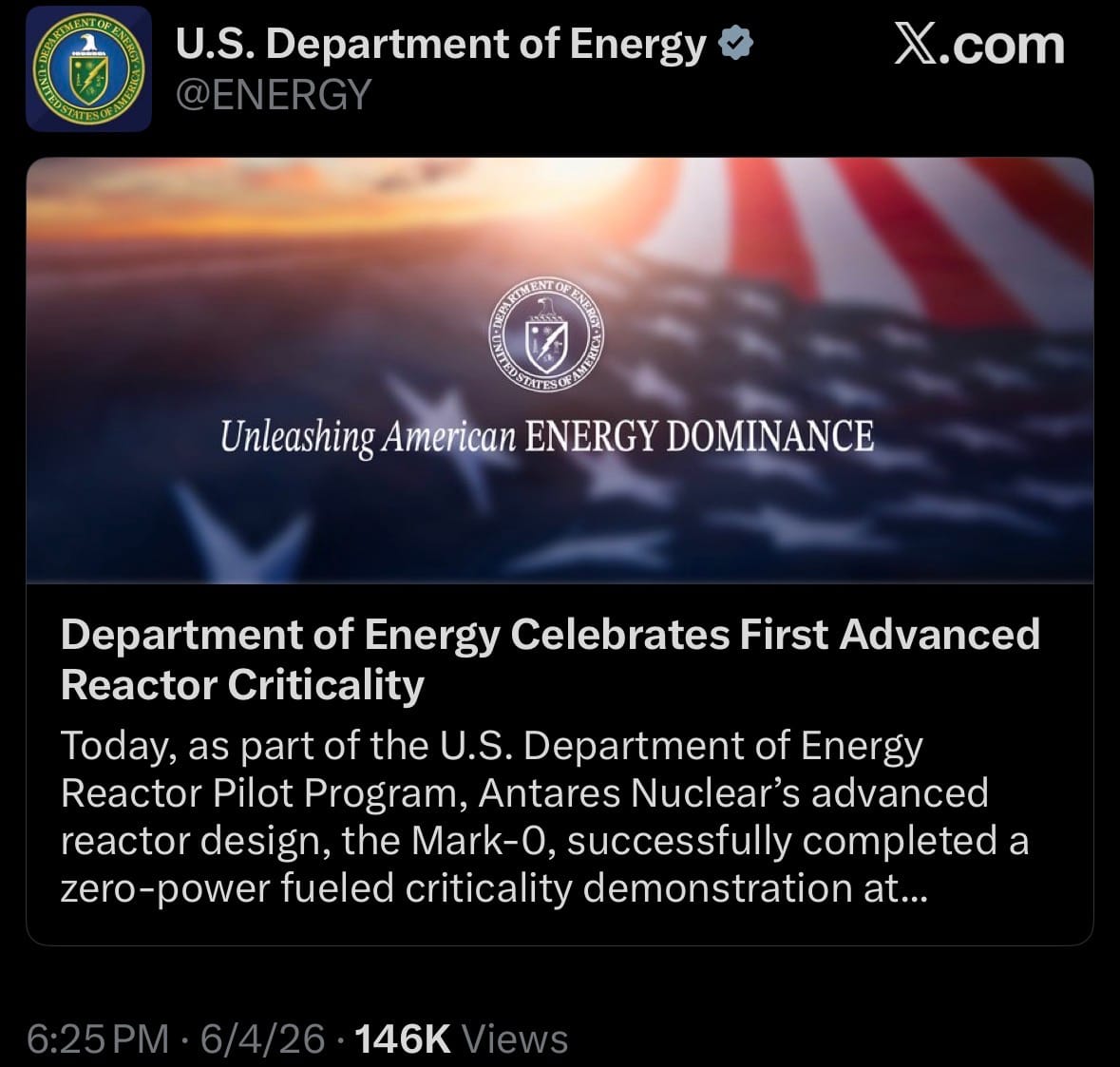
- The Mark-0 is a small factory-built high-temperature heat pipe microreactor designed for safe, reliable power in remote or military locations. This successful test validates its core design and paves the way for electricity-generating versions by 2027, making it the first privately developed advanced reactor to hit this milestone under the program.
Science & Technology:
- On June 4, 2026, OpenAI rolled out a significantly improved Memory system for ChatGPT.

- The new version is better at carrying useful context across different conversations, remembering important details over longer periods of time, and using that memory more effectively and reliably.

Statistic:
- Largest public tech companies by market capitalization:
- 🇺🇸 NVIDIA: $5.296T
- 🇺🇸 Apple: $4.571T
- 🇺🇸 Alphabet (Google): $4.492T
- 🇺🇸 Microsoft: $3.179T
- 🇺🇸 Amazon: $2.730T
- 🇹🇼 TSMC: $2.307T
- 🇺🇸 Broadcom: $1.983T
- 🇺🇸 Meta Platforms: $1.593T
- 🇺🇸 Tesla: $1.571T
- 🇰🇷 Samsung: $1.419T
- 🇺🇸 Micron Technology: $1.123T
- 🇰🇷 SK Hynix: $971.04B
- 🇺🇸 AMD: $853.13B
- 🇺🇸 Oracle: $679.72B
- 🇳🇱 ASML: $677.35B
- 🇺🇸 Intel: $561.80B
- 🇨🇳 Tencent: $525.19B
- 🇺🇸 Cisco: $512.38B
- 🇺🇸 Lam Research: $420.70B
- 🇬🇧 Arm Holdings: $420.22B
- 🇺🇸 Applied Materials: $398.32B
- 🇺🇸 Netflix: $343.43B
- 🇺🇸 Palantir: $339.69B
- 🇨🇳 Alibaba: $302.17B
- 🇺🇸 IBM: $283.62B
History:
- Mercenaries—soldiers who fight primarily for pay, contracts, or private sponsorship rather than direct loyalty to a nation-state—have existed for over 2,500 years and have appeared in nearly every major civilization. One of the earliest famous examples was the Ten Thousand Greek mercenaries in 401 BC, hired by the Persian prince Cyrus the Younger during his attempt to seize the Persian throne. Ancient Greece itself relied heavily on hired soldiers, and later Rome (27 BC–476 AD) increasingly recruited foreign auxiliaries, cavalry units, archers, and tribal warriors from across Europe, North Africa, and the Middle East. After Rome’s fall, mercenary armies became common throughout Europe. During the Hundred Years’ War (1337–1453), roaming groups known as Free Companies fought for whichever ruler paid them. In Renaissance Italy, powerful mercenary leaders called condottieri commanded private armies and often became political rulers themselves. The famous Swiss mercenaries emerged during the 1400s, gaining a reputation as some of Europe’s most effective soldiers. Their legacy survives today in the Pontifical Swiss Guard, established in 1506, which still protects the Vatican. By the age of empire, mercenaries became increasingly institutionalized. The British East India Company (1600–1874) built one of the largest private armies in history, eventually commanding over 250,000 troops, more than many European nations. The company fought wars, controlled territory, collected taxes, and effectively ruled much of India. During the American Revolution (1775–1783), Britain hired roughly 30,000 Hessian soldiers from German states to fight in North America, showing how mercenary forces remained deeply integrated into state warfare.
- The modern era transformed mercenaries from individual hired soldiers into large-scale organizations. The French Foreign Legion (1831–present) became one of the world’s most famous examples, recruiting foreigners to fight under French command in conflicts ranging from Algeria and Mexico to Afghanistan and Africa. Following decolonization after World War II, mercenaries appeared throughout Africa, especially during the Congo Crisis (1960–1965), Angola’s civil war, and conflicts in Rhodesia and South Africa. By the late 20th century, professional military contracting began replacing traditional mercenary models. South Africa’s Executive Outcomes (1989–1998) became one of the first modern private military companies, operating in Angola and Sierra Leone. The United States saw the rise of firms like Blackwater (1997), DynCorp, Triple Canopy, CACI, and KBR, which provided security, logistics, intelligence support, training, and protection during the Iraq and Afghanistan wars. Europe produced companies such as Aegis Defence Services (UK) and numerous smaller security firms operating globally. Russia developed the Wagner Group (2014), which became active in Ukraine, Syria, Libya, Sudan, Mali, and the Central African Republic before its famous mutiny in 2023. Turkey developed SADAT, while Gulf states increasingly hired foreign contractors and former special operations personnel. China also began expanding private security operations tied to the Belt and Road Initiative, particularly across Africa and Asia, though these firms generally operate with less public visibility than Western counterparts.
- By 2026, mercenaries have evolved into a global ecosystem of private military companies (PMCs), security contractors, foreign volunteers, military advisors, intelligence specialists, drone operators, and cyber contractors. The Russia-Ukraine War (2022–present) has become one of the largest modern examples, involving Wagner, Russian volunteer formations, the International Legion of Ukraine, foreign volunteers from the United States, United Kingdom, Canada, France, Germany, Poland, Georgia, Colombia, Brazil, Australia, and dozens of other nations. Colombian veterans in particular have become highly sought after globally due to their extensive combat experience and relatively lower cost. Across Africa, private military organizations continue operating in countries such as Mali, Libya, Mozambique, Nigeria, Sudan, and the Central African Republic. In the Middle East, contractors protect oil facilities, shipping routes, embassies, and infrastructure. Modern mercenaries increasingly perform functions beyond direct combat, including drone warfare, cybersecurity, intelligence collection, logistics, VIP protection, training, and infrastructure security. The biggest misconception is that mercenaries are primarily an Eastern phenomenon; in reality, the modern PMC industry is deeply rooted in the United States, United Kingdom, France, Russia, South Africa, Turkey, China, Latin America, and the Middle East. What began with Greek hoplites seeking pay in 401 BC has evolved into a multi-billion-dollar global industry operating alongside national militaries, intelligence agencies, multinational corporations, and governments across nearly every region of the world.
Image of the day:

Thanks for reading! Earth is complicated, we make it simple.
- Download our mobile app:



Click below to view our previous newsletters:

Support/Suggestions Email:
support@earthintel.io