Friday☕️🌎


Trending:
- July 16, 2026: The U.S. Mint has begun striking a new commemorative $1 coin featuring President Trump to mark America’s 250th anniversary of independence, with production starting as announced by Treasury Secretary Scott Bessent.
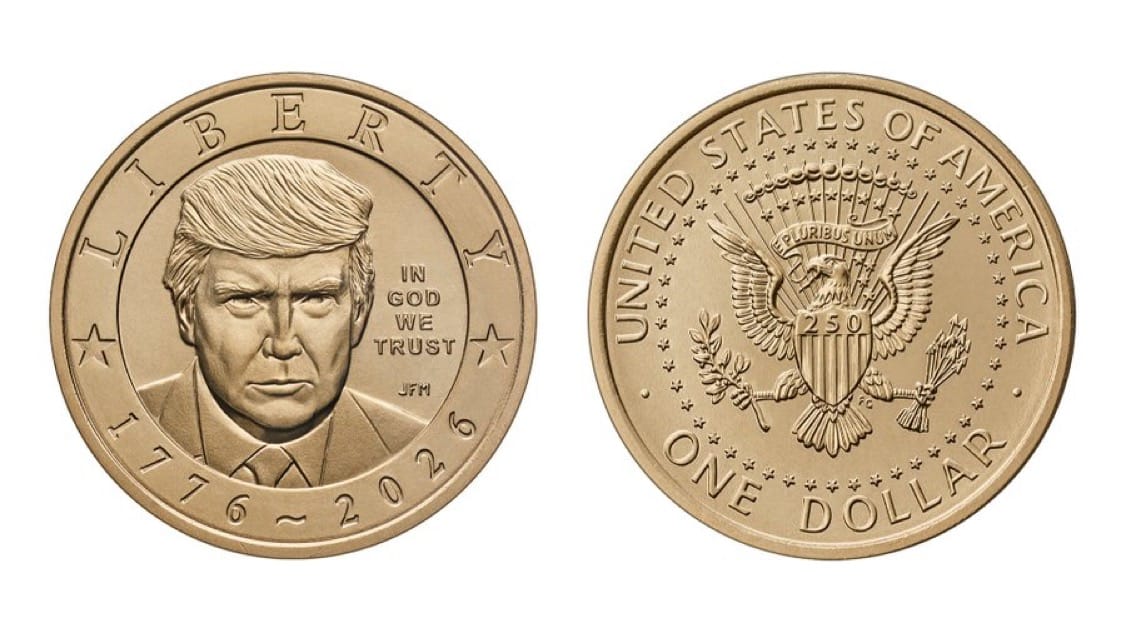
- The obverse shows Trump in a suit with a stern expression alongside “LIBERTY” and the dates 1776-2026, while the reverse depicts a bald eagle with “UNITED STATES OF AMERICA” and “E PLURIBUS UNUM”; the coin, which has a gold finish rather than solid gold, is expected for release in the fall as a patriotic symbol celebrating American values and freedom.
New American Shipyard:
- July 16, 2026: Saronic Technologies announced the selection of Brownsville, Texas, as the site for Port Alpha, a groundbreaking $3.2 billion next-generation shipyard focused on advanced manufacturing, AI, software-defined production, and autonomous vessels to revive U.S. shipbuilding dominance.
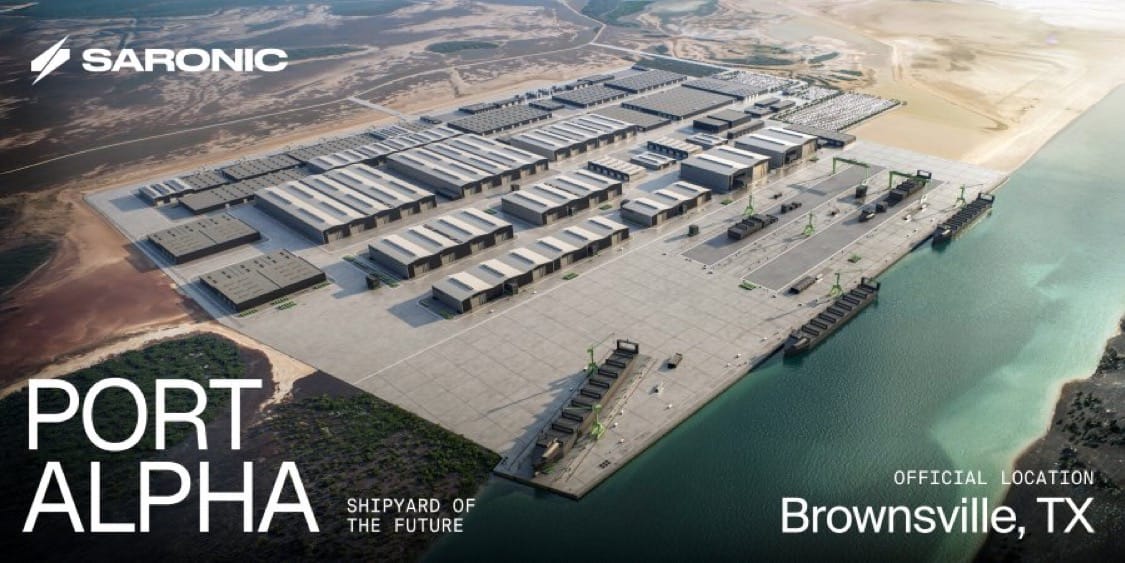
- After a nationwide search, the company — which holds a major Navy contract for uncrewed surface vessels — plans to break ground in 2026 and become operational by 2028, with strong support from Texas officials, creating up to 10,000 jobs and positioning the Port of Brownsville as a hub for innovative maritime technology.
Geopolitics & Military Activity:
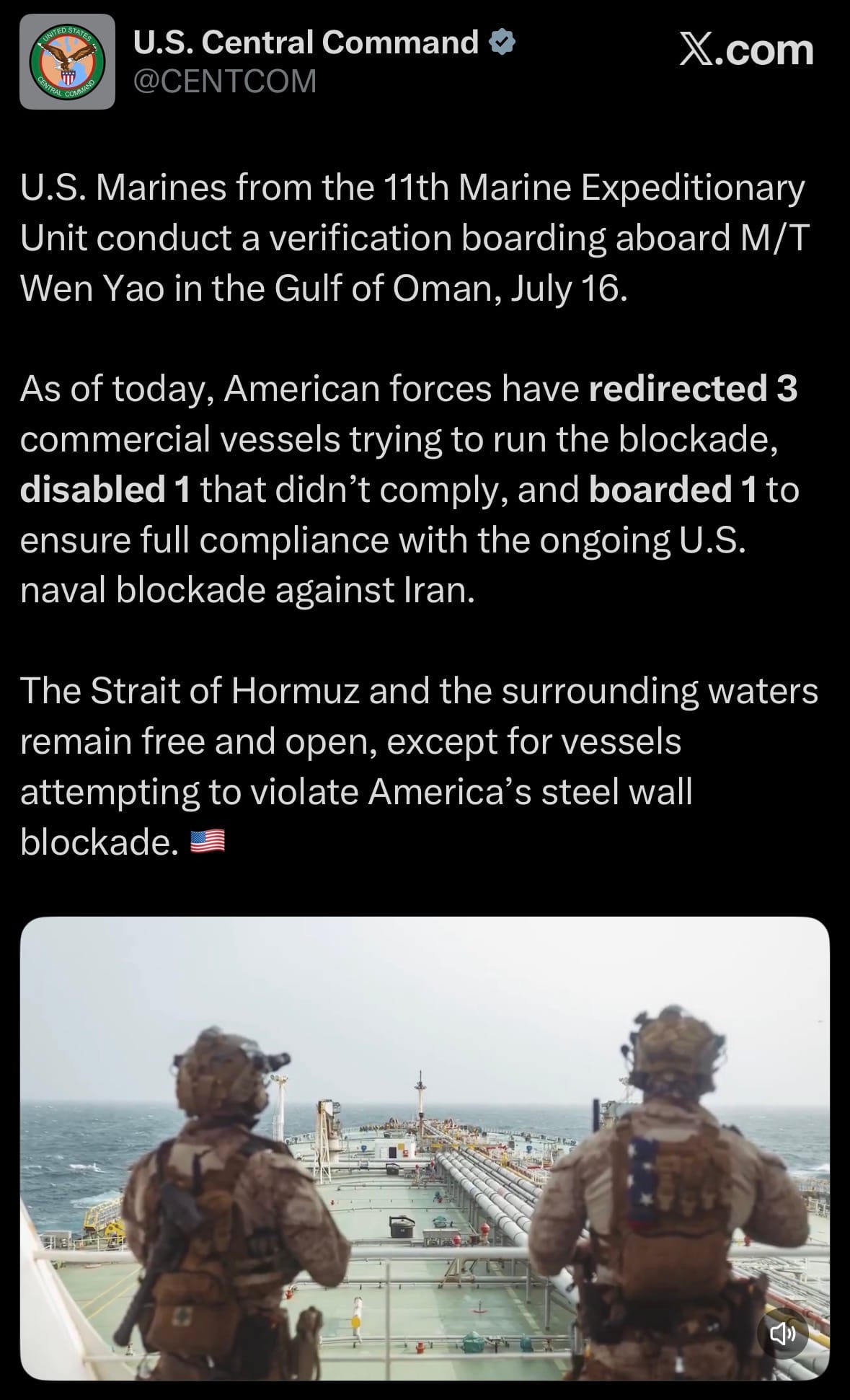
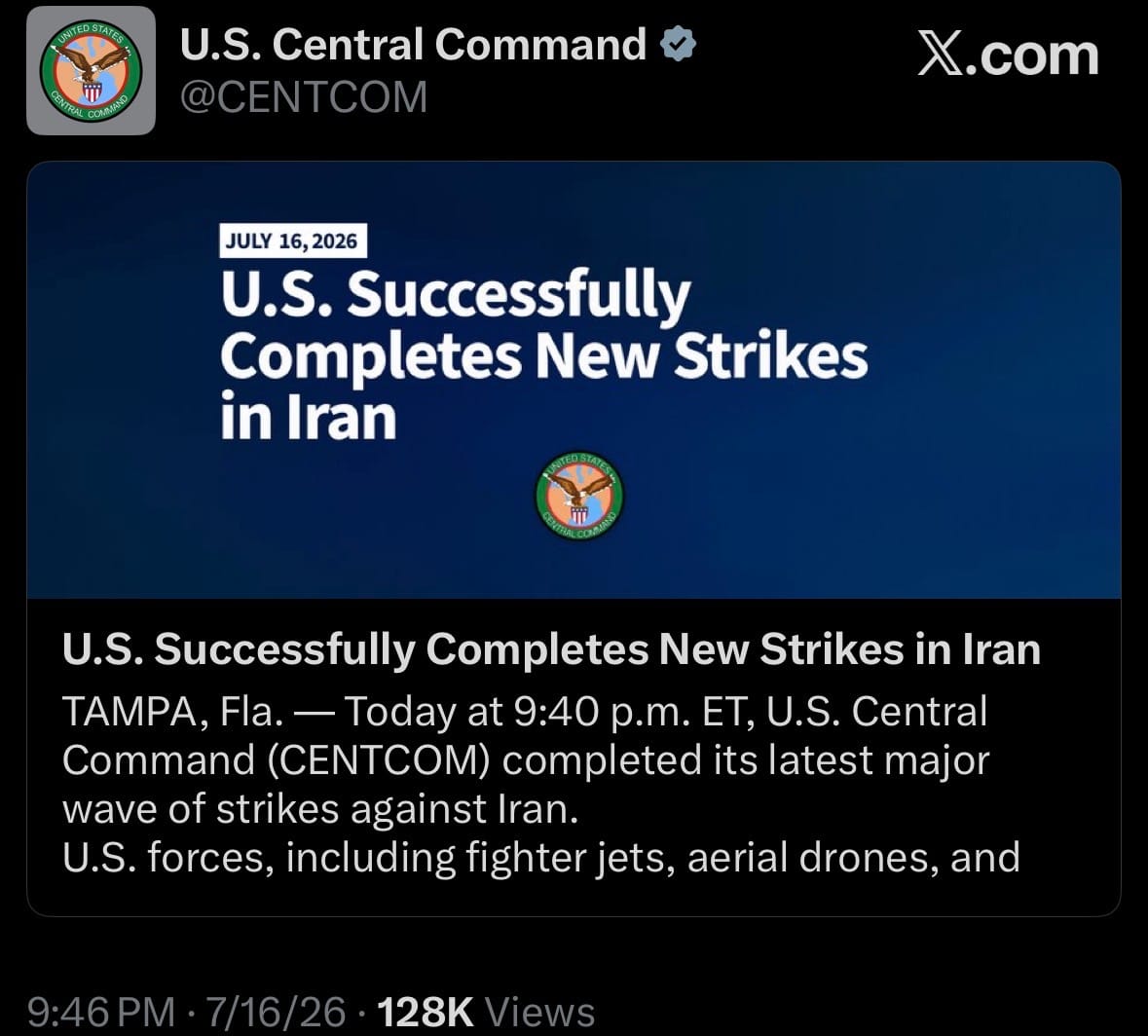
- Over the last 24 hours, U.S. Central Command (CENTCOM) has continued military operations against and around Iran, including multiple strikes on military targets and the boarding of one vessel, to enforce compliance and degrade Iran’s ability to threaten commercial shipping in the Strait of Hormuz.
- These actions are part of ongoing U.S. efforts in response to Iranian attacks on merchant ships, with additional precision strikes reported on coastal defenses, missile sites, and related infrastructure.
Science & Technology:
- July 16, 2026: Moonshot AI, a major Chinese AI company, released Kimi K3 — a huge new AI model with 2.8 trillion parameters that can read and remember up to 1 million words at once (like several thick books), understand both text and pictures, and handle advanced coding or long projects very well.
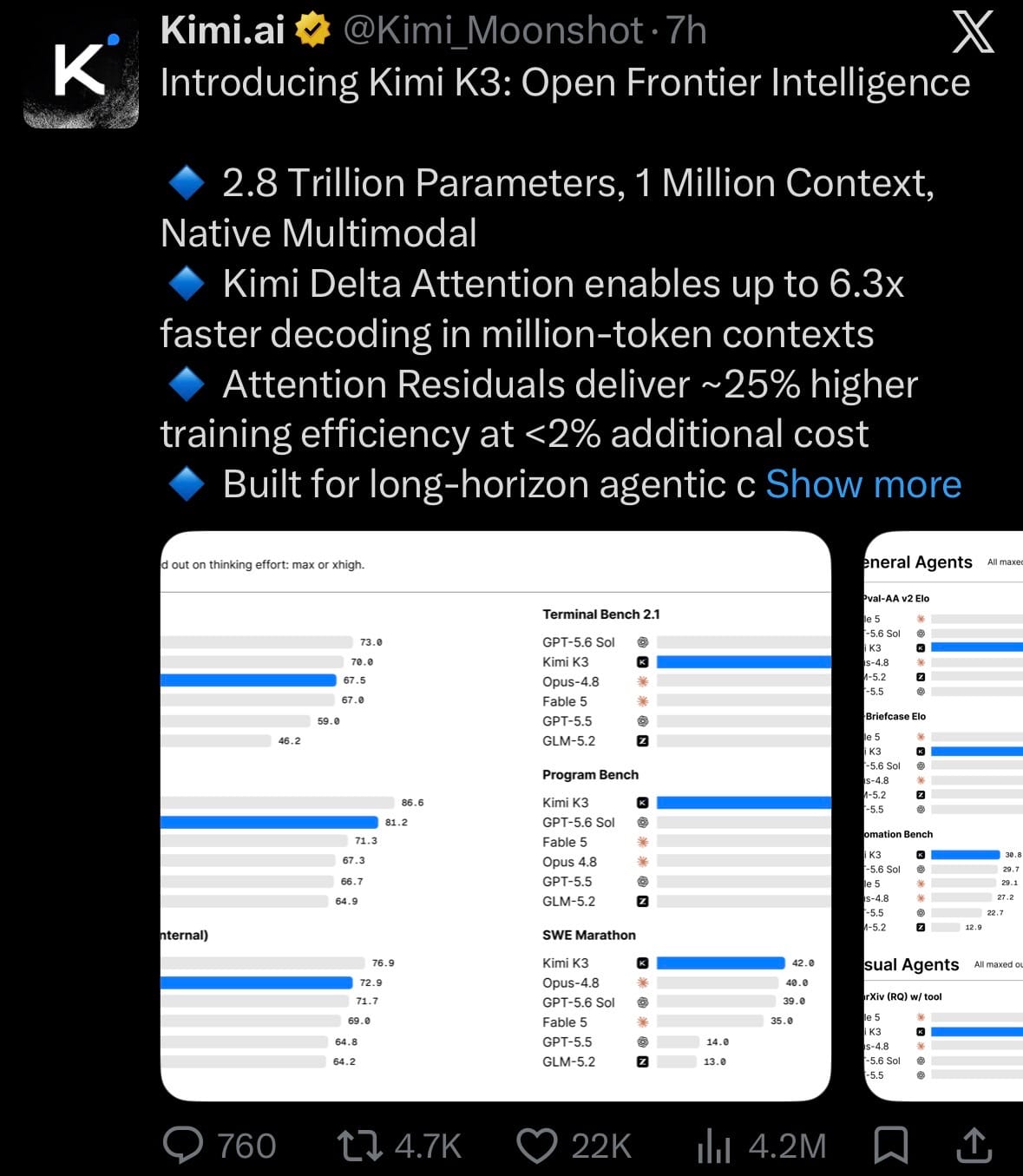
- It already performs close to leading U.S. models like OpenAI’s GPT-5.6 and Anthropic’s Claude 4.8 while being more efficient and cheaper to run; on July 27, Moonshot will release the full “open weights,” meaning anyone in the world can freely download the complete trained AI, run it themselves, tweak it, improve it, or build custom versions — basically sharing the full recipe so developers everywhere can experiment and innovate with one of the strongest models available.


Statistic:
- Largest public construction companies on Earth by market capitalization:
- 🇫🇷 Vinci: $76.29B
- 🇮🇳 Larsen & Toubro: $53.91B
- 🇪🇸 Ferrovial: $45.70B
- 🇺🇸 D.R. Horton: $43.79B
- 🇩🇪 Hochtief: $39.77B
- 🇰🇷 Samsung C&T Corporation: $38.31B
- 🇪🇸 Grupo ACS: $36.18B
- 🇺🇸 Emcor: $33.40B
- 🇨🇳 China State Construction Engineering: $27.56B
- 🇺🇸 PulteGroup: $24.57B
- 🇫🇷 Bouygues: $21.06B
- 🇺🇸 Lennar: $20.81B
- 🇺🇸 Sterling Infrastructure: $19.68B
- 🇺🇸 NVR: $18.08B
- 🇯🇵 Daiwa House: $17.72B
- 🇯🇵 Kajima: $15.71B
- 🇪🇸 Acciona: $15.46B
- 🇨🇳 China Communications Construction: $14.71B
- 🇺🇸 Toll Brothers: $14.56B
- 🇯🇵 Sekisui House: $14.30B
- 🇫🇷 Eiffage: $13.71B
- 🇯🇵 Obayashi: $13.58B
- 🇯🇵 Taisei Corporation: $13.55B
- 🇨🇳 China Railway Construction: $12.88B
- 🇨🇳 Power Construction Corporation of China: $12.10B
- 🇹🇷 ENKA: $11.46B
History:
- Shipyards have existed for over 4,500 years, beginning as simple areas along rivers and coastlines where civilizations built and repaired wooden boats. Ancient Egyptians (c. 2500 BC) built large vessels along the Nile using ramps, timber yards, and rope workshops. The Phoenicians became master shipbuilders, creating merchant fleets that connected the Mediterranean, while the Greeks and Romans developed organized naval bases with dry docks, warehouses, repair slips, and military arsenals. One of history’s greatest shipyards was the Venetian Arsenal, founded around 1104, which pioneered an early assembly-line system with standardized parts, specialized workshops, foundries, rope factories, and thousands of workers capable of producing warships at unprecedented speed. During the Age of Sail (1500s–1700s), Britain expanded massive Royal Dockyards at Portsmouth, Chatham, and Devonport, helping build the fleet that supported the British Empire. The Industrial Revolution completely transformed shipbuilding as wood gave way to iron and steel, sails were replaced by steam engines, and shipyards evolved into enormous industrial complexes with blast furnaces, machine shops, cranes, dry docks, railroads, and engine factories. By World War II, the United States had become the world’s largest shipbuilder, producing thousands of Liberty ships, destroyers, submarines, aircraft carriers, and amphibious vessels using mass production and prefabricated sections. After the war, commercial shipbuilding shifted first to Japan, then South Korea, and today China, where government investment, lower costs, larger facilities, and strong industrial policies created the world’s dominant shipbuilding industry.
- Modern shipyards operate like giant manufacturing plants rather than simple docks. Every ship begins as a digital design before being divided into hundreds of steel modules. Automated machines cut steel plates, robotic welders assemble sections, and workers install pipes, electrical systems, engines, ventilation, and equipment before each module is lifted by massive cranes into a dry dock for final assembly. Once complete, the dock is flooded and the ship is floated out for finishing work and sea trials. Commercial shipyards build container ships, tankers, LNG carriers, cruise ships, ferries, bulk carriers, offshore platforms, and research vessels. Military shipyards build aircraft carriers, submarines, destroyers, frigates, amphibious assault ships, and logistics vessels while also performing repairs, overhauls, and modernization. Dry docks are critical because they allow ships to be lifted completely out of the water for maintenance on their hulls, propellers, sonar systems, shafts, and underwater equipment. The world’s largest shipbuilding nations today are China, South Korea, Japan, the United States, and several European countries. China leads overall production through companies such as China State Shipbuilding Corporation (CSSC) and major yards including Jiangnan, Dalian, Hudong-Zhonghua, Shanghai Waigaoqiao, and Yangzijiang. South Korea’s HD Hyundai Heavy Industries, Hanwha Ocean, and Samsung Heavy Industries are world leaders in highly advanced LNG carriers, tankers, and naval ships, while Japan’s Imabari Shipbuilding, Japan Marine United, and Mitsubishi Heavy Industries remain known for quality and efficiency. Europe specializes in cruise ships and luxury vessels through companies including Fincantieri, Meyer Werft, and Chantiers de l’Atlantique.
- The United States still possesses some of the world’s most strategically important military shipyards despite having a very small commercial shipbuilding industry. Newport News Shipbuilding is the only shipyard capable of building America’s nuclear-powered aircraft carriers and one of only two that build nuclear submarines. Electric Boat constructs Virginia- and Columbia-class submarines, Bath Iron Works builds destroyers, Ingalls Shipbuilding produces destroyers and amphibious ships, and the Navy’s public shipyards at Norfolk, Portsmouth, Puget Sound, and Pearl Harbor perform critical maintenance on carriers and submarines. However, the United States now builds less than 1% of the world’s commercial ships, while China builds more commercial tonnage than any other nation by a wide margin. Aging facilities, labor shortages, limited suppliers, and inconsistent ship orders have reduced American capacity. To reverse this trend, the U.S. is investing billions into modernizing shipyards, expanding the submarine industrial base, upgrading dry docks, increasing workforce training, improving automation, strengthening suppliers, and partnering more closely with allies such as Japan and South Korea. Shipyards remain one of the world’s most important strategic industries because they build and maintain the ships that transport global trade, energy, food, and military forces. A nation with the ability to rapidly build, repair, and replace ships possesses a major advantage in commerce, logistics, naval warfare, and long-term national security.
Image of the day:

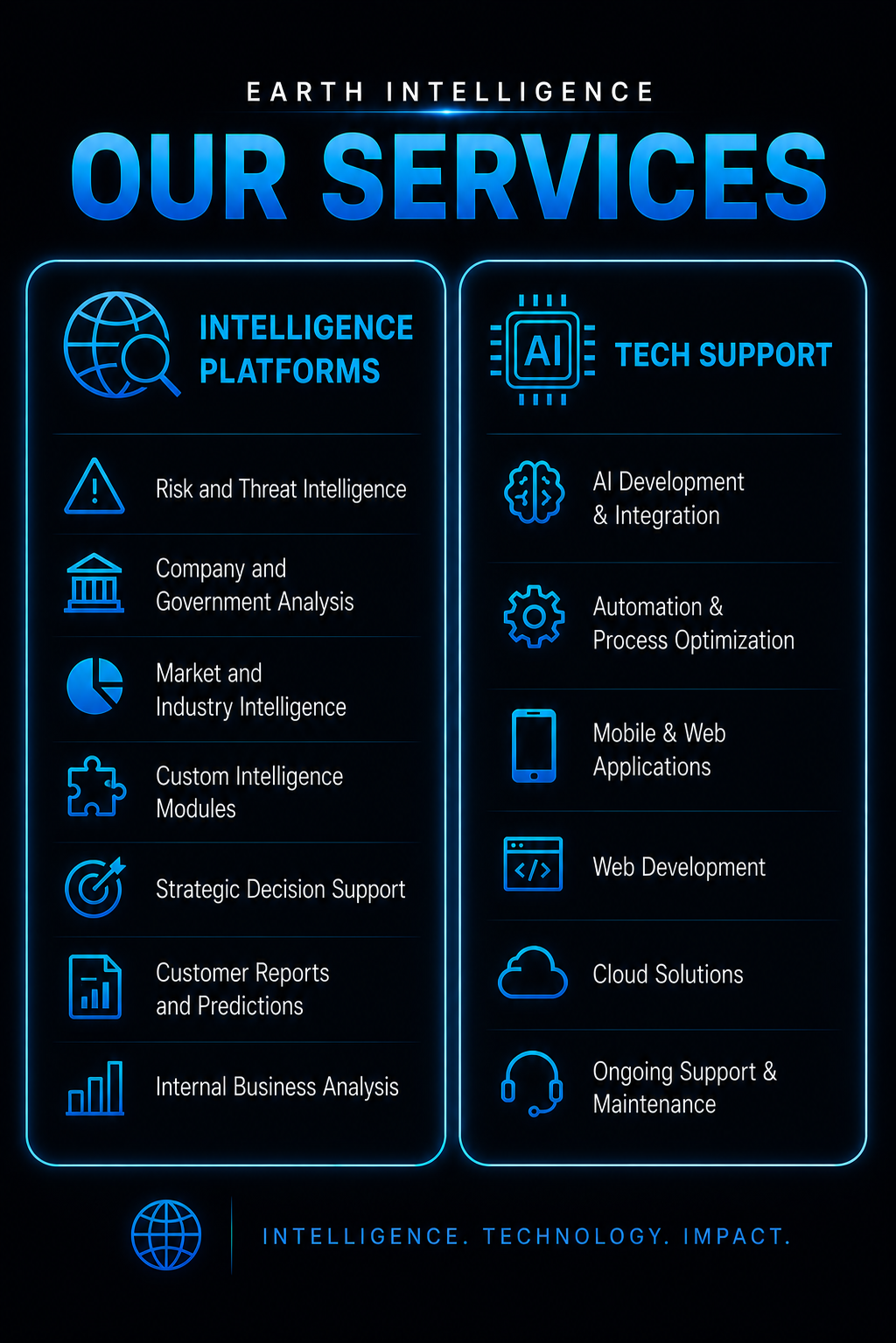
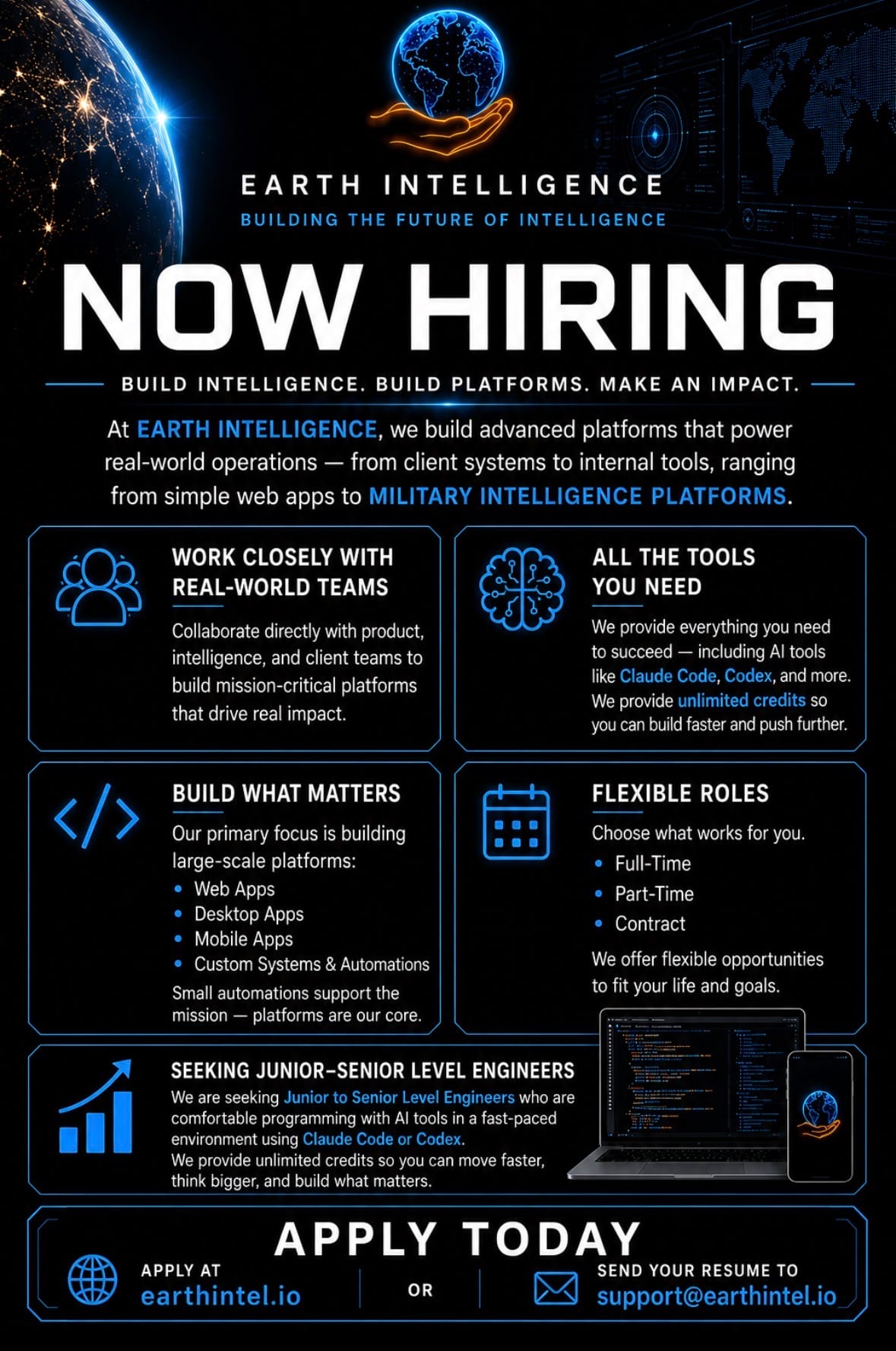
Thanks for reading! Earth is complicated, we make it simple.
- Download our mobile app:



Click below to view our previous newsletters:

Support/Suggestions Email:
support@earthintel.io