Friday☕️


Trending:
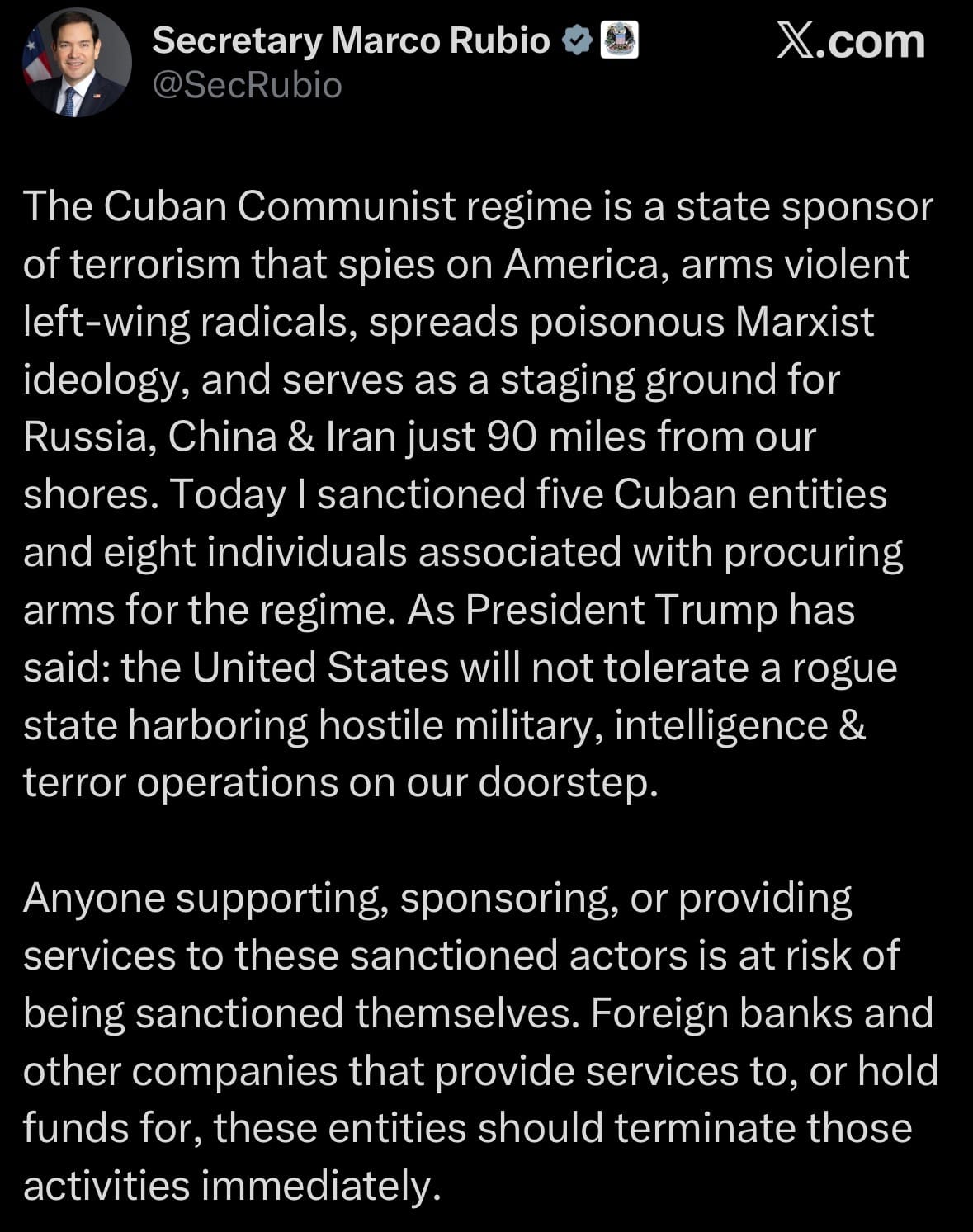
- Yesterday, the United States imposed new sanctions on five Cuban entities and eight individuals accused of helping Cuba acquire and maintain military equipment, including weapons and aircraft tied to suppliers in Russia and China.
Economics & Markets:
- Thailand confirmed a 0% personal capital gains tax on Bitcoin and other cryptocurrencies when they are sold through exchanges and brokers licensed by Thailand’s SEC.

- The exemption covers eligible transactions from January 1, 2025 through December 31, 2029, as Thailand works to attract crypto investment and strengthen its position as a regulated digital-asset hub; trades through unlicensed platforms do not qualify.
Geopolitics & Military Activity:
- Yesterday, Israel launched a new wave of airstrikes across southern Lebanon targeting what the IDF says were Hezbollah command centers, weapons storage sites, launch positions, observation posts, and other military infrastructure embedded in villages.

- The strikes followed an explosion near Majdal Zoun that killed two Israeli soldiers and seriously wounded four others; the escalation comes as a fragile June ceasefire remains under pressure and Israel and Lebanon continue negotiations over Israeli withdrawals and Hezbollah’s disarmament.

Science & Technology:
Space:

Statistic:
- Largest public automakers by market capitalization:
- 🇺🇸 Tesla: $1.261T
- 🇯🇵 Toyota: $222.00B
- 🇨🇳 BYD: $121.00B
- 🇨🇳 Xiaomi: $88.12B
- 🇺🇸 General Motors: $78.63B
- 🇰🇷 Hyundai: $73.57B
- 🇮🇹 Ferrari: $71.58B
- 🇺🇸 Ford: $54.98B
- 🇩🇪 Mercedes-Benz: $51.60B
- 🇮🇳 Maruti Suzuki India: $46.53B
- 🇩🇪 Porsche: $45.72B
- 🇩🇪 Volkswagen: $43.66B
- 🇮🇳 Mahindra & Mahindra: $42.99B
- 🇩🇪 BMW: $40.31B
- 🇯🇵 Honda: $39.87B
- 🇰🇷 Kia: $36.47B
- 🇨🇳 Geely: $25.51B
- 🇯🇵 Suzuki Motor: $24.08B
- 🇺🇸 Rivian: $22.26B
- 🇳🇱 Stellantis: $20.90B
- 🇨🇳 Great Wall Motors: $19.95B
- 🇮🇳 Hyundai Motor India: $18.89B
- 🇨🇳 Chery Automobile: $18.85B
- 🇨🇳 SAIC Motor: $18.36B
- 🇮🇳 Tata Motors: $16.63B
- 🇨🇳 Seres Group: $14.74B
- 🇨🇳 Li Auto: $12.46B
- 🇨🇳 NIO: $11.52B
- 🇯🇵 Subaru: $11.18B
- 🇨🇳 XPeng: $11.17B
- 🇨🇳 Chongqing Changan: $10.85B
- 🇨🇳 Dongfeng Motor: $10.05B
- 🇯🇵 Isuzu: $9.89B
- 🇫🇷 Renault: $9.42B
- 🇹🇼 Hotai Motor: $8.91B
- 🇨🇳 JAC Motors: $8.11B
- 🇨🇳 GAC (Guangzhou Automobile Group): $7.95B
- 🇻🇳 VinFast Auto: $7.67B
- 🇯🇵 Nissan: $7.39B
- 🇸🇪 Volvo Car: $6.11B
- 🇹🇷 Ford Otosan: $5.79B
- 🇨🇳 Leapmotor: $5.73B
- 🇯🇵 Mazda: $4.60B
- 🇨🇳 FAW Car: $4.55B
- 🇺🇸 Polaris: $3.98B
- 🇯🇵 Mitsubishi Motors: $2.91B
- 🇺🇸 Lucid Motors: $2.75B
- 🇹🇷 Tofaş Türk Otomobil Fabrikası: $2.70B
- 🇮🇳 Force Motors: $2.58B
- 🇸🇪 Polestar: $2.01B
History:
- U.S. government contracting is almost as old as the country itself. During the Revolutionary War (1775–1783), the Continental Congress depended on private merchants, shipbuilders, gunsmiths, farmers, and transportation companies to supply George Washington’s forces with weapons, food, clothing, horses, ships, and ammunition. After the federal government formed in 1789, private contractors built government buildings, roads, forts, naval vessels, and infrastructure. The Springfield Armory (1794) and private weapons manufacturers helped establish standardized production, while government contracts later accelerated interchangeable parts and American mass manufacturing. Contracting exploded during the Civil War (1861–1865) as companies supplied rifles, railroads, telegraphs, uniforms, ironclad ships, and enormous quantities of food and ammunition. Fraud and price manipulation also became major problems, producing stronger procurement oversight. During World War I and especially World War II (1939–1945), contracting became industrial warfare on an unprecedented scale. The government funded private factories while Ford, General Motors, Boeing, Douglas, Lockheed, North American Aviation, Grumman, General Electric, DuPont, Westinghouse and thousands of smaller suppliers produced aircraft, tanks, ships, radar, explosives, electronics, and eventually components for the Manhattan Project. After 1945, the Cold War made this relationship permanent. President Dwight Eisenhower famously called it the “military-industrial complex” in 1961. Companies increasingly specialized in extremely complex government systems: Lockheed built aircraft and reconnaissance platforms; Boeing developed bombers and missiles; Northrop and Grumman developed aircraft and space systems; General Dynamics produced submarines, aircraft, and armored vehicles; and companies such as Raytheon became missile and radar specialists. NASA’s creation in 1958 created another enormous contractor ecosystem involving Boeing, Grumman, North American Aviation, IBM, Rocketdyne, and others. Procurement became increasingly standardized through laws and eventually the Federal Acquisition Regulation (FAR) in 1984, which remains the basic rulebook governing most federal purchases.
- Today the system operates in layers. At the top are prime contractors, companies that receive major contracts directly from federal agencies and take responsibility for delivering complete systems. In defense, the major primes include Lockheed Martin, RTX, Northrop Grumman, General Dynamics, Boeing Defense, L3Harris, and Huntington Ingalls Industries. Lockheed leads programs such as the F-35, missiles, satellites, and classified systems; Northrop builds the B-21 Raider, strategic missiles, radar, and space systems; RTX produces Patriot, radar, missiles, sensors, and aircraft engines; General Dynamics builds Virginia- and Columbia-class submarines, Abrams tanks, Gulfstream aircraft, and information systems; Boeing builds military aircraft, satellites, helicopters, and weapons; Huntington Ingalls builds nuclear aircraft carriers, submarines, destroyers, and amphibious ships; and L3Harris specializes heavily in communications, sensors, electronic warfare, propulsion, and space technology. Beneath the primes are enormous networks of Tier 1, Tier 2, and Tier 3 subcontractors supplying engines, semiconductors, software, antennas, optics, steel, batteries, electronics, cybersecurity, machining, logistics, and thousands of specialized components. Newer defense companies including SpaceX, Anduril, Palantir, Shield AI, Firefly, Rocket Lab, and others are challenging the traditional model with privately financed products, software, AI, autonomous systems, reusable rockets, and faster development cycles. The government also deliberately reserves opportunities for small businesses through SBIR/STTR, 8(a), HUBZone, Women-Owned, Veteran-Owned, and Service-Disabled Veteran-Owned programs. Contracts themselves range from fixed-price purchases to cost-reimbursement R&D contracts, IDIQs, task orders, Other Transaction Agreements, prototypes, grants, and massive multi-year weapons programs. A company might therefore sell directly to the Pentagon, subcontract under Lockheed Martin, participate in an SBIR research program, and later become the prime contractor for its own system.
- The ecosystem extends far beyond the military. The Department of Defense buys weapons, aircraft, ships, satellites, software, construction, intelligence systems, logistics, cybersecurity, food, fuel, healthcare, and research. The Intelligence Community, including the CIA, NSA, NRO, NGA, and DIA, contracts for satellites, cloud computing, artificial intelligence, cybersecurity, signals processing, data analytics, linguists, engineering, and classified technology through companies ranging from major primes to highly specialized intelligence contractors. NASA contracts spacecraft, launch services, lunar landers, scientific instruments, communications, and engineering from companies such as SpaceX, Boeing, Lockheed Martin, Northrop Grumman, Blue Origin, and thousands of suppliers. DHS buys border technology, cybersecurity, Coast Guard ships, surveillance systems, disaster-response services, and airport-security equipment. The Department of Energy uses contractors to operate national laboratories and nuclear facilities, including Los Alamos, Sandia, Lawrence Livermore, and major weapons-complex sites. HHS and the VA contract for pharmaceuticals, hospitals, medical technology, research, and healthcare services; Transportation buys infrastructure and engineering; GSA provides government-wide contracts for everything from laptops to cloud computing; and nearly every federal agency purchases consulting, construction, software, telecommunications, vehicles, and professional services. The result is a federal contracting economy worth hundreds of billions of dollars annually, extending from a one-person cybersecurity company to corporations employing more than 100,000 people. The modern direction is increasingly toward AI, autonomous systems, space infrastructure, cybersecurity, cloud computing, semiconductors, biotechnology, advanced manufacturing, nuclear energy, quantum technology, and resilient supply chains. Government contracting is therefore not one industry—it is the enormous private industrial layer underneath the U.S. government, where agencies define missions and requirements while companies compete to build, operate, supply, and increasingly invent the technology required to execute them.
Image of the day:

Thanks for reading! Earth is complicated, we make it simple.
- Download our mobile app:



Click below to view our previous newsletters:

Support/Suggestions Email:
support@earthintel.io