Friday☕️🌎


Trending:
- September 18, 2026 — Exa launched Snapshot, a system that lets you search the web as it looked on a specific date in the past using more than 400 billion saved webpage versions.

- It can be used to test trading or prediction models with only the information available at that time, train AI without exposing it to future data, and study how websites and information changed over time.
Economics & Markets:
- September 18, 2026 — The Bank of Japan raised its key interest rate by 0.25 percentage point to 1.25%, the highest level in roughly 31 years, continuing its gradual move away from the ultra-low rates that defined Japanese monetary policy for decades.

- The BOJ said Japan’s economy is still recovering but inflation risks remain elevated, and indicated it could continue raising rates if growth and prices develop as expected.
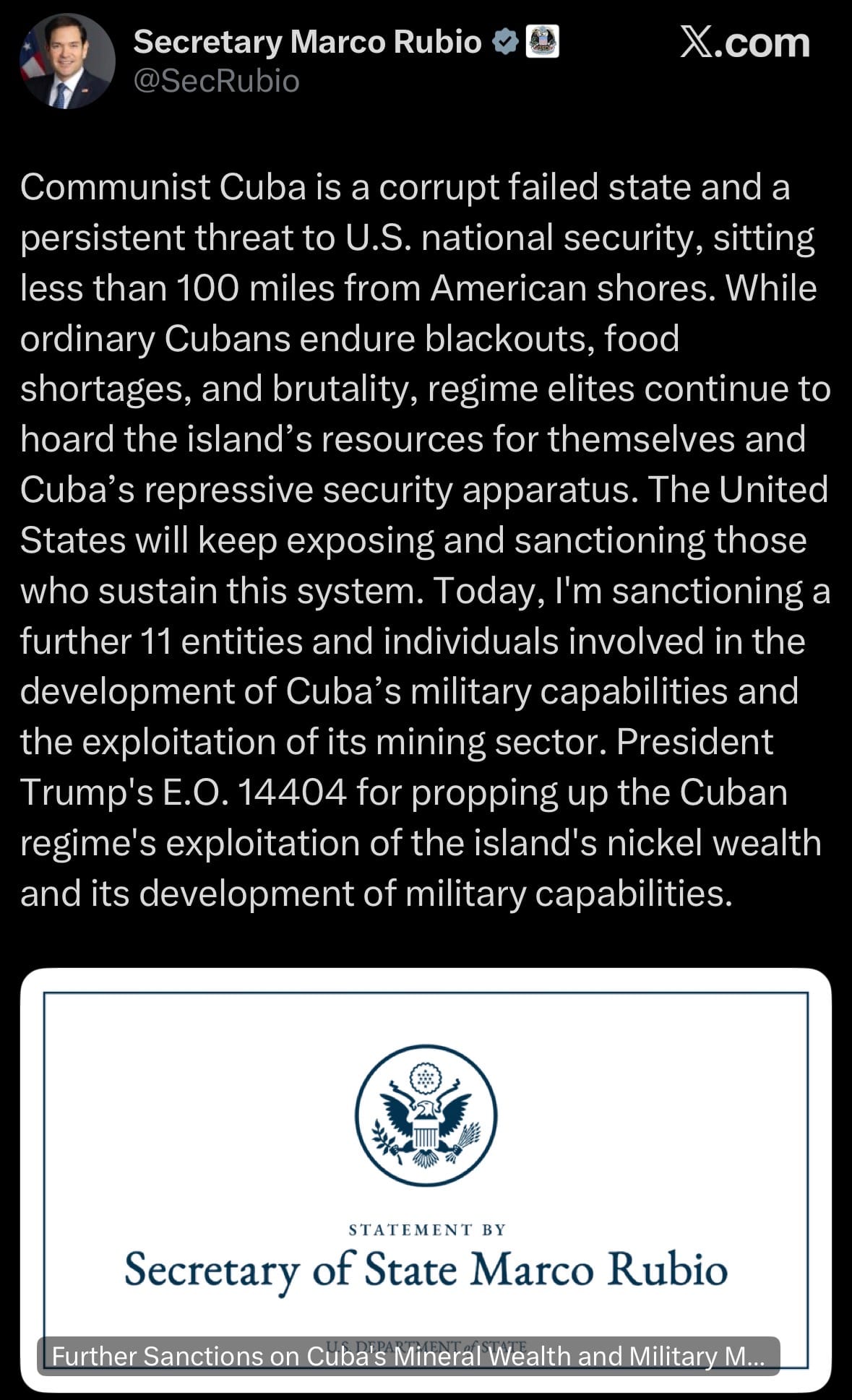

Geopolitics & Military Activity:
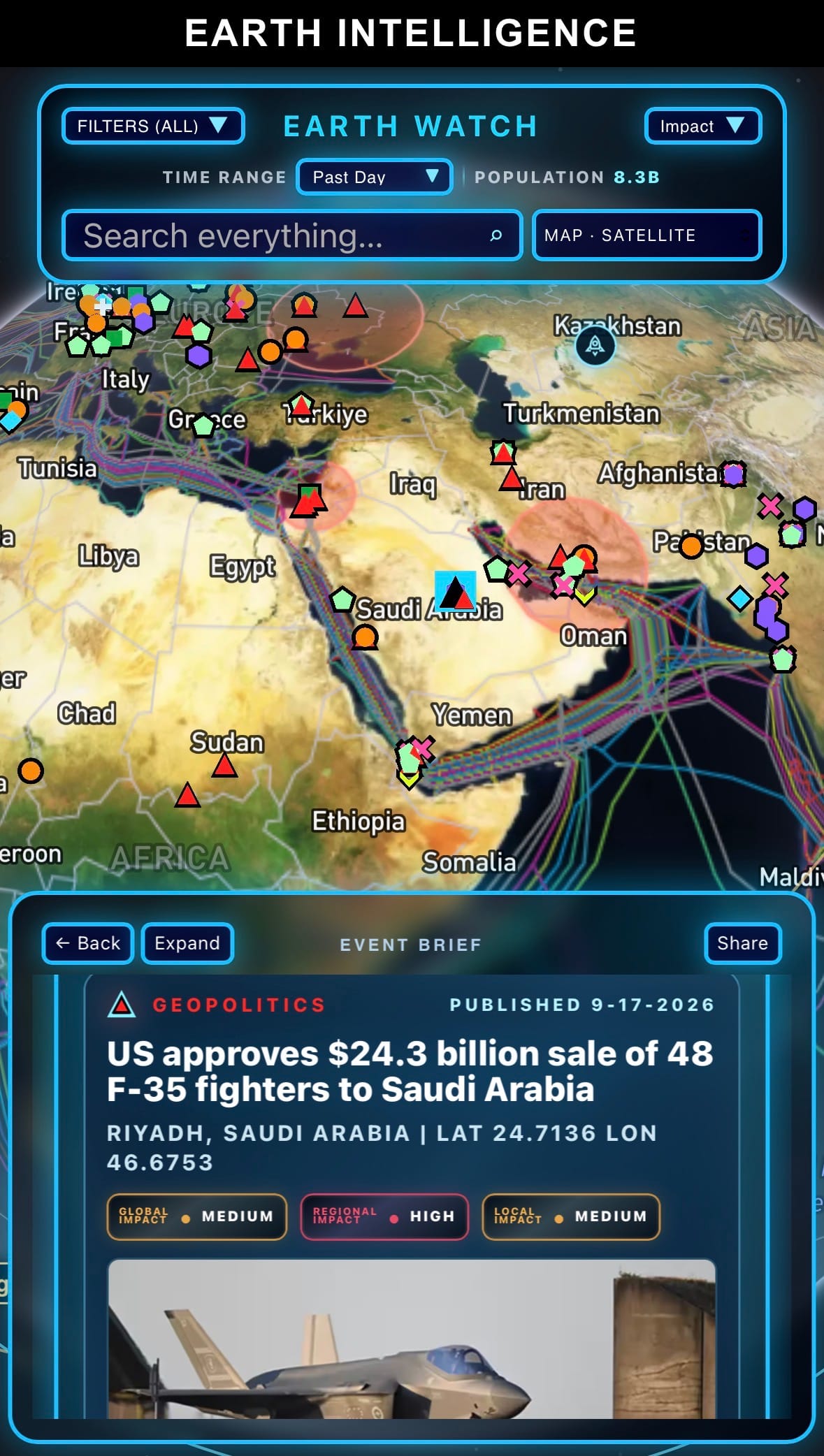

Science & Technology:
- September 17, 2026 — Figure released Helix 2.5, a major upgrade to the AI system controlling its humanoid robots, demonstrating that the robots could enter 30 unfamiliar Bay Area homes and immediately perform tasks such as making beds, folding towels, and tidying rooms without being retrained for each house.

- Figure says pretraining Helix on its large Index dataset raised zero-shot task success from 9% to 56%, showing that humanoid robots are beginning to generalize skills to new environments instead of having to learn every location individually.



Statistic:
- Largest public semiconductor companies by market cap:
- 🇺🇸 NVIDIA: $5.296T
- 🇹🇼 TSMC: $2.231T
- 🇺🇸 Broadcom: $1.657T
- 🇰🇷 Samsung: $1.230T
- 🇺🇸 Micron Technology: $1.103T
- 🇰🇷 SK Hynix: $934.66B
- 🇺🇸 AMD: $889.84B
- 🇳🇱 ASML: $625.95B
- 🇨🇳 CXMT: $581.61B
- 🇺🇸 Intel: $575.12B
- 🇺🇸 Lam Research: $336.99B
- 🇺🇸 Applied Materials: $331.24B
- 🇬🇧 Arm Holdings: $282.91B
- 🇺🇸 Texas Instruments: $235.74B
- 🇹🇼 MediaTek: $232.58B
- 🇺🇸 KLA: $220.78B
- 🇺🇸 Marvell Technology: $216.37B
- 🇺🇸 QUALCOMM: $201.55B
- 🇺🇸 Analog Devices: $175.72B
- 🇯🇵 Tokyo Electron: $152.22B
- 🇯🇵 Advantest: $146.99B
- 🇨🇳 Cambricon Technologies: $106.86B
- 🇹🇼 ASE Group: $104.12B
- 🇩🇪 Infineon: $81.19B
- 🇨🇳 NAURA Technology Group: $73.44B
History of NASA
- NASA grew out of America’s early aviation research and the Cold War Space Race. Its predecessor was NACA—the National Advisory Committee for Aeronautics—created in 1915 to advance American aircraft technology. After the Soviet Union shocked the United States by launching Sputnik 1 in 1957, President Dwight D. Eisenhower signed the National Aeronautics and Space Act on July 29, 1958, creating the National Aeronautics and Space Administration, which officially began operations October 1 under its first administrator, T. Keith Glennan. NASA quickly absorbed NACA laboratories, engineers and several existing military space projects. Pioneer 1 became its first spacecraft in October 1958. Project Mercury followed: Alan Shepard became the first American in space in 1961, and John Glenn became the first American to orbit Earth in 1962. After Soviet cosmonaut Yuri Gagarin became the first human in space, President John F. Kennedy committed the United States in 1961 to landing a man on the Moon before the decade ended. Gemini (1965–66) taught NASA the essential techniques needed to accomplish that—long-duration flight, spacewalking, orbital rendezvous and docking. NASA then developed Apollo, supported by the enormous Saturn V rocket designed under a team led by Wernher von Braun at Marshall Space Flight Center. Apollo 1 suffered a devastating launch-pad fire in 1967, killing Gus Grissom, Ed White and Roger Chaffee, but NASA redesigned the spacecraft and continued. Apollo 8 carried humans around the Moon in 1968; then on July 20, 1969, Apollo 11 landed Neil Armstrong and Buzz Aldrin on the Moon while Michael Collins remained in lunar orbit. Apollo 13 nearly ended in disaster in 1970 but returned safely, and NASA ultimately completed six crewed lunar landings from Apollo 11 through Apollo 17, placing 12 people on the Moon before the program ended in 1972.
- After Apollo, NASA shifted from racing to the Moon toward space stations, reusable spacecraft, planetary exploration and long-term scientific missions. Skylab, America’s first space station, launched in 1973; Apollo-Soyuz in 1975 produced the first U.S.-Soviet crewed docking; Viking 1 and 2 landed on Mars in 1976; Voyager 1 and 2 launched in 1977 and explored the outer planets, with Voyager 1 eventually entering interstellar space. NASA’s next enormous human-spaceflight project was the Space Shuttle, first launched with Columbia on April 12, 1981. Unlike Apollo’s disposable spacecraft, the Shuttle orbiter and solid rocket boosters were reusable, and the system became America’s primary human spaceflight vehicle for 30 years. Shuttles deployed satellites and planetary spacecraft, carried laboratories, launched and repeatedly serviced the Hubble Space Telescope after its 1990 deployment, performed classified missions and ultimately constructed much of the International Space Station. The program also suffered NASA’s two worst operational disasters: Challenger in 1986 and Columbia in 2003, each killing seven astronauts and driving major safety reforms. Meanwhile NASA’s robotic science program produced missions such as Galileo to Jupiter, Cassini-Huygens to Saturn, Mars Pathfinder, Spirit and Opportunity, Curiosity, New Horizons to Pluto, Kepler’s exoplanet survey, Juno at Jupiter, Parker Solar Probe, Perseverance on Mars and the James Webb Space Telescope, launched in 2021. Construction of the ISS began in orbit in 1998, and continuous human occupation started in 2000. The Shuttle completed 135 missions before retiring in 2011, leaving NASA temporarily dependent on Russian Soyuz spacecraft for astronaut transportation while the agency deliberately changed its business model: rather than NASA owning and operating every vehicle itself, private companies would increasingly develop and operate transportation systems while NASA purchased the service.
- That change produced today’s NASA. Through Commercial Orbital Transportation Services and Commercial Resupply Services, NASA helped SpaceX develop Falcon 9 and Dragon, and Dragon began delivering cargo to the ISS in 2012. NASA then selected SpaceX and Boeing in 2014 for Commercial Crew. SpaceX succeeded first: Falcon 9 and Crew Dragon Demo-2 launched astronauts Bob Behnken and Doug Hurley on May 30, 2020, restoring human orbital launches from American soil after nine years. SpaceX has since become NASA’s primary operational commercial astronaut transporter; Crew-12 launched in February 2026, while Boeing’s Starliner remained uncertified after problems encountered during its three flight tests. NASA also routinely buys commercial rockets for cargo and science missions—especially Falcon 9 and Falcon Heavy, while also using vehicles from other providers when appropriate. SpaceX’s 35th NASA commercial ISS resupply mission is targeted for no earlier than October 2026, illustrating how routine that relationship has become. But it is not quite accurate that NASA has stopped using its own rockets: NASA still leads the government-owned Space Launch System (SLS), Orion and Artemis architecture for deep-space human exploration, while commercial companies supply major pieces of the system. SpaceX is developing Starship Human Landing System to carry Artemis astronauts between lunar orbit and the Moon, and NASA increasingly concentrates on exploration, science, research, mission architecture and technology while purchasing transportation from industry. NASA today operates major centers including Kennedy, Johnson, Marshall, Goddard, JPL, Ames, Glenn and Langley, runs or supports the ISS, Hubble, Webb, Mars missions, Earth-observation satellites and planetary probes, develops Artemis for returning humans to the Moon and ultimately preparing for Mars, and conducts major aeronautics research such as the X-59. The overall evolution is 1915 NACA → 1957 Sputnik → 1958 NASA → Mercury → Gemini → Apollo → 1969 Moon landing → Skylab → Viking/Voyager → 1981 Space Shuttle → 1990 Hubble → 1998 ISS → Mars exploration → 2011 Shuttle retirement → commercial cargo → 2020 SpaceX Crew Dragon → Webb → Artemis/SLS/Orion/Starship → today’s NASA-commercial partnership. NASA has therefore evolved from an agency that designed, owned and operated nearly the entire American human-spaceflight transportation system into one that increasingly sets the mission, funds breakthrough technology, conducts science and exploration, and buys launch and transportation services from companies such as SpaceX, allowing NASA to direct more of its resources toward the Moon, Mars and deeper space.
Image of the day:

Thanks for reading! Earth is complicated, we make it simple.

- Download our mobile app:


Click below to view our previous newsletters:

Support/Suggestions Email:
support@earthintel.io