Monday☕️

Trending:
- On June 14, 2026, President Donald Trump announced that a deal with Iran is now complete.
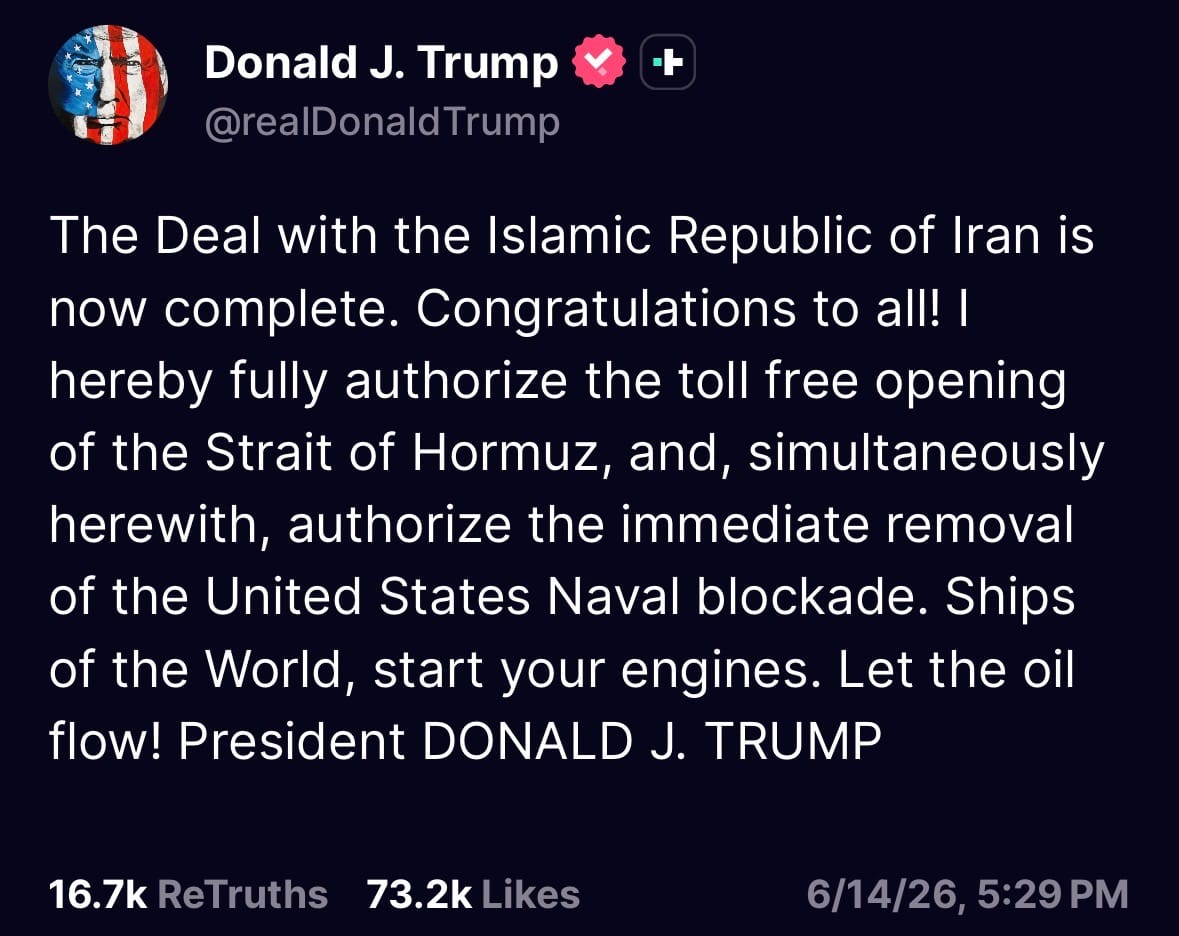
- He authorized the immediate toll-free reopening of the Strait of Hormuz and the removal of the U.S. naval blockade, stating “Ships of the World, start your engines. Let the oil flow!” An official signing ceremony is scheduled for June 19 in Switzerland.
Economics & Markets:
- On June 14, 2026, the UK and Japan announced a major £18 billion investment partnership. It will support tens of thousands of jobs in clean energy, offshore wind, infrastructure, and advanced technology while helping lower energy bills and boost British economic growth.
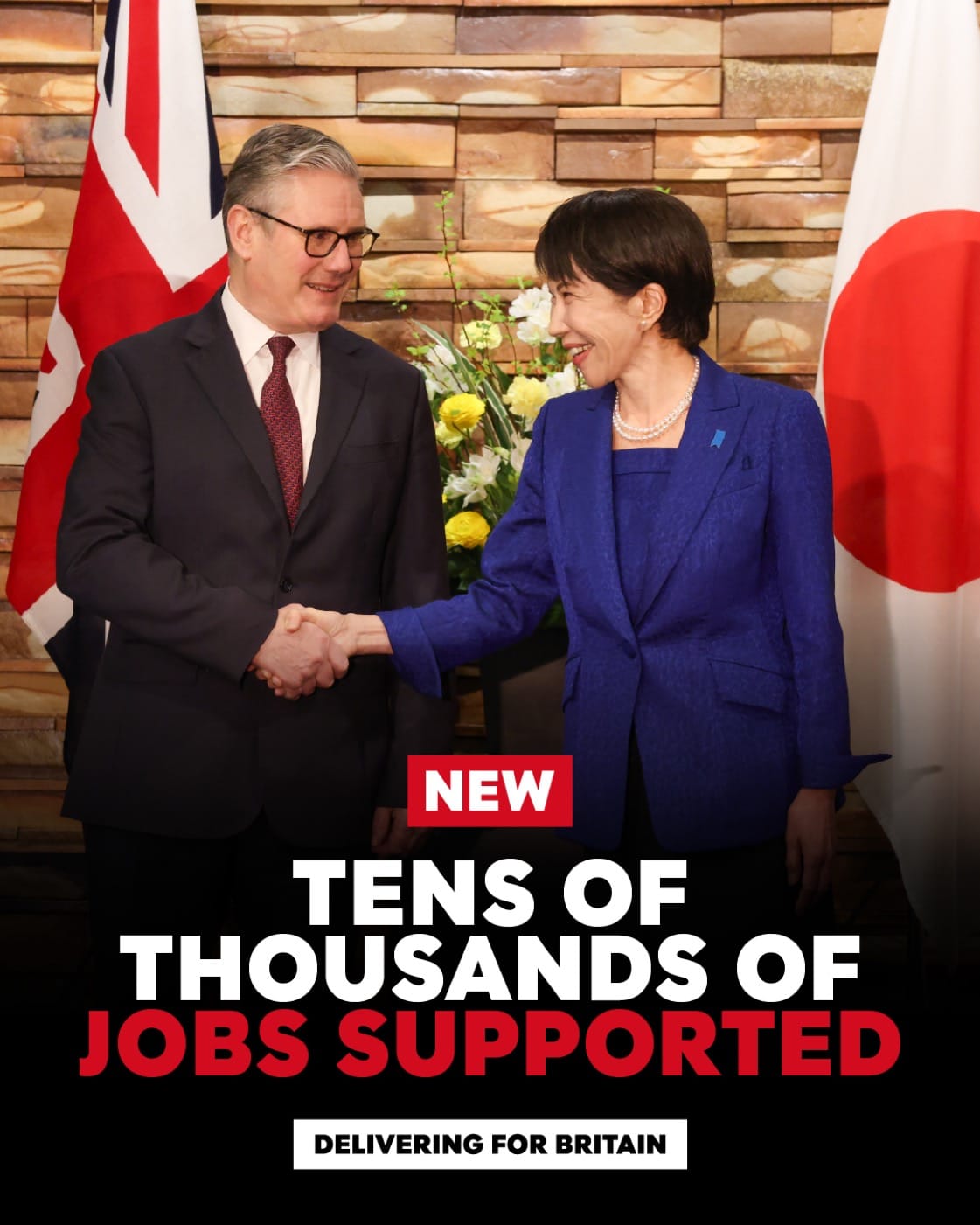
- Included in this deal, Rolls-Royce signed a new nuclear cooperation agreement with Japan’s Atomic Energy Agency and the UK National Nuclear Laboratory to develop advanced modular mini reactors for factories, data centres, and military bases, aiming for deployment by the mid-2030s.
Geopolitics & Military Activity:
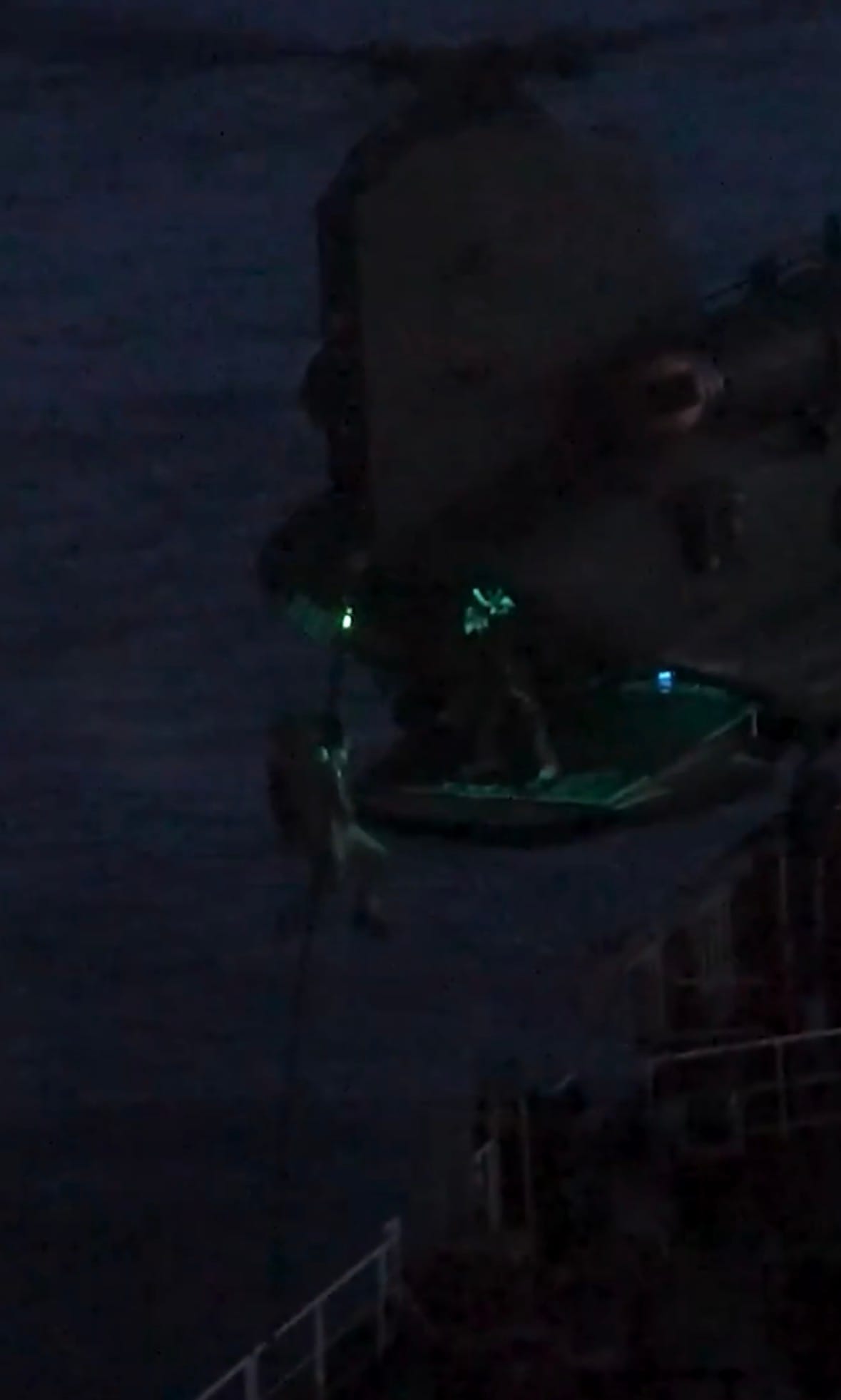
- On June 14, 2026, UK forces boarded a Russian tanker in the English Channel. The operation targeted a vessel accused of secretly helping finance Russia’s war in Ukraine. British authorities described it as the first action of its kind and a signal that sanctions evaders have nowhere to hide.
Science & Technology:
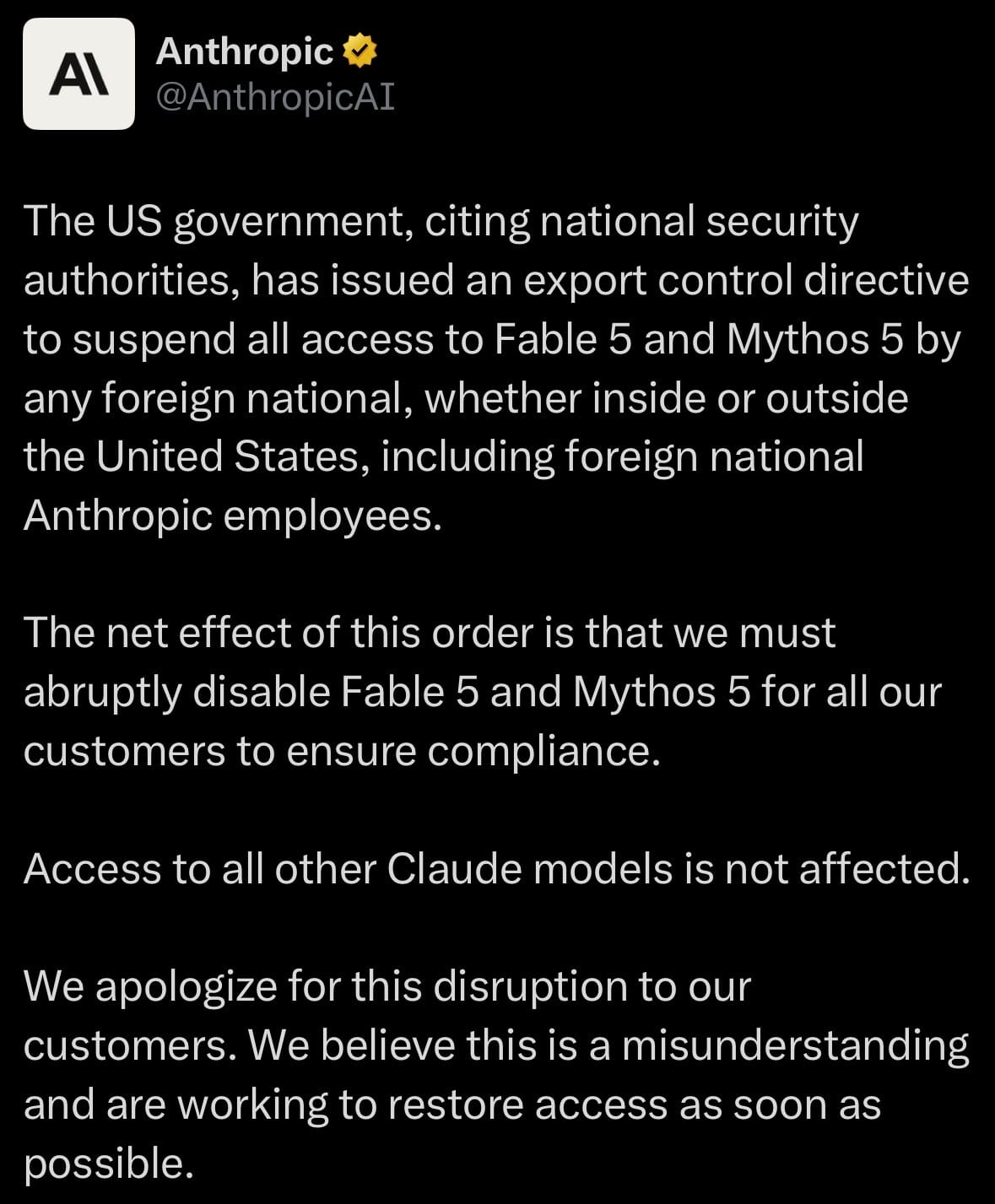
- On June 12, 2026, the U.S. government banned foreign nationals from using Anthropic’s two most powerful AI models — Fable 5 and Mythos 5 — for national security reasons. To follow the new rule, Anthropic has temporarily turned off both models for everyone worldwide. All other Claude models are still available and unaffected.
Statistic:
- Largest assets on Earth by market capitalization:
- Gold: $30.253T
- 🇺🇸 NVIDIA: $4.969T
- 🇺🇸 Alphabet (Google): $4.367T
- 🇺🇸 Apple: $4.275T
- Silver: $3.986T
- 🇺🇸 Microsoft: $2.902T
- 🇺🇸 Amazon: $2.566T
- 🇹🇼 TSMC: $2.198T
- 🇺🇸 SpaceX: $2.106T
- 🇺🇸 Broadcom: $1.817T
- 🇸🇦 Saudi Aramco: $1.732T
- 🇺🇸 Tesla: $1.526T
- 🇰🇷 Samsung: $1.458T
- 🇺🇸 Meta Platforms: $1.439T
- Bitcoin: $1.314T
- 🇺🇸 Micron Technology: $1.106T
- 🇰🇷 SK Hynix: $1.068T
- 🇺🇸 Berkshire Hathaway: $1.055T
- 🇺🇸 Eli Lilly: $1.010T
- 🇺🇸 Vanguard S&P 500 ETF (VOO): $976.31B
- 🇺🇸 Walmart: $963.24B
- 🇺🇸 JPMorgan Chase: $859.37B
- 🇺🇸 AMD: $834.16B
- 🇺🇸 iShares Core S&P 500 ETF (IVV): $801.69B
- 🇺🇸 SPDR S&P 500 ETF (SPY): $783.12B
- 🇳🇱 ASML: $718.24B
History:
- U.S. Special Operations Forces (SOF) trace their roots to elite scouting, raiding, and reconnaissance units used throughout American military history, but the modern special operations era began during World War II (1939–1945). Inspired by British Commandos and the Special Air Service (SAS), the United States created organizations such as the 1st Special Service Force (1942)—known as the “Devil’s Brigade”—the Office of Strategic Services (OSS) in 1942, which conducted espionage and sabotage behind enemy lines, and the Navy Underwater Demolition Teams (1943), the predecessors to the Navy SEALs. During the war, these units carried out reconnaissance, intelligence gathering, guerrilla warfare, and covert operations across Europe and the Pacific. After WWII, the OSS was dissolved, but its legacy later helped shape the CIA (1947) and future special operations units. During the Green Berets’ formation in 1952, the U.S. Army Special Forces were specifically designed to train resistance fighters, conduct unconventional warfare, and operate behind enemy lines during the Cold War. During the Vietnam War (1955–1975), Green Berets became legendary for training indigenous forces, conducting reconnaissance missions in Laos and Cambodia, and leading highly classified operations through units such as MACV-SOG (1964–1972), one of the most secretive military organizations in U.S. history.
- The modern SOF structure emerged after several high-profile lessons. The failed Operation Eagle Claw (1980) attempt to rescue American hostages in Iran exposed major coordination problems between military branches. In response, the U.S. created Joint Special Operations Command (JSOC) in 1980, one of the most secretive military commands in the world. JSOC oversees elite “Tier 1” units including Delta Force (1st SFOD-D, founded 1977), focused on counterterrorism and hostage rescue; SEAL Team Six (DEVGRU, founded 1980), the Navy’s premier counterterrorism unit; and specialized aviation support through the 160th Special Operations Aviation Regiment (“Night Stalkers,” founded 1981). The Goldwater-Nichols Act (1986) and creation of U.S. Special Operations Command (USSOCOM) in 1987 unified special operations forces under a dedicated combatant command. Throughout the 1990s, SOF units conducted operations in Panama, Somalia, Bosnia, Kosovo, and numerous classified missions worldwide. Their role expanded dramatically after September 11, 2001, when special operations forces became central to the Global War on Terror. Green Berets, Rangers, SEALs, Delta Force operators, Air Force Special Tactics personnel, and Marine Raiders conducted thousands of missions across Afghanistan, Iraq, Syria, Yemen, Somalia, and other regions. Some of the most famous operations include the capture of Saddam Hussein (2003), the rescue of Captain Richard Phillips from Somali pirates (2009), and Operation Neptune Spear (May 2, 2011), which resulted in the death of Osama bin Laden by SEAL Team Six.
- By 2026, U.S. Special Operations Command oversees approximately 70,000 personnel and is widely regarded as the most capable special operations organization in the world. Its major components include the Army Special Forces (Green Berets), 75th Ranger Regiment, Delta Force, Navy SEAL Teams, SEAL Team Six (DEVGRU), Air Force Pararescue (PJs), Combat Controllers (CCTs), Special Reconnaissance units, Special Operations Weather Teams, Marine Raiders, and the 160th SOAR helicopter force. Modern missions extend far beyond direct action raids and include cyber operations, intelligence gathering, counterterrorism, hostage rescue, foreign military training, drone integration, strategic reconnaissance, information warfare, and support to intelligence agencies such as the CIA. Today, U.S. special operators routinely work alongside foreign special forces, intelligence services, and joint task forces across the globe. What began with small commando units in World War II has evolved into a global network of elite forces capable of conducting precision operations almost anywhere on Earth within hours, making U.S. Special Operations Forces one of the most influential and strategically important military capabilities ever developed.
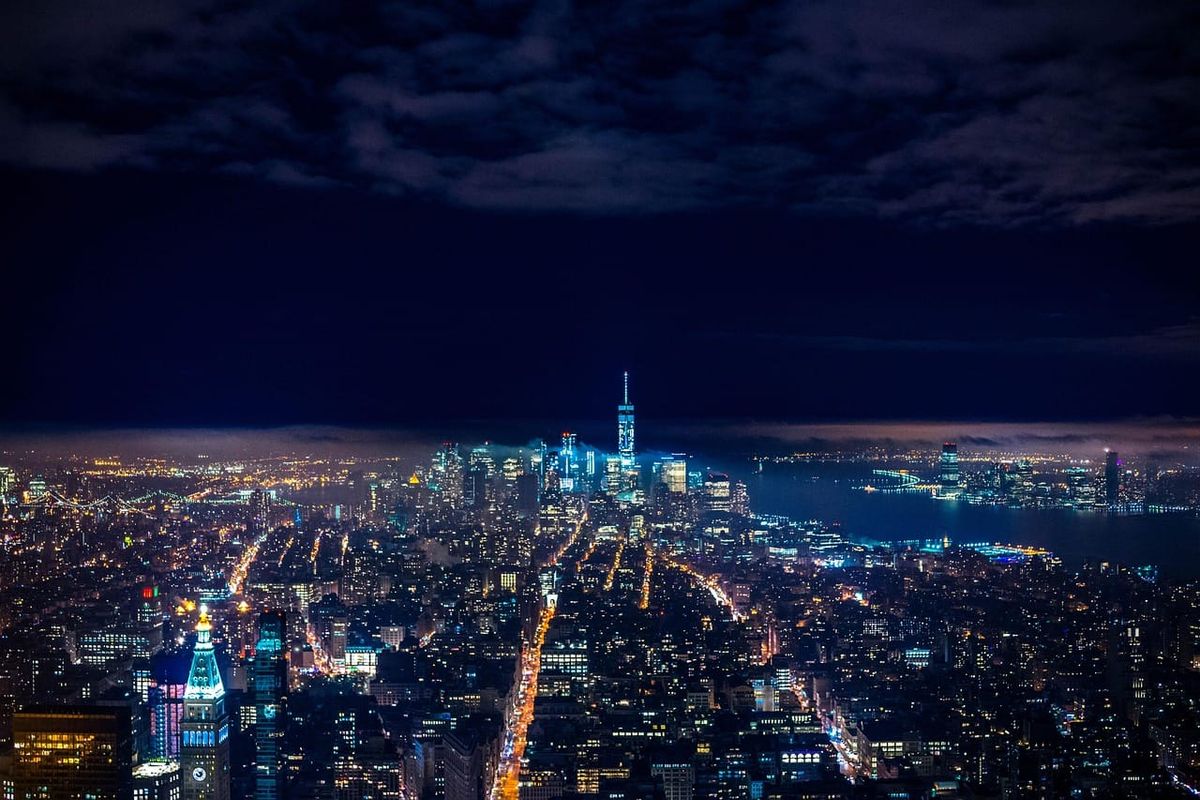
Image of the day:
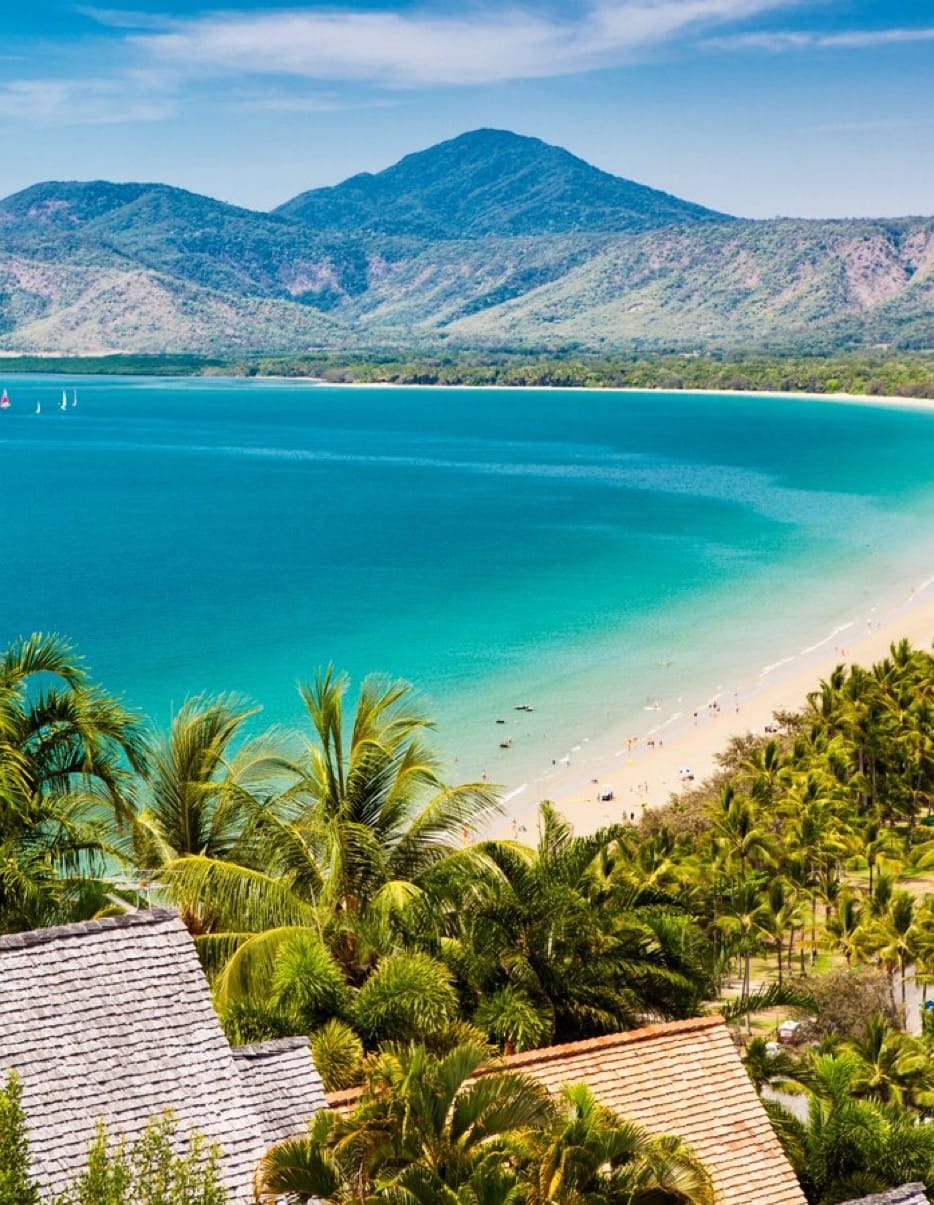
Thanks for reading! Earth is complicated, we make it simple.
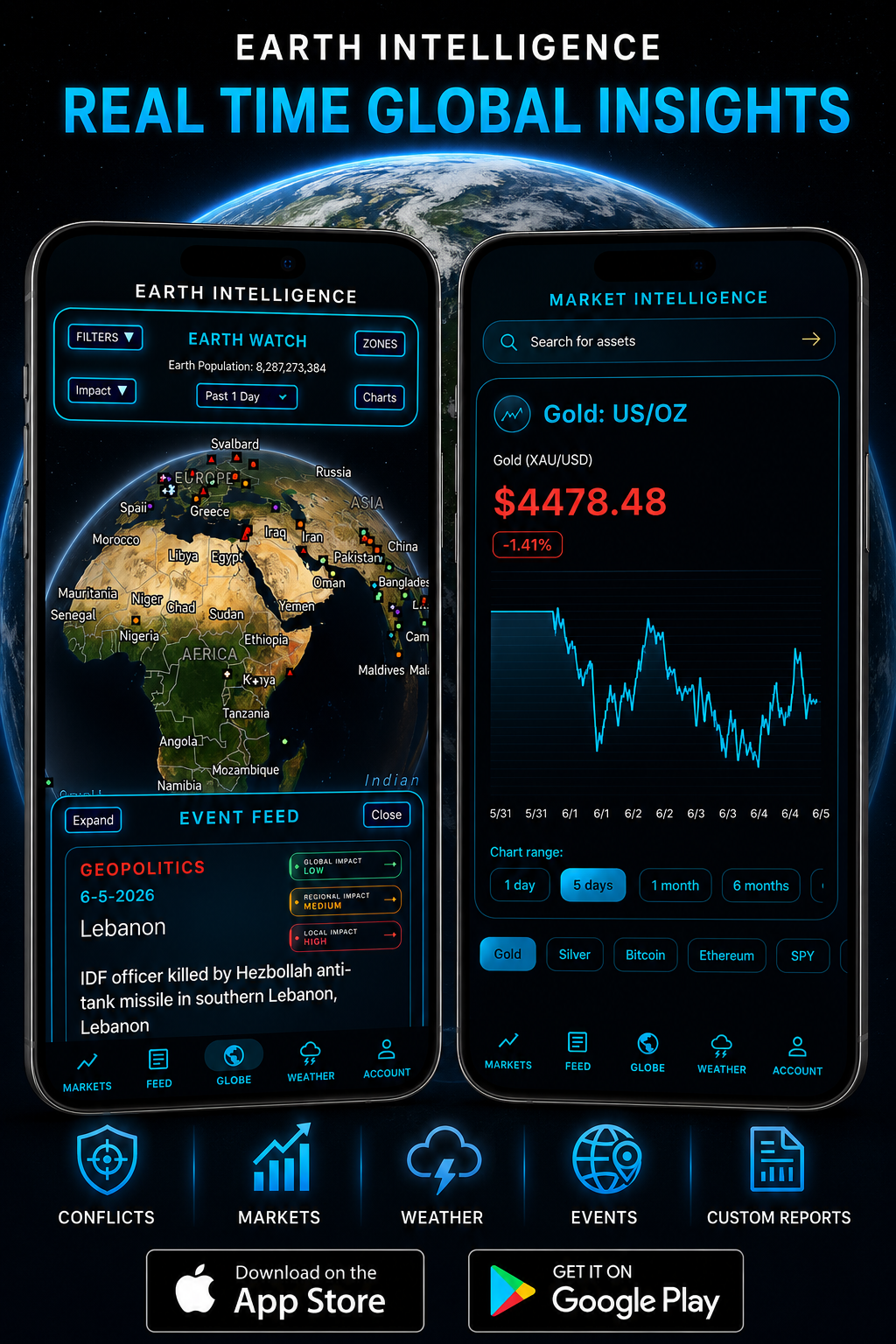
- Download our mobile app:


Click below to view our previous newsletters:
Support/Suggestions Email:
support@earthintel.io