Thursday☕️


Trending:
- The FBI Boston office charged 30 individuals today in a decade-long global insider trading scheme that made tens of millions in illegal profits. The group stole confidential information on nearly 30 major mergers and acquisitions from top corporate law firms (including one in Massachusetts) and traded on it.

Key names include:
- Nicolo Nourafchan (43, Los Angeles) – central figure, a former M&A attorney
- Robert Yadgarov (45, Long Beach, NY) – his partner
- Members of the Fensterszaub family and others such as Pedram Fejal, Yisroel Horowitz, David Moradi, and Joseph Suskind
19 people were arrested in AL, CA, FL, NJ, and NY. Two fugitives remain at large in Israel and Russia.
Geopolitics & Military Activity:
- On May 6, U.S. forces disabled an Iranian-flagged oil tanker (M/T Hasna) in the Gulf of Oman after it tried to violate the naval blockade and sail toward an Iranian port.
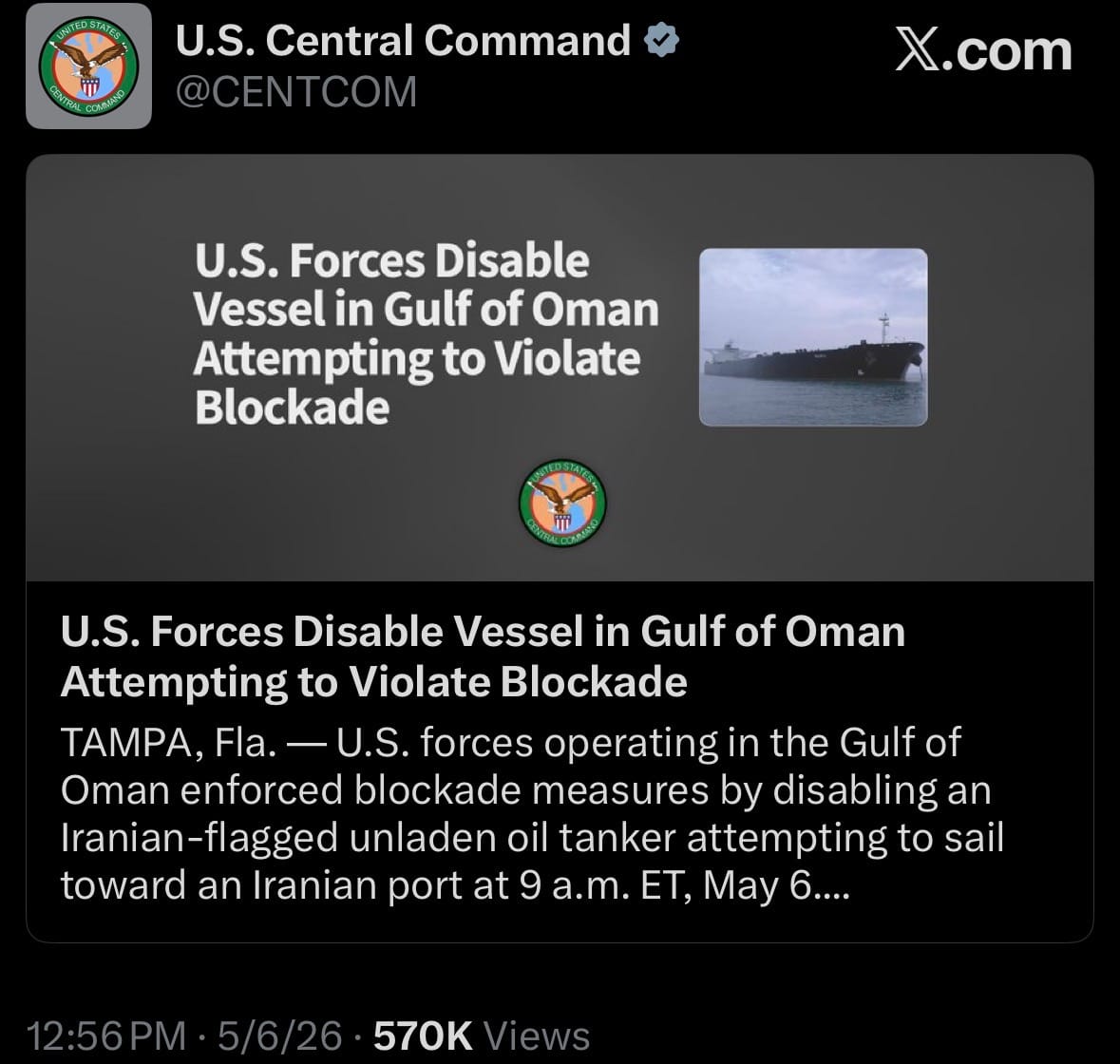
- A Navy F/A-18 Super Hornet launched from the USS Abraham Lincoln fired 20mm cannon rounds to disable the ship’s rudder after the crew ignored multiple warnings. The tanker was unladen, no injuries were reported, and it is now unable to proceed. The blockade remains fully in effect.
Science & Technology:
- Anthropic has signed a major deal with SpaceX (which now owns xAI as a subsidiary) to use the full computing power of the massive Colossus 1 data center in Memphis. This gives Anthropic access to over 300 megawatts and more than 220,000 Nvidia GPUs, allowing them to significantly increase usage limits for Claude Code and the Claude API.


- How SpaceX owns xAI: SpaceX fully acquired xAI in February 2026 in a large all-stock deal. The partnership shows the two companies (now under the same parent) working together on AI compute, with future interest in building orbital (space-based) AI data centers.
Statistic:
- Largest public companies by market capitalization:
- 🇺🇸 NVIDIA: $5.051T
- 🇺🇸 Alphabet (Google): $4.787T
- 🇺🇸 Apple: $4.222T
- 🇺🇸 Microsoft: $3.075T
- 🇺🇸 Amazon: $2.958T
- 🇹🇼 TSMC: $2.175T
- 🇺🇸 Broadcom: $2.014T
- 🇸🇦 Saudi Aramco: $1.741T
- 🇺🇸 Meta Platforms: $1.555T
- 🇺🇸 Tesla: $1.497T
- 🇰🇷 Samsung: $1.234T
- 🇺🇸 Walmart: $1.036T
- 🇺🇸 Berkshire Hathaway: $1.013T
- 🇺🇸 Eli Lilly: $880.19B
- 🇺🇸 JPMorgan Chase: $843.77B
- 🇰🇷 SK Hynix: $809.45B
- 🇺🇸 Micron Technology: $751.73B
- 🇺🇸 AMD: $687.11B
- 🇺🇸 Exxon Mobil: $616.31B
- 🇺🇸 Visa: $606.27B
- 🇳🇱 ASML: $595.37B
- 🇺🇸 Intel: $567.98B
- 🇺🇸 Oracle: $558.03B
- 🇨🇳 Tencent: $549.84B
- 🇺🇸 Johnson & Johnson: $540.70B
History:
- Air defense began with the simple problem of protecting cities and armies from attacks coming from above, but it evolved into one of the most technologically advanced military systems ever built. Early concepts appeared during World War I (1914–1918), when aircraft first became a real battlefield threat. Initial defenses were primitive: soldiers used rifles and modified artillery guns aimed upward, eventually leading to the first dedicated anti-aircraft artillery (AAA) systems. By the 1930s and World War II (1939–1945), air defense became a major strategic priority as bombers gained the ability to devastate entire cities. Countries developed massive anti-aircraft gun networks like Germany’s Flak towers and Britain’s integrated radar-based defense system during the Battle of Britain (1940). One of the biggest breakthroughs was radar, first operationally deployed in the late 1930s, allowing defenders to detect incoming aircraft before visual contact. This transformed air defense from reactive firing into coordinated interception, combining radar stations, command centers, and fighter aircraft into integrated defense networks. During WWII, defenses expanded further with proximity fuses, searchlights, barrage balloons, and early command-and-control systems, laying the groundwork for modern layered defense architecture.
- The Cold War completely transformed air defense because the threat evolved from propeller aircraft to high-speed jets, ballistic missiles, and eventually nuclear weapons. In the 1950s–1960s, surface-to-air missile (SAM) systems emerged, such as the Soviet S-25 and S-75 (SA-2) and the U.S. Nike missile systems, replacing many traditional anti-aircraft guns. These systems proved deadly during conflicts like the Vietnam War, where North Vietnamese SAM networks challenged American air superiority. At the same time, countries built massive early-warning radar networks like the U.S.-Canadian DEW Line to detect Soviet bombers approaching over the Arctic. By the 1970s–1990s, air defense evolved into multi-layered systems combining radar, missiles, electronic warfare, and airborne surveillance aircraft like AWACS. The Soviet Union developed increasingly advanced systems like the S-300, while the U.S. focused on integrated missile defense and stealth aircraft designed to bypass defenses entirely. After the Gulf War and into the 2000s, air defense expanded beyond aircraft into defense against cruise missiles, drones, and ballistic missiles, leading to systems like Patriot, THAAD, Aegis, and Israel’s Iron Dome, which intercepts short-range rockets in real time.
- From 2020–2026, air defense has entered a new era driven by drones, hypersonic weapons, AI, and networked warfare. Modern systems are no longer isolated missile batteries—they are part of integrated sensor webs combining satellites, radar arrays, electronic intelligence, aircraft, ships, and AI-driven targeting systems. Countries like the United States, Russia, China, and Israel are the dominant players. Russia’s S-400 and S-500 systems focus on long-range interception of aircraft and missiles; China has built dense integrated air defense systems around the South China Sea and Taiwan; the U.S. relies heavily on layered missile defense and naval systems like Aegis; and Israel’s multi-layered shield combines Iron Dome, David’s Sling, and Arrow systems. Modern threats now include low-cost drone swarms, stealth aircraft, cruise missiles, and hypersonic glide vehicles, forcing air defense systems to become faster, more automated, and more distributed. The evolution is clear: air defense started as soldiers firing into the sky and has become a real-time, multi-domain sensing and interception network designed to detect, track, and destroy threats moving at extreme speed across air and space simultaneously.
Image of the day:

Thanks for reading! Earth is complicated, we make it simple.

- Download our mobile app:


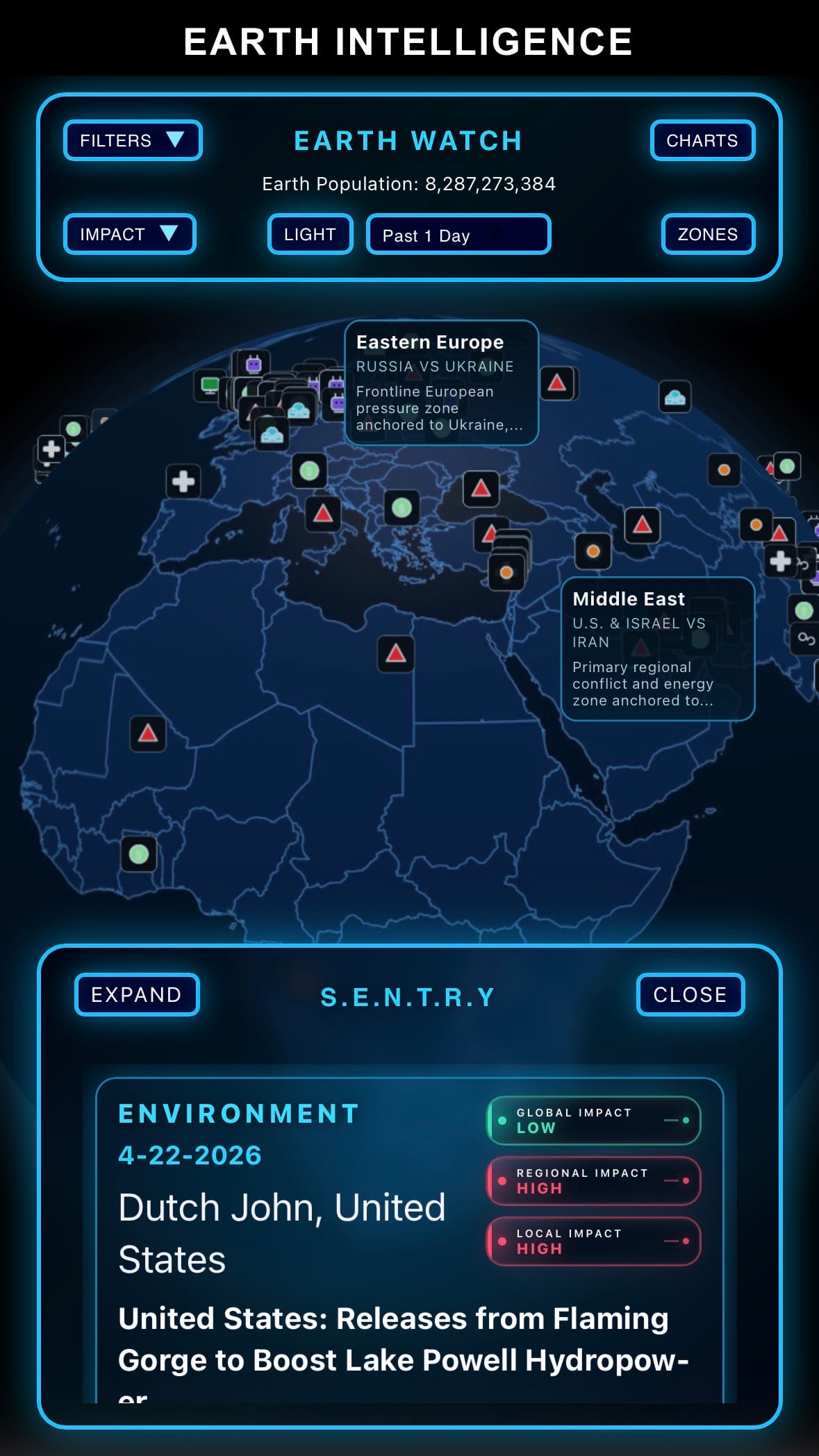
- Click below if you’d like to view our free EARTH WATCH globe:
Click below to view our previous newsletters:

Support/Suggestions Email:
support@earthintel.io