Thursday☕️


Trending:
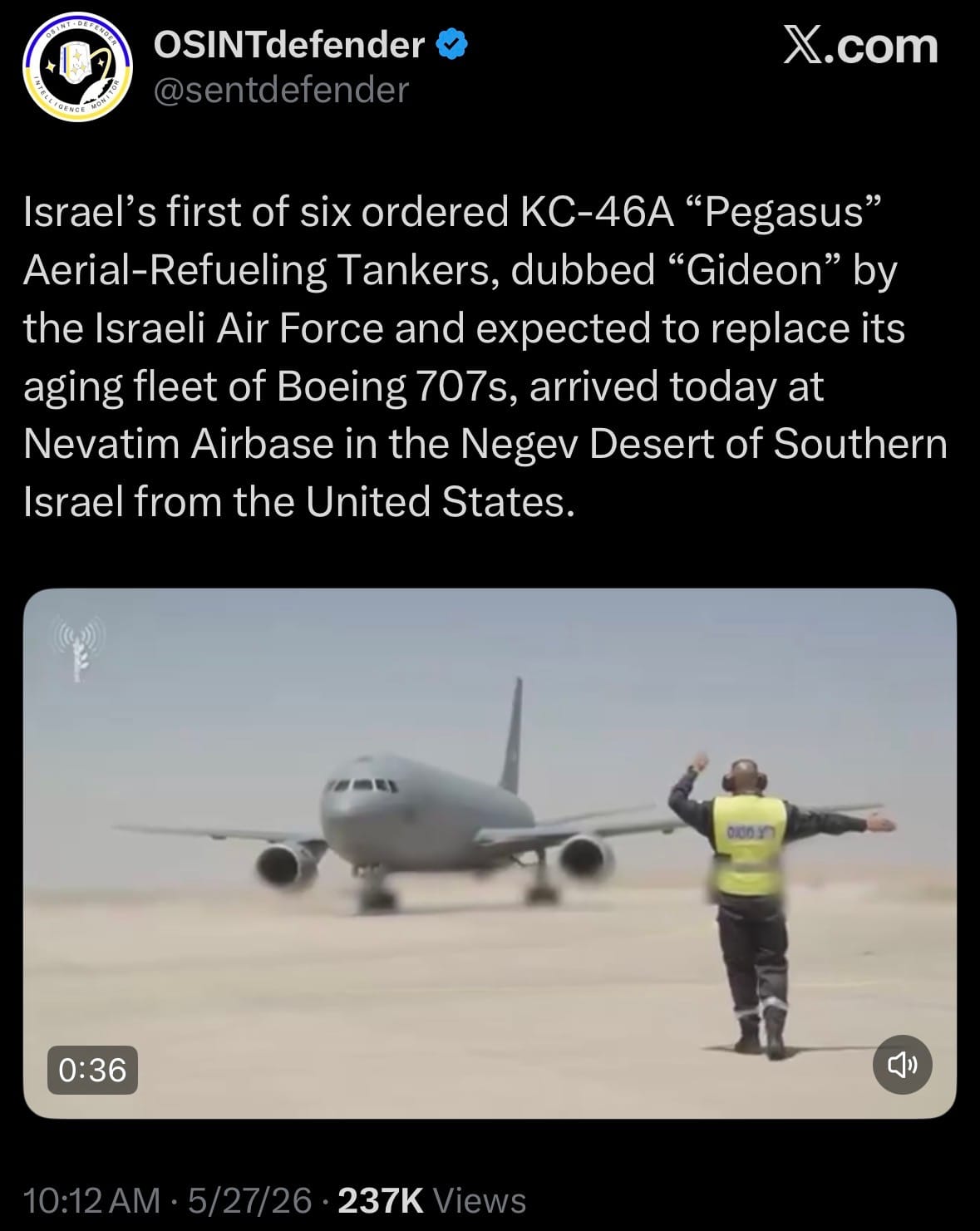
- On May 27, 2026, Israel received its first KC-46A Pegasus aerial refueling tanker, named “Gideon,” at Nevatim Airbase from the United States. It is the first of six ordered (with options for two more) in a U.S.-funded deal — the initial four cost about $930 million and the next two about $500 million, paid for with U.S. military aid to Israel.
- Most aerial refueling tankers:
- United States: ~610 tankers
- Saudi Arabia: 22
- Russia: 18
- France: 15
- China: 9
- Israel: 13
- All other nations: 85–100
Economics & Markets:



Geopolitics & Military Activity:
- On May 28, Iran’s IRGC claimed it launched missiles and drones at a U.S. airbase in Kuwait in retaliation for recent U.S. defensive strikes near Bandar Abbas.
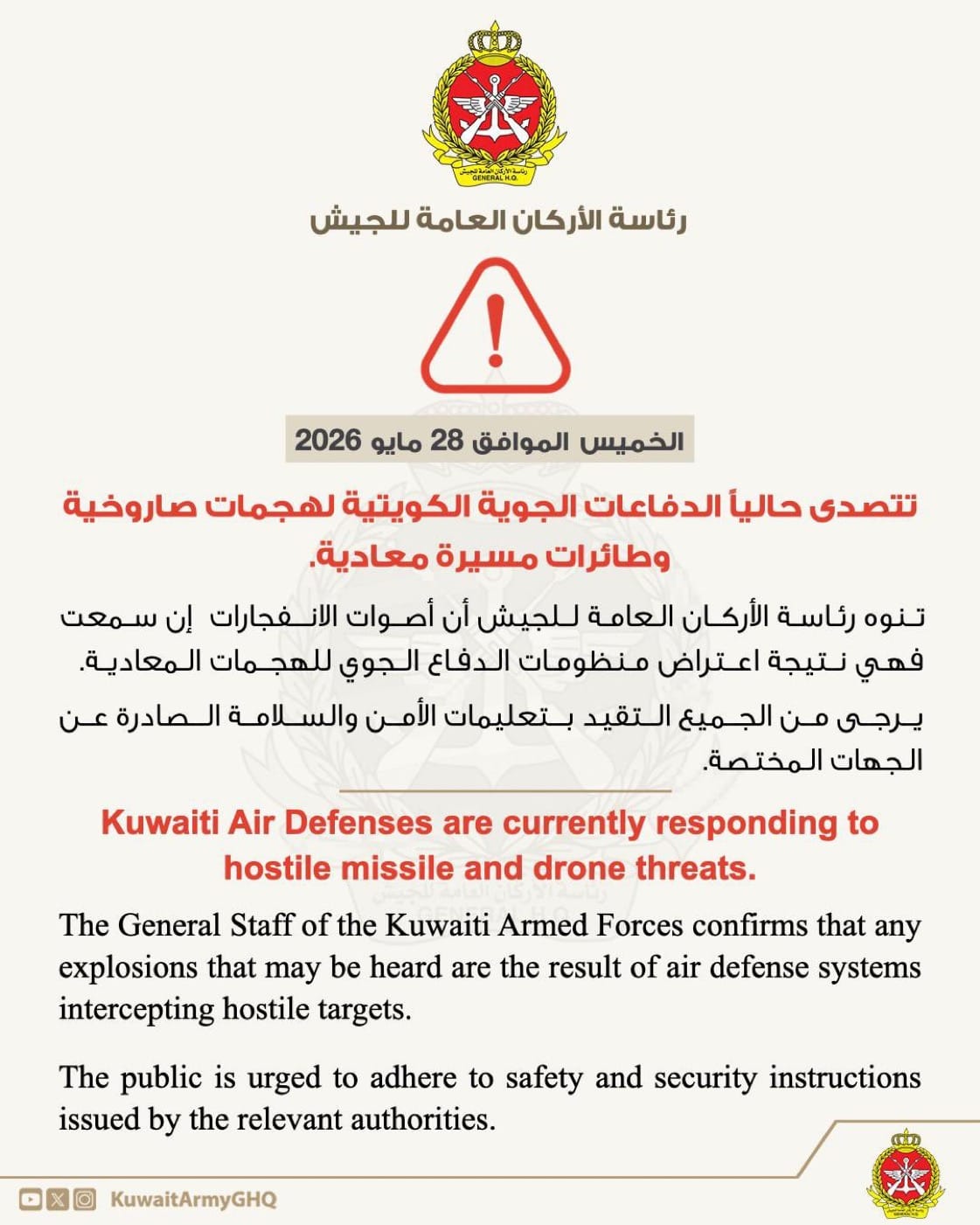
- Kuwait’s air defenses intercepted the incoming threats, with alarms sounding across the country and no confirmed damage or casualties reported so far. U.S. officials described their earlier actions as limited and defensive, emphasizing that these exchanges do not end the current ceasefire.
Science & Technology:
- On May 27, the MQ-28 Ghost Bat went international for the first time.
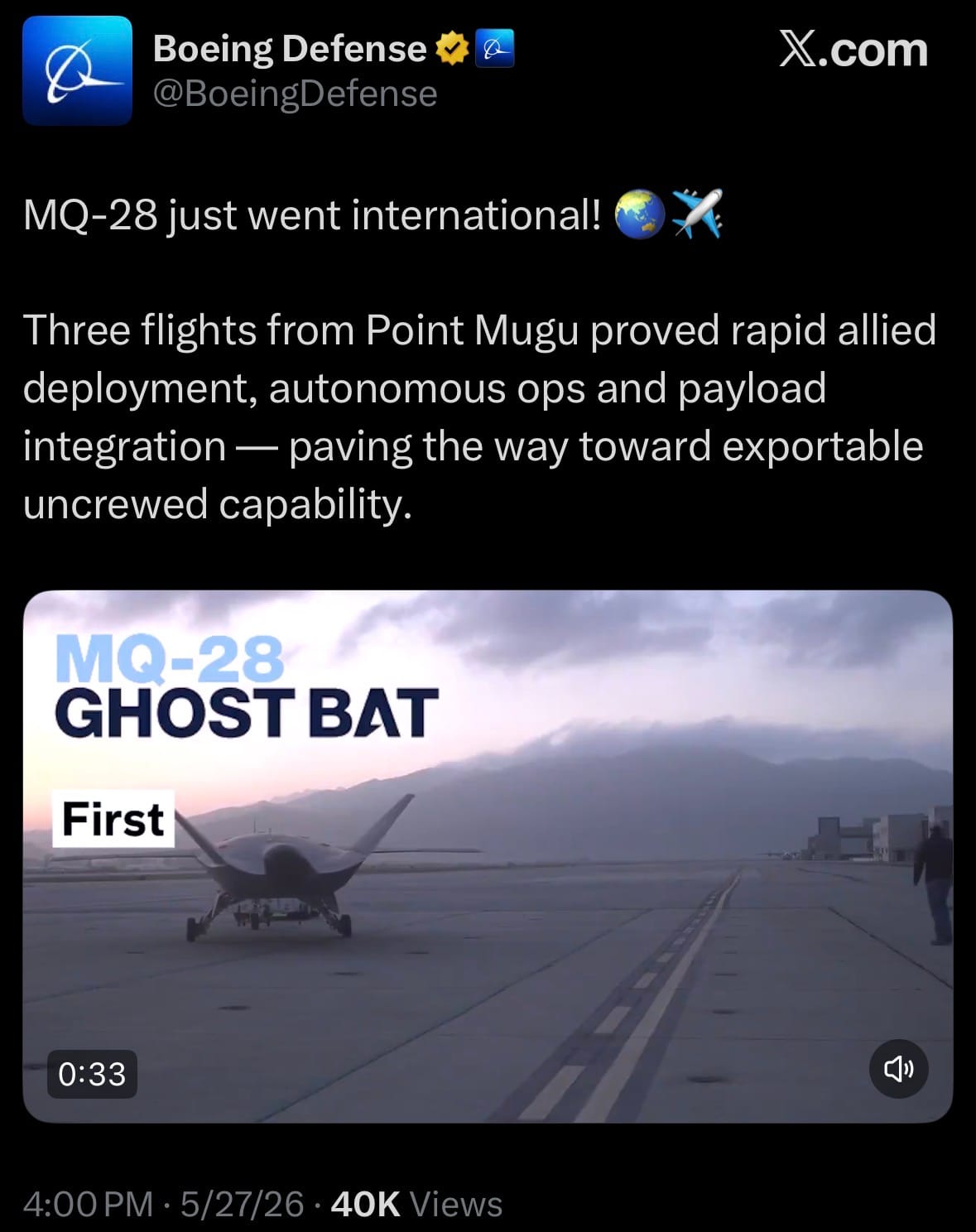
- Boeing and the Royal Australian Air Force successfully completed three test flights from Naval Air Station Point Mugu in California, demonstrating rapid allied deployment, autonomous operations, and payload integration — a major step toward making the uncrewed combat aircraft exportable to other countries.

Statistic:
- Largest public financial service companies by market capitalization:
- 🇺🇸 JPMorgan Chase: $801.92B
- 🇺🇸 Visa: $623.03B
- 🇺🇸 Mastercard: $437.40B
- 🇨🇳 China Construction Bank: $390.36B
- 🇺🇸 Bank of America: $362.63B
- 🇬🇧 HSBC: $324.71B
- 🇨🇳 Agricultural Bank of China: $320.46B
- 🇺🇸 Morgan Stanley: $317.99B
- 🇨🇳 ICBC: $298.52B
- 🇺🇸 Goldman Sachs: $293.96B
- 🇨🇳 Bank of China: $278.41B
- 🇨🇦 Royal Bank Of Canada: $262.98B
- 🇯🇵 SoftBank Group Corp.: $254.34B
- 🇺🇸 Wells Fargo: $232.91B
- 🇯🇵 Mitsubishi UFJ Financial: $214.23B
- 🇺🇸 Citigroup: $213.86B
- 🇺🇸 American Express: $213.25B
- 🇦🇺 Commonwealth Bank: $193.14B
- 🇨🇦 Toronto Dominion Bank: $188.12B
- 🇪🇸 Santander: $181.30B
- 🇨🇭 UBS: $154.58B
- 🇺🇸 Charles Schwab: $148.88B
- 🇨🇳 CM Bank: $148.12B
- 🇯🇵 Sumitomo Mitsui Financial Group: $142.51B
- 🇺🇸 Interactive Brokers: $137.61B
History:
- Aerial refueling began as an experimental concept in the early days of aviation, when militaries realized aircraft range was one of the biggest limitations in air power. The first successful in-air refueling occurred in 1923, when U.S. Army Air Service pilots transferred fuel between biplanes using a simple gravity-fed hose system while flying. Throughout the 1920s–1930s, refueling experiments focused mainly on endurance records, including aircraft staying airborne for days at a time. The technology became strategically important during World War II, as bombers and long-range aircraft required greater operational reach across Europe and the Pacific. However, true modern aerial refueling infrastructure emerged during the Cold War, especially after the creation of nuclear-capable bomber fleets. The United States developed large tanker aircraft like the KC-97 Stratofreighter (1950s) and later the legendary KC-135 Stratotanker (first flight 1956), built specifically to keep strategic bombers airborne for extended periods as part of nuclear deterrence strategy. Around the same period, two major refueling methods emerged: the flying boom system, pioneered largely by the U.S. and offering faster fuel transfer, and the probe-and-drogue system, used heavily by the Navy and many allied countries because it was simpler and more flexible for smaller aircraft.
- From the 1960s–1990s, aerial refueling became one of the defining force multipliers of modern military power. During the Vietnam War, the United States used tankers extensively to support bombing campaigns and long-range fighter operations. By the Gulf War (1991), aerial refueling had become essential to global rapid deployment, allowing fighters, bombers, surveillance aircraft, and cargo planes to operate continuously across enormous distances. The U.S. developed massive tanker fleets around aircraft like the KC-10 Extender (1981) and expanded global tanker basing networks. Other nations also built significant capabilities—Russia developed tanker variants like the Il-78, while NATO allies, China, and others expanded smaller refueling fleets. However, the United States became overwhelmingly dominant because aerial refueling allowed it to project power globally without relying entirely on foreign bases. This created a major strategic advantage: U.S. aircraft could launch from America or distant bases and still reach almost any region on Earth with tanker support. By the late Cold War and post-9/11 era, aerial refueling enabled continuous bomber patrols, rapid Middle East deployments, stealth operations, drone missions, and persistent global surveillance.
- By 2026, the United States remains by far the dominant aerial refueling power on Earth—not even close. The U.S. Air Force alone operates roughly 450–500 dedicated tanker aircraft, primarily KC-135s and newer KC-46 Pegasus tankers, plus additional refueling assets operated by the Navy and allies. In comparison, most major powers operate tanker fleets measured in dozens, not hundreds: China has expanded its fleet significantly but remains far behind, Russia maintains a smaller aging fleet, and European NATO countries collectively operate far fewer tankers than the U.S. The dominance gap is massive because aerial refueling is not just about aircraft—it requires logistics, global basing, training, command systems, and interoperable doctrine developed over decades. Modern refueling now supports stealth aircraft like the F-22 and F-35, strategic bombers like the B-2 and B-21, drones, special operations aircraft, and even allied coalition networks. The future is moving toward stealthier tankers, autonomous refueling drones, AI-assisted formation systems, and more survivable tanker operations for conflicts involving China or advanced missile threats. What started as pilots passing fuel through hoses between biplanes has evolved into one of the core systems that makes modern global military reach possible—and the United States dominates this domain more than any other country by a very large margin.
Image of the day:

Thanks for reading! Earth is complicated, we make it simple.
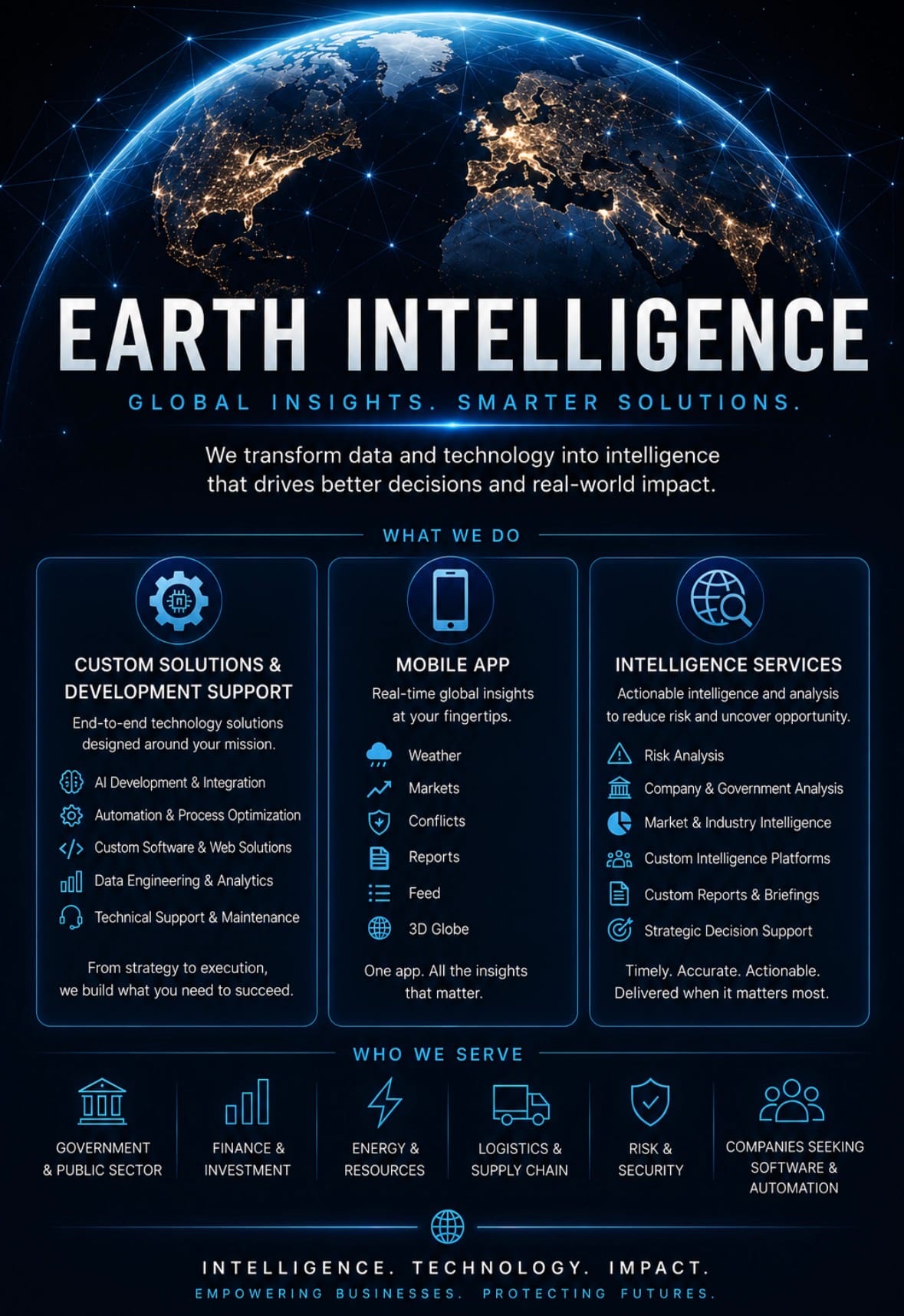
- Download our mobile app:



Click below to view our previous newsletters:
Support/Suggestions Email:
support@earthintel.io