Thursday☕️

Trending:
- On June 3, 2026, CCTV footage captured an Iranian Shahed-136 kamikaze drone striking Terminal 1 at Kuwait International Airport.
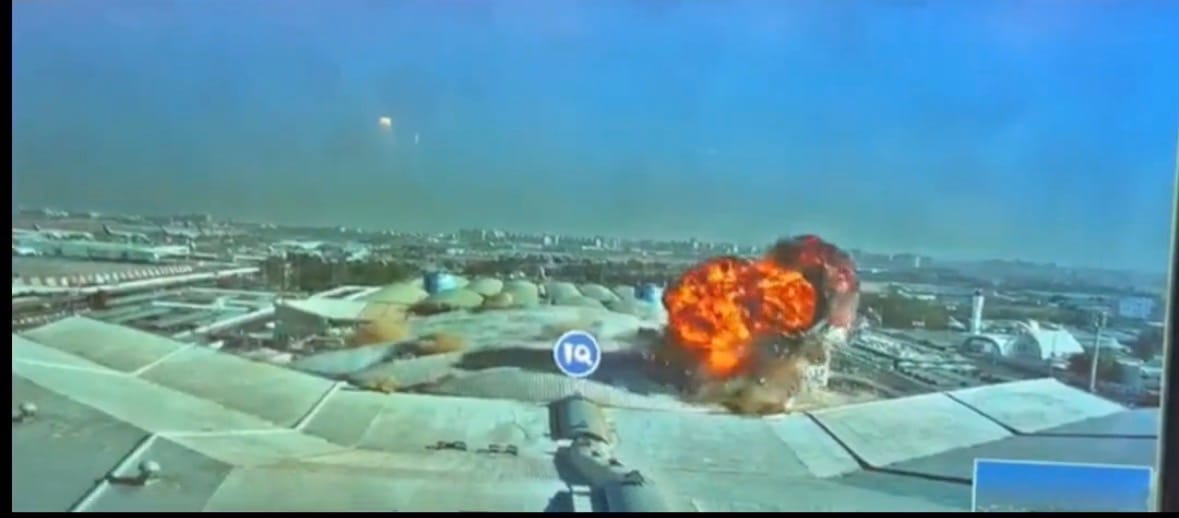
- The attack killed one person (an Indian national) and injured 63 others (passengers and airport workers, some seriously). The IRGC denied responsibility and blamed a malfunctioning Patriot interceptor, but the video clearly shows the drone directly hitting the terminal.
Science & Technology:
- Yesterday, xAI released Grok Imagine 1.5 Preview.
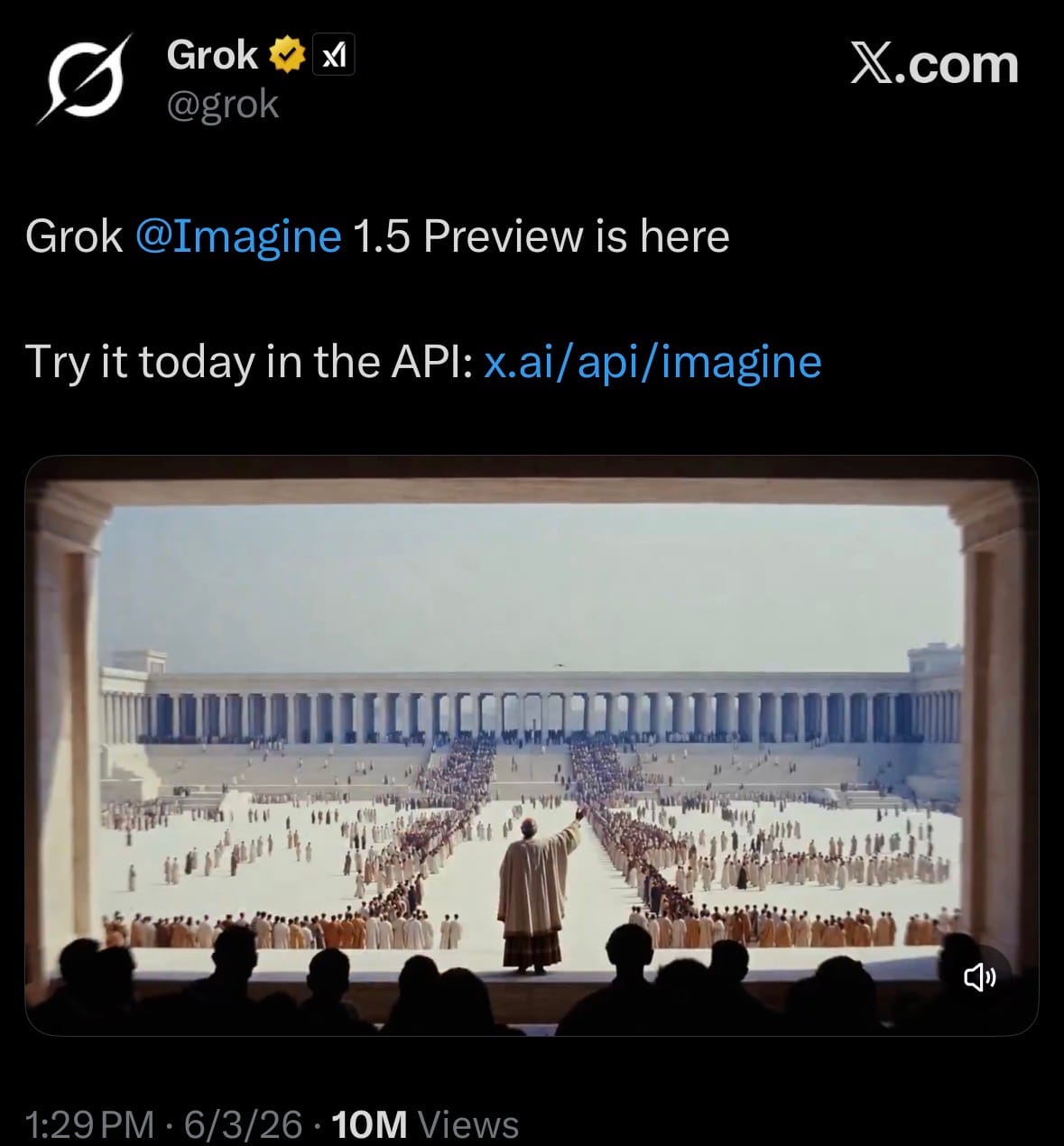
- This update to Grok’s built-in image generation tool improves image quality, realism, detail, and how accurately it follows user prompts and complex instructions. It is now available to Premium and SuperGrok subscribers.
U.S. HIMARS Sale:
- Canada has finalized a Foreign Military Sales (FMS) agreement with the United States to purchase 26 HIMARS rocket launchers for approximately $1.9 billion USD.

- Deliveries are scheduled to begin in 2029. This deal significantly strengthens Canada’s long-range precision fire capability.
Statistic:
- Largest public semiconductor companies by market capitalization:
- 🇺🇸 NVIDIA: $5.201T
- 🇺🇸 Broadcom: $2.268T
- 🇹🇼 TSMC: $2.264T
- 🇰🇷 Samsung: $1.531T
- 🇺🇸 Micron Technology: $1.217T
- 🇰🇷 SK Hynix: $1.064T
- 🇺🇸 AMD: $884.63B
- 🇳🇱 ASML: $665.36B
- 🇺🇸 Intel: $566.48B
- 🇬🇧 Arm Holdings: $439.86B
- 🇺🇸 Lam Research: $429.83B
- 🇺🇸 Applied Materials: $397.59B
- 🇺🇸 Texas Instruments: $280.84B
- 🇺🇸 KLA: $277.59B
- 🇺🇸 Marvell Technology: $264.11B
- 🇺🇸 QUALCOMM: $263.51B
- 🇹🇼 MediaTek: $227.00B
- 🇺🇸 Analog Devices: $213.18B
- 🇯🇵 Tokyo Electron: $178.54B
- 🇩🇪 Infineon: $132.78B
- 🇯🇵 Advantest: $127.17B
- 🇨🇳 Cambricon Technologies: $126.56B
- 🇺🇸 Synopsys: $95.36B
- 🇹🇼 ASE Group: $87.56B
- 🇨🇳 SMIC: $84.99B
- 🇺🇸 Monolithic Power Systems: $83.02B
History:
- Christianity began as a largely unified faith in the 1st century AD, but as it expanded across continents, languages, cultures, and empires, disagreements emerged over leadership, theology, politics, and church authority. For the first several centuries, major Christian centers existed in Rome, Constantinople, Alexandria, Antioch, and Jerusalem, and bishops from these cities worked together through Church councils to resolve disputes. The first major split occurred in 1054 AD, known as the Great Schism, which divided Christianity into the Roman Catholic Church and the Eastern Orthodox Church. The split did not happen overnight—it developed over centuries. Major issues included whether the Bishop of Rome (the Pope) should have supreme authority over all Christians or be considered “first among equals” alongside other patriarchs, differences in language (Latin in the West vs. Greek in the East), cultural differences between the Western and Eastern Roman Empires, and theological disputes such as the Filioque controversy, involving wording added to the Nicene Creed in the West. Political tensions also played a major role, especially after the fall of the Western Roman Empire in 476 AD and the rise of Constantinople as a major Christian center. In 1054, representatives of Rome and Constantinople formally excommunicated one another, creating the Catholic-Orthodox divide that largely remains today. The Roman Catholic Church, centered in Vatican City, grew to roughly 1.4 billion followers, while Eastern Orthodoxy developed into multiple national churches such as the Greek Orthodox, Russian Orthodox, Serbian Orthodox, Romanian Orthodox, and Bulgarian Orthodox Churches, totaling approximately 220–300 million followers.
- The second major split came during the Protestant Reformation, beginning in 1517 when German monk Martin Luther published his 95 Theses. Luther’s concerns focused on issues such as indulgences, church corruption, the authority of scripture, and whether salvation came through faith alone or through faith combined with church sacraments and works. What began as a reform movement quickly became a broader challenge to church authority. Other reformers emerged, including John Calvin (1509–1564) in Switzerland and Ulrich Zwingli (1484–1531), each developing their own interpretations of Christianity. In 1534, King Henry VIII separated England from Rome and established the Church of England (Anglican Church) after disputes over royal authority and marriage. Over the next several centuries, Protestantism continued to branch into numerous denominations including Lutherans, Anglicans, Presbyterians, Baptists, Methodists, Reformed churches, Pentecostals, Evangelicals, and many others. These divisions often arose over issues such as baptism, communion, church governance, spiritual gifts, predestination, worship style, and biblical interpretation. The Methodist movement emerged under John Wesley in the 1700s, emphasizing personal holiness and revival. The Pentecostal movement, beginning around 1901–1906, emphasized spiritual gifts such as speaking in tongues and became one of the fastest-growing Christian movements in history. Unlike the Catholic and Orthodox Churches, many Protestant groups operate independently without a single global authority structure, which contributed to the creation of thousands of denominations over time.
- By 2026, Christianity remains the largest religion on Earth with approximately 2.4 billion followers, divided primarily among Roman Catholicism (~1.4 billion), Protestantism (~900 million), and Eastern Orthodoxy (~220–300 million), along with smaller but historically important branches such as Oriental Orthodoxy, which separated after the Council of Chalcedon in 451 AD due to disagreements about the nature of Christ. This branch includes the Coptic Orthodox Church of Egypt, Armenian Apostolic Church, Syriac Orthodox Church, and Ethiopian Orthodox Tewahedo Church, some of the oldest Christian communities on Earth. While Christianity is often viewed as highly divided organizationally, most denominations still share core beliefs surrounding Jesus Christ, the Bible, the resurrection, and the central events of early Christianity. The story of Christian denominations is ultimately the story of a faith spreading across different civilizations, languages, cultures, and political systems for nearly 2,000 years, with each branch emerging from specific historical debates about authority, doctrine, governance, and tradition. Rather than a single split, Christianity experienced a series of major turning points—451 AD, 1054 AD, 1517 AD, 1534 AD, the 1700s revival movements, and the 1900s Pentecostal expansion—that shaped the global Christian landscape seen today.
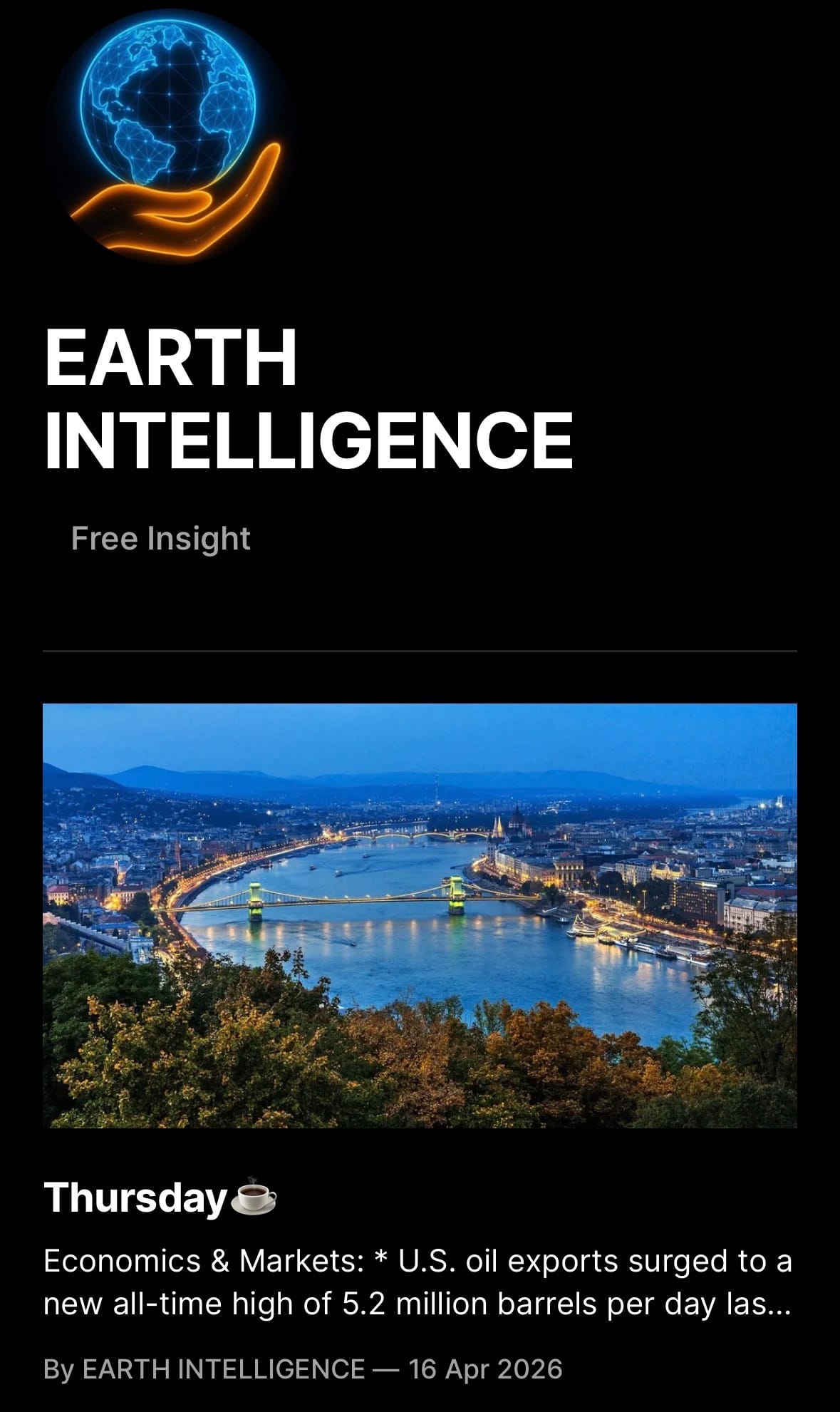
Image of the day:

Thanks for reading! Earth is complicated, we make it simple.
- Download our mobile app:


Click below to view our previous newsletters:
Support/Suggestions Email:
support@earthintel.io