Thursday☕️🌎


Trending:
- August 19, 2026 — U.S., Colombian, and Panamanian forces carried out a joint operation in the Eastern Pacific after a U.S. SOUTHCOM aircraft detected a suspected drug-smuggling boat traveling from Colombia toward Central America.

- Panamanian forces intercepted the vessel about 114 nautical miles south of Panama, seizing 2,428 kilograms of cocaine and 619 pounds of marijuana and detaining three suspects.
Economics & Markets:
Geopolitics & Military Activity:
- August 20, 2026 — Pakistani security forces killed five militants during an intelligence-led operation in Panjgur, Balochistan, after receiving information that the group was preparing an attack.
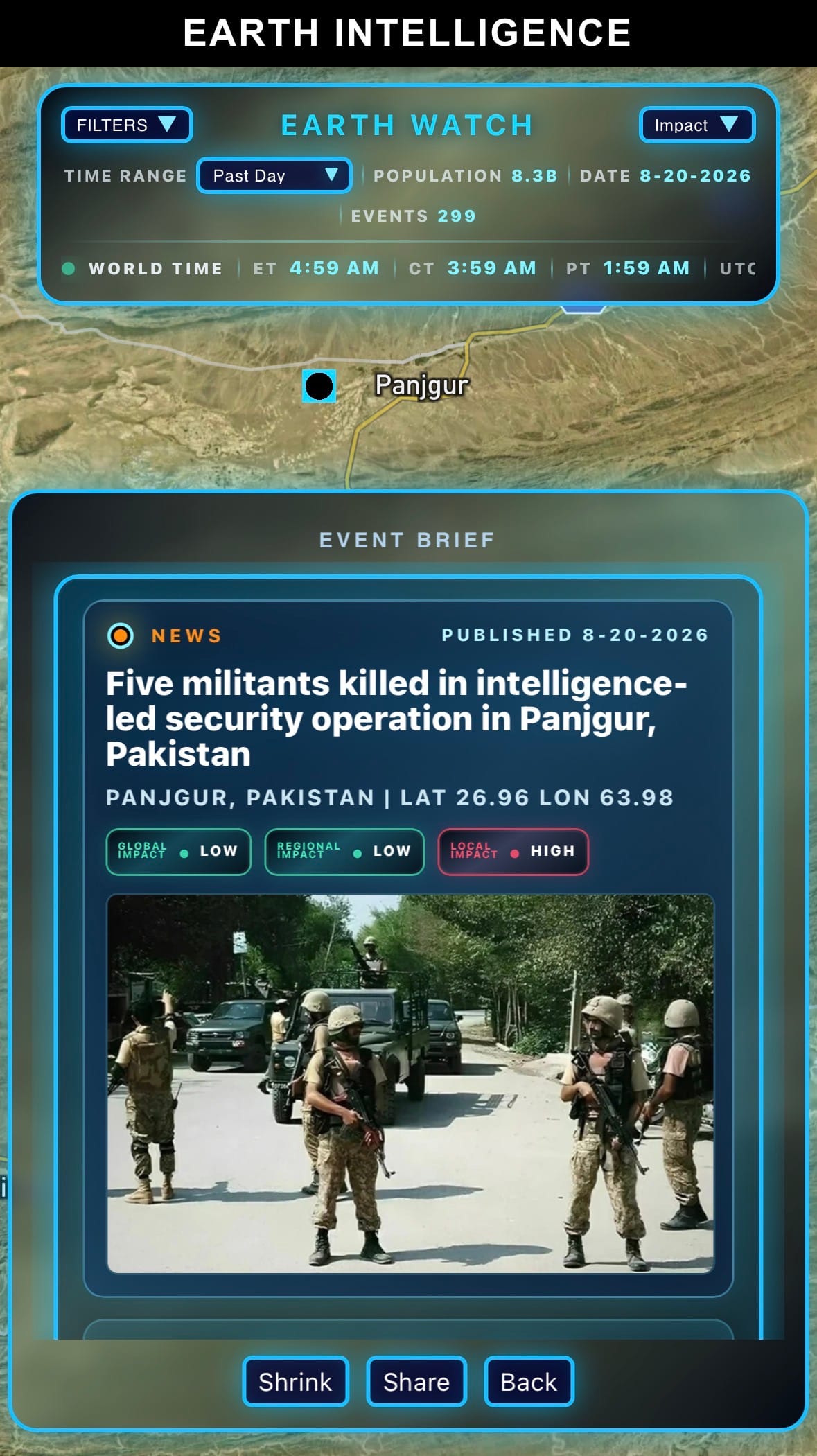
- Authorities said several other militants were wounded and recovered weapons, ammunition, vehicles, motorcycles, and an explosive device as Pakistan continues intensified counterterrorism operations across Balochistan.
Science & Technology:
- August 19, 2026 — Amazon announced a major expansion of Prime Air, its autonomous drone delivery service, which will reach nearly 500 U.S. cities and towns by the end of 2026—about six times its current coverage.
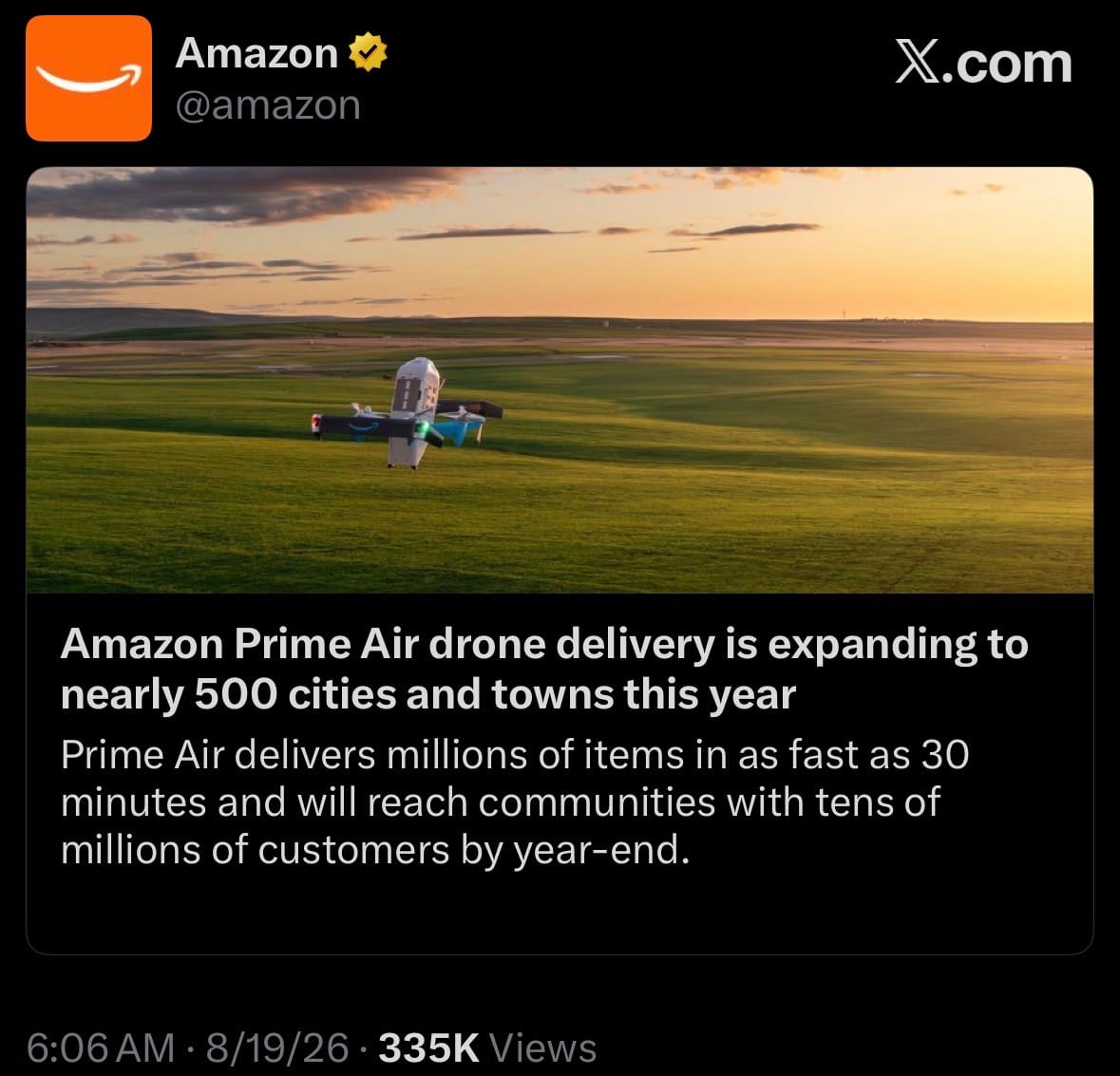
- Amazon’s MK30 drones can carry packages up to five pounds, including groceries, medicine, electronics, and household items, and deliver them directly to customers in as little as 30 minutes; the service is expanding to areas including Chicago, Atlanta, Cleveland, Syracuse, and Boise.
Space:
- August 19, 2026 — Chinese private space company LandSpace successfully launched its reusable Zhuque-3 Y2 rocket at 7:35 a.m. local time, placing the Honghu-03 satellite into orbit before landing the first-stage booster vertically in Gansu Province about eight minutes later.
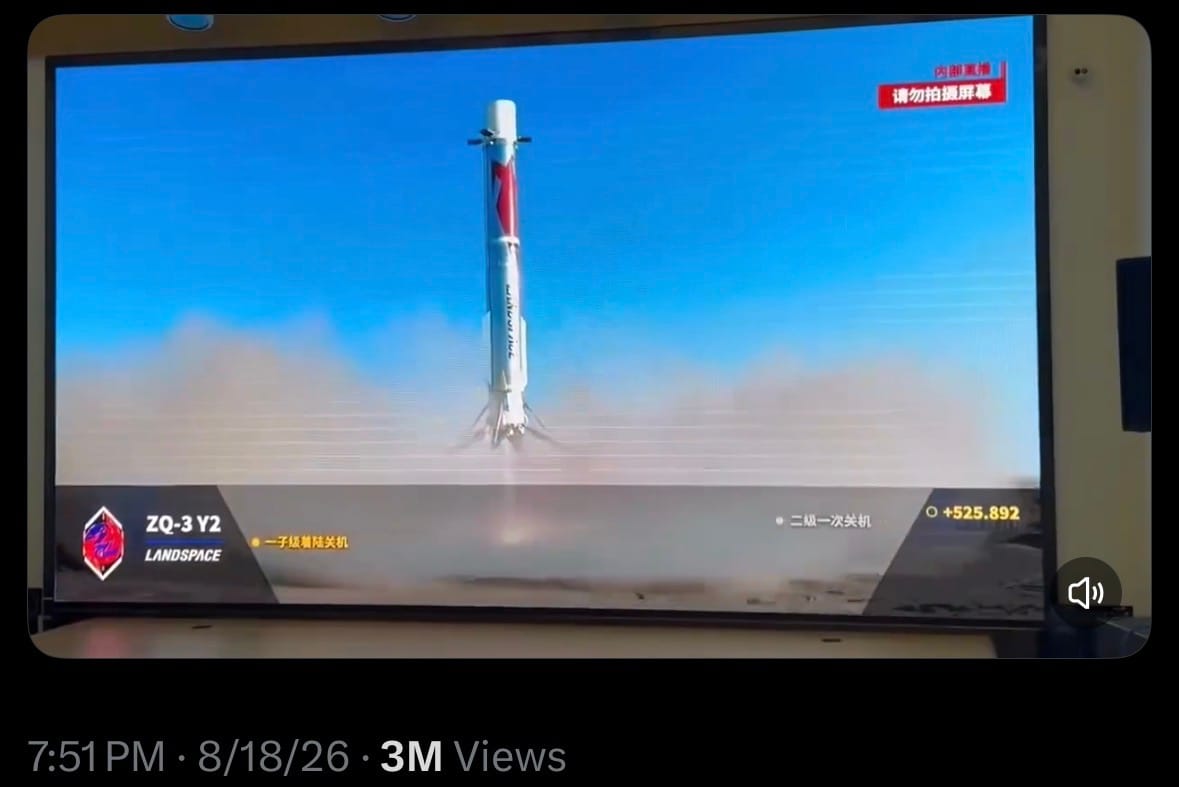
- The mission marked the first time a private Chinese company successfully recovered an orbital-class rocket booster on land, a major step toward reusable rockets that can lower launch costs and increase launch frequency for China.
Statistic:
- Public companies ranked by trailing twelve month (TTM) earnings:
- 🇺🇸 Alphabet (Google): $195.68B
- 🇸🇦 Saudi Aramco: $194.99B
- 🇺🇸 NVIDIA: $189.74B
- 🇺🇸 Microsoft: $154.50B
- 🇺🇸 Apple: $147.36B
- 🇺🇸 Amazon: $117.99B
- 🇺🇸 Meta Platforms: $90.78B
- 🇺🇸 JPMorgan Chase: $74.66B
- 🇰🇷 Samsung: $67.67B
- 🇹🇼 TSMC: $65.34B
- 🇰🇷 SK Hynix: $64.20B
- 🇺🇸 Berkshire Hathaway: $61.78B
- 🇺🇸 Micron Technology: $59.29B
- 🇨🇳 ICBC: $57.50B
- 🇨🇳 China Construction Bank: $52.70B
- 🇨🇳 Agricultural Bank of China: $46.08B
- 🇨🇳 Bank of China: $42.97B
- 🇺🇸 Bank of America: $39.98B
- 🇺🇸 Exxon Mobil: $36.63B
- 🇨🇳 PetroChina: $35.77B
- 🇯🇵 Toyota: $34.40B
- 🇺🇸 Broadcom: $33.62B
- 🇺🇸 Walmart: $33.48B
- 🇺🇸 Eli Lilly: $31.12B
- 🇨🇳 Tencent: $31.10B
History of Google
- Google began as a Stanford University research project. In 1995, computer-science students Larry Page and Sergey Brin met at Stanford and began developing a better way to organize the rapidly expanding World Wide Web. Their project, originally called BackRub, analyzed relationships between websites rather than simply counting keywords. Page and Brin developed PageRank, an algorithm that treated links from other websites as signals of importance and relevance. In 1997, they registered Google.com, with the name derived from “googol,” the number 1 followed by 100 zeros, representing their ambition to organize enormous amounts of information. Google Inc. was incorporated on September 4, 1998, after Sun Microsystems co-founder Andy Bechtolsheim wrote the company an early $100,000 check. Google initially operated from Susan Wojcicki’s garage in Menlo Park, California before moving into offices and eventually establishing its headquarters in Mountain View. Search became dramatically popular because Google was fast, simple, and generally produced better results than competitors such as Yahoo, AltaVista, Lycos, and Excite. The real business breakthrough came with AdWords in 2000, followed by increasingly sophisticated advertising auctions that allowed businesses to place advertisements alongside searches. Google essentially turned human intent—what billions of people were searching for—into an enormous advertising business.
- Google rapidly expanded from search into an entire internet ecosystem. Google News launched in 2002, Gmail in 2004, and Google completed its IPO in August 2004, raising about $1.67 billion and valuing the company at roughly $23 billion. It acquired Android in 2005 and YouTube for $1.65 billion in 2006, two acquisitions that became foundational to its future. Google Maps launched in 2005, Chrome in 2008, and the first commercial Android phone appeared that same year. Android eventually became the world’s dominant smartphone operating system by unit volume, while Chrome became the dominant web browser and YouTube became the world’s largest major video platform. Google simultaneously built Google Earth, Drive, Docs, Photos, Translate, Calendar, Play, Meet, Cloud, and enormous global data-center infrastructure. It also pushed into experimental technologies through self-driving cars, robotics, quantum computing, artificial intelligence, healthcare, and high-speed internet. In 2015, Page and Brin reorganized Google under a new parent company called Alphabet, allowing Google to remain the core internet business while projects such as Waymo, Verily, DeepMind, and other “Other Bets” could operate separately. Sundar Pichai, who had helped lead Chrome and Android, became Google CEO in 2015 and Alphabet CEO in 2019.
- Today, Google/Alphabet is one of the world’s most powerful technology organizations, built around Search, YouTube, Android, Chrome, Maps, advertising, Google Cloud, hardware, and artificial intelligence. AI has become central to its next era. Google acquired DeepMind in 2014, whose researchers later produced breakthroughs including AlphaGo (2016) and AlphaFold, while Google’s own researchers introduced the Transformer architecture in 2017, the fundamental technology behind most modern large language models. After ChatGPT launched in 2022, Google accelerated its generative-AI strategy, introducing Bard and later replacing it with Gemini, which developed into Google’s primary family of multimodal AI models and assistants. Google now integrates Gemini across Search, Workspace, Android, Cloud, coding, research, video, images, and AI agents while competing directly with OpenAI, Anthropic, Microsoft, Meta, xAI, and other AI companies. Its broader empire includes Waymo autonomous vehicles, Google Cloud infrastructure, custom TPU AI chips, Pixel devices, Nest hardware, quantum computing research, cybersecurity, satellites and mapping data, and some of the world’s largest computing infrastructure. Google’s progression is essentially 1996 BackRub → 1998 Google → 2000 advertising engine → 2004 IPO → 2005 Android and Maps → 2006 YouTube → 2008 Chrome → 2015 Alphabet → DeepMind and AI → Gemini and today’s AI race. What started as two students trying to rank webpages became one of the central infrastructure companies of the digital world, controlling or operating major gateways through which billions of people search, watch video, navigate, communicate, use smartphones, access cloud computing, and increasingly interact with artificial intelligence.
Image of the day:

Thanks for reading! Earth is complicated, we make it simple.
- Download our mobile app:

Click below to view our previous newsletters:
Support/Suggestions Email:
support@earthintel.io