Tuesday☕️

Trending:
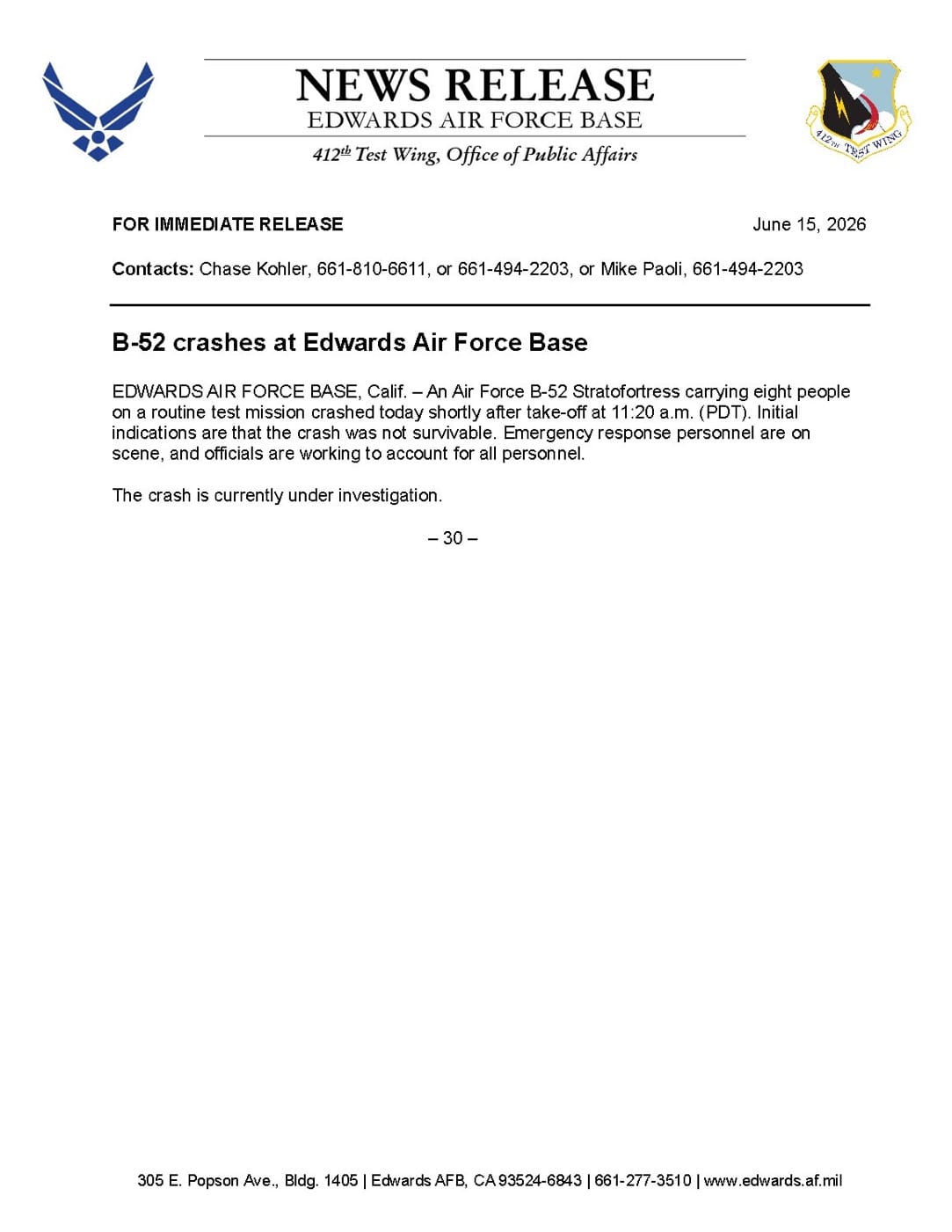
- On June 15, 2026, a U.S. Air Force B-52H Stratofortress crashed shortly after takeoff at Edwards Air Force Base in California. All eight people on board were killed — a mix of uniformed military, government civilians, and contractors. The cause is still under investigation.
Geopolitics & Military Activity:
- On June 15, 2026, U.S.-led Joint Interagency Task Force South (JIATFS) and seven partner nations successfully disrupted eight cartel drug shipments across the Caribbean and Eastern Pacific.

- The operations, which included the capture of a low-profile vessel, resulted in the seizure of nearly 14 metric tons of cocaine and 4,000 pounds of marijuana.
Science & Technology:
- On June 15, 2026, Teledyne FLIR Defense launched the Black Recon™, an autonomous micro-drone system designed for military use.
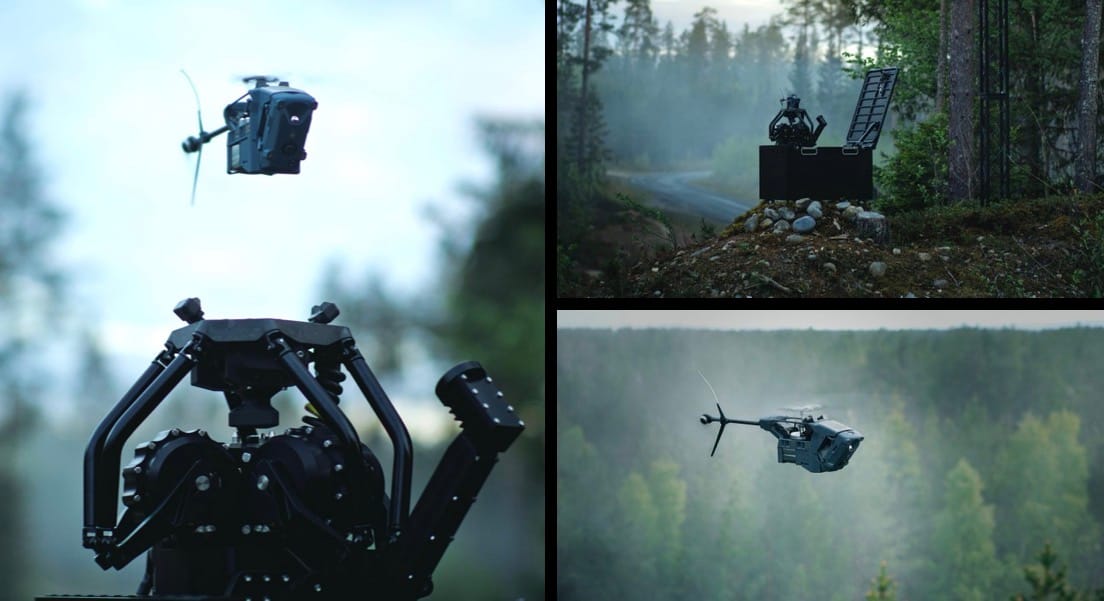
- The system uses a rotating team of three small drones that autonomously launch, conduct surveillance, and return for recharging from vehicles or fixed positions, providing persistent real-time intelligence and targeting data even in contested or GPS-denied environments.
Space:
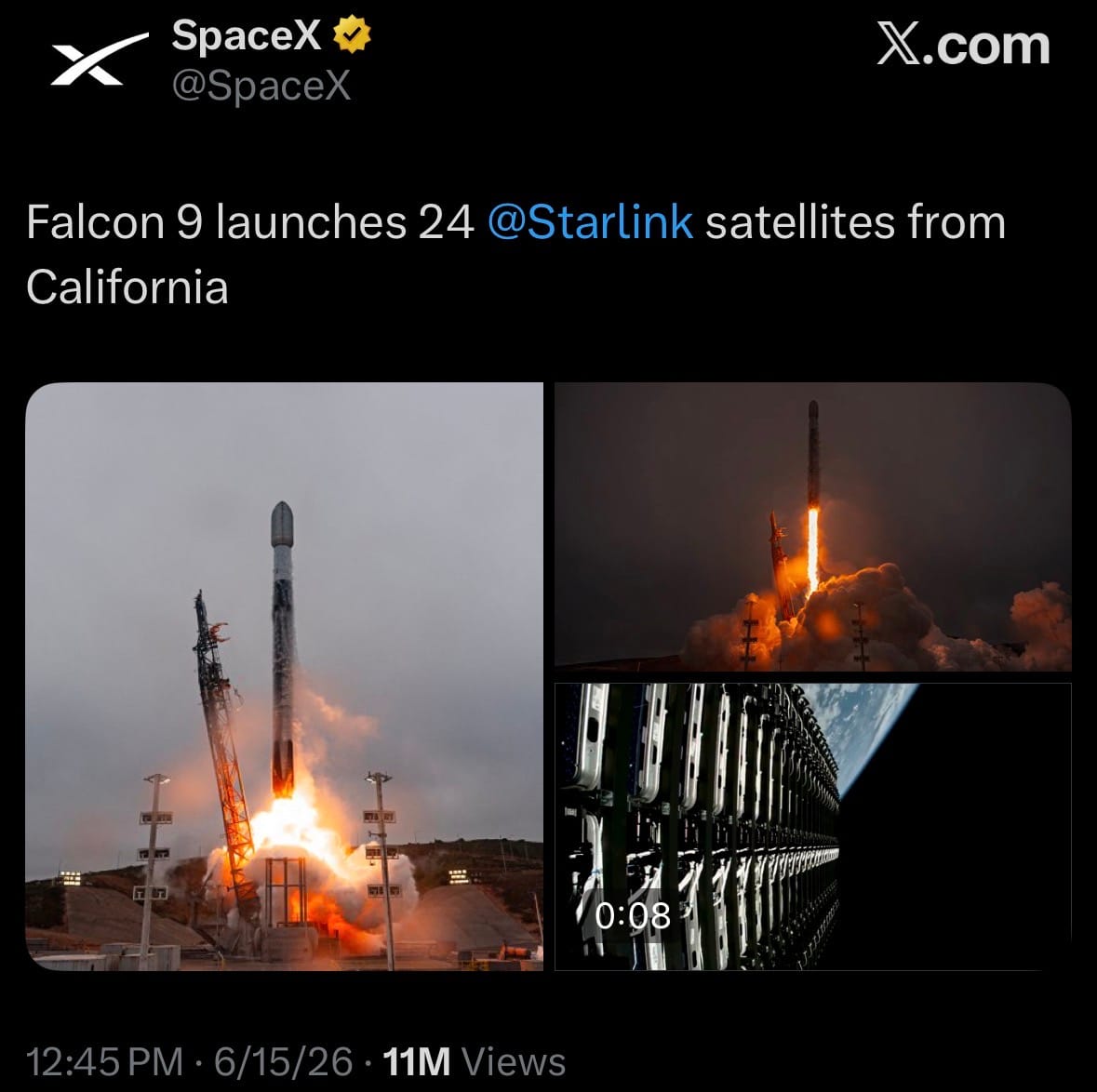
- On June 15, 2026, SpaceX launched a Falcon 9 rocket from Vandenberg Space Force Base in California. The rocket successfully deployed 24 Starlink satellites into low Earth orbit.
Statistic:
- Largest public semiconductor companies by market capitalization:
- 🇺🇸 NVIDIA: $5.145T
- 🇹🇼 TSMC: $2.289T
- 🇺🇸 Broadcom: $1.874T
- 🇰🇷 Samsung: $1.490T
- 🇺🇸 Micron Technology: $1.226T
- 🇰🇷 SK Hynix: $1.116T
- 🇺🇸 AMD: $892.36B
- 🇳🇱 ASML: $729.46B
- 🇺🇸 Intel: $642.62B
- 🇺🇸 Lam Research: $486.37B
- 🇺🇸 Applied Materials: $465.08B
- 🇬🇧 Arm Holdings: $440.63B
- 🇺🇸 KLA: $334.95B
- 🇺🇸 Texas Instruments: $285.16B
- 🇺🇸 Marvell Technology: $270.44B
- 🇺🇸 QUALCOMM: $232.73B
- 🇹🇼 MediaTek: $229.64B
- 🇺🇸 Analog Devices: $208.26B
- 🇯🇵 Tokyo Electron: $205.48B
- 🇯🇵 Advantest: $140.59B
- 🇨🇳 Cambricon Technologies: $122.52B
- 🇩🇪 Infineon: $121.62B
- 🇺🇸 Synopsys: $87.00B
- 🇹🇼 ASE Group: $84.46B
- 🇺🇸 Monolithic Power Systems: $81.17B
- 🇺🇸 Coherent Corp.: $80.96B
History:
- Fiber optic cables are the hidden backbone of the modern world. While satellites get most of the attention, over 95% of international internet traffic travels through fiber-optic cables, not space. The technology began in 1880 when Alexander Graham Bell invented the Photophone, which transmitted voice using light. The real breakthrough came in 1966, when Charles Kao proved that ultra-pure glass could carry light signals over long distances with very little loss. In 1970, Corning produced the first practical fiber-optic cable, and by the 1980s, telecom companies began replacing copper lines with fiber because a single fiber strand could carry vastly more data. A major milestone came in 1988 with TAT-8, the first transatlantic fiber-optic cable, connecting the United States, United Kingdom, and France. This marked the beginning of the modern global internet infrastructure.
- The internet boom of the 1990s and 2000s triggered one of the largest infrastructure projects in human history. Millions of miles of fiber were buried underground and laid across the ocean floor. Today, over 600 active undersea cable systems stretch across the globe, totaling roughly 1.4 million kilometers (870,000+ miles). These cables connect major landing stations in places such as Virginia Beach, New York, Miami, Los Angeles, London, Marseille, Singapore, Mumbai, Hong Kong, and Tokyo. Every Google search, stock trade, Netflix stream, AI query, military communication, bank transfer, and cloud transaction likely travels through fiber at some point. Financial firms spend billions to shave milliseconds off transmission times because speed directly impacts trading profits. Global banking systems, cloud computing, military command networks, and AI infrastructure all depend on these cables remaining operational. In many ways, fiber-optic networks have become as important to civilization as highways, railroads, electrical grids, and oil pipelines.
- By 2026, fiber optics are considered critical national infrastructure. Major technology companies such as Google, Meta, Microsoft, Amazon, and Apple now own or co-own many of the world’s largest cable systems. Governments and intelligence agencies closely monitor them because whoever controls information flow gains enormous strategic advantages. The United States operates some of the world’s largest fiber networks, while key chokepoints exist in places such as the Red Sea, Suez Canal, Strait of Malacca, and Mediterranean Sea, where multiple cables converge. Cable cuts—whether from anchors, earthquakes, sabotage, or conflict—can disrupt communications for entire regions. Modern fiber systems transmit data using pulses of light traveling through glass strands thinner than a human hair, carrying terabits of data per second. As AI, cloud computing, autonomous systems, and global connectivity continue expanding, fiber-optic cables remain the nervous system of modern civilization. If satellites are the eyes in the sky, fiber-optic cables are the nerves connecting the planet together.
Image of the day:

Thanks for reading! Earth is complicated, we make it simple.
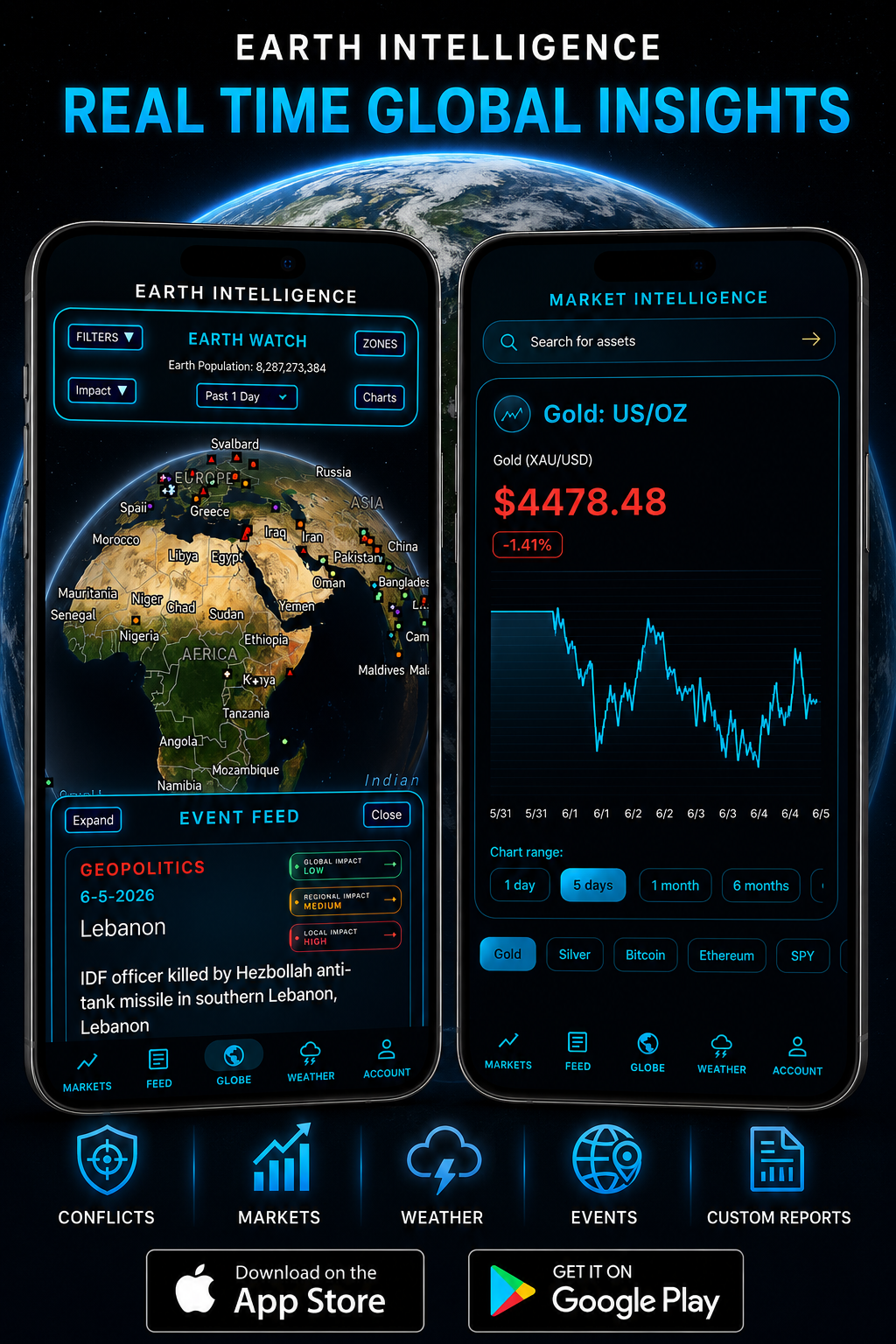
- Download our mobile app:


Click below to view our previous newsletters:
Support/Suggestions Email:
support@earthintel.io