Wednesday☕️


Trending:
- On June 2, 2026, U.S. forces successfully intercepted multiple Iranian ballistic missiles and drones across the Middle East and carried out self-defense strikes on a military ground control station on Qeshm Island.
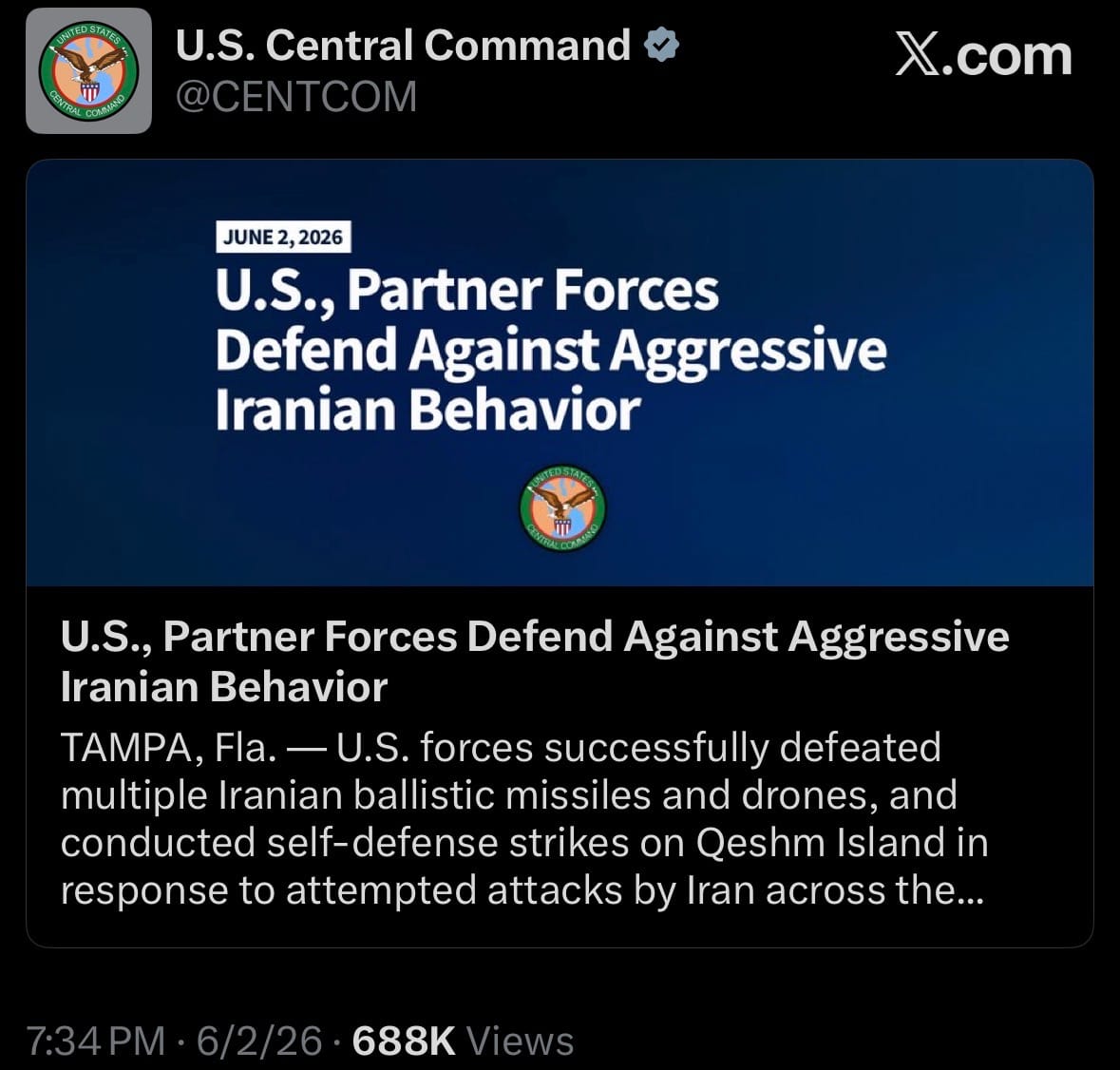
- Iran launched several ballistic missiles toward Kuwait and Bahrain, but all either fell short, broke apart, or were intercepted by U.S. and Bahraini defenses. U.S. Central Command also shot down three Iranian one-way attack drones that were targeting civilian ships in regional waters. No U.S. casualties were reported.
- On June 2, 2026, U.S. Central Command (CENTCOM) disabled a Botswana-flagged oil tanker, the M/T Lexie, in the Arabian Gulf.
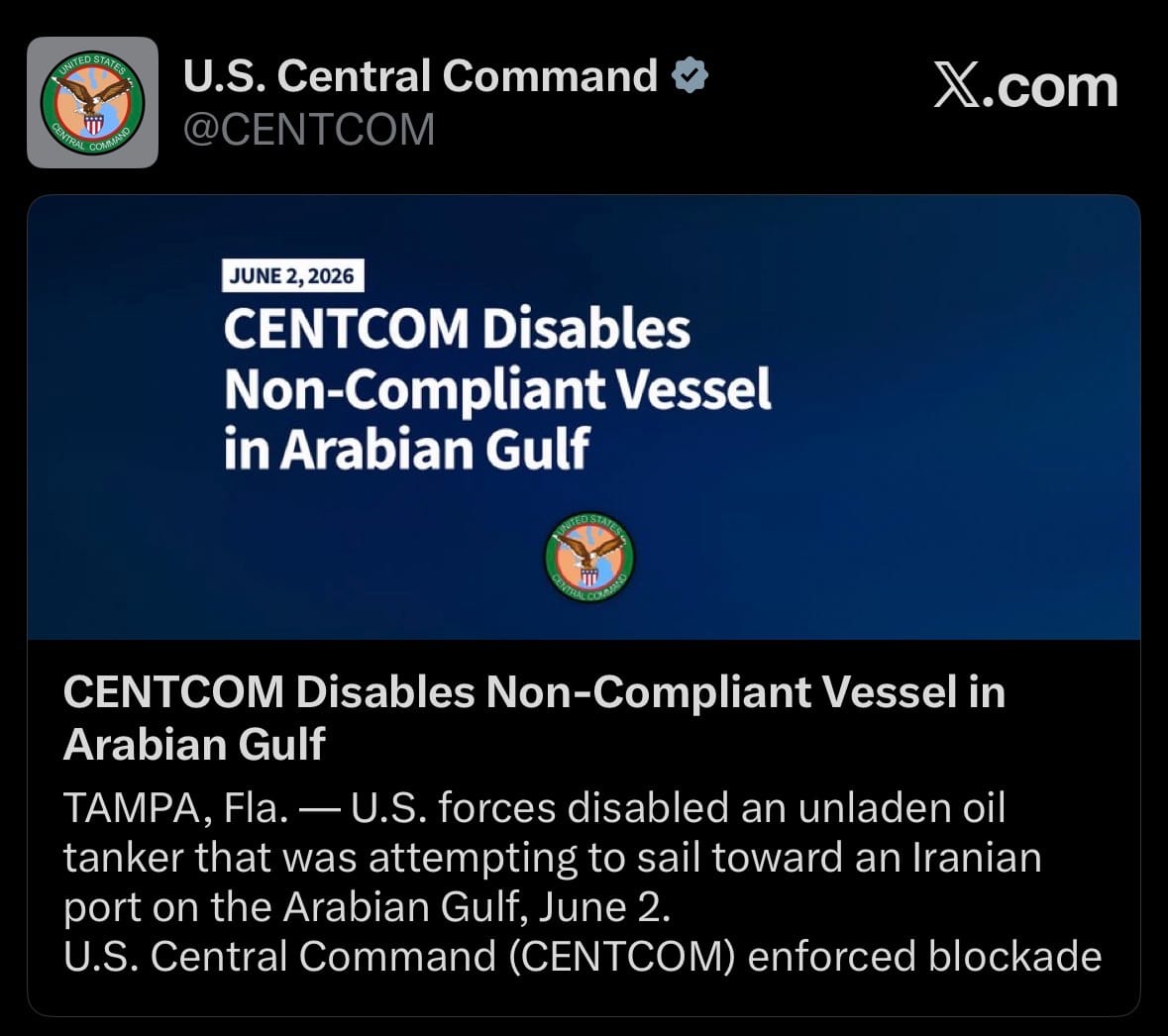
- The unladen vessel ignored repeated warnings and was attempting to reach the Iranian port of Kharg Island; a U.S. aircraft fired a Hellfire missile into its engine room to stop it. This is part of the ongoing U.S. blockade of Iranian ports that began on April 13, during which six commercial vessels have been disabled and 122 redirected.
Economics & Markets:
- On June 2, 2026, the U.S. Treasury’s Office of Foreign Assets Control (OFAC) sanctioned Nobitex — Iran’s largest cryptocurrency exchange — along with three other Iranian digital asset platforms (Wallex, Bitpin, and Ramzinex).
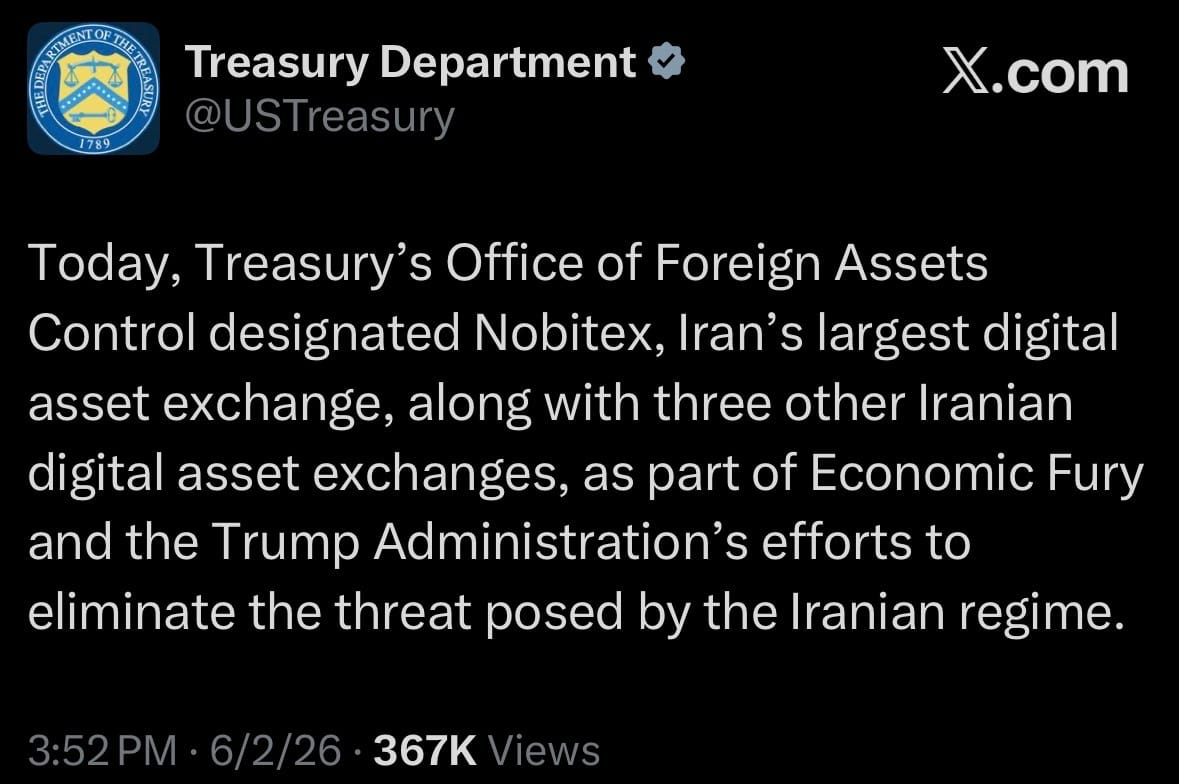
- These OFAC designations add the exchanges and several of their executives (including Nobitex chairman Amir Hossein Rad) to the SDN list, which blocks U.S. persons and companies from doing business with them, freezes any assets under U.S. jurisdiction, and pressures global banks and crypto platforms to cut ties — aiming to disrupt Iran’s use of crypto for sanctions evasion, IRGC funding, and moving regime wealth.
Geopolitics & Military Activity:
- Early on June 3, 2026, a drone attack struck the AO Petersburg Oil Terminal in St. Petersburg, igniting a major fire at one of Russia’s largest Baltic oil-product export facilities.
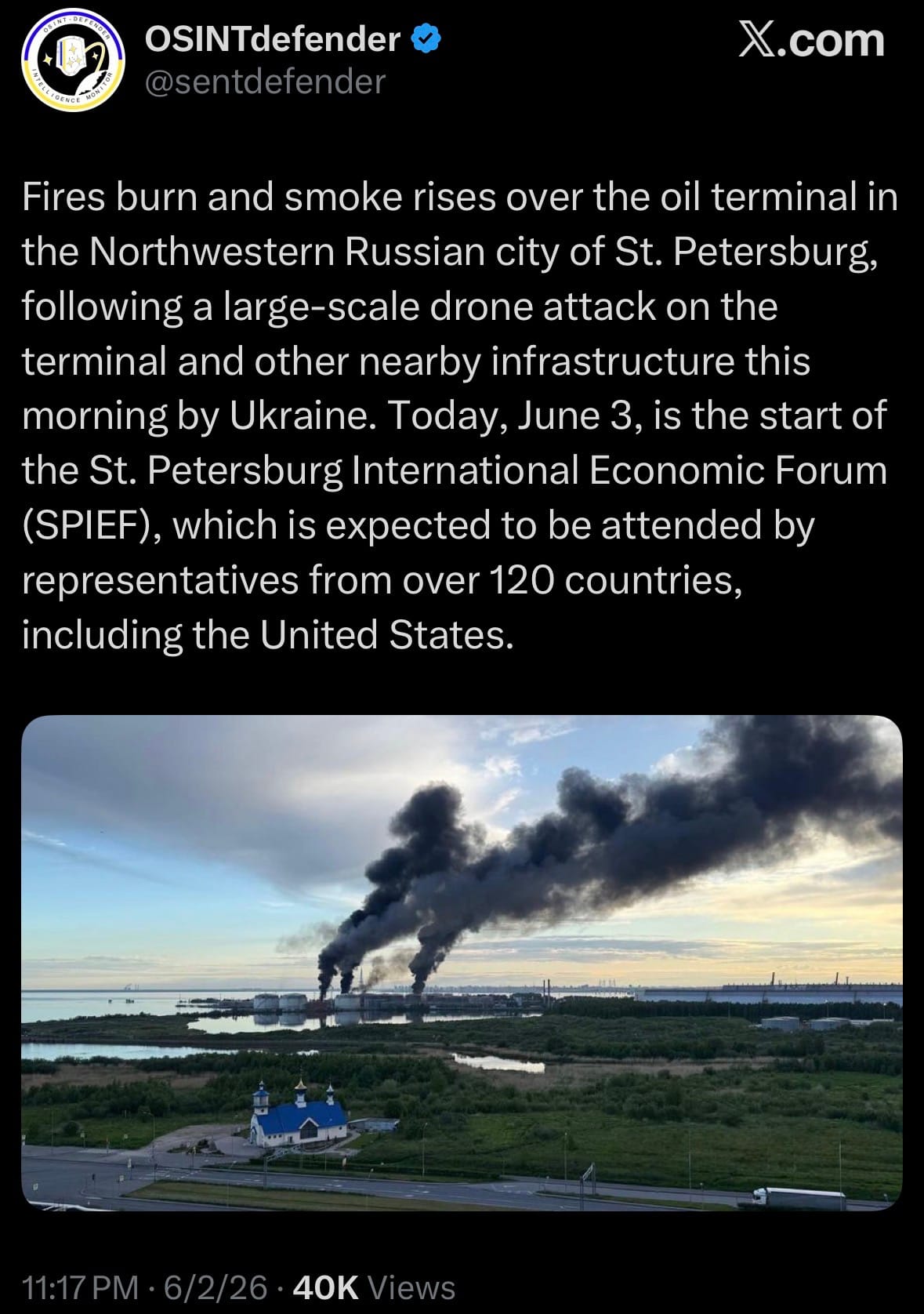
- The strike happened on the opening day of the St. Petersburg International Economic Forum (SPIEF). Russian authorities reported intercepting 30 drones over the Leningrad Region that morning. The terminal, which handles millions of tons of oil products annually, is a strategically important national asset.
Science & Technology:
- On June 2, 2026, Microsoft and the OpenClaw team announced a partnership to bring OpenClaw into the Microsoft and Windows enterprise ecosystems.
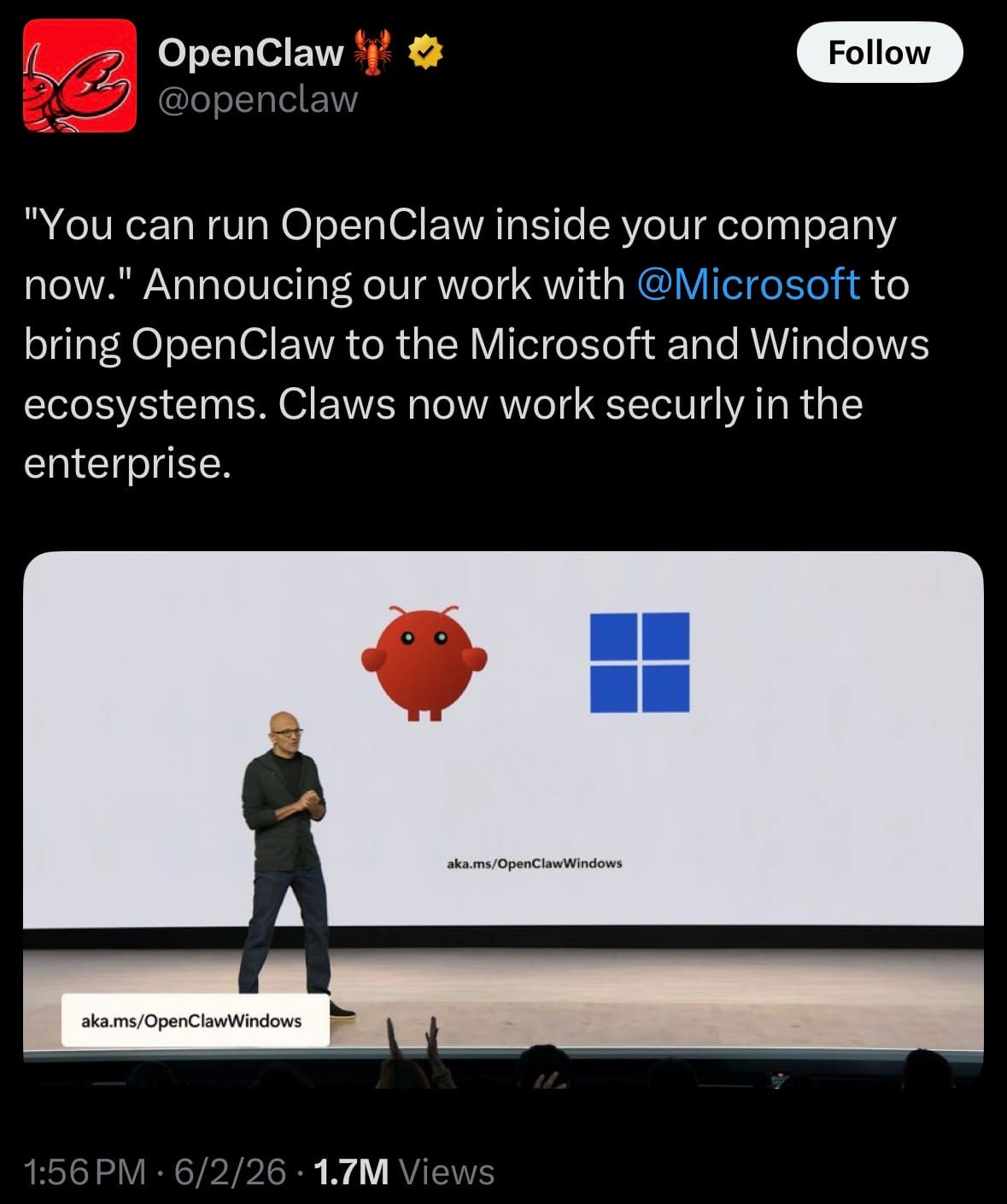
- OpenClaw is an open-source, self-hosted AI agent framework that runs on your own machine or server and can proactively perform real tasks (like managing email, calendar, files, and apps) through messaging apps. The new integration adds secure enterprise features (such as sandboxing and execution containers), allowing companies to run it safely inside their organizations for the first time.
Statistic:
- Largest assets on Earth by market capitalization:
- Gold: $31.382T
- 🇺🇸 NVIDIA: $5.396T
- 🇺🇸 Apple: $4.629T
- 🇺🇸 Alphabet (Google): $4.342T
- Silver: $4.243T
- 🇺🇸 Microsoft: $3.278T
- 🇺🇸 Amazon: $2.759T
- 🇹🇼 TSMC: $2.316T
- 🇺🇸 Broadcom: $2.280T
- 🇸🇦 Saudi Aramco: $1.764T
- 🇺🇸 Tesla: $1.591T
- 🇰🇷 Samsung: $1.562T
- 🇺🇸 Meta Platforms (Facebook): $1.517T
- Bitcoin: $1.328T
- 🇺🇸 Micron Technology: $1.200T
- 🇰🇷 SK Hynix: $1.105T
- 🇺🇸 Berkshire Hathaway: $1.016T
- 🇺🇸 Vanguard S&P 500 ETF (VOO): $980.71B
- 🇺🇸 Eli Lilly: $948.94B
- 🇺🇸 Walmart: $899.74B
- 🇺🇸 AMD: $850.42B
- 🇺🇸 iShares Core S&P 500 ETF (IVV): $848.67B
- 🇺🇸 JPMorgan Chase: $806.42B
- 🇺🇸 SPDR S&P 500 ETF (SPY): $787.20B
- 🇺🇸 Oracle: $703.42B
- 🇺🇸 Vanguard Total Stock Market ETF (VTI): $659.83B
- 🇳🇱 ASML: $657.27B
History:
- Islam began in the 7th century AD in Arabia through the teachings of the Prophet Muhammad (c. 570–632 AD), who Muslims believe received revelations from God (Allah) through the angel Gabriel beginning in 610 AD. These revelations became the Qur’an, Islam’s central holy text. After the Hijra (622 AD)—Muhammad’s migration from Mecca to Medina—Islam rapidly expanded, and by his death in 632 AD, most of Arabia had been unified. Islam views itself not as a new religion but as the continuation and restoration of the original monotheistic faith of prophets such as Adam, Noah, Abraham, Moses, David, Solomon, John the Baptist, and Jesus. One of the most important distinctions between Islam and Christianity is the Islamic view of Jesus (Isa). Muslims consider Jesus one of the greatest prophets and explicitly call him Al-Masih (The Messiah), recognizing his virgin birth, miracles, and future return before the Day of Judgment. However, Islam rejects the idea that Jesus is God, the Son of God, or part of a Trinity, teaching instead that he was a human prophet sent by God. Because of this, Islam shares significant overlap with Christianity while differing on key theological questions. The Qur’an mentions Jesus dozens of times, and Mary (Maryam) is honored so highly that an entire chapter of the Qur’an is named after her.
- As Islam expanded under the Rashidun Caliphate (632–661), Umayyad Caliphate (661–750), and Abbasid Caliphate (750–1258), it became one of the world’s most influential civilizations. During the Islamic Golden Age, scholars in cities like Baghdad, Damascus, Cairo, and Cordoba advanced mathematics, astronomy, medicine, engineering, navigation, and philosophy while preserving knowledge from ancient Greece, Persia, India, and Rome. A central concept in Islam is that earthly life is a test before the afterlife. Muslims believe that faith in God, righteous actions, prayer, charity, fasting, honesty, and obedience to God can lead to Jannah (Paradise) after death. The concept of sacrifice for faith has also played a major role in Islamic history. In Islamic teachings, those who die while sincerely defending their faith, community, or innocent lives can be considered shuhada (martyrs). Classical Islamic tradition teaches that martyrs receive special rewards in the afterlife, including immediate entry into Paradise according to many interpretations. However, mainstream Islamic scholarship historically distinguished legitimate martyrdom from unlawful violence, emphasizing intention, justice, and adherence to religious law. The martyrdom of Hussein ibn Ali at the Battle of Karbala in 680 AD became one of the defining events in Islam, especially for Shia Muslims, symbolizing sacrifice, resistance against tyranny, and devotion to God even in the face of death.
- Over the centuries, Islam spread across Africa, Europe, Central Asia, South Asia, and Southeast Asia, giving rise to major powers such as the Ottoman Empire (1299–1922), Safavid Empire (1501–1736), and Mughal Empire (1526–1857). Following Muhammad’s death, disagreements over leadership led to the Sunni-Shia split, which remains one of the most important divisions within Islam today. By 2026, Islam has around 2 billion followers, making it the world’s second-largest religion. Together with Christianity and Judaism, it forms the three major Abrahamic religions, sharing many prophets, historical figures, and moral teachings. Modern Islam encompasses a vast range of cultures, schools of thought, legal traditions, and political systems. While often associated with the Middle East, the largest Muslim populations today include countries such as Indonesia, Pakistan, India, Bangladesh, and Nigeria. From its origins in 7th-century Arabia to its role in shaping empires, trade networks, science, law, and global culture, Islam remains one of the most influential religious and civilizational forces in human history, with its teachings on faith, sacrifice, justice, charity, and the afterlife continuing to shape the lives of billions.
Image of the day:

Thanks for reading! Earth is complicated, we make it simple.
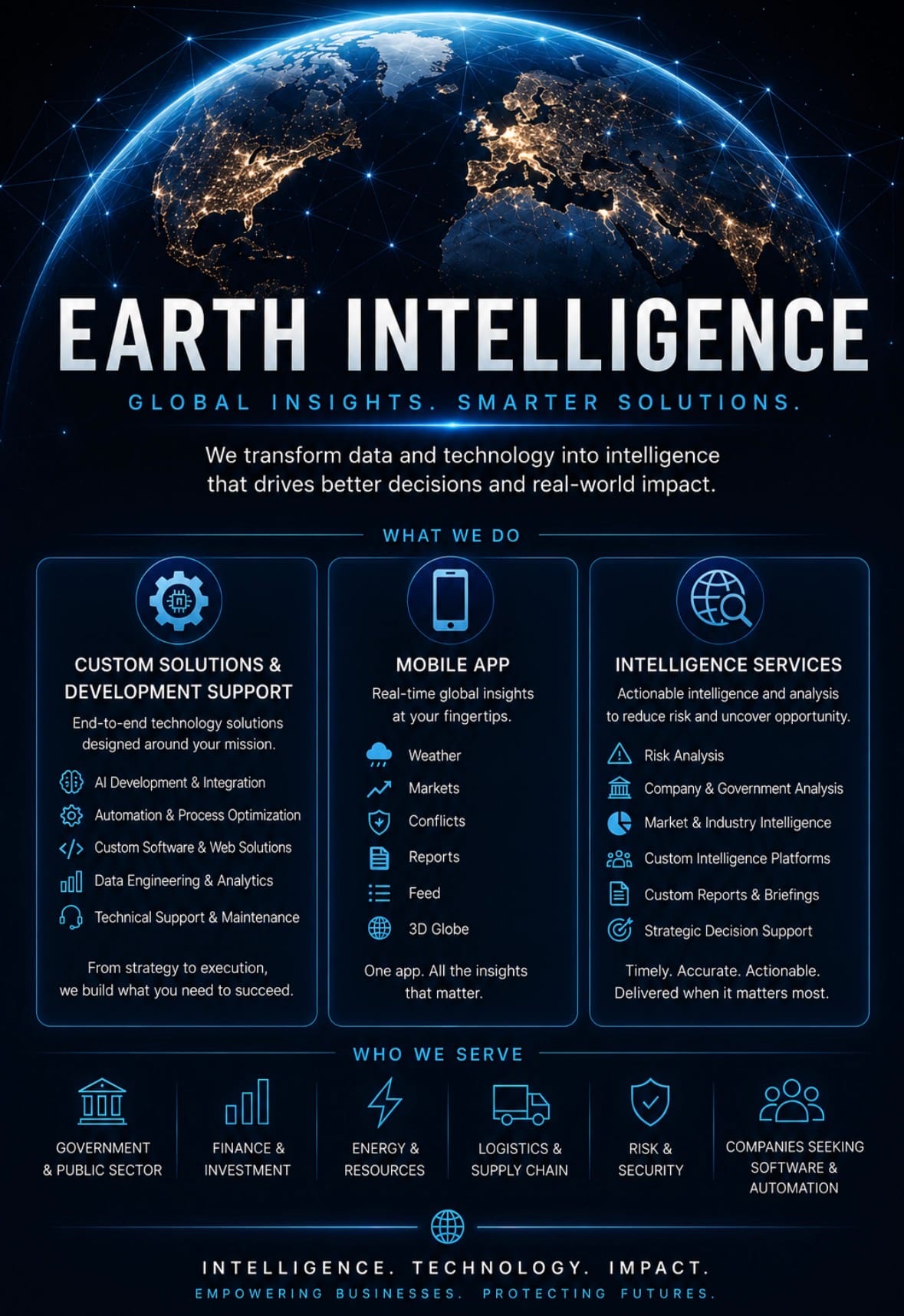
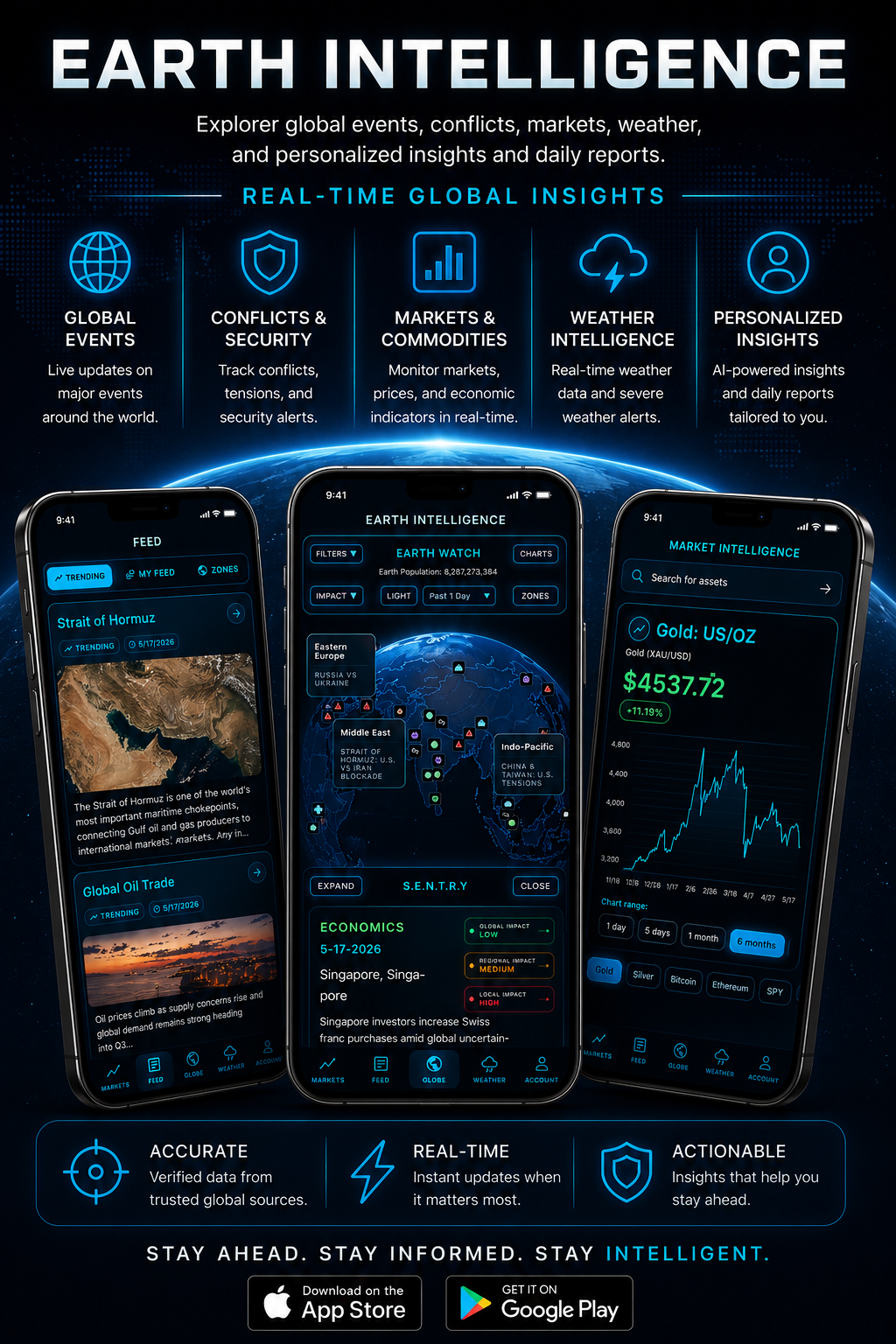
- Download our mobile app:

Click below to view our previous newsletters:
Support/Suggestions Email:
support@earthintel.io