Wednesday☕️


Trending:
- On June 9, 2026, U.S. Central Command forces carried out self-defense strikes against Iran at the direction of the Commander in Chief.
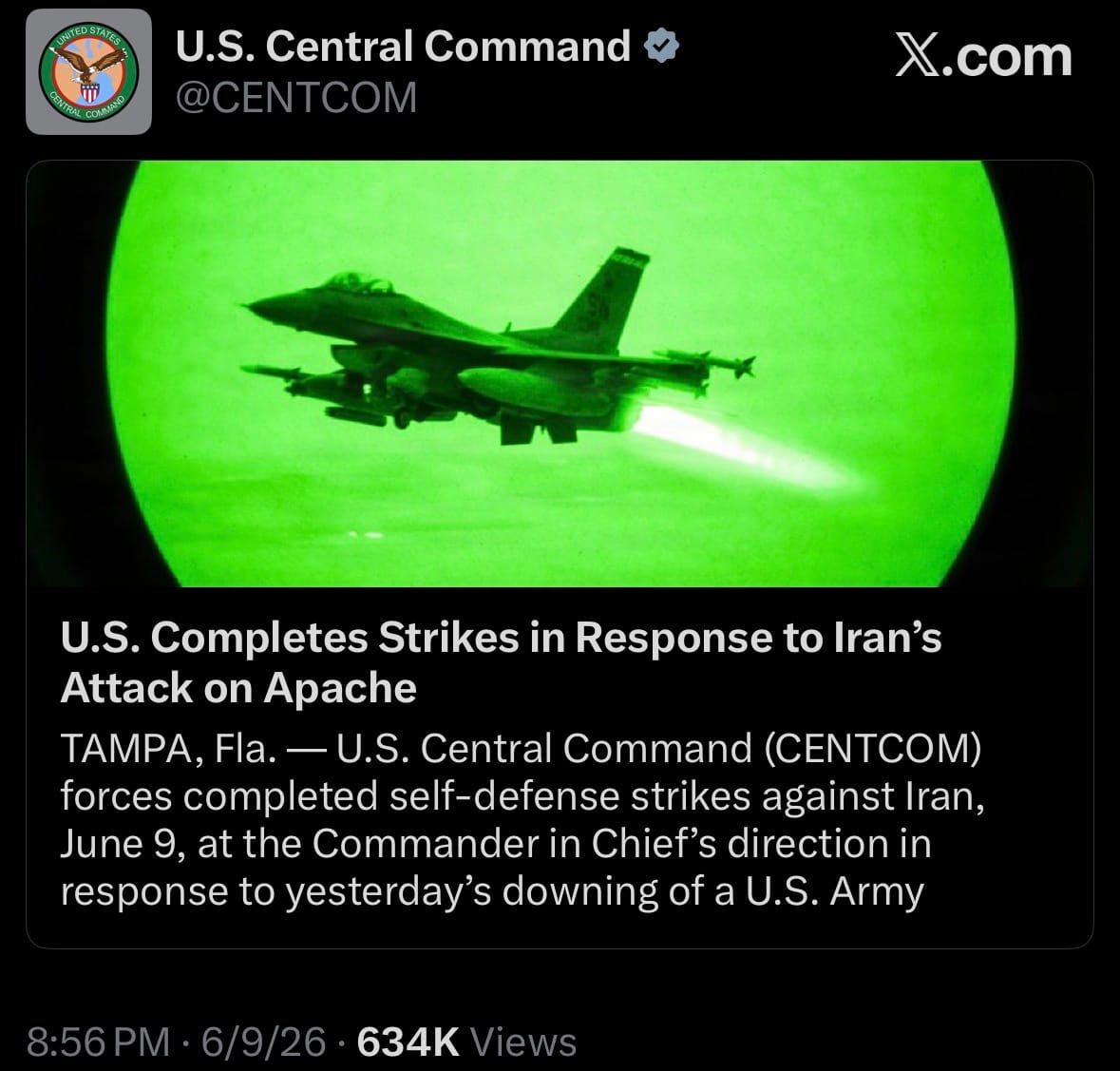
- The strikes targeted Iranian air defense systems, ground control stations, and surveillance radar sites near the Strait of Hormuz using precision munitions from U.S. Air Force and Navy jets. This was a direct response to Iran downing a U.S. Army Apache helicopter the day before; both crew members were rescued uninjured.
Cyber:
- On June 9, 2026, the FBI announced Operation Riptide, an ongoing coordinated law enforcement campaign targeting cybercriminal actors, their infrastructure, tools, communications platforms, and finances.
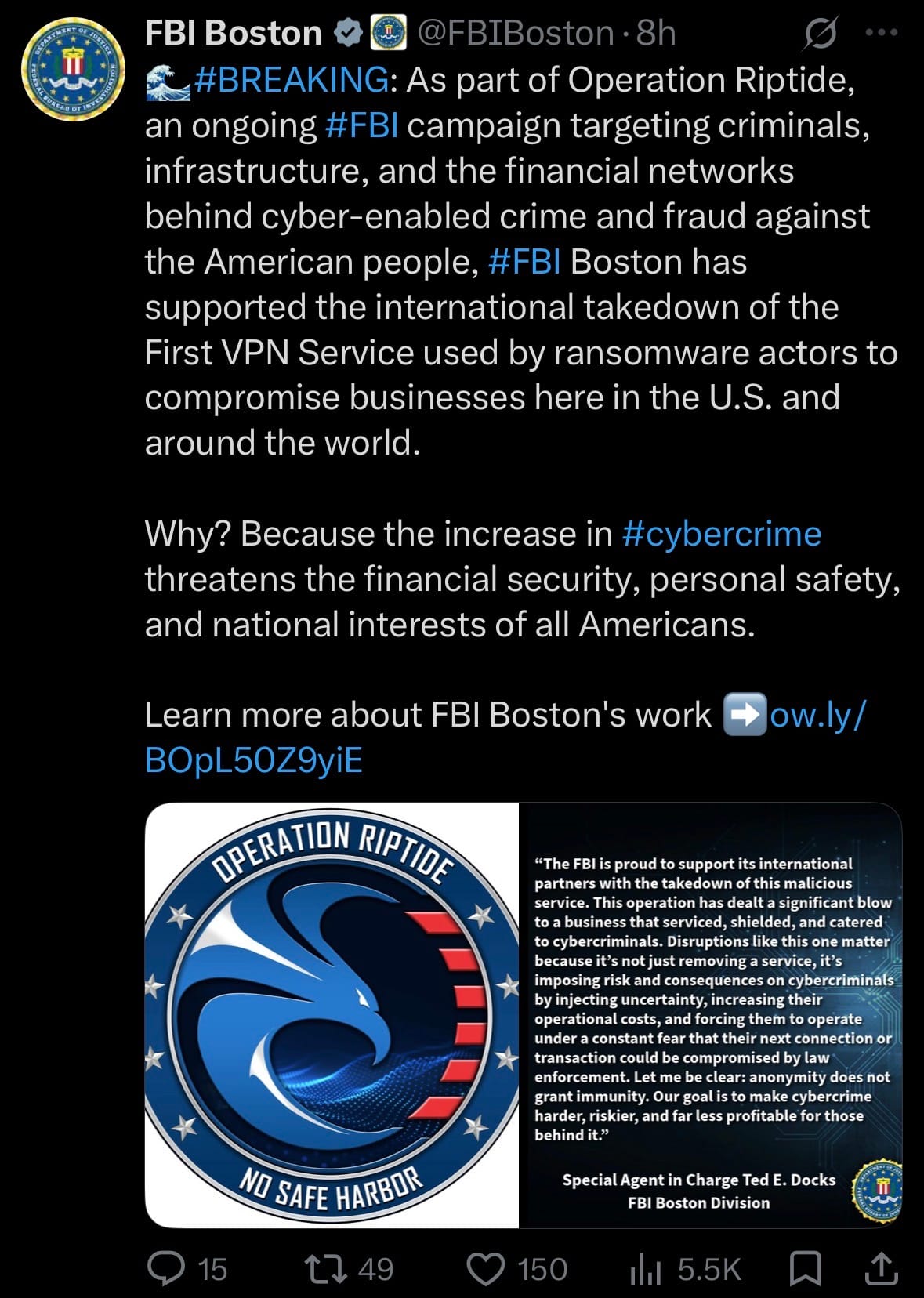
- The operation implements priorities from Executive Order 14390 and the National Cyber Strategy, with recent actions including search warrants, indictments, arrests, and infrastructure takedowns as part of a focused 60-day national effort.
Science & Technology:
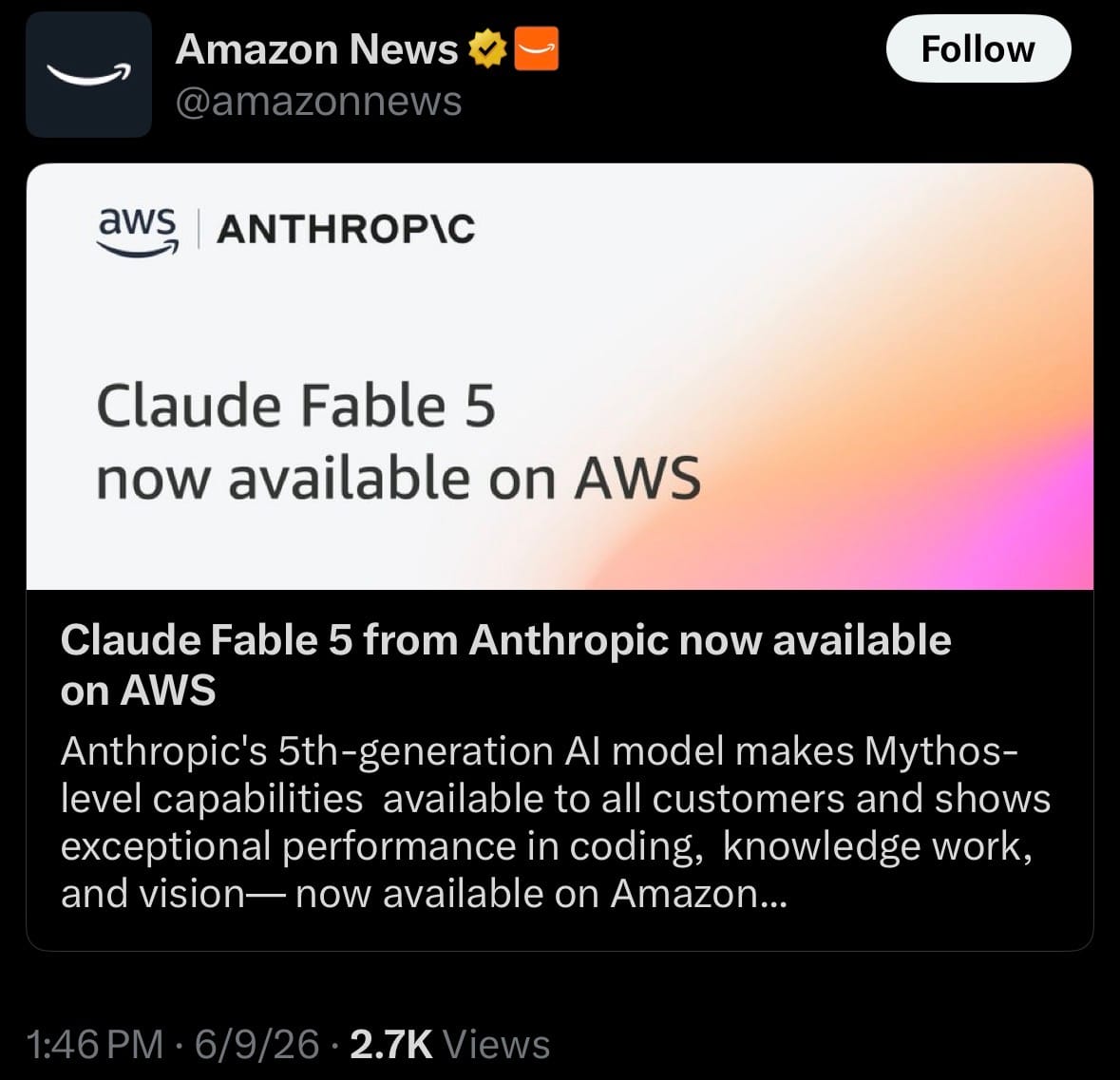
- On June 9, 2026, Anthropic introduced Claude Fable 5, a Mythos-class AI model made safe for general public use.
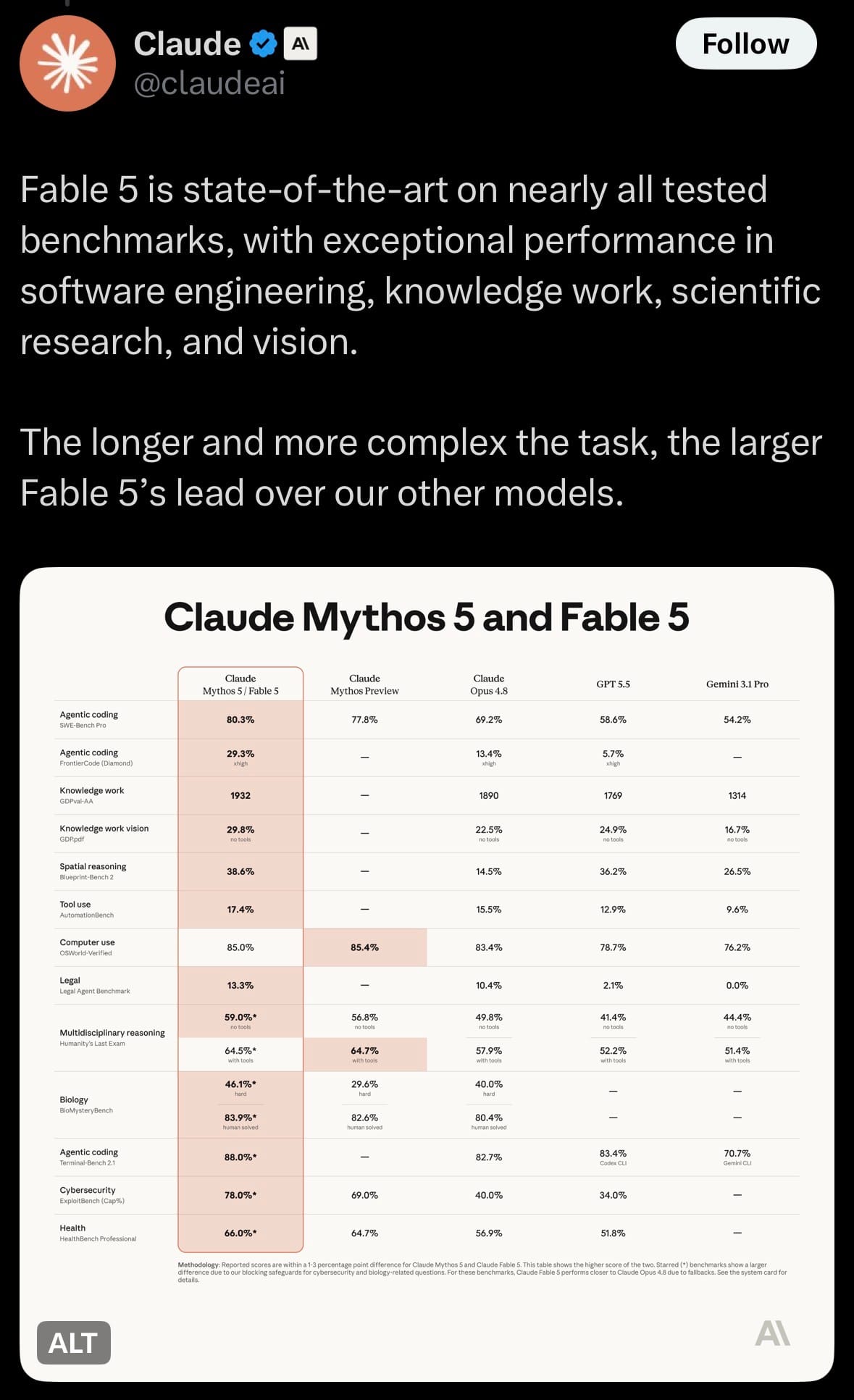
- Its capabilities exceed those of any previous model Anthropic has released broadly, with strong performance on complex, long-horizon tasks in coding, reasoning, knowledge work, and vision.
Statistic:
- Largest public companies by market capitalization:
- 🇺🇸 NVIDIA: $5.042T
- 🇺🇸 Alphabet (Google): $4.418T
- 🇺🇸 Apple: $4.267T
- 🇺🇸 Microsoft: $2.996T
- 🇺🇸 Amazon: $2.626T
- 🇹🇼 TSMC: $2.219T
- 🇺🇸 Broadcom: $1.865T
- 🇸🇦 Saudi Aramco: $1.749T
- 🇺🇸 Tesla: $1.489T
- 🇺🇸 Meta Platforms: $1.483T
- 🇰🇷 Samsung: $1.282T
- 🇺🇸 Micron Technology: $1.055T
- 🇺🇸 Berkshire Hathaway: $1.052T
- 🇺🇸 Eli Lilly: $1.020T
- 🇺🇸 Walmart: $946.05B
- 🇰🇷 SK Hynix: $932.85B
- 🇺🇸 JPMorgan Chase: $837.88B
- 🇺🇸 AMD: $775.35B
- 🇳🇱 ASML: $685.18B
- 🇺🇸 Visa: $618.16B
- 🇺🇸 Exxon Mobil: $617.22B
- 🇺🇸 Oracle: $591.91B
- 🇺🇸 Johnson & Johnson: $570.51B
- 🇺🇸 Intel: $542.40B
- 🇨🇳 Tencent: $520.31B
- 🇺🇸 Cisco: $474.39B
History:
- The history of intelligence networks is nearly as old as civilization itself because rulers quickly learned that information could be more valuable than armies. One of the earliest documented intelligence systems emerged in Ancient Egypt (c. 3000–1000 BC), where pharaohs used scouts, informants, and diplomatic messengers to monitor rival kingdoms and internal threats. The Persian Empire (550–330 BC) developed one of history’s first large-scale intelligence networks through the “King’s Eyes and Ears,” a system of inspectors and agents reporting directly to the emperor. Around 500 BC, Chinese strategist Sun Tzu wrote in The Art of War that spies were essential to victory, describing five types of intelligence agents and arguing that no military operation could succeed without information. The Greeks and Romans expanded these concepts further. Rome employed scouts, informants, political surveillance, intercepted communications, and the Frumentarii, an intelligence and courier organization that eventually functioned as an early secret police. During the Middle Ages, intelligence networks evolved through merchant routes, religious institutions, diplomatic envoys, and royal courts. The Venetian Republic (697–1797) developed one of Europe’s most sophisticated intelligence systems, monitoring trade routes, rival states, and political conspiracies across the Mediterranean. By the Renaissance and Age of Exploration, espionage became increasingly professionalized as European powers competed for colonies, trade routes, and military advantage.
- The modern intelligence era began to emerge during the 1700s and 1800s as nation-states built formal intelligence organizations. During the American Revolution (1775–1783), George Washington relied heavily on the Culper Spy Ring, one of America’s earliest organized intelligence networks. The British, French, Russian, and Prussian empires all expanded espionage capabilities throughout the 19th century. Intelligence became truly industrialized during World War I (1914–1918) and World War II (1939–1945). Britain created organizations that evolved into MI5 (1909) and MI6 (1909), while the United States established the Office of Strategic Services (OSS) in 1942, the predecessor to the CIA. During WWII, intelligence operations included codebreaking efforts such as Britain’s Bletchley Park, where Alan Turing and others helped crack Germany’s Enigma codes. After the war, the intelligence world exploded in scale. The CIA (1947), NSA (1952), KGB (1954), Mossad (1951), and countless other agencies emerged as the Cold War turned intelligence into a global battlefield. Intelligence was no longer just about spies—it included satellites, intercepted communications, covert operations, coups, counterintelligence, propaganda, psychological warfare, and nuclear surveillance. The Five Eyes alliance, originating from intelligence-sharing agreements between the U.S. and UK during WWII and formalized after the war, expanded to include Canada, Australia, and New Zealand, creating one of the most powerful intelligence-sharing networks in history.
- By 2026, intelligence has evolved into a multi-domain global system spanning human spies, cyber operations, satellites, artificial intelligence, drones, financial tracking, biometric systems, and mass data analysis. Modern agencies such as the CIA, NSA, FBI, DIA, MI6, MI5, GCHQ, Mossad, FSB, SVR, MSS (China), DGSE (France), BND (Germany), RAW (India) and many others operate across physical and digital domains simultaneously. Intelligence collection now comes from SIGINT (signals intelligence), HUMINT (human intelligence), GEOINT (geospatial intelligence), OSINT (open-source intelligence), CYBINT (cyber intelligence), and increasingly AI-assisted analysis. Satellites can monitor military activity worldwide, cyber operators can infiltrate foreign networks from across the globe, and AI systems can process more information in hours than entire agencies once could in years. The intelligence battlefields of today include Ukraine, Taiwan, the South China Sea, cyber warfare, critical infrastructure, elections, and influence operations on social media. What began thousands of years ago with scouts carrying messages across deserts has become a planetary intelligence architecture connecting satellites, sensors, databases, algorithms, analysts, and operatives in real time. Throughout history, the core principle has remained unchanged: nations that understand what is happening before everyone else gain an enormous advantage over those that do not.
Image of the day:

Thanks for reading! Earth is complicated, we make it simple.
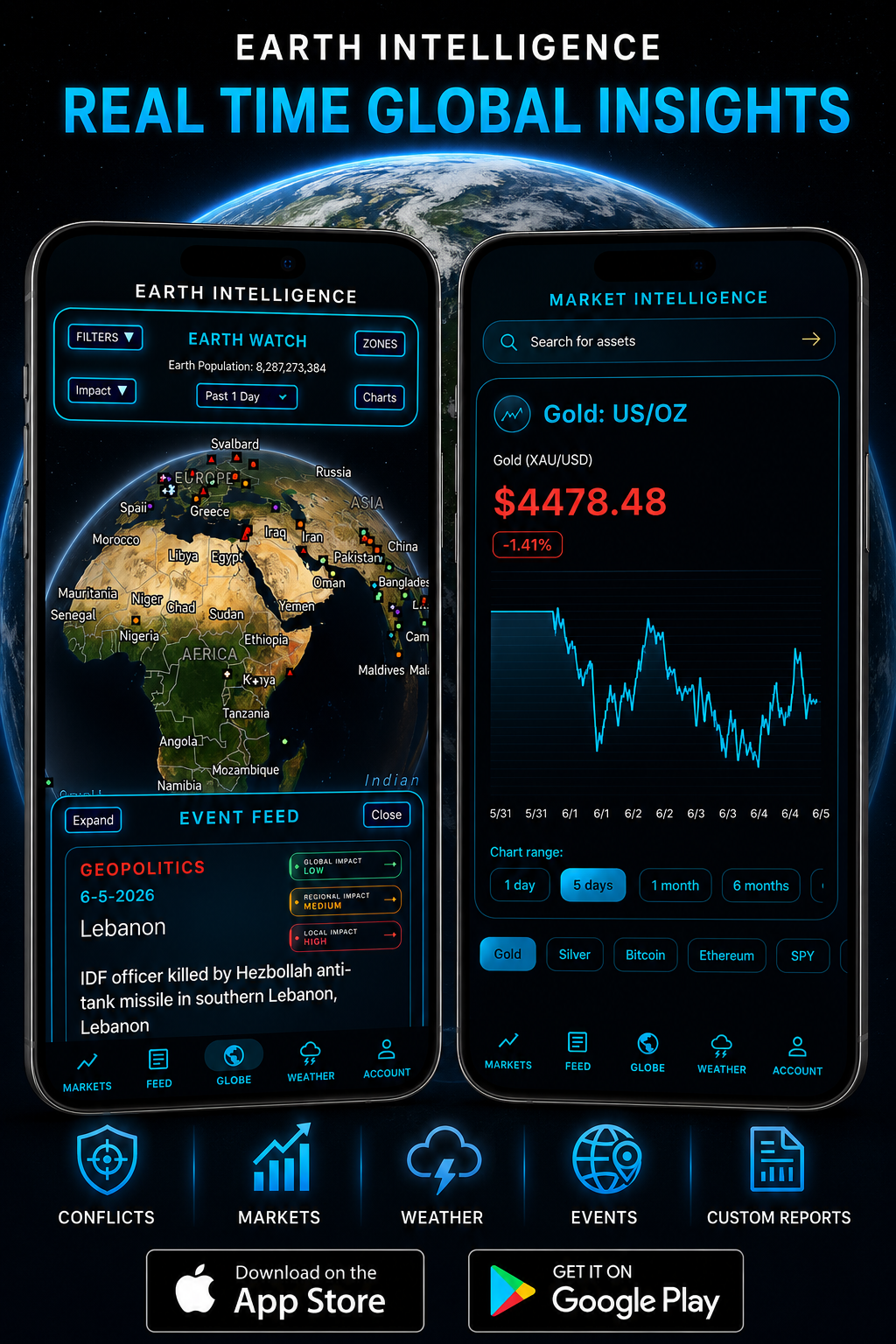
- Download our mobile app:


Click below to view our previous newsletters:

Support/Suggestions Email:
support@earthintel.io