Wednesday☕️🌎


Trending:
- August 11, 2026 — FinCEN permanently ended the requirement for U.S. companies and U.S. individuals to report beneficial ownership information (BOI), which identifies the people who ultimately own or control a company.
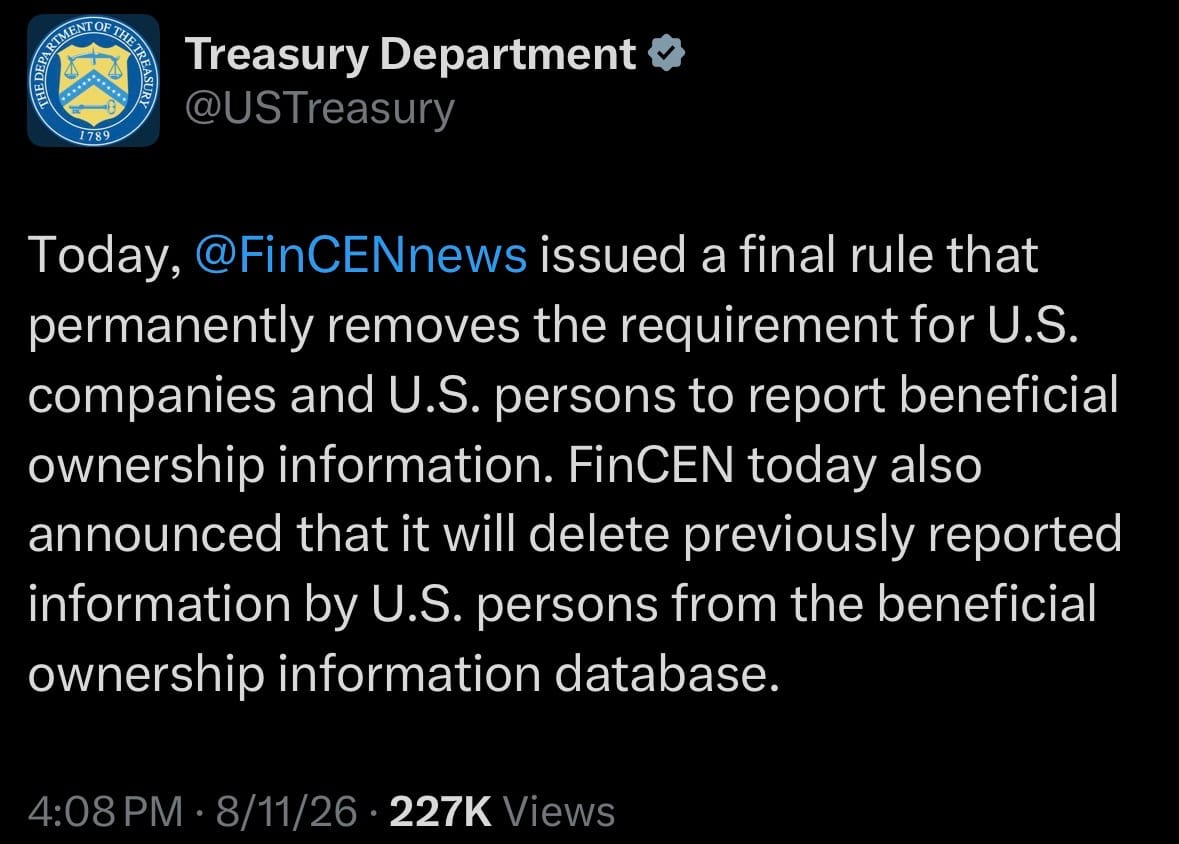
- This means American businesses no longer need to submit this ownership information to the federal government, and FinCEN will begin deleting previously submitted data on U.S. persons; certain foreign companies operating in the U.S. will still have reporting requirements.
Economics & Markets:
- August 11, 2026 — U.S. labor force participation fell to 61.4% in July, its lowest since February 2021, as 264,000 Americans left the workforce.
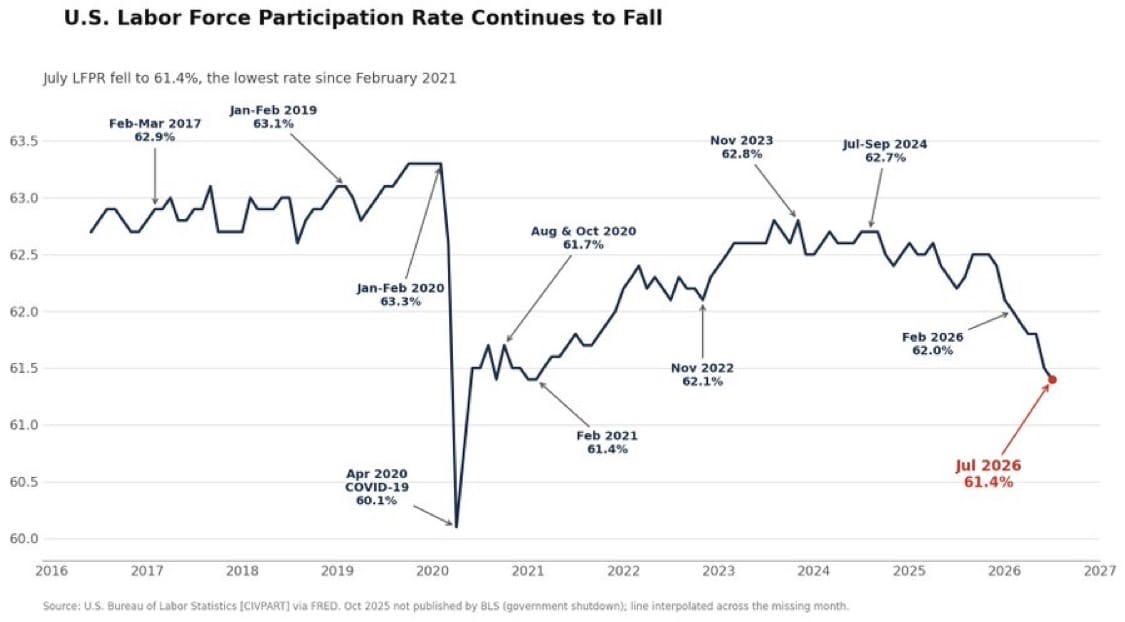
- The labor force participation rate measures the percentage of working-age Americans who are either employed or actively looking for a job, meaning the unemployment rate can fall even when the job market weakens if enough people stop looking for work; this comes ahead of the CPI inflation report, which tracks changes in consumer prices and is expected to show annual inflation cooling to 3.4%.
Firefly Earnings:
- August 11, 2026 — Firefly Aerospace reported record Q2 revenue of $117.7 million, up 659% from a year ago and 45.5% from the previous quarter, driven by growing demand for its rockets, Blue Ghost lunar landers, spacecraft, and defense programs.

- Firefly also secured major NASA and U.S. Space Force contracts during the quarter and now expects $420–$450 million in total revenue for 2026.
Geopolitics & Military Activity:
- August 11, 2026 —U.S. forces fired two Hellfire missiles from a Navy MH-60 helicopter at the Panama-flagged cargo ship Vela Nova in the Gulf of Oman after CENTCOM said it ignored repeated warnings and attempted to sail toward an Iranian port in violation of the U.S. blockade.

- The strike disabled the ship’s steering, with all 17 crew members reported safe; CENTCOM says it has now redirected 55 commercial vessels, disabled three, and boarded two while enforcing the blockade on Iran.

Space:
- August 11, 2026 — SpaceX successfully launched 29 Starlink internet satellites aboard a Falcon 9 rocket at 11:58 a.m. EDT from Cape Canaveral Space Force Station in Florida, expanding its low-Earth-orbit network that provides high-speed internet around the world.
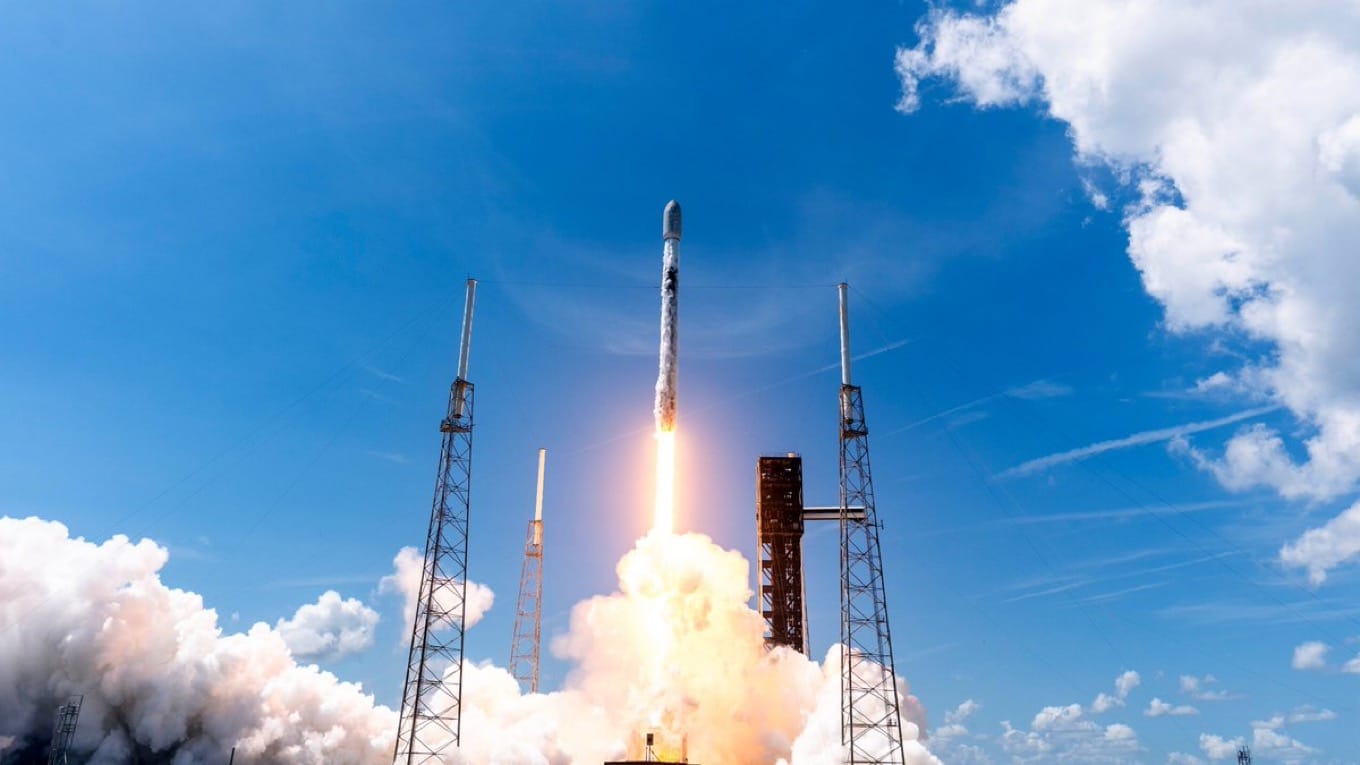
- The reusable Falcon 9 booster also successfully landed on SpaceX’s A Shortfall of Gravitas droneship after launch.
Statistic:
- Largest stock markets by market capitalization:
- 🇺🇸 United States: $81.017T
- 🇨🇳 China: $11.487T
- 🇯🇵 Japan: $7.982T
- 🇬🇧 United Kingdom: $4.773T
- 🇨🇦 Canada: $4.342T
- 🇮🇳 India: $4.173T
- 🇹🇼 Taiwan: $4.064T
- 🇰🇷 South Korea: $3.429T
- 🇫🇷 France: $3.297T
- 🇨🇭 Switzerland: $3.181T
- 🇩🇪 Germany: $3.061T
- 🇸🇦 Saudi Arabia: $2.532T
- 🇦🇺 Australia: $2.094T
- 🇳🇱 Netherlands: $1.916T
- 🇪🇸 Spain: $1.450T
- 🇮🇹 Italy: $1.389T
- 🇸🇪 Sweden: $1.373T
- 🇮🇪 Ireland: $1.240T
- 🇭🇰 Hong Kong: $1.195T
- 🇦🇪 United Arab Emirates: $1.015T
- 🇧🇷 Brazil: $934.12B
- 🇸🇬 Singapore: $807.94B
- 🇩🇰 Denmark: $642.49B
- 🇮🇱 Israel: $552.49B
- 🇲🇽 Mexico: $541.83B
History:
- Stock markets began when merchants realized expensive ventures could be financed by dividing ownership among many investors. The biggest early breakthrough came in 1602, when the Dutch East India Company (VOC) issued transferable shares traded in Amsterdam, creating the foundation of the modern stock exchange. London merchants later traded shares and government debt in coffeehouses, eventually forming the London Stock Exchange in 1801. In America, 24 brokers signed the Buttonwood Agreement on May 17, 1792, creating the foundation of the New York Stock Exchange (NYSE). Early markets relied on handwritten contracts and physical stock certificates, with brokers trading government bonds, banks, railroads, mining companies, and industrial businesses. Technology steadily accelerated the system: the telegraph in the 1840s transmitted prices between cities, the stock ticker in 1867 continuously printed market prices, telephones connected brokers directly, and financial newspapers distributed market information nationally. Speculation and crashes appeared almost immediately, including the South Sea Bubble (1720), Panics of 1837, 1873, 1893, and 1907, repeatedly demonstrating the same basic cycle: economic growth creates optimism, investors take greater risks and borrow more money, valuations rise too far, a shock destroys confidence, selling accelerates, and eventually the financial system stabilizes and rebuilds.
- The 1900s produced both enormous market growth and history’s most famous crashes. Charles Dow created the Dow Jones Industrial Average in 1896, giving investors a simple way to track major American companies. During the Roaring Twenties, stocks exploded higher before the 1929 Wall Street Crash, with Black Thursday (October 24), Black Monday (October 28), and Black Tuesday (October 29) helping begin a collapse in which the Dow eventually lost about 89% from its 1929 peak to its 1932 bottom. The government responded with the Securities Act of 1933, Securities Exchange Act of 1934, and creation of the SEC, establishing much of today’s regulatory system. The market eventually recovered and the Dow surpassed its 1929 high in 1954. Major crashes continued: the 1973–1974 oil and inflation crisis, Black Monday in 1987, when the Dow collapsed 22.6% in one day, Japan’s 1989 asset-bubble peak, the 1997 Asian Financial Crisis, 2000–2002 dot-com crash, when the Nasdaq lost nearly 78%, the 2008 Global Financial Crisis, when the S&P 500 fell roughly 57% from peak to bottom, the rapid COVID crash of 2020, and the inflation-and-interest-rate-driven 2022 bear market. Broad markets repeatedly recovered because economies continued producing new companies, technologies, productivity, earnings, and investment—although individual companies and even national markets can permanently fail or remain below previous highs for decades.
- Markets also evolved from physical trading floors into enormous digital networks. NASDAQ launched in 1971, accelerating electronic trading; personal computers and internet brokers transformed investing during the 1980s–1990s; decimal pricing arrived in U.S. markets in 2001; smartphones later placed trading platforms in everyone’s pocket; and modern exchanges now execute algorithmic orders in microseconds. U.S. settlement moved from T+5 → T+3 → T+2 → T+1 in 2024, meaning most stock trades now officially settle the next business day. Major markets today include the NYSE and Nasdaq in the United States, Shanghai and Shenzhen in China, Tokyo, London, Euronext, Hong Kong, India’s NSE and BSE, Toronto, South Korea, Australia, Brazil, and Saudi Arabia. Major indexes include the S&P 500, Dow Jones, Nasdaq Composite, Russell 2000, Nikkei 225, FTSE 100, DAX, Hang Seng, Shanghai Composite, CSI 300, Nifty 50, and MSCI World. Today trillions of dollars move through stocks, ETFs, options, futures, pension funds, hedge funds, sovereign wealth funds, market makers, and automated trading systems. Across centuries, one pattern repeatedly appears: innovation → economic growth → optimism → speculation → excessive risk → shock → crash → restructuring → recovery → new highs. The important distinction is that individual companies can disappear forever, while diversified markets continually replace failing companies with growing ones—one major reason broad stock markets have historically recovered from wars, depressions, banking failures, pandemics, and financial crises.
Image of the day:

Thanks for reading! Earth is complicated, we make it simple.
- Download our mobile app:



Click below to view our previous newsletters:

Support/Suggestions Email:
support@earthintel.io